
Butterflies and Moths
Order Lepidoptera
The Butterflies and Moths (Order Lepidoptera) includes 11,813 species across 112 families and 2,787 genera in our directory.
About Butterflies and Moths
Lepidoptera includes approximately 180,000 described species of butterflies and moths. Moths outnumber butterflies roughly 10:1. The monarch butterfly's eastern population has declined by more than 80% since the mid-1990s, and the western population by over 95% since the 1980s. The IUCN lists the migratory monarch as Vulnerable.
Economic Impact
Lepidoptera are critical pollinators. In Europe, grassland butterfly species have declined by almost 50% since the early 1990s. In the UK, three-quarters of butterflies are in decline. In the U.S., five butterfly species have gone extinct since 1950, with 29 listed as endangered.
Ecological Role
Butterflies and moths are essential indicators of ecosystem health. As caterpillars, they are a primary food source for birds - a single nest of blue tit chicks requires ~10,000 caterpillars. Adult moths pollinate many night-blooming plants.
Families in Lepidoptera (112)
Species in Lepidoptera (11,813)
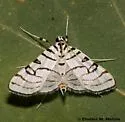
Conchylodes concinnalis - Hodges#5293
Conchylodes concinnalis
Identification: The original description of Conchylodes concinnalis Hampson, is available online in the print references below. The black patch along the forewing costa has a white center compared to the solid patch in Conchylodes ovulalis . The spac
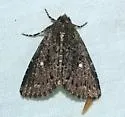
Condica albolabes - Hodges#9695
Condica albolabes
Identification: From The Canadian Entomologist Volume XII : "Fore wings uniform glistening blackish fuscous with all the lines obsolete except the subterminal, which is represented by a row of white dots, relieved by black scales. The seven white dot
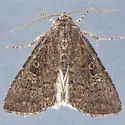
Condica andrena - Hodges#9707
Condica andrena
Identification: See detailed description at Nearctica .
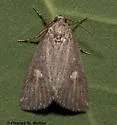
Condica begallo - Hodges#9709
Condica begallo
Identification: The original description as Catabena begallo Barnes is available at the link in the print references below. - Determined by Noel McFarland.
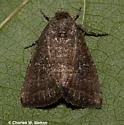
Condica charada - Hodges#9704
Condica charada
Identification: Forewing is uniform medium gray with most maculation obscure; PM line is a lighter band accented by obscure set of dark gray and white dots on outer side and series of similarly obscure gray lunules on inner side; ST line is lighter l
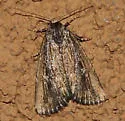
Condica discistriga - Hodges#9692
Condica discistriga
Identification: Adult: forewing dull yellowish-brown to reddish-brown with diffuse gray shading in median and terminal areas, especially along veins, giving a streaked appearance; PM line faint, scalloped, with dark dots at points of scallops; renifo
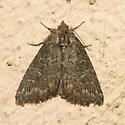
Condica mersa - Hodges#9694
Condica mersa
Identification: "This species can be identified by its streaky dark brown-gray forewing with pale filling of the lower reniform spot" ( 3 ) . This species is apparently quite rare in collections ( 3 ) , ( 5 ) .
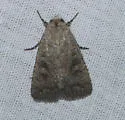
Condica morsa - Hodges#9712
Condica morsa
Condica morsa - Hodges#9712 (Condica morsa) is a species in the family Noctuidae, commonly known as owlet moths, belonging to the order Lepidoptera (Butterflies and Moths). It is classified within the subfamily Condicinae, tribe Condicini, superfamil
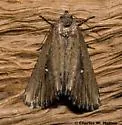
Condica temecula - Hodges#9691
Condica temecula
Identification: Forewing is uniform dark red-brown and appears somewhat glossy compared to Condica discistriga .
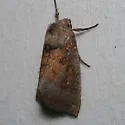
Coneflower Borer - Hodges#9502
Papaipema nelita
Identification: Adult: forewing orangish-brown to grayish-brown with reniform, orbicular, and claviform spots either white and conspicuous or dark brown and showing little contrast against ground color; subterminal area grayer than rest of wing; PM l
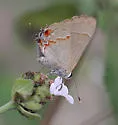
Confused Groundstreak - Hodges#4531.5
Kisutam syllis
Identification: First U.S. record, Mike A. Rickard First U.S. Record: along Bentsen-Palm Drive in Mission, Hidalgo Co., Texas - 2008 (Rickard, 2010)
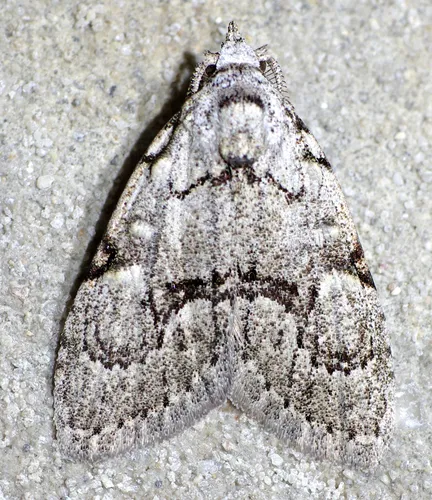
Confused Meganola Moth
Meganola minuscula
Meganola minuscula, the confused meganola, is a species of nolid moth in the family Nolidae. It is found in North America.
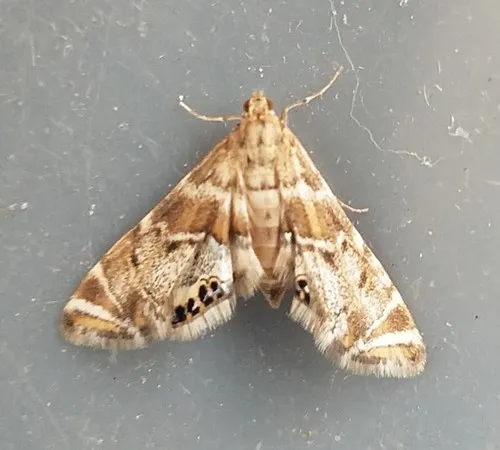
Confusing Petrophila - Hodges#4780
Petrophila confusalis
Identification: Very similar and closely related to Feather-edged Petrophila, but their ranges are widely disjunct. ( 3 ) Confusing Petrophila differs in the following subtle ways ( 3 ) : -- Center of the "discal bar" on the forewing (two short dark
Conifer Coleotechnites Moth - Hodges#1803
Coleotechnites coniferella
Identification: Adult - see original description in Print References.
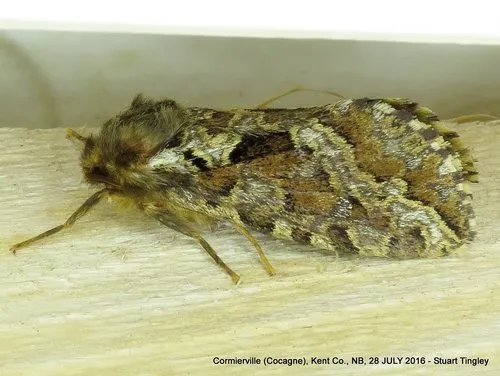
Conifer Swift Moth
Korscheltellus gracilis
The conifer swift moth (Korscheltellus gracilis) is a swift moth considered a forest pest in eastern and central North America, from Canada south to North Carolina. Larvae feed primarily on roots of evergreen trees, and are weakly polyphagous, able t
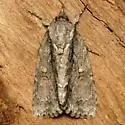
Connected Dagger - Hodges#9219
Acronicta connecta
Identification: Adult: forewing yellowish-gray with broad blackish basal and anal dashes that are diffuse, blurred, and more-or-less connected in lower median area; dull orangish shading usually noticeable in upper median area (inside and distal to r
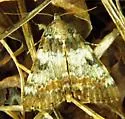
Connubial Underwing - Hodges#8877
Catocala connubialis
Identification: Has several named variants or "forms" whose colors vary considerably; see image links in Internet References section below.
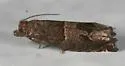
Constricted Sonia Moth - Hodges#3218
Sonia constrictana
Identification: Adult - outer margin of the FW is more concave between veins MI and CUI and the apex is pointed. There is a small ocellus-like spot near the apex of the FW. On the better marked specimens, this spot is blackish and surrounded with yel
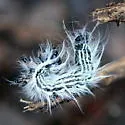
Contracted Datana - Hodges#7906
Datana contracta
Identification: Adult : FW reddish brown, with wide, conspicuous yellowish shading along lines. Outer margin is not wavy. HW yellowish with pale brown shading. Larva can be identified by the cream-colored stripes, the subspiracular stripe being thick
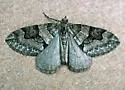
Contracted Spanworm - Hodges#7218
Thera contractata
Identification: Adult: forewing ground color white, densely speckled with brownish-gray; basal line black, wavy; AM and PM lines enclose darker median area which is wide at costa but narrow and constricted at inner margin; subterminal line white, zig
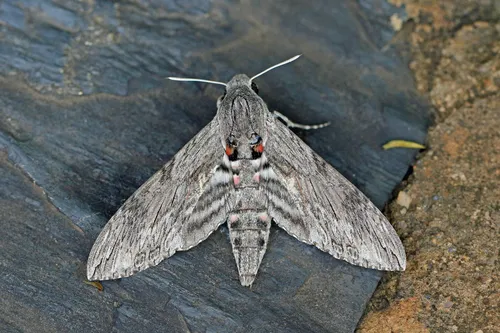
Convolvulus Hawk-moth
Agrius convolvuli
Wingspan 80-120 mm. A large species, with a wingspan of over 10cm. It has largely grey wings, with a pinkish banded body. A good photograph is generally required to support your record. It turns up in light traps and feeding at garden flowers, especi
Copablepharon absidum - Hodges#10690
Copablepharon absidum
Identification: Forewing yellow with varying amounts of olive-gray shading that can enhance the presence of two pale streaks that run parallel to the costa/inner margin. Most specimens have black dots along the PM line and have a black line along the
Copablepharon alaskensis - Hodges#10686.5
Copablepharon alaskensis
Identification: Forewing dull grayish yellow variably dusted with fuscous scales; more yellow and paler along costa, in fold, in ST area and at position of reniform spot; PM line represented by series of black spots; fringe pale grayish green with a
Copablepharon atrinotum - Hodges#10690.2
Copablepharon atrinotum
Identification: Forewing yellowish-green with prominent yellow streaks on costa, thru the cell and into ST area, in the fold, and along the posterior margin of wing; also fine yellow lines on veins in the ST area; black line along cubital vein; PM li
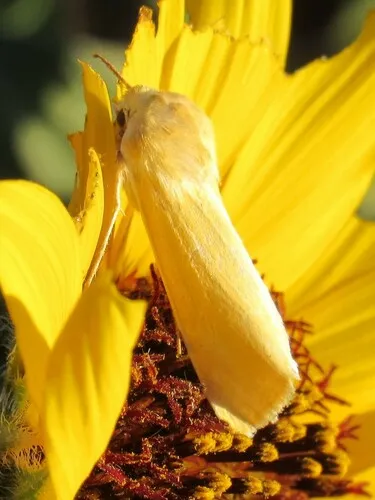
Copablepharon canariana - Hodges#10682
Copablepharon canariana
Identification: Distinct genitalia (see MONA Fascicle 27-1). Forewing of yellow ground color with contrasting white strip along edge of costa that expands to a very thin rectangular patch nearing the apex. The yellow FW can be infused with gray to va
Copablepharon columbia - Hodges#10686.4
Copablepharon columbia
Identification: Forewing ground color dark ocher with pale shading on costa, at position of reniform spot and distill to it, and along the fold; veins, especially on outer third of wing pale yellow; PM line represented by series of black spots on vei
Copablepharon flavum - Hodges#10693.2
Copablepharon flavum
Identification: Forewing chalky, pasty yellow with two pale longitudinal yellow streaks running somewhat parallel to costa and inner margin; fringe yellow. Hindwing yellowish white; fringe white. Antenna of male biserrate; female antenna filiform.
Copablepharon gillaspyi - Hodges#10686
Copablepharon gillaspyi
Identification: Forewing pale gray with pale whitish longitudinal streaks, including streaks between the veins on outer third of wing; no indication of transverse lines. Hindwing pale fuscous.
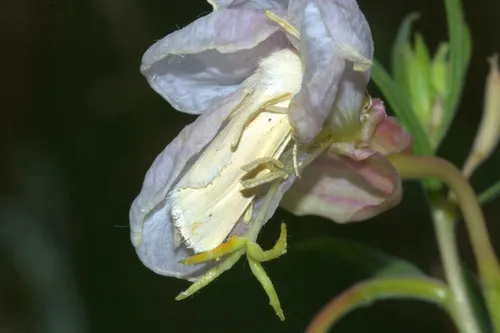
Copablepharon grandis - Hodges#10681
Copablepharon grandis
Identification: Evenly colored pale yellow forewings and fringe; hindwings white with moths from some locations exhibiting varying degrees of fuscous shading toward outer margin; male antenna beadlike. MONA Fascicle does not address forewing transver
Copablepharon longipenne - Hodges#10689
Copablepharon longipenne
Identification: Forewing ground color pale to dark yellow and overlaid with scales that give it an ocherous to greenish color; nominal form from northern Great Plains has pale shading along costa, beyond reniform and often in the fold, with some fusc
Copablepharon michiganensis - Hodges#10689.1
Copablepharon michiganensis
Identification: Forewing yellowish orange with paler yellow streaks on costa, through reniform area and in the fold; PM line represented by series of blacks spots on veins; basal half of fringe concolorous with FW and white on outer edge. Hindwing ma
Copablepharon mustelini - Hodges#10684.1
Copablepharon mustelini
Identification: Forewings and thorax pale tan to whitish tan without yellowish hue; paler creamy white longitudinal streaks thru reniform, fold and costa; occasional trace of dark dots along PM line; fringe concolorous with wing. Hindwing translucent
Copablepharon mutans - Hodges#10686.3
Copablepharon mutans
Identification: Forewing yellow or pale ocher with varying amounts of fuscous scales that create streaked appearance; black spots on veins represent AM/PM lines; enlarged yellow patch in area of reniform spot; most forms with thin dark line above cub
Copablepharon nevada - Hodges#10686.2
Copablepharon nevada
Identification: Forewing dark yellow with dark fuscous longitudinal streaks; black spots on veins represent AM/PM lines; fringe basal half pale ocher, outer half white. Hindwing dark fuscous; fringe very pale fuscous on basal half, white on outer. An
Copablepharon opleri - Hodges#10691.1
Copablepharon opleri
Identification: Small; forewing dark mottled yellow with a pasty texture, without paler longitudinal streaks; transverse lines and maculation absent; fringe yellow, concolorous with forewing or slightly paler. Hindwing fuscous with white fringe. Male
Copablepharon pictum - Hodges#10686.1
Copablepharon pictum
Identification: Forewing vividly patterned with brown and yellow streaks over ocher ground color; AM/PM lines represented by black spots on veins; fringe basal half darker brown than forewing, outer half white. Hindwing dark fuscous gray; fringe chec
Copablepharon robertsoni - Hodges#10687.1
Copablepharon robertsoni
Identification: Forewing mainly gray without yellow; blackish-gray reniform spot and AM/PM lines; thin whitish-gray streak in fold below cubital vein and wider more diffuse streak extending from AM line to reniform spot to PM line. Hindwing pale fusc
Copablepharon serrata - Hodges#10684
Copablepharon serrata
Identification: One of the least variable species in the genus. Forewing is a pale yellowish tan with some individuals exhibiting slightly paler longitudinal streaks. Hindwing is white with slight yellow tint toward outer margin. Male antenna is bise
Copablepharon serratigrande - Hodges#10684.2
Copablepharon serratigrande
Identification: Forewing even dark yellow without spots or streaks; fringe pale yellow. Hindwing white with pale fuscous wash and yellow along wing margin; fringe pale fuscous. Male antenna biserrate.
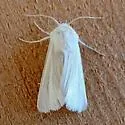
Copablepharon spiritum - Hodges#10693.1
Copablepharon spiritum
Identification: creamy white or pale yellow forewing with varying amounts of black speckling and usually with black dots on the PM line; FW fringe bicolored, yellow proximally and white distally; male antenna biserrate, female antenna filiform
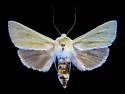
Copablepharon viridisparsa - Hodges#10687
Copablepharon viridisparsa
Identification: Most geographically variable species within the genus. MONA Fascicle 27-1 proposed 4 subspecies. Forewing ground color is generally a medium to dark gray with speckling of yellow scales that result in a greenish-gray cast. Individuals
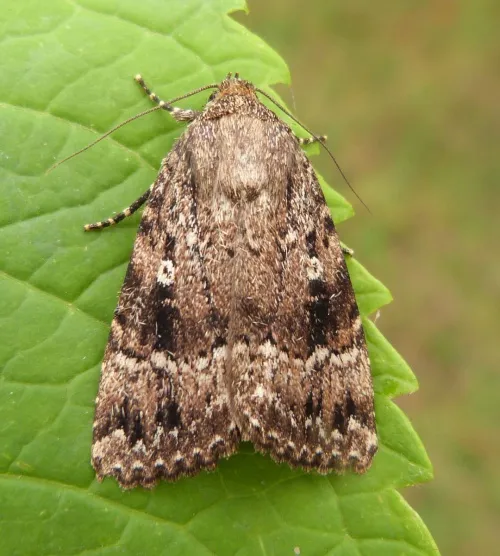
Copper Underwing
Amphipyra pyramidea
Wingspan 40-52 mm. There are a number of subtle ways to help distinguish this species from the similar Svensson's Copper Underwing ( A. berbera svenssoni ). The hindwing underside has a different pattern in the two species. Svensson's also has dark p
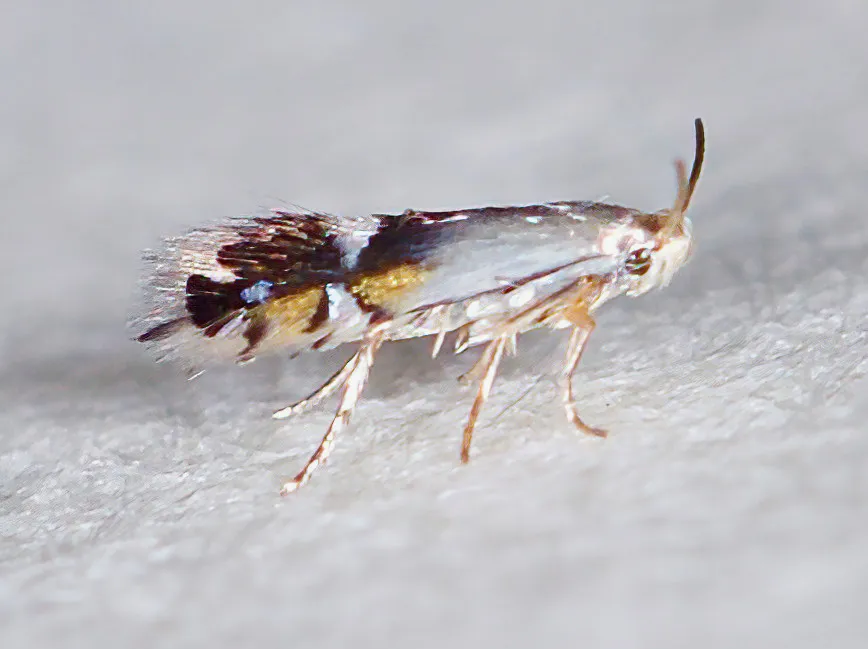
Coptodisca lucifluella - Hodges#0247
Coptodisca lucifluella
Recently discovered in Italy, where the larvae mine walnut leaves, but as far as is known this species only occurs on hickory in North America.
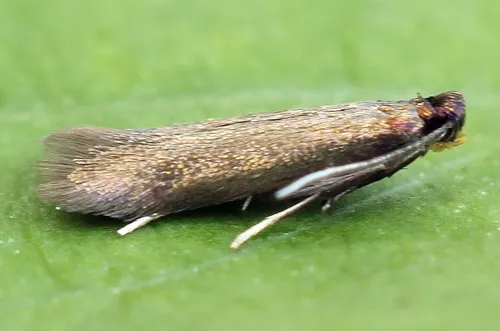
Coptotriche angusticollella
Coptotriche angusticollella
The adults are a fairly uniform bronzy brown, or golden brown and have a wingspan of about 9 mm. The larvae, like other Coptotriche species, produce a pale, papery blotch mine on the upperside of the leaves of various rose species. The mine often con
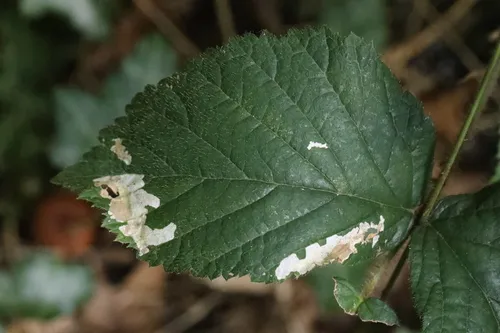
Coptotriche marginea
Coptotriche marginea
Wingspan 7 to 8 mm. The moths are small, indistinct brownish insects with a slight metallic sheen. The larva mines the leaves of Bramble. Has two generations, the moths flying in May and June, and again in August. The larvae mine the leaves of Brambl
Coranarta luteola - Hodges#10332
Coranarta luteola
Identification: Adult: forewing blackish with scattered pale scales giving hoary appearance, reniform spot white with some black scales in the middle, hindwing bright yellow with broad black marginal band and white fringe with no checkering Larva: bl
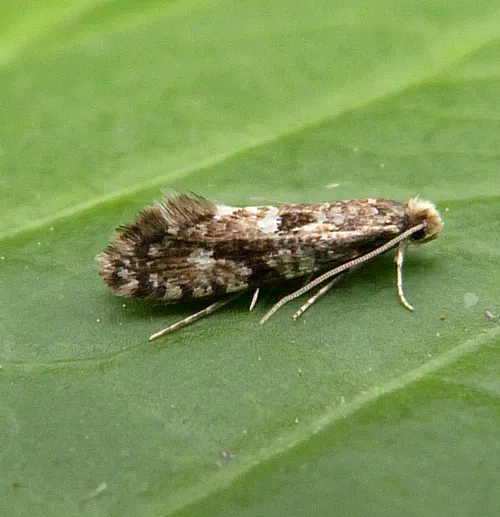
Cork Moth
Nemapogon cloacella
A fairly common species throughout most of Britain, and found chiefly in woodland, especially where there is dead wood. The adult flies during the summer months, mainly at dusk, though it sometimes flies in sunshine. The larvae feed mainly on types o
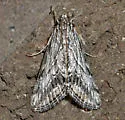
Cornifrons actualis - Hodges#4922
Cornifrons actualis
Identification: Description is online (Barnes & McDunnough). (168)
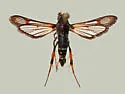
Coronopus Borer Moth - Hodges#2602
Carmenta mimuli
Identification: Adult - forewings largely transparent with wide, black distal margin powdered in orange. Has orange discal spot. Females with yellow-orange labial palpi and generally more orange on the forewings. The dark form is the typical form of
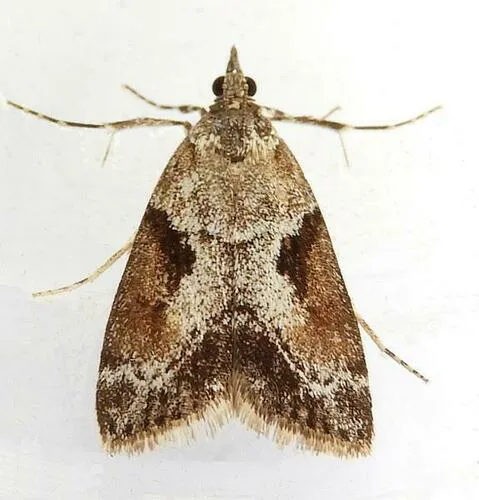
Cosipara modulalis - Hodges#4706
Cosipara modulalis
Identification: This species occurs in two color forms, with some variation and a small proportion of intergrades. One form is closely similar in appearance to C. tricoloralis , though it tends to be somewhat narrower-winged and is less variegated. I
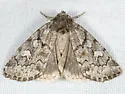
Cosmia elisae - Hodges#9814.1
Cosmia elisae
Identification: Adult: forewing light to medium gray with distinct black lines and black-rimmed spots filled with ground color; reniform spot bent into V shape; orbicular spot oval or irregular-shaped, sometimes connecting to reniform spot; claviform
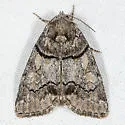
Cosmia praeacuta - Hodges#9814
Cosmia praeacuta
Identification: Adult: forewing medium gray (to almost black out to subterminal line in some individuals) with distinct black lines and black-rimmed spots filled with ground color; reniform spot slightly curved (but not bent into V shape as in C. eli
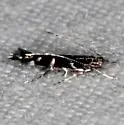
Cosmopterix abnormalis - Hodges#1498.11
Cosmopterix abnormalis
Cosmopterix abnormalis Walsingham, 1897 is now recognized within the North American fauna; specimens collected from Fort Lauderdale, FL in 2013 by James Hayden.
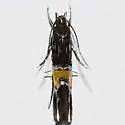
Cosmopterix astrapias - Hodges#1473
Cosmopterix astrapias
Identification: Koster states "the short oblique white line above the dorsal line near the base of the forewing is characteristic."
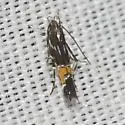
Cosmopterix bacata - Hodges#1491
Cosmopterix bacata
Identification: Dark brown with an intense orange transverse fascia. The apical seven segments of the antenna are white preceded by brown segments. The dorsal surface of the head has three white lines, and the dorsal surface of the thorax has a media
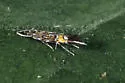
Cosmopterix clemensella - Hodges#1493
Cosmopterix clemensella
Identification: See description and figures here . Genitalia:
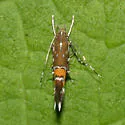
Cosmopterix gemmiferella - Hodges#1490
Cosmopterix gemmiferella
Identification: See description and figures here . According to Frey & Boll the larvae mine on Zizania miliacea (Michx.) Doell & Aschers (Poaceae) in April and July. Further data of this host plant have not been found .
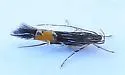
Cosmopterix inopis - Hodges#1488
Cosmopterix inopis
Identification: See description and figures here . Koster (2010) stated "Although the outer dorsal spot on the forewing is generally larger in C. inopis , it cannot be distinguished with certainty by the external characters from C. interfracta, C. le
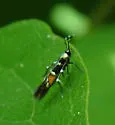
Cosmopterix molybdina - Hodges#1471
Cosmopterix molybdina
Identification: C. molybdina may be recognized by the shining lead-colored pro- and mesothorax above, by the fused and shining lead-colored basal lines on the forewing, and by the distal part of the antenna having the color combination of four white
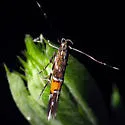
Cosmopterix montisella - Hodges#1476
Cosmopterix montisella
Identification: See description and figures here . "The orange-brown transverse fascia can be completely dark bronze brown, like the rest of the forewing. This form was formerly described as C. unicolorella Walsingham, 1889."
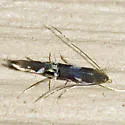
Cosmopterix nitens - Hodges#1469
Cosmopterix nitens
Identification: "Head: frons shining ochreous-white, vertex, neck tufts and collar shining pale bronze brown with greenish gloss; labial palpus, first segment very short, white, second segment three-quarters of the length of third, grey with white lo
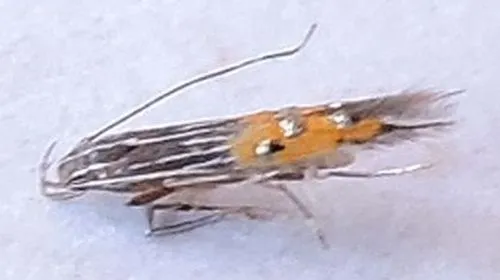
Cosmopterix opulenta - Hodges#1483
Cosmopterix opulenta
Identification: Labial Palps : first segment very short, white, second segment four-fifths of the length of third, shining dark brown with white longitudinal lines laterally and ventrally, third segment white, lined dark brown laterally. Antennae : d
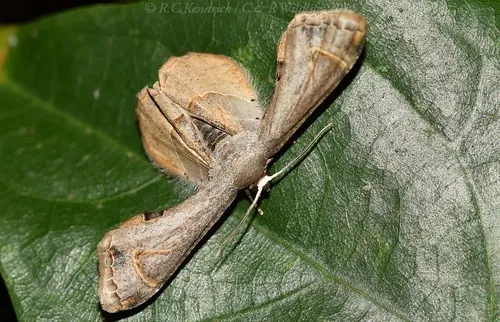
Cotton Leaf Roller
Phazaca theclata
The Cotton leaf roller, (Phazaca theclata), is a moth of the family Uraniidae. It is known from Africa south of the Sahara, from Saudi Arabia, as well as from India, Japan, Myanmar, Nepal and Sri Lanka.
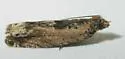
Cotton Tipworm Moth - Hodges#3274
Crocidosema plebejana-of-authors
Identification: Sexually dimorphic. The black patch at the wing base of the female does not extend to the coastal margin. The coastal margin of males has dark scales from base to apex. This page is for Crocidosema plebejana of authors not Zeller, 184
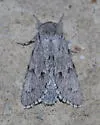
Cottonwood Dagger Moth - Hodges#9205
Acronicta lepusculina
Identification: forewing whitish; lines faint except for 3 black blotches representing tips of lines at costa; black basal dash present; usually no orbicular spot hindwing white "Although vulpina is usually paler, lepusculina is very variable and Mid
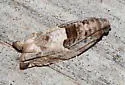
Cottonwood Twig Borer - Hodges#3226
Gypsonoma haimbachiana
Identification: Adult - see original description on Print References. The larvae are among the most destructive pests of cottonwoods in our area.
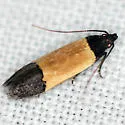
Coverdale's Anacampsis - Hodges#2234
Anacampsis coverdalella
Identification: Adult - forewing light brownish-orange or yellow except for apical one-third and small area at base which are blackish; hindwing gray; head and anterior part of thorax blackish.
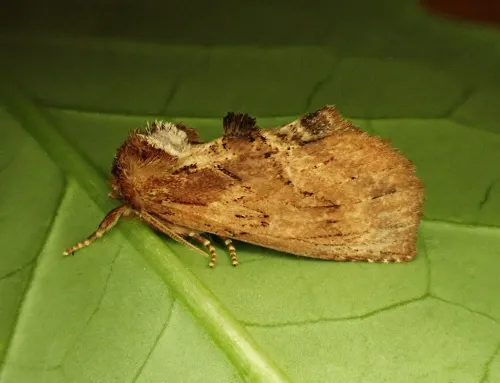
Coxcomb Prominent
Ptilodon capucina
Wingspan 35-40 mm. Although quite variable in shades of brown, typically this species is a rich chestnut colour with a tuft of creamy hairs on the thorax. When at rest it is well camouflaged and, if handled, feigns death. Flies in May and June and ag
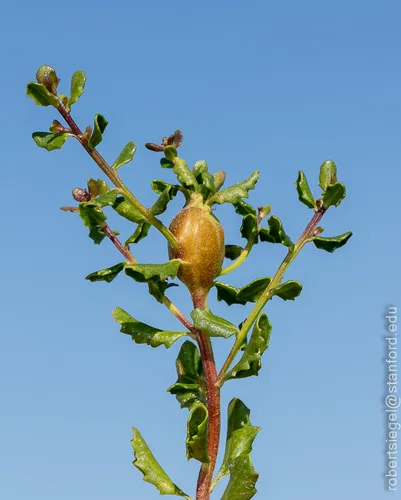
Coyote Brush Stem Gall Moth
Gnorimoschema baccharisella
Gnorimoschema baccharisella is a moth in the family Gelechiidae. It was described by August Busck in 1903. It is found in North America, where it has been recorded from California.
Coyote Cloudywing - Hodges#3907
Achalarus toxeus
Identification: Forewings are pointed. Upperside is dark brown with darker rectangular spots. Hindwing usually has white fringe. (ref = cite:1179096, but link bad)
Crambidia myrlosea - Hodges#8048
Crambidia myrlosea
Identification: Dyar (1917) description. "Head white, thorax gray. Fore wing with the costa broadly white, succeeded by dark gray, the veins faintly paler, especially towards costa. Hind wing dark gray."
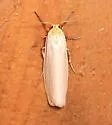
Crambidia xanthocorpa - Hodges#8053.1
Crambidia xanthocorpa
Identification: " Crambidia xanthocorpa is superficially most similar to Crambidia cephalica ; it usually can usually be distinguished by the white patagia, tegulae, and prothorax of eastern specimens of the latter, which are pale to butter yellow in
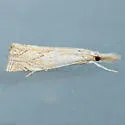
Crambus angulatus - Hodges#5405
Crambus angulatus
Identification: The original description is available online in the print references below.
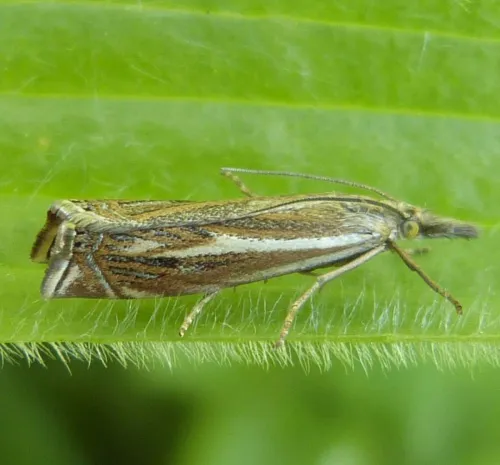
Crambus lathoniellus
Crambus lathoniellus
Wingspan around 20 mm. The whitish streaks on this moth are narrower than other similar species and the males are darker than the females. Like several similar species, the moth is to be found in grassy areas. One of the earliest Crambids to be seen
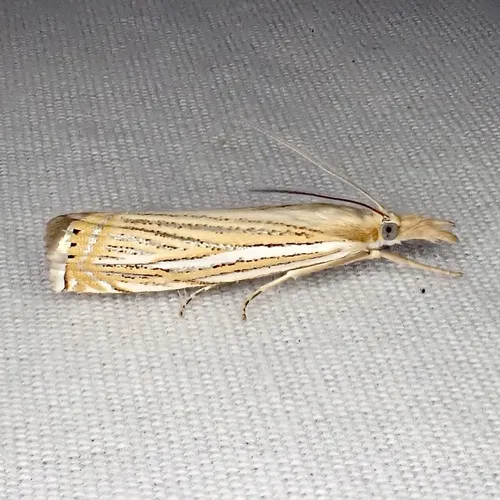
Crambus multilinellus - Hodges#5364
Crambus multilinellus
Crambus multilinellus - Hodges#5364 (Crambus multilinellus) is a species in the family Crambidae, commonly known as crambid snout moths, belonging to the order Lepidoptera (Butterflies and Moths). It is classified within the subfamily Crambinae, trib
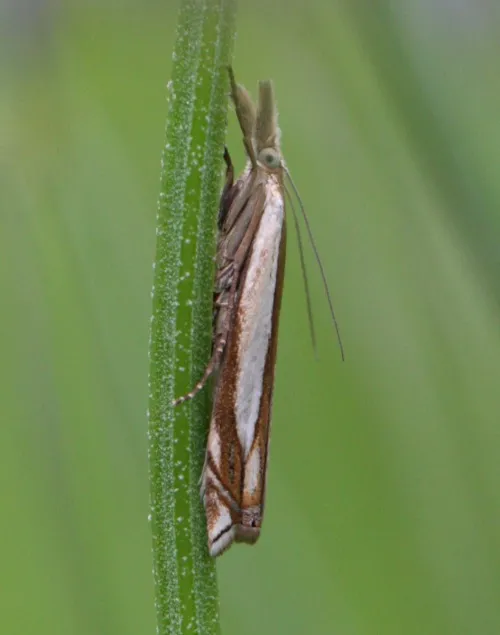
Crambus pascuella
Crambus pascuella
Wingspan 21-26 mm. This species has a distinct whitish streak against a yellow-brown ground colour. This pattern is similar to several other species and they can be rather difficult to separate. Flying from June to August, the adults are on the wing
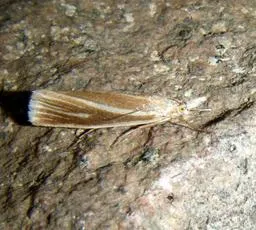
Crambus perlella
Crambus perlella
Wingspan 21-28 mm. The typical form is creamy white with a slight silken lustre. There is also a differently-marked form, warringtonellus , which has heavy streaking. The adults fly in July and August and are attracted to light. The larvae feed on gr
Crambus satrapellus - Hodges#5372
Crambus satrapellus
Identification: Adult: forewing light golden brown with silvery-white stripe that doesn't come close to touching costa, and is tapered at both ends; slender white "branch" diverges about midway along lower edge of stripe toward inner margin; distal e
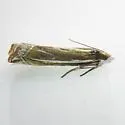
Crambus trichusalis - Hodges#5352
Crambus trichusalis
Identification: The original description of Crambus trichusalis Hulst, and the revised description by Kearfott (1902), are both available online in the print references below. Forewing is yellowish gray with a thin white stripe along the inner margin
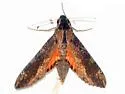
Cramer's Sphinx Moth - Hodges#7836
Erinnyis crameri
Identification: Key points are the lack of black bands on the dorsal of the gray abdomen, and the underside does not have black spots. The hindwing is dull orange with a narrow black border along the entire outer margin.
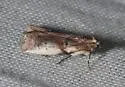
Cranberry Fruitworm - Hodges#5653
Acrobasis vaccinii
Identification: Per Brian Scholtens here : "...The relatively thin black line going to the mid-costa and the speckling of red in the white areas tend to say vaccinii."
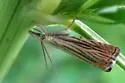
Cranberry Girdler - Hodges#5391
Chrysoteuchia topiarius
Identification: Adult: head with prominent "snout"; forewing varies from dark reddish-brown to light yellowish-brown with distinct dark veins; subterminal line prominent, angled, silvery-gray or whitish; terminal line composed of thin black line near
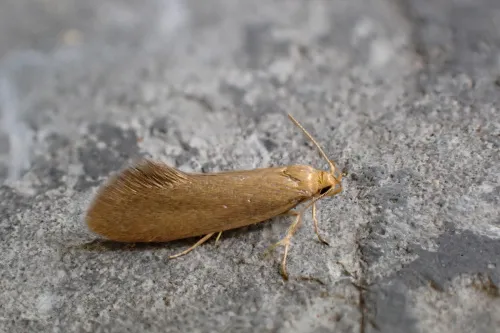
Crassa tinctella
Crassa tinctella
The wingspan is 12 to 15 mm. The adult moths are rather plain, resembling Crassa unitella , but the latter has a brighter yellow tone to the head and thorax area. Unless identified by a recognised expert, a photo is required and the identification sh
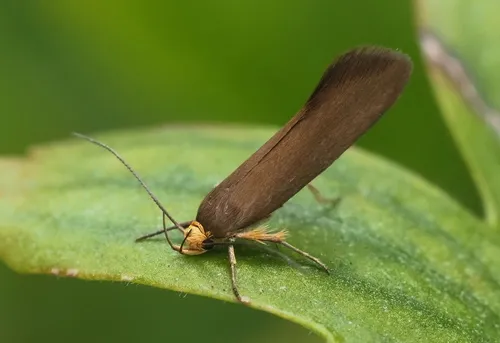
Crassa unitella
Crassa unitella
Golden-brown, with contrasting orange head and palps. Larvae- (from late September to May), feed on fungus on and under dead bark. This species is locally common in Southern England, and occurs more scarcely as far North as Lancashire and Yorkshire.
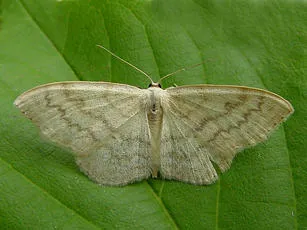
Cream Wave
Scopula floslactata
Wingspan 29-33 mm. A fairly plain moth. Its creamy white wings have a scattering of dark scales and three or four distinct light or dark brown wavy cross lines. In Scotland there is a smaller, darker variety scotica . A good photograph is generally r
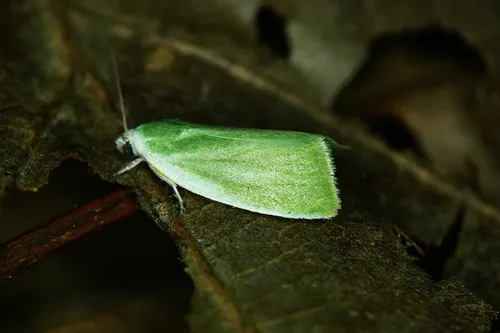
Cream-bordered Green Pea
Earias clorana
Wingspan 16 to 20 mm. A small but distinctive green species, only likely to be confused with the micro Tortrix viridana, which however rests with a much 'flatter' aspect. Inhabits fens, marshes and damp woodland. Flying mainly in May and June, someti
Cremastobombycia ambrosiaeella - Hodges#0720
Cremastobombycia ambrosiaeella
Larvae form underside tentiform mines in the leaves of various members of the aster family ( Ambrosia, Helianthus, Heterotera, Ridania, Verbesina ).
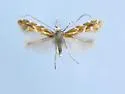
Cremastobombycia grindeliella - Hodges#0721
Cremastobombycia grindeliella
Identification: The original description as Lithocolletis grindeliella Walsingham, is available online at the link in the print references below
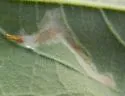
Cremastobombycia ignota - Hodges#0722
Cremastobombycia ignota
Identification: Revised description by Braun as Lithocolletis ignota Frey & Boll, is in PDF.
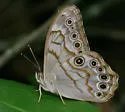
Creole Pearly-eye - Hodges#4568.2
Lethe creola
Identification: Similar to Northern and Southern Pearly-eyes. See references.
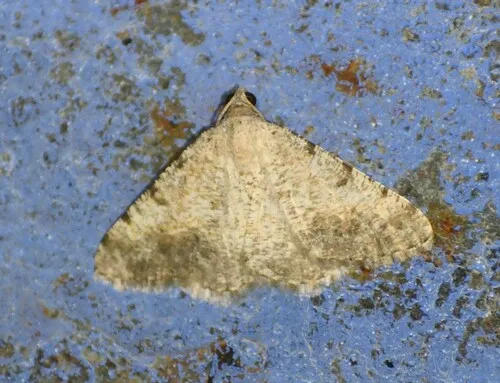
Creosote Moth - Hodges#6381
Digrammia colorata
Identification: Adult - forewing ground color variably pale yellowish to grayish-brown, with sparse to heavy speckling mixed with yellowish or orangish scales; four dark marks along costa represent tops of AM, median, PM, and subterminal lines, which
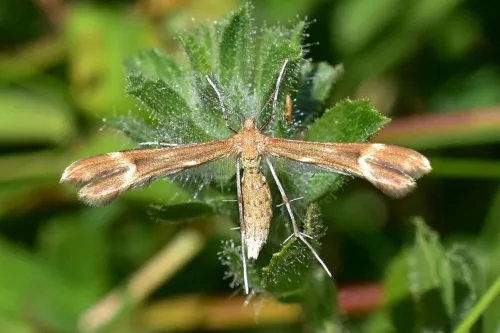
Crescent Plume
Marasmarcha lunaedactyla
Wingspan 18 to 22 mm. This species is easily recognisable by the moon-shaped creamy-white marking at the cleft in the brownish forewing. It prefers dry habitats, such as downland, shingle beaches and sand-dunes. It flies from dusk onwards in late Jun
Cresson's Grass-tubeworm Moth - Hodges#0347
Acrolophus cressoni
Identification: The original description as Eulepiste cressoni Walsingham, 1882 and the Hasbrouck 1964 revised description as Acrolophus cressoni (Walsingham) are available online in the print references below or PDF. Specimen identified by DNA analy
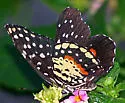
Crimson Patch - Hodges#4503
Chlosyne janais
Identification: Above forewing black with white spots, hindwing black with large red-orange basal patch. Below black with white spots, yellow basal patch on hindwing has black spots throughout. larvae white: northern-most regularly occurring populati
Crimson-bodied Lichen Moth - Hodges#8246
Lerina incarnata
Identification: Walker (1856) description. Head above, thorax, and abdomen towards the tip thickly clothed with crimson hairs. Palpi, proboscis, antennae, and legs black. Thorax with a black dorsal stripe, not extending to the front. Wings metallic b
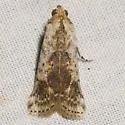
Crocidomera imitata - Hodges#5706
Crocidomera imitata
Identification: Neunzig (2000) states "In C. imitata a general melanism of the scales of the entire forewing occurs in a few males and females of a population." Species page created based on this image determined by Ed Knudson, Texas Lepidoptera Surv
Crocidosema aporema - Hodges#3332
Crocidosema aporema
Identification: Adults - See images and info at TortAI Larvae - See images and info at LepIntercept
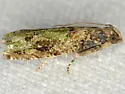
Crocidosema longipalpana - Hodges#3274.2
Crocidosema longipalpana
Crocidosema litchivora was synonymized with Crocidosema longipalpana by Baixeras after discovering the type specimen for the latter in a collection in Germany. The synonymy was published in the World Catalogue of Insects, Vol. 5. (see note 13)
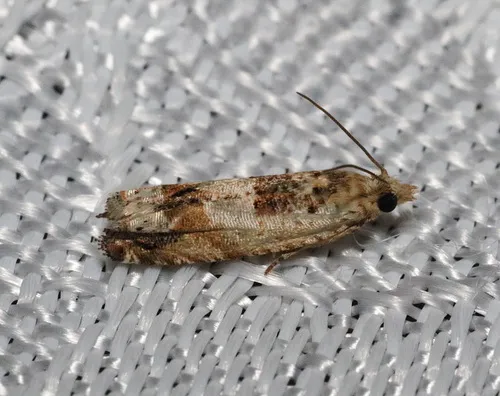
Crocidosema plebejana
Crocidosema plebejana
Various habitats including parks and gardens. The moths fly mainly between July and October, and can be found on the wing from early evening, after which they will come to light. The larvae feed on Tree-mallow (Lavatera arborea) and related species,
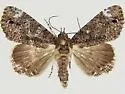
Cropia connecta - Hodges#9622
Cropia connecta
Identification: Smith original description as Chytonix connecta can be viewed online from the print references. Schaus original description as Eudipna templada : "Antennte serrate and ciliate. Primaries brown-grey, finely irrorated over a lighter gro