
Cranberry Girdler - Hodges#5391
Chrysoteuchia topiarius
This record describes Chrysoteuchia topiarius (species). Recorded family: Crambidae. Recorded order: Lepidoptera.
Identification and Appearance
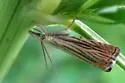
Adult: head with prominent snout; forewing varies from dark reddish-brown to light yellowish-brown with distinct dark veins; subterminal line prominent, angled, silvery-gray or whitish; terminal line composed of thin black line near apex, and three black dots near anal angle; fringe shiny gold or bronze; hindwing gray with thin dark terminal line Larva: head red or orange; thorax yellowish; abdomen white to dark brown or blackish with one or two long lateral hairs per segment A pest of cranberry growers, sod growers, and tree nursery owners. Adult females tend to drop to the ground when disturbed, whereas males tend to fly away.
Classification
- Kingdom
- Animalia
- Phylum
- Arthropoda
- Class
- Insecta
- Order
- Lepidoptera (Butterflies and Moths)
- Superfamily
- Pyraloidea
- Family
- Crambidae (Crambid Snout Moths)
- Subfamily
- Crambinae
- Tribe
- Crambini
- Genus
- Chrysoteuchia
Imported taxonomy record. Source availability varies; see the source references and editorial policy below.
Habitat and Range
Habitat
grasslands, fields, cranberry plantations, tree nurseries; adults are active day and night, and are attracted to light
Geographic Range
all of United States and southern Canada
Seasonal Activity
adults fly from June to August larvae from July to September
Diet and Behavior
Diet: young larvae feed on soft tissues such as crowns, leaves, and roots of grasses; mature larvae feed on bark of cranberry and conifer seedling roots and crowns; also feed on blueberry and many species of herbaceous plants
Life History
one or two generations per year; eggs are laid on host plant and hatch in 4-14 days, depending on temperature; overwinters either as a mature larva or a pupa wrapped in silk cocoon covered with soil Adult with eggs
Additional species information
Species notes from the sources
Etymology: TOPIARIA: from the Latin "topiarius" (an ornamental gardener); topiary is the art of trimming and training shrubs or trees in unnatural ornamental shapes - probably refers to the larva's feeding effect on host plants
About Butterflies and Moths: the wider group
Order-level background for Lepidoptera, the group containing Chrysoteuchia topiarius. Species-specific details appear above.
Group overview
Lepidoptera includes approximately 180,000 described species of butterflies and moths. Moths outnumber butterflies roughly 10:1. The monarch butterfly's eastern population has declined by more than 80% since the mid-1990s, and the western population by over 95% since the 1980s. The IUCN lists the migratory monarch as Vulnerable.
Ecological role of the group
Butterflies and moths are essential indicators of ecosystem health. As caterpillars, they are a primary food source for birds - a single nest of blue tit chicks requires ~10,000 caterpillars. Adult moths pollinate many night-blooming plants.
Economic and practical significance of the group
Lepidoptera are critical pollinators. In Europe, grassland butterfly species have declined by almost 50% since the early 1990s. In the UK, three-quarters of butterflies are in decline. In the U.S., five butterfly species have gone extinct since 1950, with 29 listed as endangered.
Recorded sources for this group: IUCN Red List, Xerces Society, USFWS, PNAS, WWF. Imported estimates may describe particular regions or reporting periods.
Photos of Cranberry Girdler - Hodges#5391 (5)
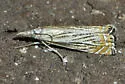
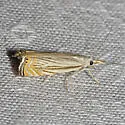
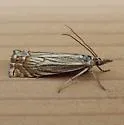
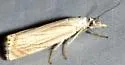
Photo credits: Contributed by Lynette Elliott; Additional contributions by Steve Nanz , Robin McLeod , Tony-2 , Maury Heiman , marcie oconnor
Frequently Asked Questions About Cranberry Girdler - Hodges#5391
What is Cranberry Girdler - Hodges#5391?
Cranberry Girdler - Hodges#5391 (Chrysoteuchia topiarius) is a species in the family Crambidae, within the order Lepidoptera.
How big is Cranberry Girdler - Hodges#5391?
wingspan 17-20 mm larvae length to 13 mm
How do you identify Cranberry Girdler - Hodges#5391?
Adult: head with prominent snout; forewing varies from dark reddish-brown to light yellowish-brown with distinct dark veins; subterminal line prominent, angled, silvery-gray or whitish; terminal line composed of thin black line near apex, and three black dots near anal angle; fringe shiny gold or bronze; hindwing gray with thin dark terminal line Larva: head red or orange; thorax yellowish; abdomen white to dark brown or blackish with one or two long lateral hairs per segment
Where is Cranberry Girdler - Hodges#5391 found?
| Feature | Details |
|---|---|
| Habitat | grasslands, fields, cranberry plantations, tree nurseries; adults are active day and night, and are attracted to light |
| Range | all of United States and southern Canada |
What does Cranberry Girdler - Hodges#5391 eat?
The diet of the Cranberry Girdler - Hodges#5391 includes young larvae feed on soft tissues such as crowns, leaves, and roots of grasses; mature larvae feed on bark of cranberry and conifer seedling roots and crowns; also feed on blueberry and many species of herbaceous plants.
When is Cranberry Girdler - Hodges#5391 active?
Cranberry Girdler - Hodges#5391: seasonal activity - adults fly from June to August larvae from July to September.
What is the life cycle of a Cranberry Girdler - Hodges#5391?
one or two generations per year; eggs are laid on host plant and hatch in 4-14 days, depending on temperature; overwinters either as a mature larva or a pupa wrapped in silk cocoon covered with soil Adult with eggs