
Spiders
Order Araneae
The Spiders (Order Araneae) includes 1,848 species across 82 families and 552 genera in our directory.
About Spiders
As of 2023, 51,673 spider species in 136 families have been recorded, though an estimated 150,000 species exist. Spiders rank 7th in total species diversity among all organism orders. Only 0.5% of spider species pose any risk to human health.
Economic Impact
The global spider community kills an estimated 400-800 million tons of prey annually (2017 study). Spiders provide billions of dollars in natural pest control for agriculture. Spider silk is 5× stronger than steel of the same diameter, driving a biomaterials research industry.
Ecological Role
Spider venom contains complex peptides with diverse pharmacological activities, making them valuable for drug development research. Spiders produce up to 7 types of silk from specialized glands. Spider silk genes have been inserted into mammals and plants for biotech applications.
Families in Araneae (82)
Species in Araneae (1,848)
'Hogna' ceratiola
Schizocosa ceratiola
Identification: Variation in the epigynum seems to be an unreliable means of ID as stated by Wallace. Epigyne of females pictured here resemble the drawing in Wallace, 1942 of H. psuedoceratiola , but the male palpal organs are distinctly ceratiola a
Aculepeira carbonarioides
Aculepeira carbonarioides
This species was generally found in the center of the web during the day while packardi was more often found in a retreat next to the web in daylight hours.
Aculepeira packardi
Aculepeira packardi
Identification: Female This species was generally found in a retreat next to the web in daylight hours while carbonarioides was more often found at the center of the web during the day.
Adanson's House Spider
Hasarius adansoni
This is an introduced species that originated in Africa and the Middle East but has spread around the world.
Admestina archboldi
Admestina archboldi
The type specimen of this spider was collected at Archbold Biological Station on 26 March 1989 by William H. Piel.
Agalenatea redii
Agalenatea redii
Length 5-10mm. Prosoma eye region pale, sternum brown, often with bright median spot. Chelicerae brown. Legs brown, vaguely annulated. Opisthosoma brown, densely haired, with brown longitudinal stripe always visible. On dry grass, shrubs and bushes,
Agelena labyrinthica
Agelena labyrinthica
Head and body up to 18mm long. The abdomen of the labyrinth spider features a central pale brown stripe with a darker, more greyish band on either side. The darker bands have tiny white dashes or chevron markings running through them. This spider pro
Agelenopsis actuosa
Agelenopsis actuosa
The common American grass spider (Agelenopsis actuosa, actuosa = "active, agile") is a species of grass spider native to southeastern Canada and the New England states. It is sometimes also encountered in such states as Michigan and New York.
Agelenopsis aleenae
Agelenopsis aleenae
Agelenopsis aleenae is a species of funnel weaver in the spider family Agelenidae. It is found in the United States.
Agnyphantes arboreus
Agnyphantes arboreus
Identification: "Cephalothorax dull yellow, strongly suffused with dusky, darker at the margin and in a shield-shaped spot in front of dorsal groove. Abdomen light with scattered silvery spots, marked by a dark median longitudinal stripe with several
Agrarian Sac Spider
Cheiracanthium inclusum
Cheiracanthium inclusum, alternately known as the black-footed yellow sac spider or the American yellow sac spider (in order to distinguish it from its European cousin C. punctorium), was formerly classified as a true sac spider (of the family Clubio
Agroeca proxima
Agroeca proxima
Body length male: 3.8 to 5 mm. Body length female: 5.2 to 7.5 mm. Opisthosoma brown-grey to light yellow-brown with distinct chevrons. Unless identified by a recognised expert, a photo is required and the specimen should be examined with a microscope
Agyneta angulata
Agyneta angulata
Identification: "Carapace light orange, shiny, finely reticulate; margin, radiating lines suffused with dark gray. Abdomen uniformly light gray. Legs yellow." Palp
Agyneta barrowsi
Agyneta barrowsi
Identification: "Carapace light orange-brown, shiny, finely reticulate; lightly suffused with gray along margin, radiating lines; sometimes with trident mark. Abdomen uniformly light to dark gray. Legs light yellow; basal part of femur darker." Epigy
Agyneta bronx
Agyneta bronx
Identification: "Carapace light yellow, shiny, finely reticulate. Abdomen uniformly off-white. Legs light yellow." Palp:
Agyneta conigera
Agyneta conigera
This is one of the 'money spiders' in the Linyphidae family - which has more UK species than any other. Most are small and need microscopic examination to identify. No additional images available for this species.
Agyneta evadens
Agyneta evadens
Identification: "Carapace dark brown, shiny, finely reticulate; lightly suffused with light gray along radiating lines, pars cephalica and margin. Abdomen uniformly dark gray, sometimes with faint, off-white broken chevrons (males) sometimes off-whit
Agyneta fabra
Agyneta fabra
Identification: Male: Carapace dark orange-brown, shiny, finely reticulate; lightly suffused with gray along margin and radiating lines; sometimes with the dark gray trident mark. Abdomen uniformly gray, or pale off-white with four dark spots mediall
Agyneta fillmorana
Agyneta fillmorana
Identification: Carapace orange, shiny, finely reticulate; can be suffused with dark gray along radiating lines and pars cephalica. Abdomen pattern variable: large morph male's is off-white with pattern consisting of a dark median band extending late
Agyneta olivacea
Agyneta olivacea
Identification: "Carapace light brown-yellow, shiny, finely reticulate; suffused with dark gray along margin and radiating lines; trident mark present. Abdomen uniformly dark gray. Legs yellow, tip of femur, tibia and metatarsus brown" Epigynum
Agyneta ramosa
Agyneta ramosa
This is one of the 'money spiders' in the Linyphidae family - which has more UK species than any other. Most are small and need microscopic examination to identify. Microscopic examination of the of the genitalia is required to confirm this species.
Agyneta rurestris
Agyneta rurestris
Length 1.4 to 3 mm. Prosoma dark brown, with black margin. Sternum dark brown. Chelicerae bright yellowish brown, sometimes tinged with black. Legs bright yellowish brown, sometimes tinged with black. Opisthosoma grey to almost black. This species ca
Agyneta saxatilis sensu stricto
Agyneta saxatilis sensu stricto
2.0 to 2.3 mm. Prosoma brown, sometimes darkened with black. Sternum black-brown. Chelicerae yellowish-brown. Legs yellowish-brown. Opisthosoma grey-black. This species can only be confirmed by examination of the genitalia of mature specimens. Widesp
Agyneta semipallida
Agyneta semipallida
Identification: "Carapace light yellow, shiny, finely reticulate; suffused with dark gray along margin, radiating lines. Abdomen off-white with an apical black mark. Legs yellow." Epigynum
Agyneta serrata
Agyneta serrata
Identification: "Carapace light orange, shiny, finely reticulate; radiating lines, margin suffused with dark gray; trident mark present. Abdomen uniformly light to dark gray, sometimes with apical white hourglass mark. Legs light yellow, femurs light
Agyneta sheffordiana
Agyneta sheffordiana
Identification: "Carapace light khaki-brown, shiny, finely reticulate; suffused with dark gray along margin, radiating lines; trident mark present. Abdomen uniformly light gray. Legs light yellow, prolateral and retrolateral surface of palpal femora
Agyneta subtilis
Agyneta subtilis
Body length: 2.5 to 3 mm. Prosoma red-brown, margin darkened. Sternum red-brown. Chelicerae without denticles. Legs yellow-brown, tibia and metatarsus darker. Opisthosoma dark brown to black. Confirmation of this species requires examination of the g
Agyneta unimaculata
Agyneta unimaculata
Identification: "Carapace yellow-brown, shiny, finely reticulate; lightly suffused with gray along radiating lines and pars cephalica. Abdomen uniformly light to dark gray. Legs light yellow, base of femur slightly suffused with dark gray" Palp Epigy
Alabama wandering spiders
Ctenus hybernalis
Identification: Similar to Ctenus exlineae but can be separated by color. Carapace dark reddish brown with light medial band. Abdomen with five-lobed light colored folium on dorsal side and on the ventral side a v-shaped mark of light dots converging
Aliatypus californicus
Aliatypus californicus
Aliatypus californicus is a species of folding-door spider in the family Antrodiaetidae. It is found in the United States.
Allocosa absoluta
Allocosa absoluta
Identification: "Carapace dark red brown to black, usually mottled with dull yellow or orange yellow, sometimes with pale median band and submarginal rows of pale spots; pale median band sometimes enclosing paired, dark, longitudinal streaks anterior
Allocosa chamberlini
Allocosa chamberlini
Identification: "Carapace dark red brown, veined with black, with several dark lines radiating from vicinity of dorsal groove, with indistinct pale median band and submarginal bands (or series of spots), with few setae. Sternum pale orange, often suf
Allocosa funerea
Allocosa funerea
Identification: Male: "Carapace dark red to black, often paler posteriorly, minutely and evenly punctate, with few setae. Sternum dark brown. Chelicerae dark red brown to black, paler distally. Legs with femora black, with femora tips and remaining s
Allocosa mulaiki
Allocosa mulaiki
Identification: "Carapace dark red brown to nearly black, sometimes iridescent, darker at margins, with few setae. Sternum orange brown. Chelicerae dark red or red brown. Legs dark orange or red brown, sparsely covered with setae; femora and tibiae e
Allocosa noctuabunda
Allocosa noctuabunda
Identification: "Carapace dark red brown, with pale median band (which often encloses paired, dark streaks anterior to dorsal groove) and pale, sinuous submarginal bands (or series of spots), and with few setae. Sternum yellow or orange. Chelicerae d
Allocosa sublata
Allocosa sublata
Identification: "Carapace dark red brown to black, sometimes iridescent, darker at margins, with few setae. Sternum orange brown. Chelicerae dark red or red brown. Legs dark orange or red brown, sparsely covered with setae; femora and tibiae each wit
Allocosa subparva
Allocosa subparva
Identification: "Carapace dark red brown to black, with indistinct pale median band (but lacking pale submarginal bands), with dark lateral margins, and with few setae. Sternum orange to black. Chelicerae dark orange to black. Legs orange to black; f
Allomengea dentisetis
Allomengea dentisetis
Identification: "Cephalothorax, chelicerae and legs light brown. Abdomen cream-colored with gray suffusion, a faint pattern of grayish chevrons dorsally." Epigynum
Alopecosa aculeata
Alopecosa aculeata
Identification: Female: Voucher specimens: South Dakota: Alberta: epigyne epigyne with some setae removed to reveal more structure Male: Voucher specimens: Alberta: Newfoundland: left palp, retrolateral view left palp, distal view - showing the "mesa
Alopecosa exasperans
Alopecosa exasperans
Alopecosa exasperans is a species of wolf spider in the family Lycosidae. It is found in Canada and Greenland.
Alopecosa pictilis
Alopecosa pictilis
Identification: Emerton called it a distinct and bright-colored species: See Emerton 1919: plate 1, figures 11 & 12 HERE . Written description under Lycosa pictilis on page 4H. Also Emerton 1885: plate XLVI, figure 5 HERE . Written description under
Amaurobius borealis
Amaurobius borealis
Amaurobius borealis is a species of hacklemesh weaver in the spider family Amaurobiidae. It is found in the United States and Canada.
Amaurobius fenestralis
Amaurobius fenestralis
This is a dark brown spider with a pale oval ring marking on its abdomen which has a dark 'cardiac' mark in its centre. It often has orange/brown chevrons below this cardiac mark. It is very similar to A. similis and the two cannot reliably be distin
Anachemmis sober
Anachemmis sober
Identification: Carapace light brown, with darker triangular markings radiating from thoracic groove to intercoxal areas; abdomen mottled brownish gray; femora light brown, more distal leg segments grading to dark reddish brown on metatarsi and tarsi
Anelosimus analyticus
Anelosimus analyticus
Anelosimus analyticus is a species of cobweb spider in the family Theridiidae. It is found in the United States and Mexico.
Anelosimus studiosus
Anelosimus studiosus
Identification: Female Only about 23 among more than 38,000 known spider species can be considered social! Unlike social insects, where the workers are sterile and only the queen lays eggs, all social spiders in a colony are able to reproduce. Debora
Anelosimus vittatus
Anelosimus vittatus
A small spider with a wide, rich brown band running the length of the abdomen. Carapace is light brown with a thin dark border and a broad brown median band tapering towards the rear. This species constructs its scaffold webs on bushes, trees and tal
Antistea brunnea
Antistea brunnea
Antistea brunnea is a species of true spider in the family Hahniidae. It is found in the United States and Canada.
Antistea elegans
Antistea elegans
Length 2.5 to 4 mm. Prosoma yellow-brown to reddish yellow, with dark spots. Opisthosoma dark grey-brown with bright areas. Identification of this species "Requires examination at high magnification in good lighting, typically examination of the geni
Antrodiaetus hageni
Antrodiaetus hageni
Antrodiaetus hageni is a species of folding-door spider in the family Antrodiaetidae. It is found in the United States.
Antrodiaetus microunicolor
Antrodiaetus microunicolor
Antrodiaetus microunicolor is a species of antrodiaetid mygalomorph spider. It is found in the United States of America.
Antrodiaetus montanus
Antrodiaetus montanus
Antrodiaetus montanus is a species of folding-door spider in the family Antrodiaetidae. It is found in the United States.
Antrodiaetus unicolor
Antrodiaetus unicolor
A very detailed treatment of Antrodiaetus bicolor appears on pp. 271-284 of Coyle(1971) . Of particular interest, this species is a larval host for the rare dipteran parasitoid Eulonchus marialiciae .
Anyphaena accentuata
Anyphaena accentuata
Size 4.5 to 7 mm. Although variable in appearance, the two chevron marks on the abdomen are the indicator of this species. There are three Anyphaena species in the UK and all are extremely similar. Microscopic examination of the genitals of mature sp
Anyphaena aperta
Anyphaena aperta
Identification: Palp Epigynum "Although the distribution indicates that this might be an introduced species, no specimens or described species from the Palearctic or Oriental regions resemble Anyphaena aperta ."
Anyphaena californica
Anyphaena californica
Identification: Very similar to A. pacifica . Requires microscopic examination of the genitalia of adults to distinguish them. Palp (ventral/retrolateral view) Epigynum
Anyphaena celer
Anyphaena celer
Identification: Palp (ventral/lateral) Epigynum (ventral/ventral dissected/dorsal dissected) Anyphaena maculata (as of 10/5/25 not listed in BugGuide) is very similar to Anyphaena celer , and shares much of the same range, though is more southern in
Anyphaena dixiana
Anyphaena dixiana
Identification: May be quickly recognized by the spur borne on the dorsal prong of the RTA of males and the greatly reduced epigynal midpiece of females. Palp (ventral/lateral) Epigynum (ventral/dorsal dissected) Closest to A. crebrispina .
Anyphaena fraterna
Anyphaena fraterna
Identification: A species that can be fairly easily recognized under a microscope by the long and narrow median apophysis of the males and by the female's epigynal plate being wider anteriorly than posteriorly. Habitus (male/female) Palp (ventral vie
Anyphaena numida
Anyphaena numida
Length 6mm. Pale yellow to reddish brown, with darker brownish spots on legs, prosoma and opisthosoma. Prosoma yellowish with faint radial stripes and a dark spot in the centre. Abdomen yellow-brown to red-brown with six distinctive black spots and s
Anyphaena pacifica
Anyphaena pacifica
Identification: Palp (ventral/lateral) Epigynum (ventral/dorsal dissected)
Anyphaena pectorosa
Anyphaena pectorosa
Identification: Palp (ventral/lateral) Epigynum (ventral/ventral dissected/dorsal dissected)
Apache Recluse
Loxosceles apachea
Loxosceles apachea, the Apache recluse, is a species of recluse spider in the family Sicariidae. It is found in the United States and Mexico.
Aphileta misera
Aphileta misera
Identification: Palp: Epigynum: Additional palp/epigynum images can be found here .
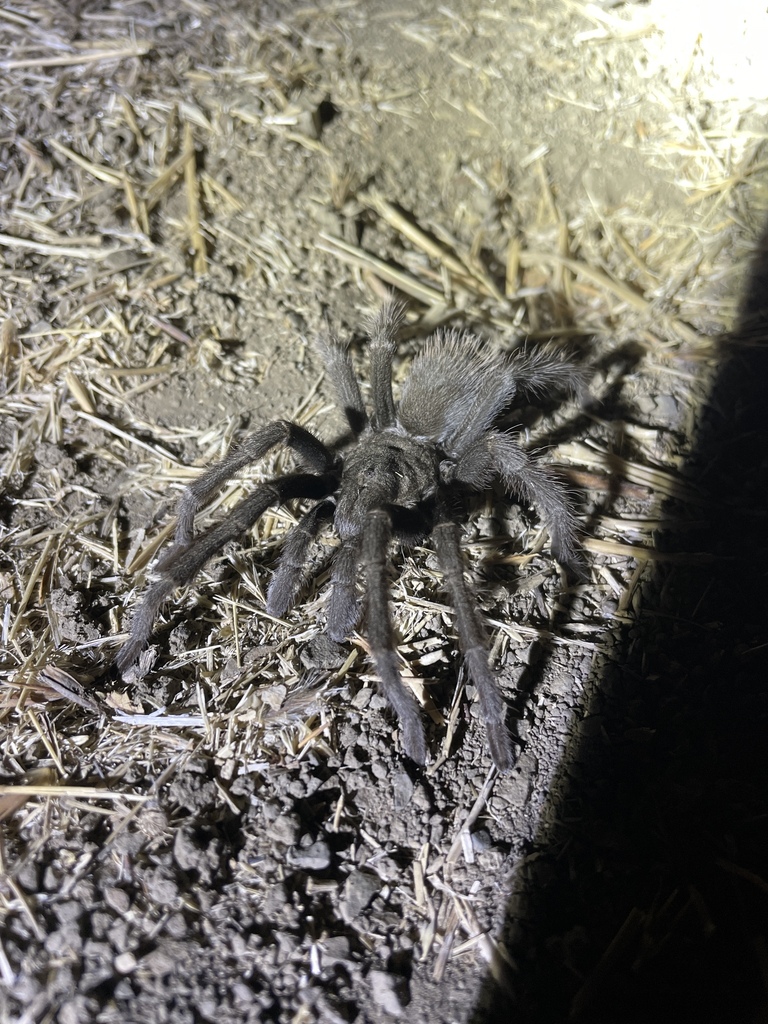
Aphonopelma iodius
Aphonopelma iodius
no rights reservedAphonopelma iodius or desert tarantula is a species of spider in the family Theraphosidae, found in United States (California, Nevada, Arizona and Utah).
Aphonopelma moderatum
Aphonopelma moderatum
Identification: "Females and subadult males are morphologically unique and can be readily identified by possessing an orange body disrupted by distinctly darkened (black or dark brown) banding on the patellae, metatarsi, and tarsi."
Apollophanes margareta
Apollophanes margareta
Identification: ...has the posterior eye row equidistant (not like Philodromus with the posterior median eyes conspicuously closer to the laterals than to each other), a second, bigger "v" behind the usual small v-mark on the carapace, and 4 big ligh
Araneus alboventris
Araneus alboventris
Identification: Carapace, sternum, legs greenish yellow. Bright yellow rings around posterior median eyes. Abdomen dorsum with black patch bordered by crimson red border on golden yellow background. Epigynum
Araneus andrewsi
Araneus andrewsi
Identification: Female (adult/juvenile) -also see remarks below Epigynum Compare these two different voucher females, collected only 32 miles apart in California:
Araneus bispinosus
Araneus bispinosus
Identification: Palp Epigynum See notes below about distinguishing A. bispinosus from A. montereyensis .
Araneus bivittatus
Araneus bivittatus
Identification: A. bivittatus is the only species (of the small Araneus ) that has the abdomen longer than wide, widest in the middle, with a median anterior hump and two longitudinal dorsal red or green bands on the abdomen.
Araneus bonsallae
Araneus bonsallae
Identification: To separate from other similar looking green Araneus, look for the dark patch on the dorsum. Palp
Araneus calusa
Araneus calusa
Identification: Distinct red mark anterior on each lateral hump. A pair of red spots posteriorly on each side.
Araneus detrimentosus
Araneus detrimentosus
Identification: Typical fresh female: Male Abdomen can sometimes be white or white with brown marks. It can looks very similar to A. thaddeus but the only area it appears they overlap is southern Arizona.
Araneus gadus
Araneus gadus
Identification: Female legs banded, male legs not banded.
Araneus gemma
Araneus gemma
Identification: Female: carapace and abdomen vary in color from gray to brownish purple. The abdomen has anterior paired humps and may have a medial light stripe that varies in length. Male: similar in color and pattern to the female. This species is
Araneus illaudatus
Araneus illaudatus
Identification: It closely resembles A. gemma . Ventral view
Araneus iviei
Araneus iviei
Araneus iviei is a species of orb weaver in the family of spiders known as Araneidae. It is found in the United States and Canada.
Araneus juniperi
Araneus juniperi
Identification: Juniperi differs from bivittatus by having the abdomen subspherical rather than oval, and the bands much less distinct, separated by lighter green rather than white. Palp
Araneus mammatus
Araneus mammatus
Araneus mammatus is a species of orb weaver in the spider family Araneidae. It is found in the United States.
Araneus niveus
Araneus niveus
Araneus niveus is a species of orb weaver in the family of spiders known as Araneidae. It is found in the United States.
Araneus nordmanni
Araneus nordmanni
Identification: Epigynum (ventral/posterior/lateral)
Araneus sturmi
Araneus sturmi
Length male: 4-5.5mm. Prosoma brown. Sternum unicoloured brown, darker than coxa. Opisthosoma red-brown. https://srs.britishspiders.org.uk/portal.php/p/Summary/s/Araneus+sturmi No additional images available for this species.
Araniella inconspicua
Araniella inconspicua
Body length male 4 to 5 mm, female 5 to 8.7mm. Prosoma brown. Legs brown. Opisthosoma dorso-laterally always without black spots, ventrally without spots. Detailed examination of genitalia of mature specimens is required to confirm this species. http
Araniella opisthographa
Araniella opisthographa
Araniella cucurbitina - Conspicuous red spot above spinnerets, visible only from below. Male femur I with ventral median part lacking bristles (regularly 3 bristles basally, 1 bristle distally). Females difficult to identify as this species with cert
Arctosa lama
Arctosa lama
Identification: Carapace reddish brown, with few short dark setae. Anterior row of eyes straight or procurved, shorter than middle row; eyes uniform in size. Chelicerae reddish brown. Legs reddish brown, darker distally, lacking dark rings; scopulae
Arctosa leopardus
Arctosa leopardus
Length 5 to 10 mm. Prosoma red-brown, dark. Legs reddish yellow, annulated. Opisthosoma dark, median with slender, arrow-shaped, yellowish longitudinal stripe, posteriorly 2 rows of yellow-greenish spots. Identification of this species "Requires exam
Arctosa littoralis
Arctosa littoralis
Identification: Male Palps: Female Epigynum: Eye Arrangement:
Arcuphantes arcuatulus
Arcuphantes arcuatulus
Arcuphantes arcuatulus is a species of sheetweb spider in the family Linyphiidae. It is found in the United States and Canada.
Arethyna coloradensis
Arethyna coloradensis
Identification: Palp This species is very similar to A. volucripes . Both sexes of A. coloradensis average larger in size and the coloration is much darker. The epigynum is not easily differentiated from that of A. volucripes with the median atria sl
Argiope blanda
Argiope blanda
Identification: Very similar to A. argentata , however the adult doesn't have the rounded "Mickey Mouse ear" shaped protusions on the anterior of the abdomen. The ventral markings are also different. Epigynum The images placed here are from the sout
Argyrodes elevatus
Argyrodes elevatus
Identification: Voucher specimens (Det. Lenny Vincent): - Female - Male This is a kleptoparasite that steals small insects from the orb webs of other spiders, as well as pillages large prey items that have already been caught and often predigested by
Argyrodes nephilae
Argyrodes nephilae
Identification: Abdomen silver with a dark narrow median line on dorsum and usually a small black spot at tip. Abdomen higher and proportionally heavier than in males of A. elevatus .
Ariadna bicolor
Ariadna bicolor
Ariadna bicolor is a tube-dwelling spider. Found in North America, the spider's cephalothorax and legs are yellowish-brown and its abdomen is purplish-brown.
Arizona Recluse
Loxosceles arizonica
Identification: Tibia and tarsus of palps typically dark; darker than other US spp. (except reclusa , range does not include AZ)
Arrowshaped Micrathena
Micrathena sagittata
Identification: Female: three pairs of pointed tubercles on the abdomen, with the rear pair large and spreading to give the abdomen a triangular look. Tubercles are black-tipped and red at the base. The center of the dorsum is yellow. Male abdomen do
Artema atlanta
Artema atlanta
Identification: Largest pholcid in the world. Abdomen is globular. Males' chelicerae have a very conspicuous black modification. Web is a domed sheet with a network of irregular threads above it.
Asagena pulcher
Asagena pulcher
Identification: Abdomen varies from reddish to black and can have a variable pattern of white spots. See diagrams in Gertsch, 1960 , page 34, for examples. Sometimes the white spots can be extensive enough to cover most of the abdomen in white. Legs
Attulus finschi
Attulus finschi
Attulus finschi is a species of spider from the jumping spider family Salticidae. It is found in Russia, Canada, and the United States.
Atypoides gertschi
Atypoides gertschi
Atypoides gertschi is a species of folding-door spider in the family Antrodiaetidae. It is found in the United States.