
Family Clearwing Moths (Sesiidae)
Sesiidae is a family in the order Lepidoptera. Browse 140 named species recorded in this family, or open an individual profile for its available identification and natural-history information.
Species in Sesiidae (140)
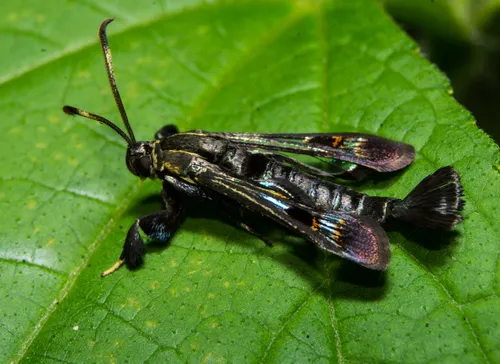
Virginia Creeper Clearwing
Albuna fraxini
Albuna fraxini, the Virginia creeper clearwing, is a moth of the Sesiidae family. It is known from the northern United States and southern Canada.
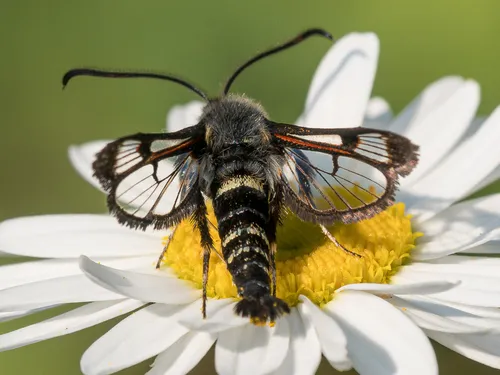
Fireweed Clearwing Moth
Albuna pyramidalis
Albuna pyramidalis, the fireweed clearwing moth, is a species of clearwing moth in the family Sesiidae.
Alcathoe autumnalis - Hodges#2622.1
Alcathoe autumnalis
Adult is a remarkably good mimic of Pompiliid spider wasps.
Clematis Borer - Hodges#2622
Alcathoe carolinensis
Males respond to (E,Z)-3,13-ODDA and blended (E,Z)-3,13-ODDA/(Z,Z)-3,13-ODDA sex attractants. ,
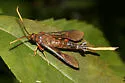
Clematis Clearwing Moth - Hodges#2623 - Hodges#2623
Alcathoe caudata
Identification: Adult - variable, with 4 different appearances. Males have a long slender appendage extending from the eigth abdominal segment. Larvae are parasitized by the Ichneumon wasp Bracon sanninoideae . ( 4 )
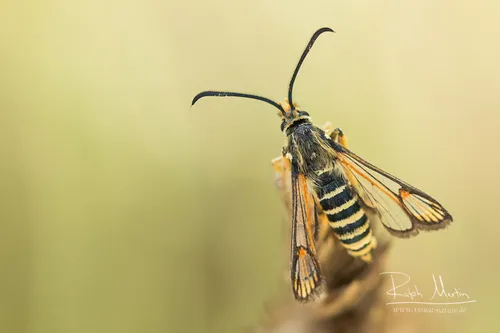
Six-belted Clearwing
Bembecia ichneumoniformis
Wingspan 15 to 21 mm. It gets its name from the six yellowish bands on the abdomen and has mostly transparent wings, only edged in scales. When adding a record please state whether a pheromone lure was used. Inhabits various locations where the food
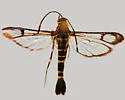
Arizona Clearwing Moth - Hodges#2595
Carmenta auritincta
Identification: Adult - see Engelhardt in Print References.
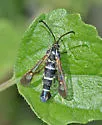
Carmenta engelhardti - Hodges#2598
Carmenta engelhardti
Identification: Adult - see Duckworth & Eichlin in Print References. This species resembles several other species in southern Arizona. I have collected this species on Brickellia foliage found along small creeks in the Patagonia and Huachuca Mountain
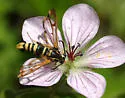
Carmenta giliae - Hodges#2599
Carmenta giliae
Identification: Adult - see Engelhardt description and figures in Print References and E.H. Strickland Entomological Museum page in Internet References.
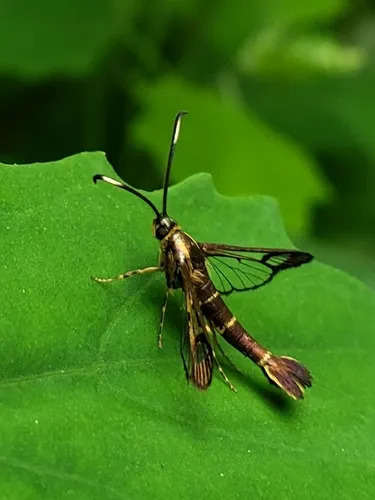
Ithaca Clearwing Moth
Carmenta ithacae
Carmenta ithacae is a moth of the Sesiidae family. It was described by William Beutenmüller in 1897. It is known from North America, including Florida, Arizona, Illinois, Michigan, Nebraska, New York, Virginia and Wisconsin.
Carmenta mariona - Hodges#2601
Carmenta mariona
Identification: Adult - see Engelhardt in Print References. Carmenta mariona is one of the scarcest clearwing moths in collections.
Coronopus Borer Moth - Hodges#2602
Carmenta mimuli
Identification: Adult - forewings largely transparent with wide, black distal margin powdered in orange. Has orange discal spot. Females with yellow-orange labial palpi and generally more orange on the forewings. The dark form is the typical form of
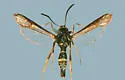
Carmenta odda - Hodges#2603
Carmenta odda
Identification: Adult - see Duckworth & Eichlin in Print References.
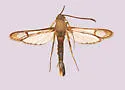
Carmenta pallene - Hodges#2605
Carmenta pallene
This small Carmenta species was originally described from Tabasco, Mexico. The first U.S. record was reported from near Portal, Arizona in 1978 (MONA 5.1 Sesioidea/Sesiidae by Eichlin & Duckworth 1988). Our specimens were collected much farther west
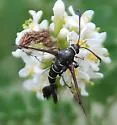
Mistletoe Borer - Hodges#2606
Carmenta phoradendri
Identification: Adult - see Engelhardt in Print References.
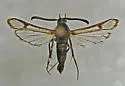
Mesquite Clearwing Moth - Hodges#2607
Carmenta prosopis
Identification: Adult - see Engelhardt in Print References.
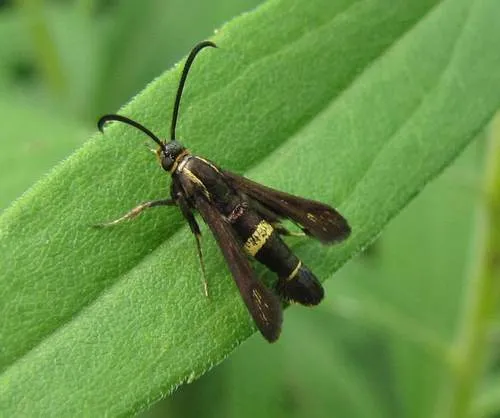
Boneset Borer Moth
Carmenta pyralidiformis
Carmenta pyralidiformis, the boneset borer, is a moth of the Sesiidae family. It was described by Walker in 1856. It is known from the United States, including Arkansas, Illinois, Maryland, Massachusetts, Michigan, Missouri, New Jersey, Ohio and Virg
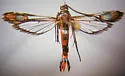
Carmenta rubricincta - Hodges#2610
Carmenta rubricincta
This is one of the rarest clearwing moths in the southwest. ( 4 )
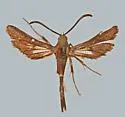
Carmenta suffusata - Hodges#2612
Carmenta suffusata
Identification: Engelhardt original description. Males attracted to pheromone bait (E,Z 3, 13-ODDOH). William H. Taft reports the species as rare.
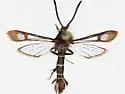
Carmenta tildeni - Hodges#2617.1
Carmenta tildeni
Carmenta tildeni - Hodges#2617.1 (Carmenta tildeni) is a species in the family Sesiidae, commonly known as clearwing moths, belonging to the order Lepidoptera (Butterflies and Moths). It is classified within the subfamily Sesiinae, tribe Synanthedoni
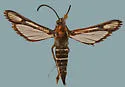
Carmenta verecunda - Hodges#2615
Carmenta verecunda
Identification: Adult - see Duckworth & Eichlin in Print References.
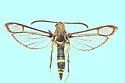
Carmenta wellerae - Hodges#2617
Carmenta wellerae
Identification: Adult - similar to other Carmenta from the southwest but with orange powdering on the antennae, large pale yellow or white area on the ventral abdomen, and white tarsal segments on the hind legs. See Duckworth & Eichlin description in
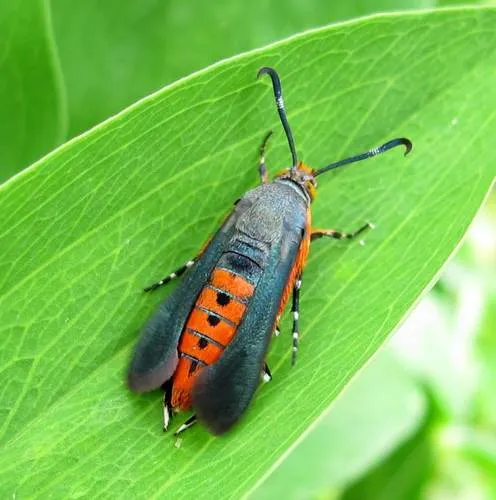
Squash Vine Borer
Eichlinia cucurbitae
The squash vine borer (Melittia cucurbitae) is a diurnal species of sesiid moth. The moth is often mistaken for a bee or wasp because of its movements, and the bright orange hind leg scales. The females typically lay their eggs at the base of leaf st
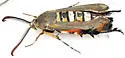
Glorious Squash Vine Borer - Hodges#2540
Eichlinia gloriosa
Identification: Male & Female both: Melittia gloriosa Hy. Edwards Det. R. S. Fleischer
Eichlinia grandis - Hodges#2539
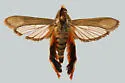
Eichlinia grandis
Identification: Melittia grandis (Strecker) - female Det. R. E. Fleischer, 2010 The host of this large moth is Curcurbita foetidissima . I have captured this moth in both southwest Kansas and southern Arizona but it is also found in California, Texas
Gaura Borer - Hodges#2534
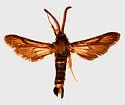
Euhagena emphytiformis
Identification: Adult - see Engelhardt in Print References.
Euhagena nebraskae - Hodges#2535
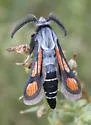
Euhagena nebraskae
Identification: Adult - forewing orangish-red, outlined in black, and with broad black PM line; hindwing similar color with black discal spot; fringe on both wings prominent, dusky; antennae long, thick, black, pectinate; head and thorax covered with
Burrowbush Borer Moth - Hodges#2626
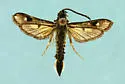
Hymenoclea palmii
Identification: Eichlin description is is available in PDF. The original description as Sesia palmii Beutenmüller, and the Engelhardt revised description as Hymenoclea palmii are both available online in the print references below. Sexually dimorphic
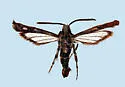
Osminia donahueorum - Hodges#2545.1
Osminia donahueorum
Identification: Adult - see Duckworth & Eichlin in Print References. These tiny and uncommon clearwing moths sit on a small legumes ( Coursetia caribaea ) found under the live oaks on the side hills of Madera Canyon in early August (William H. Taft).
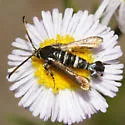
Osminia ruficornis - Hodges#2545
Osminia ruficornis
Identification: Adult - see Duckworth & Eichlin in Print References. Responds well to the sex attractant E,Z 2,13- octadecadien-1-ol alcohol. ( 4 )
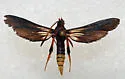
Palmia praecedens - Hodges#2587
Palmia praecedens
Identification: Adult - the lemon yellow abdomen is a key characteristic.
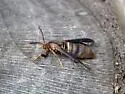
Oak Stump Borer Moth - Hodges#2522
Paranthrene asilipennis
Identification: Larva - white body with brown head, light brown thoracic shield and blackish mandibles.
Doll's Clearwing Moth - Hodges#2523
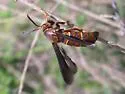
Paranthrene dollii
Identification: Adult - an excellent mimic of the red paper wasp. Larva - body white to light pink, head and thoracic shield brown. Uncommon, but widespread in Texas
Paranthrene fenestrata - Hodges#2525 - Hodges#2525
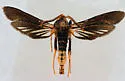
Paranthrene fenestrata
Identification: Adult - There are two color forms, one with mostly black wings and a red-orange and black body and another form with red-orange wings and black body. ( 3 ) , ( 4 ) Males respond well to ZZA pheromone baits. ( 3 )
Pin Oak Clearwing - Hodges#2527.1
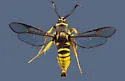
Paranthrene pellucida
Identification: Adult - the lack of scaling on the forewing is a key feature. Larva - grayish body, brown head and light brown thoracic shield. Large numbers of moths have been taken with ZZA pheromone lures in July in Michigan. Males very active bet
Western Poplar Clearwing - Hodges#2526
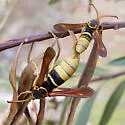
Paranthrene robiniae
Identification: Adult - colored almost exactly like a paper wasp. Mostly yellow, first three abdominal segments black. Head is black, with yellow facial scales. FW orange brown with darker veins; HW clear with a deep yellow discal mark, fringed with
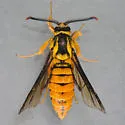
Red Oak Clearwing Moth - Hodges#2527
Paranthrene simulans
Identification: Adult - closely resembles a queen southern yellowjacket, Vespula squamosa . Larva - purple-brown with black head and yellow-brown thoracic shield. Prominent elliptical spiracles.
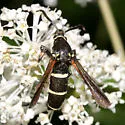
Dusky Clearwing - Hodges#2524
Paranthrene tabaniformis
Identification: Larva - ivory with pale yellow-brown head. Dorsal surface yellowish with two brown furrows that converge at the head. Spriracles elliptical and prominent. ( 4 )
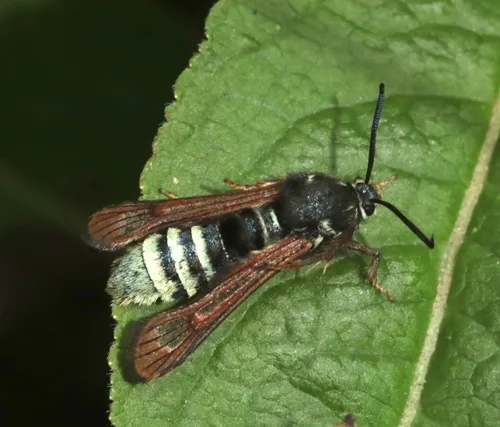
Raspberry Crown Borer - Hodges#2513
Pennisetia marginatum
Identification: Adult - resembles a yellow jacket. Body black with some yellow streaking and four or more narrow yellow bands around abdomen; legs dull yellow; forewing dark olive and reddish-brown with prominent dark discal bar; antennae black, pect
Penstemonia clarkei - Hodges#2618
Penstemonia clarkei
Identification: Adult - see Duckworth & Eichlin description and Engelhardt figures in Print References.
Penstemon Borer - Hodges#2620
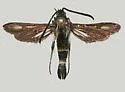
Penstemonia edwardsii
Identification: Adult - see Engelhardt in Print References. Adults respond to (Z,Z)-3,13-ODDA pheromone lures (Meyer & Cranshaw, 1994).
Banded Ash Clearwing Moth - Hodges#2588
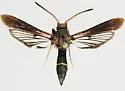
Podosesia aureocincta
Identification: Drooz stated Podosesia aureocincta can be distinguished from Podosesia syringae by the narrow, orange-yellow, partial band on the fourth abdominal segment. Albu mentioned wide year to year fluctuations in population for many species i
Lilac Borer - Hodges#2589
Podosesia syringae
Identification: Adult - a yellow color variation is found in the northern states and Canada (William H. Taft). Genitalia: Larva - body white with amber head, thoracic shield and spiracles. ( 3 ) Adults respond to (Z,Z)-3,13-ODDA (and blends) pheromon
Fiery Clearwing
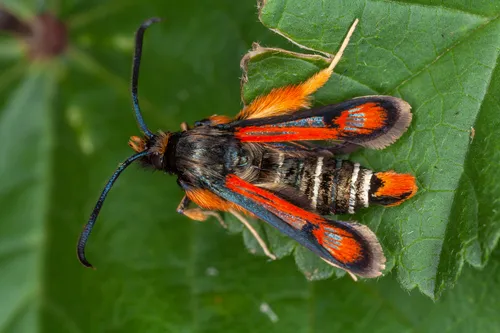
Pyropteron chrysidiforme
Pyropteron chrysidiforme, the fiery clearwing, is a moth of the Sesiidae family. It is found in Europe, more specifically in Spain, Portugal, Majorca, southern England, Belgium, France, Corsica, Sardinia, Italy and southern Germany.
Persimmon Borer - Hodges#2590
Sannina uroceriformis
Identification: The original description is available online in the print references below. Engelhardt revised description is available in PDF. Adult : bluish black and wasp-like, with a distinctive orange band across the abdomen, though may be lacki
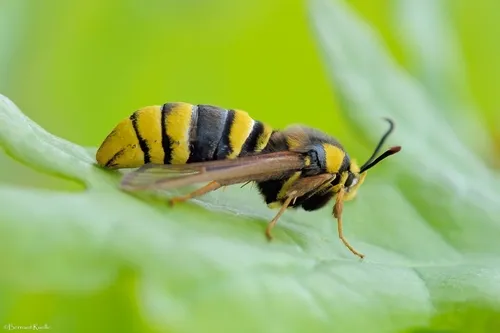
Hornet Moth
Sesia apiformis
Wingspan 33 to 48 mm. Rather similar to the Lunar Hornet Moth, this species can easily be distinguished by the yellow head and tegulae. A good photograph is generally required to support your record and state whether pheromone lure used. The moths em
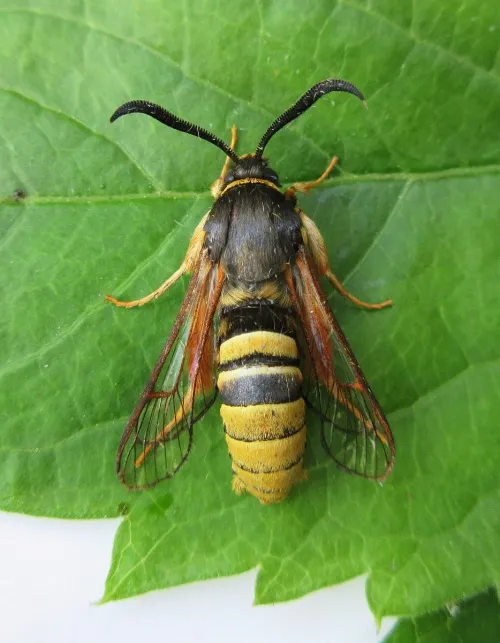
Lunar Hornet Moth
Sesia bembeciformis
Wingspan 32 to 42 mm. One of several similar 'mimic' species, known as Clearwings, this is one of the largest. When adding a record please state whether a pheromone lure was used. Best looked for in July, as the adults emerge and rest low down on the
Sesia spartani - Hodges#2543.1
Sesia spartani
Identification: Adult - see Eichlin & Taft in Print References.
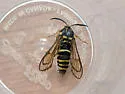
American Hornet Moth - Hodges#2543
Sesia tibiale
In flight they closely resemble wasps, even producing the droning sound. Strongly attracted to (Z,Z)-3,13-ODDA/(E,Z)-3,13-ODDA/(Z,Z)-3,13-ODDOH blended pheromone lures (Meyer & Cranshaw, 1994).
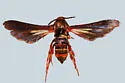
Sophona snellingi - Hodges#2513.2
Sophona snellingi
Identification: Adult - see Eichlin (p.135, f.3) in Print References.
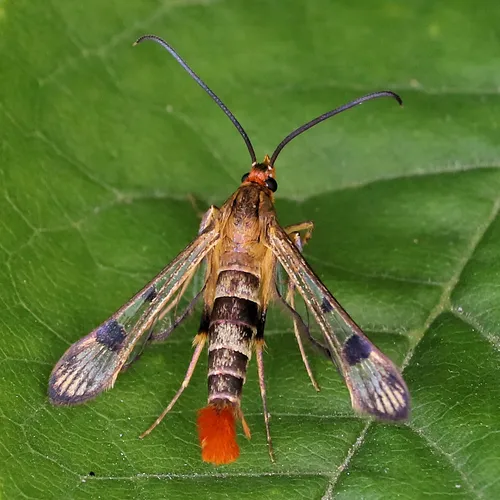
Maple Callus Borer Moth
Synanthedon acerni
Synanthedon acerni, the maple callus borer, is a moth of the Sesiidae family. It is found in Western Canada.
Red Maple Borer - Hodges#2546
Synanthedon acerrubri
Identification: Larva - body dull white, deeply segmented, with brown head that is wider than long.
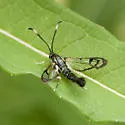
Western Willow Borer - Hodges#2570
Synanthedon albicornis
Identification: Larva - body white with brown head, light brown cervical shield with curved lines. Males respond well to Z-ODDA pheromone baits.
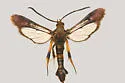
Synanthedon alleri - Hodges#2557
Synanthedon alleri
Identification: Adult - a melanistic form accounts for 5% of specimens in Florida.
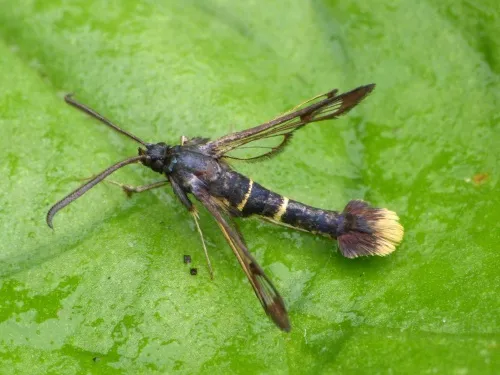
Orange-tailed Clearwing
Synanthedon andrenaeformis
When adding a record please state whether a pheromone lure was used. Usually found on chalk downland, preferring the edges of woodland. The adults fly in May and June, but are very difficult to locate unless a lure is used. The larva lives for two ye
Northern Willow Clearwing - Hodges#2559
Synanthedon bolteri
Responds well to Z-ODDA pheromone baits - 99:1 (E,Z)-2,13-ODDA/(Z,Z)-3,13-ODDA (Taft, 2005).
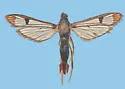
Synanthedon canadensis - Hodges#2560
Synanthedon canadensis
Identification: Adult - orange anal tuft easily distinguish this moth.
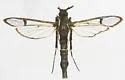
Chestnut Borer - Hodges#2577
Synanthedon castaneae
Identification: Larva - body white with brown head and light brown thoracic shield and spriracles. ( 3 ) Re-discovered in the 1980's in Connecticut using pheromone lures and has since been collected all along the east coast to Florida. This specimen
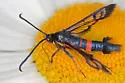
Large Red-belted Clearwing - Hodges#2561
Synanthedon culiciformis
Identification: Larva - body light colored with dark brown head and light brown thoracic shield. ( 3 ) Adults attracted to (Z,Z)-3,13-ODDA and (Z,Z)-3,13-ODDA/(E,Z)-3,13-ODDA/(Z,Z)-3,13-ODDOH blended pheromone lures (Meyer & Cranshaw, 1994).
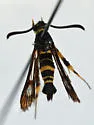
Oak Gall Borer - Hodges#2571
Synanthedon decipiens
Identification: Adult - see Solomon in Print References. Adults attracted to (Z,Z)-3,13-ODDA and (Z,Z)-3,13-ODDA/(E,Z)-3,13-ODDA/(Z,Z)-3,13-ODDOH blended pheromone lures (Meyer & Cranshaw, 1994).
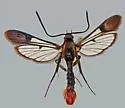
Synanthedon dominicki - Hodges#2562
Synanthedon dominicki
Identification: Adult - male: see Duckworth & Eichlin in Print References. Female: see Brown, Eichlin & Snow.
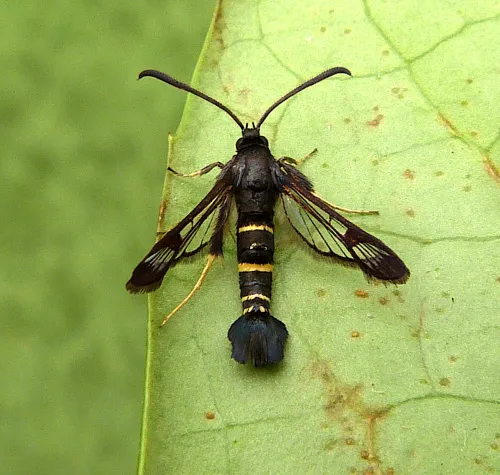
Sallow Clearwing
Synanthedon flaviventris
One of the smallest British clearwings with a wingspan of 17 to 20 mm. Similar in appearance to Currant Clearwing, but Sallow Clearwing has an all black thorax - Currant Clearwing has yellow marks on the thorax. Good photographs and/or the specimen r
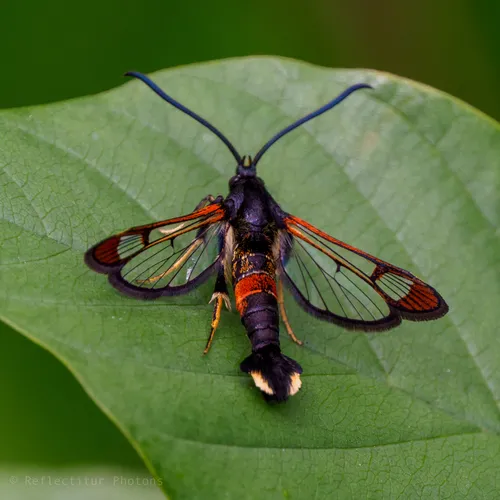
Red-tipped Clearwing
Synanthedon formicaeformis
Wingspan 17 to19 mm. This moth derives its English name from the reddish patches at the tips of the forewings. When adding a record please state whether a pheromone lure was used. The species inhabits fens, marshes and other damp localities. Larvae f
Pecan Bark Borer - Hodges#2547
Synanthedon geliformis
Identification: Adult - see Brown & Mizell and/or Engelhardt in Print References. , Larva - white with a darker line on each side of the prothoracic shield, head more wide than long.
Synanthedon helenis - Hodges#2564
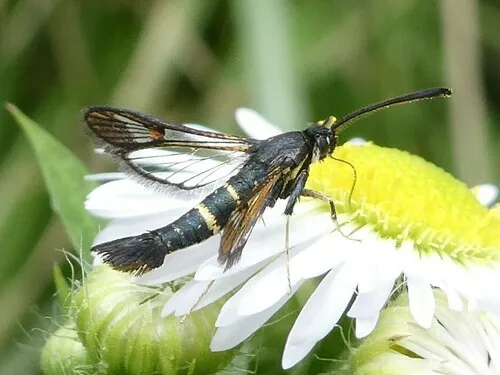
Synanthedon helenis
Identification: Adult: forewing mostly hyaline (clear) except for dark brownish-black scales on veins; discal bar prominent, slanted slightly toward apex, and has a few orange scales mixed with mostly black ones; outer half of area between discal bar
Ceanothus Borer - Hodges#2580
Synanthedon mellinipennis
Identification: Adult - see Duckworth & Eichlin in Print References.
Red-belted Clearwing
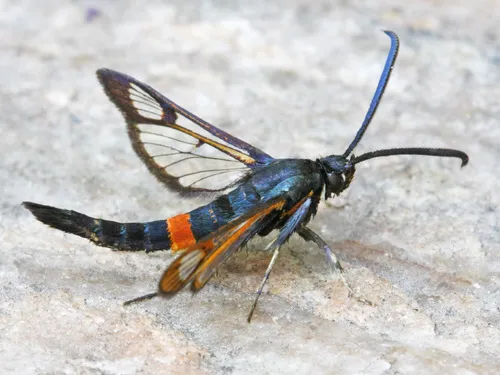
Synanthedon myopaeformis
When adding a record please state whether a pheromone lure was used. Allotments, orchards, gardens and woodland. They occur from June to early August. The moths fly during the day but are not often seen, except by the use of pheromone lures. The larv
Douglas-Fir Pitch Moth - Hodges#2584
Synanthedon novaroensis
Identification: See Duckworth & Eichlin in Print References.
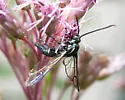
Lesser Peachtree Borer - Hodges#2550
Synanthedon pictipes
Identification: Adult male has yellow scales on top of head between the eyes, and black scales between the antennae, which differentiates if from male Peachtree Borer (see See Also section below).
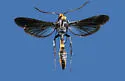
Pitch Mass Borer - Hodges#2585
Synanthedon pini
Identification: Larva - body white with a light brown head. (Kellicott, 1881). It is found rarely in insect collections and museums. Trees with active larvae have pitch mass swellings on the tree trunk with a white, powdery appearance. ,
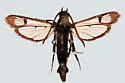
Willow Borer - Hodges#2572
Synanthedon proxima
Identification: Adult - apical third to half of antennae white, and basal portion black; body all black except broken yellow collar at back of head, and yellow dorsolateral stripes on thorax; legs black with white rings at joints. Larva - white with
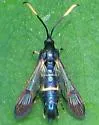
Apple Bark Borer - Hodges#2565
Synanthedon pyri
Identification: Adult - female: antenna pale yellow on apical half; fourth abdominal segment with broad yellow band; anal tuft brushlike with yellow laterally (MONA fascicle 5.1). Larva - creamy white with brown head (head wider than long), covered i
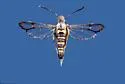
Red-Lined Clearwing - Hodges#2566
Synanthedon refulgens
Meyer & Cranshaw caught them on (E,Z)-2,13-ODDA/(Z,Z)-3,13-ODDA blended pheromone lures (Meyer & Cranshaw, 1994).
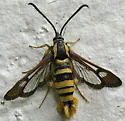
Sycamore Borer - Hodges#2582
Synanthedon resplendens
Identification: Adult - see descriptions by Duckworth & Eichlin and Solomon, as well as Engelhardt figures, available in Print References. Larva - body pinkish white to dark pink, head reddish brown. Regarding the potential management of trees infest
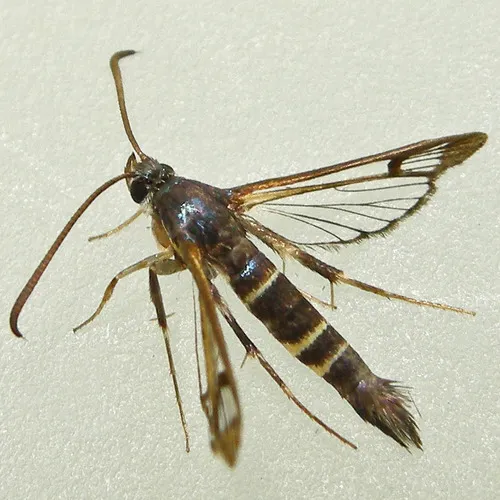
Rhododendron Borer Moth - Hodges#2551
Synanthedon rhododendri
Identification: The original description as Sesia rhododendri Beutenmueller is available online in the print references below. "The key to this species is the yellow posterior banding on abdominal segment 2, 4, and 5." William H. Taft Please see note
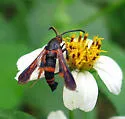
Florida Oakgall Moth - Hodges#2573
Synanthedon sapygaeformis
Identification: Larva - white with brown head and spiracles. ( 3 )
Sequoia Pitch Moth - Hodges#2586
Synanthedon sequoiae
Identification: See Duckworth & Eichlin in Print References.
Willow Clearwing - Hodges#2569
Synanthedon sigmoidea
Identification: Larva - body white, brown head and thoracic shield. Woodpeckers prey on the larvae.
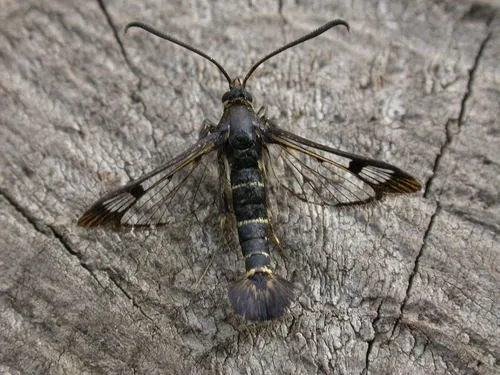
Currant Clearwing
Synanthedon tipuliformis
A rather small species with a wingspan of 17-20 mm. When adding a record please state whether a pheromone lure was used. Tends to be found around allotments, gardens and other similar places where the larval foodplant is present. The larvae of this s
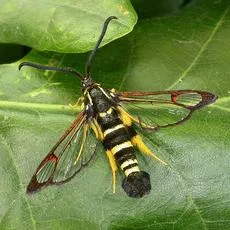
Yellow-legged Clearwing
Synanthedon vespiformis
Wingspan 18 to 20 mm. Another wasp-mimic getting its name from its noticeable yellow legs. A good photograph is generally required to support your record. When adding a record please state whether a pheromone lure was used. To be seen in areas where
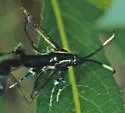
Viburnum Clearwing - Hodges#2556
Synanthedon viburni
Identification: Larva - body pinkish white to dark pink with reddish brown head.
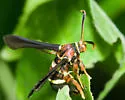
Vitacea admirandus - Hodges#2528
Vitacea admirandus
Identification: Adult - resembles Polistes paper wasps. This species was practically unknown before synthetic pheromones, only three specimens in major collections for the first 100 years. It is now known throughout Texas, and is exquisitely sensitiv
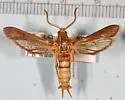
Vitacea cupressi - Hodges#2529
Vitacea cupressi
Identification: Engelhardt revised description is in PDF. ♂ ♀
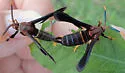
Grape Root Borer - Hodges#2530
Vitacea polistiformis
Identification: Adult - excellent mimic of a paper wasp.
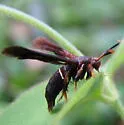
Lesser Grape Root Borer - Hodges#2531
Vitacea scepsiformis
Identification: Adult - hindwing, which is not visible, is key to positive identification. We will never really know since the HW fold(CuP)is really hidden. Both P.dollii and V. scepsiformis are closely related (same tribe) and are variable within th
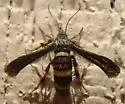
Zenodoxus sidalceae - Hodges#2520
Zenodoxus sidalceae
Identification: Adult - see Duckworth & Eichlin in Print References. Engelhardt plate 32 , f.182-183.
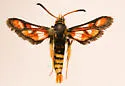
Albuna beutenmuelleri - Hodges#2533.2
Albuna beutenmuelleri
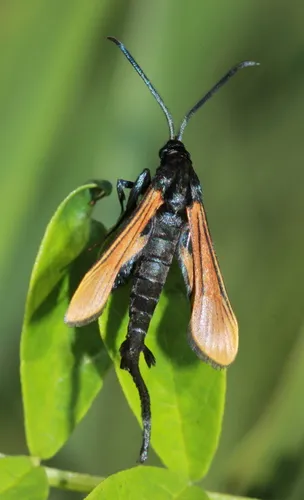
Alcathoe pepsioides - Hodges#2624
Alcathoe pepsioides
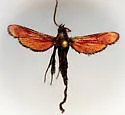
Alcathoe verrugo - Hodges#2625
Alcathoe verrugo
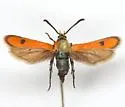
Calasesia coccinea - Hodges#2544
Calasesia coccinea
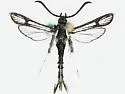
Carmenta albociliata - Hodges#2591
Carmenta albociliata
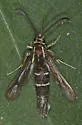
Blazingstar Borer Moth - Hodges#2592
Carmenta anthracipennis
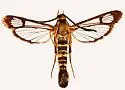
Carmenta apache - Hodges#2593
Carmenta apache
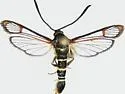
Carmenta arizonae - Hodges#2594
Carmenta arizonae
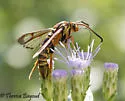
Carmenta armasata - Hodges#2594.1
Carmenta armasata
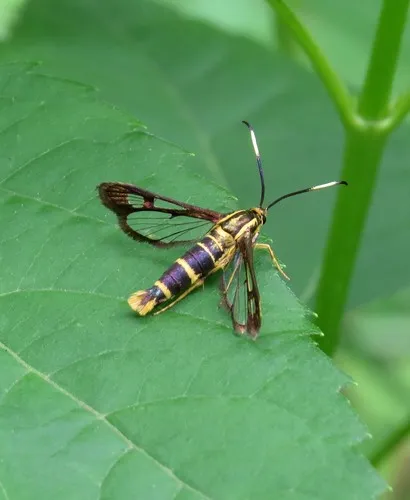
Ironweed Clearwing Moth
Carmenta bassiformis
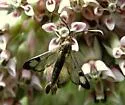
Carmenta corni - Hodges#2597
Carmenta corni
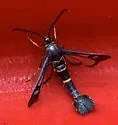
Carmenta laurelae - Hodges#2600.1
Carmenta laurelae
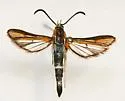
Carmenta ogalala - Hodges#2604
Carmenta ogalala
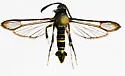
Western Oakgall Clearwing - Hodges#2609
Carmenta querci