
Family Crambid Snout Moths (Crambidae)
Crambidae is a family in the order Lepidoptera. Browse 788 named species recorded in this family, or open an individual profile for its available identification and natural-history information.
Species in Crambidae (788)
Abegesta concha - Hodges#4868
Abegesta concha
Identification: Description can found in MONA Fascicle 13.1B at link in citations below.
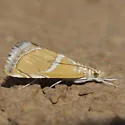
White-trimmed Abegesta - Hodges#4867
Abegesta remellalis
Identification: Adult - forewing yellowish-orange to brown; median line white, fairly straight, ragged-edged, jogs basally at costa; subterminal line white, wavy, angles sharply before reaching costa, and curves away from terminal line as it nears th
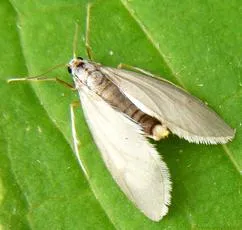
Water Veneer
Acentria ephemerella
Wingspan 11-13 mm. A small and unassuming species. There are two forms of the female - one wingless, which lives under the water and one winged. The fully-winged males have very plain pale grey-green wings. Various, sometimes near to water but also s
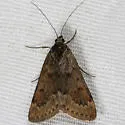
Achyra occidentalis - Hodges#4976
Achyra occidentalis
Identification: Adults have a dark and pale form. Pale form is very similar to Achyra rantalis dark form
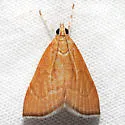
Invisible Crambid - Hodges#4877
Aethiophysa invisalis
Identification: "12mm . Ailes super, squammeuses, d'un fauve-isabelle uni , avec la frange noirâtre, à extrémité blanche et précédée d'une série terminale de petits points noirs arrondis. Aucune ligne ni tache. Ailes infér. blanches, avec un double l
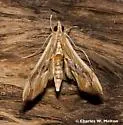
Agathodes monstralis - Hodges#5240
Agathodes monstralis
Identification: Adult: purple-and-green marbled, hindwings are beige, abdomen held in an up-right position, males with pair of hair-pencils that are extended for the release of pheromones. Larva: early instars translucent and orange with six rows of
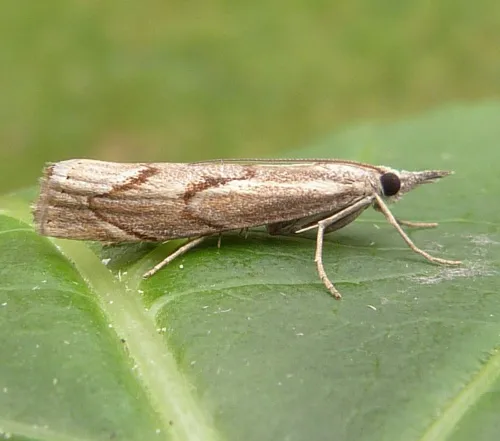
Agriphila geniculea
Agriphila geniculea
Wingspan 20-25 mm. The strongly elbowed cross-lines generally serve to distinguish this moth, but on some specimens the lines are obscure. It is an inhabitant of dry, grassy areas, sand-dunes and similar locations. The larva, found from late Septembe
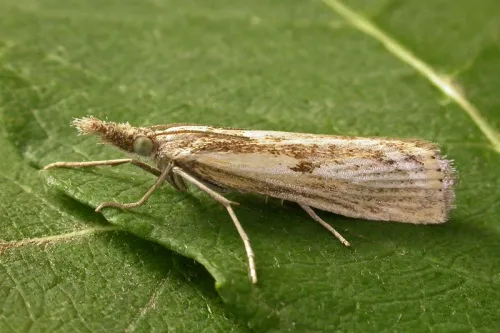
Agriphila inquinatella
Agriphila inquinatella
Wingspan about 22 mm. Quite distinctive, but variable, with its whitish or creamy ground colour suffused with darker markings. This species prefers dryer grassy areas. On the wing from July to September, it can be attracted by light. Present througho
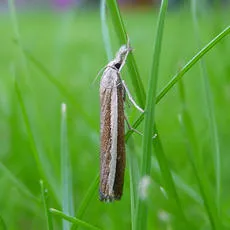
Agriphila latistria
Agriphila latistria
Wingspan 22 to 27 mm. Distinguished by its single, white longitudinal streak against a brownish background. This species is local in dry or sandy areas, being commoner near the coast. It flies in July and August and is nocturnal. Distributed in the s
Agriphila plumbifimbriellus - Hodges#5397
Agriphila plumbifimbriellus
Identification: Adult: forewing whitish to pale yellowish with dark brown speckling between veins, giving the wing a streaked appearance; thin dark ST line angles sharply near costa and extends toward base a considerable distance before touching cos
Lesser Vagabond Sod Webworm - Hodges#5399
Agriphila ruricolellus
Identification: Adult: forewing pale yellowish with reddish-brown speckling between veins, giving a streaked appearance to the wing; median line represented by a diagonal smear or diffuse smudge (sometimes faint) across veins; subterminal (ST) line i
Agriphila selasella
Agriphila selasella
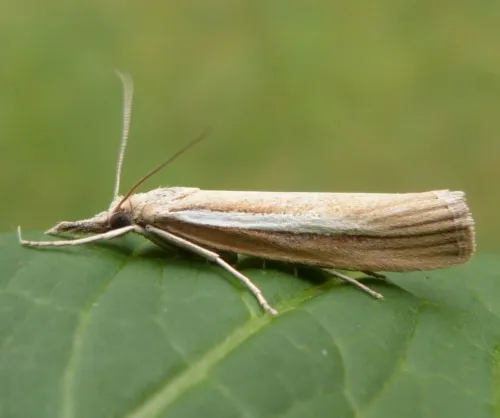
Wingspan around 26 mm. Although superficially resembling Agriphila tristella , this species has the forewing tip more squared, a much reduced facial cone and a whiter longitudinal streak which doesn't have quite such obvious 'fingers' at the rear. Of
Agriphila straminella
Agriphila straminella
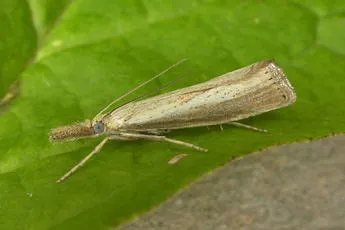
A pale and rather plain looking 'grass moth'. The food plants are various grasses, especially Sheep's-fescue, where the larvae feed internally on the lower part of the stems. Present in good numbers throughout the whole of the British Isles. In the B
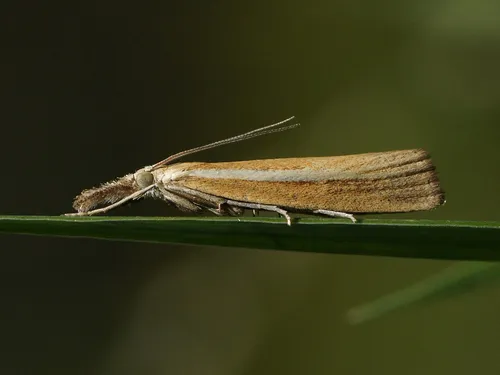
Agriphila tristella
Agriphila tristella
Wingspan around 27 mm. Fairly distinctive with its pale yellowish or creamy longitudinal streak which branches into 'fingers' towards the wing tip. Flying from June to September, it is nocturnal and a regular visitor to the light-trap. The larvae fee
Vagabond Crambus - Hodges#5403
Agriphila vulgivagellus
Identification: Adult: head with long hairy "snout"; forewing dull yellowish with brown speckling between veins, giving streaked appearance to wing; no AM, PM, or ST lines; terminal line composed of seven black dots; fringe gold or bronze but may loo
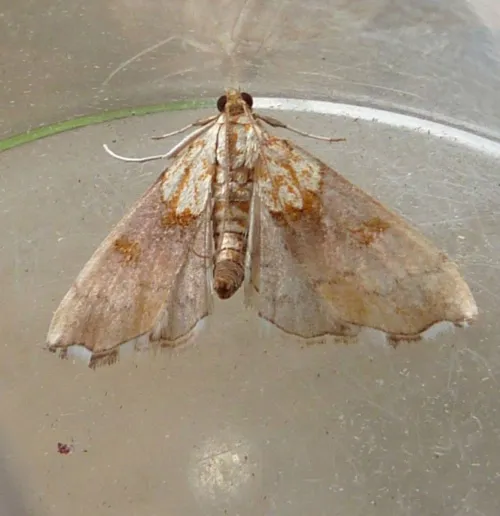
Agrotera nemoralis
Agrotera nemoralis
Wingspan 20 to 24 mm. An attractive and distinctive moth. Associated with Hornbeam (Carpinus betulus) and a few other deciduous trees, but usually encountered as a migrant in Britain. The larvae feed on Hornbeam, Birch, Hazel and Chestnut leaves. Per
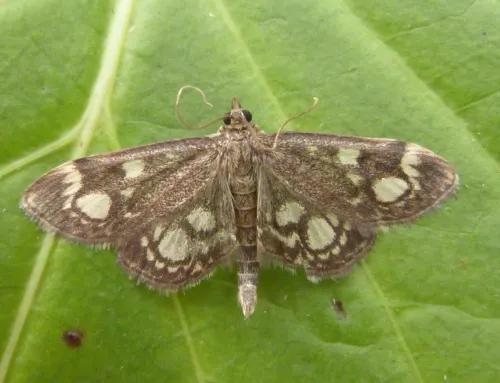
Anania coronata
Anania coronata
Wingspan 22-26 mm. This is an easy species to recognise - its dark brown wings have large pale circular patches and are lightly fringed. Rough ground and in gardens where Elder flourishes. June to July is the main flight period often attracted to lig
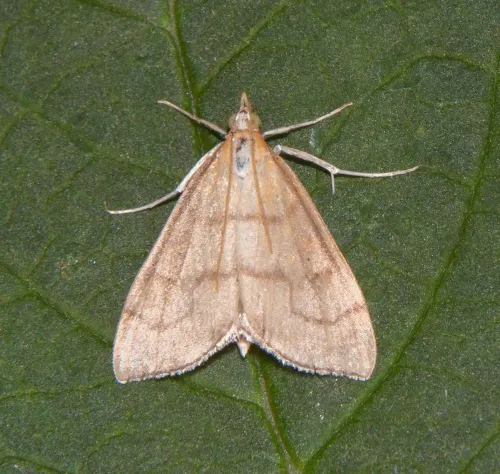
Anania crocealis
Anania crocealis
Marshes, water meadows and similar damp localities. The flight period of the adults is July to August, when it flies at night and can be attracted by light. The larvae feed on common Fleabane (Pulicaria dysenterica) or Ploughman's Spikenard (Inula co
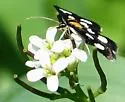
White-spotted Sable - Hodges#4958
Anania funebris
Identification: Adult: forewing black with two large white spots and one tiny one; hindwing black with two large white spots; no tuft of orange hair-like scales on legs Almost always referred to by its scientific name, which is surprising because the
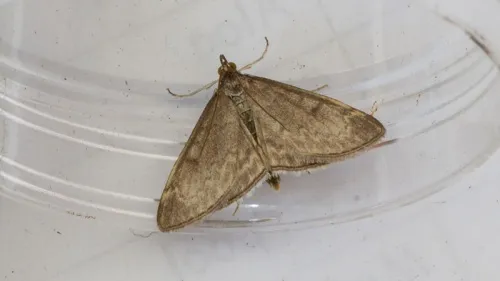
Anania fuscalis
Anania fuscalis
Wingspan 20 to 26 mm. A weakly-coloured brown species with light patterning. Damp pastures, grassland and marshy areas. The single generation of moths are on the wing in late May and June. The foodplants are Yellow-rattle and Common Cow-wheat. It is
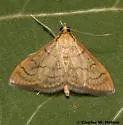
Anania labeculalis - Hodges#4959
Anania labeculalis
Identification: Original description is online as Botis labeculalis (Hulst). (link below) - Determined by Bob Patterson.
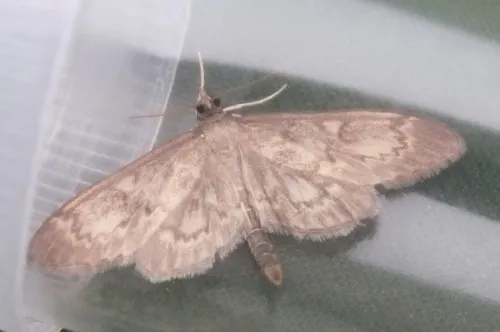
Anania lancealis
Anania lancealis
Wingspan 26 to 34 mm. The males of this species have distinctively long and narrow forewings, the females being more normally proportioned. Can be confused with the much more common Mother of Pearl. Records must be supported by detailed photographs.
Anania leuschneri - Hodges#4955
Anania leuschneri
Type locality: USA, Florida, Orange County, 15 miles west of Cocoa.
Anania mysippusalis - Hodges#4957
Anania mysippusalis
Identification: Adult: forewing medium brown with dark brown AM and PM lines and dark fringe; PM line irregular, slightly wavy, with large lobe near mid-point; hindwing similar but with pale fringe; abdomen long, slender, brown with whitish band at b
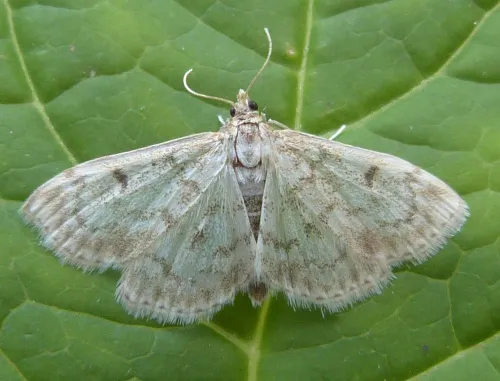
Anania perlucidalis
Anania perlucidalis
Wingspan 21-23mm. A fairly plain browny-white moth with a dark mark on the wings. Grassland and scrub where Thistles are present, also known to enjoy coastal locations. The adults are found on the wing during June and July. The life history is incomp
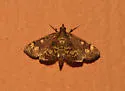
Anania plectilis - Hodges#4953.1
Anania plectilis
Identification: Adult: wings dull grayish-brown with pale yellow spots and accents along darker lines; forewing and hindwing with large yellowish spots outside PM line; PM line zigzagged and sharply pointed on all wings [adapted from description of A
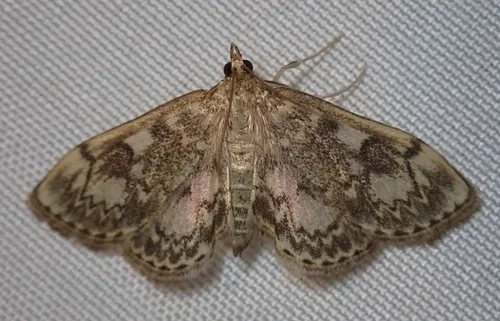
Anania tertialis - Hodges#4953
Anania tertialis
Identification: Adult: wings dull grayish-brown with pale yellow spots and accents along darker lines; forewing and hindwing with large yellowish spots outside PM line; PM line zigzagged and sharply pointed on all wings [adapted from description of A
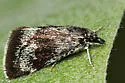
Anatralata versicolor - Hodges#4814
Anatralata versicolor
Identification: The original description as Aporodes versicolor Warren, is available online in the print references below. Adult: Forewing chestnut-brown with some black scales mixed in. Basal third and subterminal area with pale whitish green scales
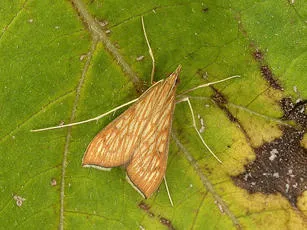
Antigastra catalaunalis
Antigastra catalaunalis
Wingspan about 20 mm. An orangey-brown and white moth that bears a superficial resemblance to Nascia cilialis, but has generally narrower forewings. Probably best looked for in areas where the larval foodplant is present. Previous records suggest Sep
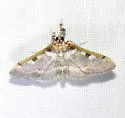
Apilocrocis Moth - Hodges#5113
Apilocrocis pimalis
Identification: Adult: forewing shiny, semitransparent, whitish in AM area and beyond PM line, pale gray median area, and dark brown basal area; pale yellowish strip along costa contains dark mark at PM line; blackish patch in median area near costa;
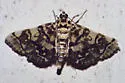
Checkered Apogeshna - Hodges#5177
Apogeshna stenialis
Identification: Adult: forewing variably bright to pale yellow (mostly along costa) and brown (mostly along inner margin and beyond PM line); hollow oval spot in median area, and another descending from AM line; AM, PM, and median lines fairly straig
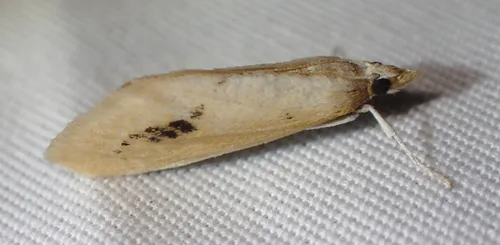
Arenochroa flavalis - Hodges#4988
Arenochroa flavalis
Identification: Head, thorax, and forewings, light ocher yellow. Labial palpi, darker yellow on the outside, white beneath. The outer cross-line is represented by a row of more or less diffuse dark brown dots arising from a little beyond the middle o
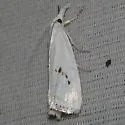
Arequipa turbatella - Hodges#5392
Arequipa turbatella
Identification: Fernald description in print references.
Argyria centrifugens - Hodges#5463.2
Argyria centrifugens
Argyria centrifugens Dyar, 1914 is now recognized within the North American fauna, Florida, in Landry et al. (2023).
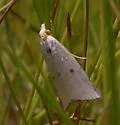
Argyria gonogramma - Hodges#5463.1
Argyria gonogramma
Identification: Adult: forewing white with orange fringe (may appear brown or blackish in certain light); medial line faint, consisting mainly of a small dark spot at costa and at inner margin, plus a third dark spot halfway between these two; a four
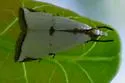
Milky Urola - Hodges#5463
Argyria lacteella
Identification: Adult: forewing white with orange fringe; medial line faint, consisting mainly of a small dark spot at costa and at inner margin, plus a third dark spot halfway between these two; a fourth dark spot usually present where PM line meets
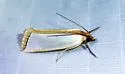
Argyria nummulalis - Hodges#5460
Argyria nummulalis
Identification: Bob Patterson notes from Richard Brown at Mississippi Entomological Museum. "We have been calling these A. rufisignella in error, just pointed out to me by Richard Brown at Miss. Entomol. Museum. A rufisignella lacks the substantial b
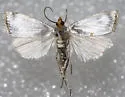
Mother-of-pearl Moth - Hodges#5462
Argyria rufisignella
Identification: Updated notes very soon September 10, 2013
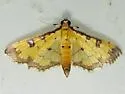
Ategumia ebulealis - Hodges#5158
Ategumia ebulealis
Identification: The original description is available online in the print references below. (French) Introduced to Hawaii in 1970 to control Cledemia hirta . ( 7 )
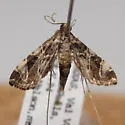
Aulacodes cf. aechmialis - Hodges#4766.1
Aulacodes cf-aechmialis
Aulacodes cf. aechmialis Guenée, 1854 has male genitalia matching the illustration by Lange (1956) of " Aulacodes aechmialis ". The original descriptions of aechmialis and it's synonym Hydrophysa plumipedalis Hampson, 1895 seem to somewhat match. The
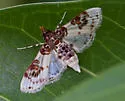
Azochis rufidiscalis - Hodges#5232
Azochis rufidiscalis
Identification: The original Hampson (1904) description is available online in the print references below.
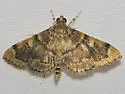
Bicilia iarchasalis - Hodges#5271
Bicilia iarchasalis
Identification: Determined by James Hayden and Brian Scholtens.
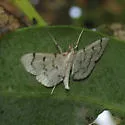
Blepharomastix achroalis - Hodges#5185
Blepharomastix achroalis
Identification: Determined by James Hayden: The population on S. Padre Is., Texas (also IDed by J. Hayden and barcoded) is much more heavily marked than most Florida examples.
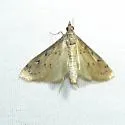
Blepharomastix haedulalis - Hodges#5186
Blepharomastix haedulalis
Identification: Hulst (1886) original description as Botis haedulalis is online in the print references. "Fore wings fuscous, very thinly scaled; basal line broken into dots; outer line fine, sharply and strongly dentate, and after the Botis pattern;
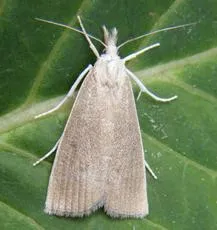
Calamotropha paludella
Calamotropha paludella
Wingspan 22-33 mm. Sexually dimorphic, the males are slightly smaller and darker than the females. Both sexes have bright white hind wings. In marshes, fens and other wet habitats. The adults fly in July and August and are attracted to light. The sle
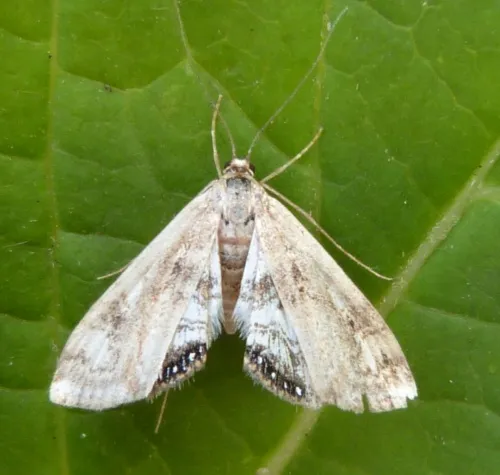
Small China-mark
Cataclysta lemnata
Wingspan 18-24 mm. The males of this species are slightly smaller and whiter than the females but both sexes have a distinctive row of blue-centred black dots on the hindwing. The adults are on the wing between June and August, when the females in pa
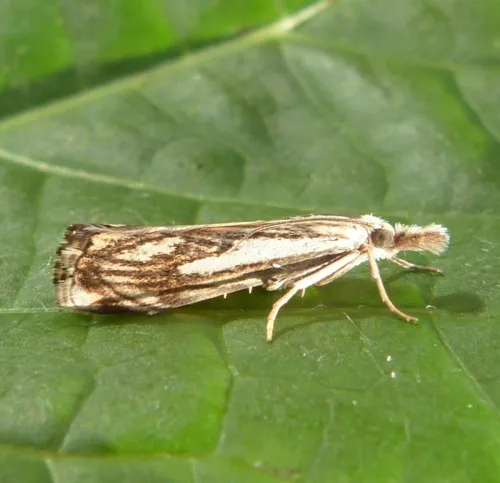
Catoptria falsella
Catoptria falsella
Wingspan18-22 mm. This is rather a creamy brown looking well marked moth with a distinct pale patch running about half the length of the wing. July and August, when it can be attracted to light. The larva feeds on mosses growing on walls, especially
Two-banded Catoptria - Hodges#5408
Catoptria latiradiellus
Identification: Adult: forewing reddish-brown with silvery-white longitudinal stripe crossed by two diagonal medium-brown bands; terminal line a series of black dots; fringe gray; hindwing whitish basally, shading to light brown distally; fringe whit
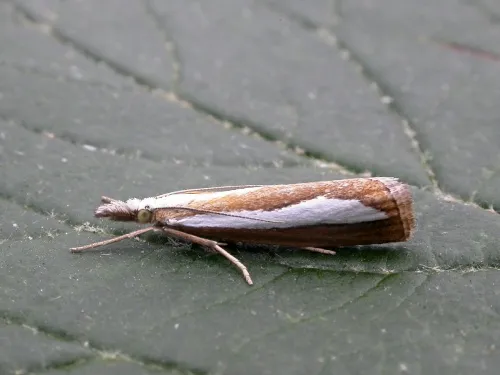
Catoptria margaritella
Catoptria margaritella
Wingspan 20 to 23 mm. The broad, unbroken white longitudinal mark on this species is quite distinctive. It occurs in boggy and heathland habitats. The nocturnal adult is on the wing in July and August, and can be attracted to light. At present the ea
Western Catoptria - Hodges#5409
Catoptria oregonicus
Identification: Adult: forewing white with patchy brown scaling; central white streak runs from base to median line; median line dark, deeply zigzagged; PM line white, diffuse, blotchy; subterminal line thin, dark, curved, edged distally with white;
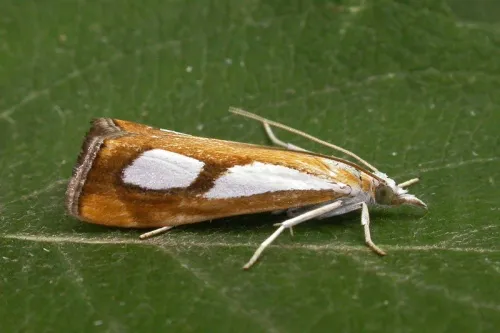
Catoptria pinella
Catoptria pinella
Wingspan 18-24 mm. An attractive and distinctively marked moth, the orange wings having two large white discs. Damp areas, boggy heath land, fens and marshes. It flies by night in July and August and tends to rest in trees by day. The larvae feed on
Chabula acamasalis - Hodges#5199.3
Chabula acamasalis
Chabula acamasalis Walker, 1859, a non-native species, is tentatively recognized within the North American fauna; two photo records from Florida in 2020 and 2022; no specimens collected. (Steve Nanz, 4/23/2022).
Pegasus Chalcoela Moth - Hodges#4896
Chalcoela pegasalis
Identification: Adult: forewing brown in basal and terminal areas, and densely speckled with gray in median area; AM and PM lines white, thick; AM line either smoothly rounded or slightly wavy; PM line with large V-shaped lobe projecting toward outer
Chilo erianthalis - Hodges#5471
Chilo erianthalis
Identification: Original description is online: (31) Forewing gray with slight reddish tint. The dark shaded veins are limited to the outer half of the wing. Dark chevron shaped patch of scales in the median area. Terminal line is a series of black d
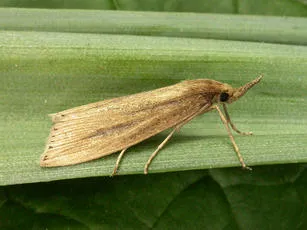
Chilo phragmitella
Chilo phragmitella
Wingspan 24 to 40 mm. A sexually dimorphic species, with the females paler in colour and generally larger than the males. Both sexes have distinctively long labial palps. It occupies fens and other wet places where large reedbeds occur. The whitish c
Choristostigma disputalis - Hodges#5133
Choristostigma disputalis
Identification: See original description in "Print References."
Choristostigma elegantalis - Hodges#5132
Choristostigma elegantalis
Identification: The original description as Choristostigma elegantalis Warren, is available online in the print references below.
Choristostigma plumbosignalis - Hodges#5128
Choristostigma plumbosignalis
Identification: The original description as Botis plumbosignalis Fernald, is available online in the print references below. Adult: forewing yellow with broad purplish-gray or silvery-gray (lead-colored) PM line shaped like a Y, with the top of the "
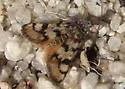
Chrismania pictipennalis - Hodges#4820
Chrismania pictipennalis
Identification: The original description is available online in the print references below.
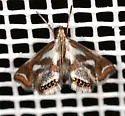
Chrysendeton imitabilis - Hodges#4746
Chrysendeton imitabilis
Identification: Adult: FW dark brown with large basal and median white patches and orangish terminal band bordered by white; basal white patch reaches base of wing, and its upper side is parallel to costa but does not come close to touching costa; po
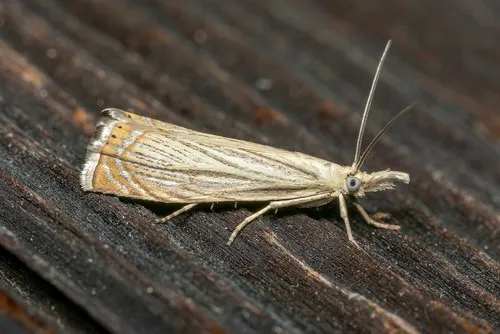
Chrysoteuchia culmella
Chrysoteuchia culmella
Wingspan around 20 mm. It is easily distinguished with its one or two angled cross-lines and metallic golden fringe to the forewings. This species flies in June and July. Its normal flight time is at night, when it is attracted to light. By day it re
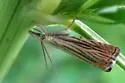
Cranberry Girdler - Hodges#5391
Chrysoteuchia topiarius
Identification: Adult: head with prominent "snout"; forewing varies from dark reddish-brown to light yellowish-brown with distinct dark veins; subterminal line prominent, angled, silvery-gray or whitish; terminal line composed of thin black line near
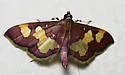
Distinguished Colomychus - Hodges#5200
Colomychus talis
Identification: Adult: forewing dark purplish-red with two large irregular yellow patches - one ascending from midway along inner margin, the other descending from costa about two-thirds distance from base (patches almost meet near middle of wing); s
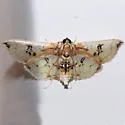
Compacta capitalis - Hodges#5233
Compacta capitalis
Identification: Adult: forewing white, semitransparent, with reddish-brown shading at base and along inner margin; at least 2 main black discal spots, an irregular subterminal line, and dark apical blotch present on both wings Polygrammodes posticata
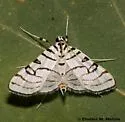
Conchylodes concinnalis - Hodges#5293
Conchylodes concinnalis
Identification: The original description of Conchylodes concinnalis Hampson, is available online in the print references below. The black patch along the forewing costa has a white center compared to the solid patch in Conchylodes ovulalis . The spac
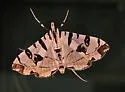
Blush Conchylodes Moth - Hodges#5291
Conchylodes salamisalis
Type locality: Mexico, Vera Cruz, Paso de San Juan; Guatemala, in the city; San Isodro; Panama, Chiriqui; Ecuador
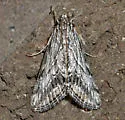
Cornifrons actualis - Hodges#4922
Cornifrons actualis
Identification: Description is online (Barnes & McDunnough). (168)
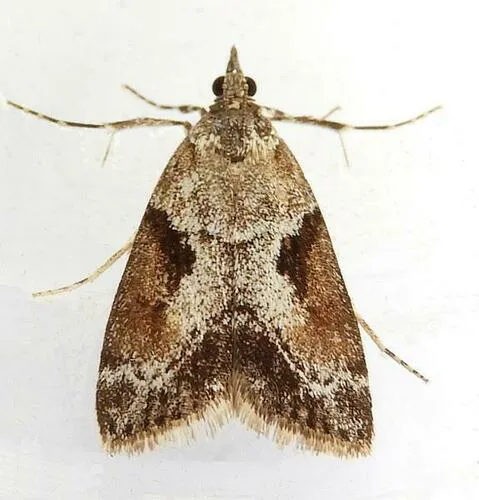
Cosipara modulalis - Hodges#4706
Cosipara modulalis
Identification: This species occurs in two color forms, with some variation and a small proportion of intergrades. One form is closely similar in appearance to C. tricoloralis , though it tends to be somewhat narrower-winged and is less variegated. I
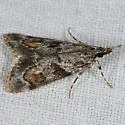
Tricolored Cosipara - Hodges#4705
Cosipara tricoloralis
Identification: Adult: forewing ground color white, covered by dark speckling and overlaid by dark gray, dull orangish, and brownish-gray shading in AM, PM, and subterminal areas respectively [based on appearance of this photo ]; AM and PM lines pale
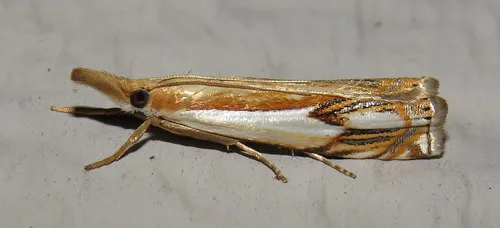
Double-banded Grass-veneer
Crambus agitatellus
Crambus agitatellus, the double-banded grass-veneer moth, is a moth of the Crambidae family. It is found in the eastern two-thirds of the United States and south-eastern Canada.
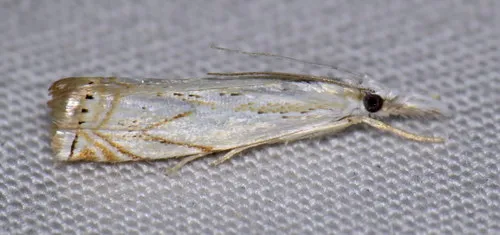
Small White Grass-veneer - Hodges#5361
Crambus albellus
Identification: Adult: forewing white with sharply-pointed V-shaped PM line in strongly-marked specimens (otherwise faint or undetectable); ST line double, brownish-yellow, parallel to outer margin in lower two-thirds of wing, then bending basally an
Crambus angulatus - Hodges#5405
Crambus angulatus
Identification: The original description is available online in the print references below.
Forked Grass-veneer - Hodges#5342
Crambus bidens
Identification: Adult: forewing yellowish to brownish with very wide white stripe sometimes bisected by brown longitudinal strip; upper edge of stripe almost touches costa, and lower edge has prominent tooth about two-thirds distance from base; obliq
Daecke's Grass-veneer - Hodges#5350
Crambus daeckellus
Identification: The combination of its large size and pattern of silvery streaks should be diagnostic . Heavily dependent on frequent fire, which cuts back on tall shrubs, invasive species, and allows Eastern Turkeybeard ( Xerophyllum asphodeloides )
Girard's Grass-veneer - Hodges#5365
Crambus girardellus
Identification: Forewings silvery-white with a longitudinal orange stripe. Narrow brown terminal line with five dark brown dashes in lower part. Hindwings white, often smoky away from the margin. ( U Alberta Entomology Collection )
Eastern Grass-veneer - Hodges#5378
Crambus laqueatellus
Identification: Adult: forewing light brownish-yellow with white streak along costa completely bisected by thin brown longitudinal strip; dark streaks extend inward from lower half of outer margin [lacks a separately-dotted terminal line]; upper half
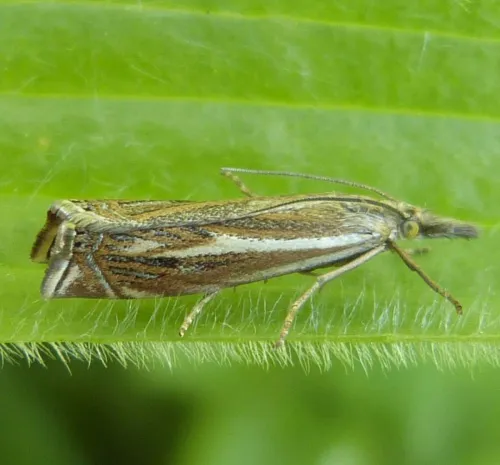
Crambus lathoniellus
Crambus lathoniellus
Wingspan around 20 mm. The whitish streaks on this moth are narrower than other similar species and the males are darker than the females. Like several similar species, the moth is to be found in grassy areas. One of the earliest Crambids to be seen
Leach's Grass-veneer - Hodges#5357
Crambus leachellus
Identification: Adult: forewing brown with broad silvery-white stripe running from base to subterminal area, tapered at both ends (i.e. spindle-shaped); width of stripe at base is greater than distance between stripe and costa; subterminal line curve
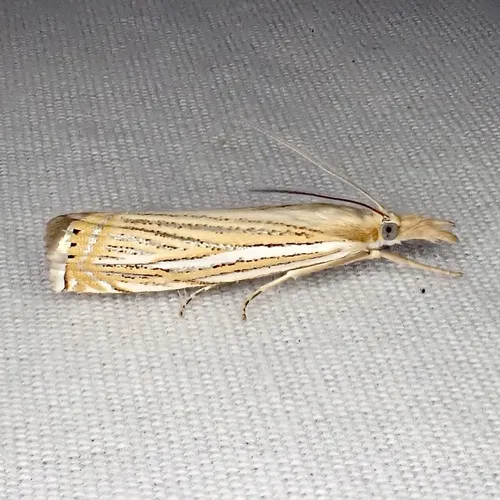
Crambus multilinellus - Hodges#5364
Crambus multilinellus
Crambus multilinellus - Hodges#5364 (Crambus multilinellus) is a species in the family Crambidae, commonly known as crambid snout moths, belonging to the order Lepidoptera (Butterflies and Moths). It is classified within the subfamily Crambinae, trib
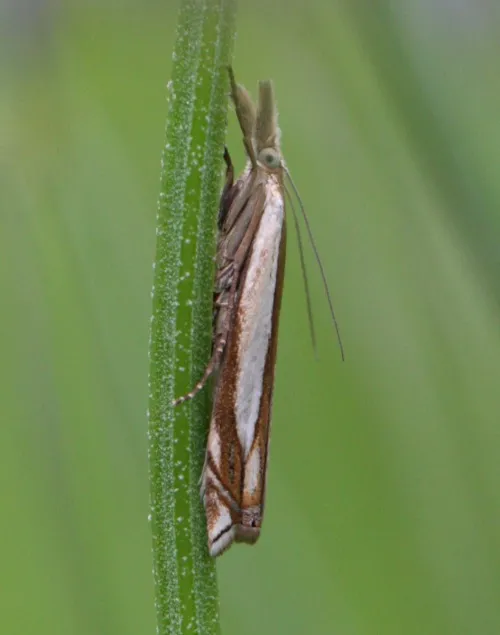
Crambus pascuella
Crambus pascuella
Wingspan 21-26 mm. This species has a distinct whitish streak against a yellow-brown ground colour. This pattern is similar to several other species and they can be rather difficult to separate. Flying from June to August, the adults are on the wing
Crambus perlella
Crambus perlella
Wingspan 21-28 mm. The typical form is creamy white with a slight silken lustre. There is also a differently-marked form, warringtonellus , which has heavy streaking. The adults fly in July and August and are attracted to light. The larvae feed on gr
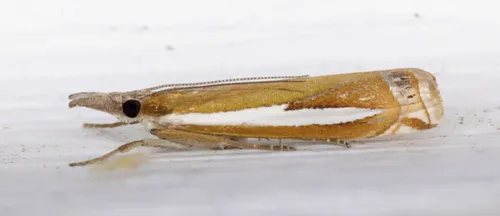
Common Grass-veneer - Hodges#5355
Crambus praefectellus
Identification: Adult - forewing brownish-orange with long white or silvery stripe, tapered at both ends; width of stripe at base less than or equal to distance from stripe to costa; several thin black lines run from white stripe to ST line, which is
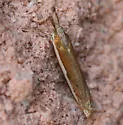
Large-striped Grass-veneer Moth - Hodges#5369
Crambus quinquareatus
Identification: Very similar to Crambus leachellus but the area beyond the tip of the silver streak is also white, thus appearing to connect the larger streak with the small white terminal triangle. This same area in leachellus is yellowish. Also,
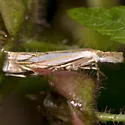
Pasture Grass-veneer - Hodges#5363
Crambus saltuellus
Identification: Adult: very similar to Crambus agitatellus but forewing with broad white stripe bisected by prominent brownish-yellow strip [instead of a faint yellowish strip or no strip at all, as in C. agitatellus ]; several double black lines run
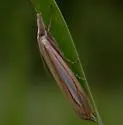
Crambus satrapellus - Hodges#5372
Crambus satrapellus
Identification: Adult: forewing light golden brown with silvery-white stripe that doesn't come close to touching costa, and is tapered at both ends; slender white "branch" diverges about midway along lower edge of stripe toward inner margin; distal e
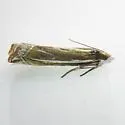
Crambus trichusalis - Hodges#5352
Crambus trichusalis
Identification: The original description of Crambus trichusalis Hulst, and the revised description by Kearfott (1902), are both available online in the print references below. Forewing is yellowish gray with a thin white stripe along the inner margin
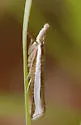
Wide-stripe Grass-veneer - Hodges#5344
Crambus unistriatellus
Identification: Forewings light brown with a broad silver-white discal stripe which is almost parallel-sided and extends from the base to the outer margin; submarginal row of minute black dots. The hindwings are white.
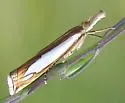
Watson's Grass-veneer - Hodges#5366
Crambus watsonellus
Identification: Adult: forewing ground color light golden brown, with a satiny luster, paler dorsally. Silvery white discal stripe very broad, separated from costa along its basal half by only a narrow, dark brown line, then diverging. A dorsal tooth
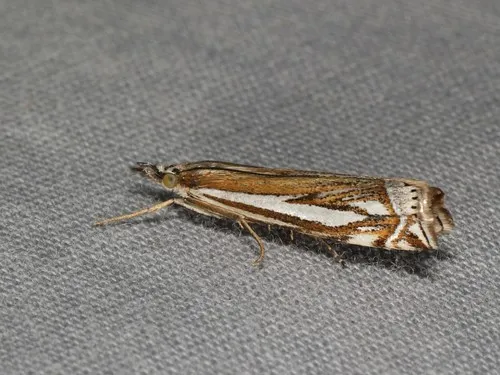
Whitmer's Sod Webworm Moth - Hodges#5345
Crambus whitmerellus
Identification: Adult: forewing yellowish-brown with two white patches in subterminal area, brown V-shaped subterminal line, and black terminal line broken into 4 black dots in lower half; narrow white strip along costa for almost half its length; si
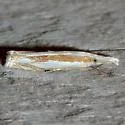
Young's Grass-veneer - Hodges#5349
Crambus youngellus
Identification: Adult: forewing mostly silvery white with broad yellowish-orange streak running from subterminal line to base, and continuing onto shoulders and head to eye; ST line V-shaped, yellowish-orange, broad at inner margin, tapering to thin
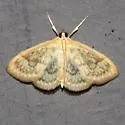
Sawtoothed Crocidophora - Hodges#4944
Crocidophora serratissimalis
Identification: Adult: forewing dull yellow with brown PM line having prominent outward bulge near middle, and conspicuously toothed subterminal line; hindwing paler and with arc-shaped PM line that has no bulge See Forbes Genitalia: ♀ ♂
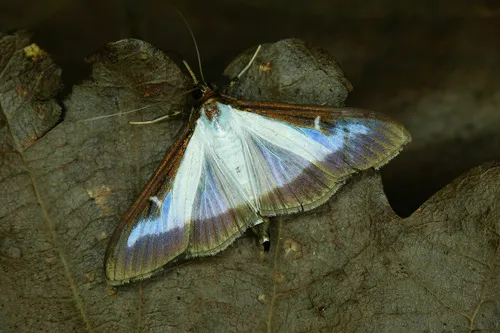
Cydalima perspectalis
Cydalima perspectalis
A distinctive species which should be recognised without difficulty, although there is also a very dark brown form. As an introduced species it may occur at any time. The moth is a pest species of box (Buxus), and is almost certainly an introduction
Cymbopteryx fuscimarginalis - Hodges#4804
Cymbopteryx fuscimarginalis
Identification: Specimen determined by DNA analysis (BOLD). Type locality: USA, Arizona, Tucson
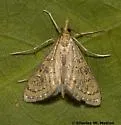
Daulia arizonensis - Hodges#5296
Daulia arizonensis
Identification: The original description of Daulia arizonensis Munroe, is available online in the print references below.
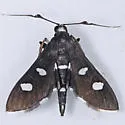
Grape Leafroller - Hodges#5160
Desmia maculalis
Identification: From Brian Scholtens: "The character that I use is the extent of the white patch on the underside of the abdomen. D. funeralis individuals have a solid white patch on the underside of the abdomen on segments 1-5 (or may have a slight
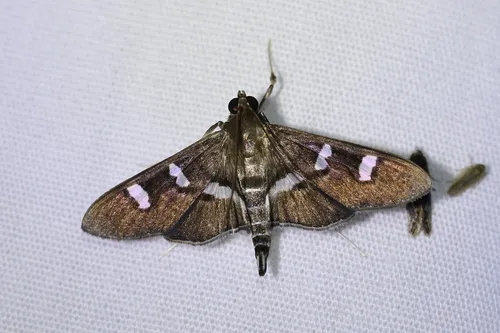
Desmia ploralis - Hodges#5167
Desmia ploralis
Hampson (1912) described deploralis as sexually dimorphic with HW white median band of females divided by a black line vs. a solid line in males. It would seem that ploralis is sexually dimorphic too though this seems contradicted by the description
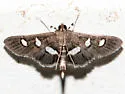
Desmia subdivisalis - Hodges#5161
Desmia subdivisalis
Identification: Grote original description of Desmia subdivisalis is available online in the print references. From Brian Scholtens: The fringes on the wings are completely white and there is a slight dark halo around the spots. This species tends to
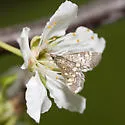
Darker Diacme Moth - Hodges#5143
Diacme adipaloides
Identification: Resembles Paler Diacme, but darker FW is grayish brown with irregular pale orange bands. HW is paler yellow with wide brown border. According to Brian Scholtens and others, the presence of a basal line on the hindwing is diagnostic fo
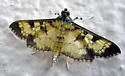
Diacme mopsalis - Hodges#5145
Diacme mopsalis
Identification: Female: Pale yellow, whitish beneath, slender. Head beneath and fore part of the pectus pure white. Palpi brown, porrect, short, moderately broad, white beneath; joints indistinct. Thorax slightly fawn-color in front. Abdomen extendin
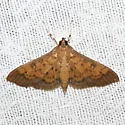
Diacme phyllisalis - Hodges#5144
Diacme phyllisalis
Identification: "Fawn-colour, whitish beneath. Palpi short, broad, porrect, brown above, white beneath. Abdomen cinereous. Tibiae somewhat dilated, partly brown. Wings narrow, lanceolate, with three irregular undulating brown lines, purplish cinereou