
Family Short-horned Grasshoppers (Acrididae)
Acrididae is a family in the order Orthoptera. Browse 502 named species recorded in this family, or open an individual profile for its available identification and natural-history information.
Species in Acrididae (502)
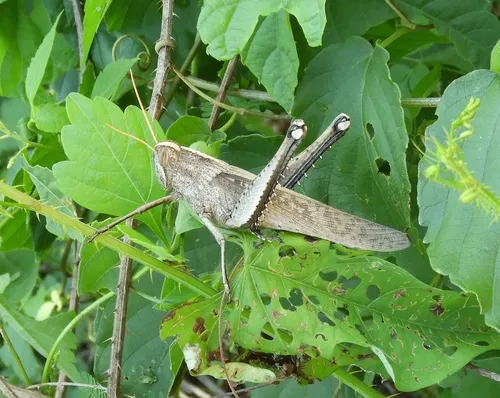
Schistocerca camerata
Schistocerca camerata
Identification: Nearly inseparable from S. damnifica . Texas specimens differing in top of pronotum averaging more nearly level (less arching) in side profile. Wings proportionately longer with tegmina usually more distinctly mottled with irregular
Rosemary Grasshopper
Schistocerca ceratiola
Identification: The smallest Schistocerca species. Eyes bulging, long antennae, narrow forewings. Distinctive color pattern that matches its hostplant. Nocturnal, emerging at night to feed on its hostplant. Very reluctant to leave Ceratiola bushes an
Spotted Bird Grasshopper
Schistocerca lineata
In Wyoming, Colorado and New Mexico the " typical " form blends with the green western form that was formerly most often known as S. venusta ; with green " venusta " occurring mostly in and west of the Rockies, and typical brownish " lineata " eastwa
Rusty Bird Grasshopper
Schistocerca rubiginosa
This is a member of the "Alutacea" Group, which includes several very closely related populations that are treated by some authors all as subspecies of S. alutacea , while most authors treat most as distinct species. S. rubiginosa is very similar and
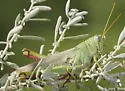
Green Bird Grasshopper
Schistocerca shoshone
Identification: Nearly solid green in color, usually rather pale and dull; eyes usually blue (when alive); usually lacking yellowish dots on thorax, yellowish spot on side of thorax, and pale mid-dorsal stripe (stripe may be faintly developed on pron
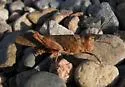
Campestral Grasshopper
Spharagemon campestris
Identification: Similar to other Spharagemon , but differs in smaller size than most of those, smalish head and nearly flat top of pronotum with median ridge low and cut twice instead of (usually) once. Also, other species of Spharagemon have the in
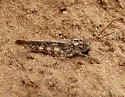
Mottled Sand Grasshopper
Spharagemon collare
Identification: Shaped like Carolina Grasshoppers (pronotum with a fairly high crest, cut deeply once at an angle), but smaller, with red hind tibiae, proportionately shorter wings. Hind wings yellow with a curved black cross band. This one often m
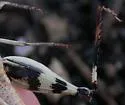
Crepitating Grasshopper
Spharagemon crepitans
Type locality: Georgia Often considered as a southeastern subspecies of S. bolli.
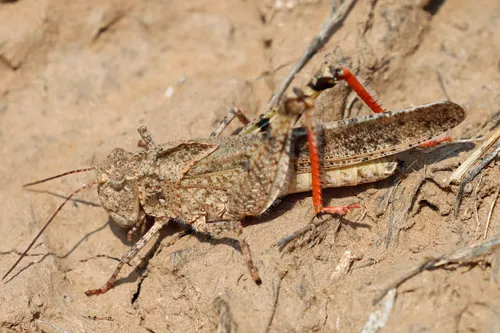
Ridgeback grasshopper
Spharagemon cristatum
Identification: Brownish or grayish grasshopper usually somewhat speckled with darker color, sometimes with indications of broken dark bands across the tegmina. Wings yellow with a bold curving dark cross band that has a spur pointing toward the bas
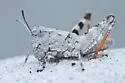
Marbled Grasshopper
Spharagemon marmoratum
Identification: Gray and brown, with strongly banded femora. Tibia are orange or red, pale yellowish ring at base. In flight, hindwings show a distinctive wide, curved, dark band. The Longhorn Bandwinged Grasshopper, Psinidia fenestralis is similar,
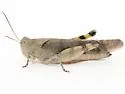
Ledge Grasshopper
Spharagemon saxatile
Identification: Basically identical to Spharagemon equale , but with inner hind femur usually yellow (usually orange in S. equale ) with three black cross bars more strongly developed. Northern insects that have been called subspecies saxatile have t
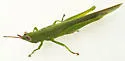
Glassy-winged Toothpick Grasshopper
Stenacris vitreipennis
Identification: Green to brownish green, long, slender, pointed head,sword-shaped antennae. Has spine beneath head in front of forelegs, distinguishing it from somewhat similar slant-faced grasshoppers, subfamily Gomphocerinae .
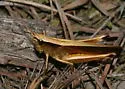
Southern Sedge Grasshopper
Stethophyma celata
Identification: Spines on hind tibia yellow, tipped with black; side of forewings without white streak; lateral carinae cut by one sulcus
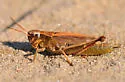
Graceful Sedge Grasshopper
Stethophyma gracilis
Identification: Spines on hind tibiae completely black; side of forewings without white streak; lateral carinae cut by one or two sulci
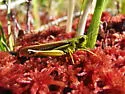
Striped Sedge Grasshopper
Stethophyma lineata
Identification: Spines on hind tibiae completely black; side of forewings with white streak; lateral carinae cut by three sulci
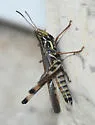
Admirable Grasshopper
Syrbula admirabilis
Identification: Face very slanted, hind legs very long and slender. Antennae are thread-like, but have expanded tip in males. Pronotum has two ridges. See this detail: Females typically green/brown, males may be blackish. Forewings have wavy (crenula
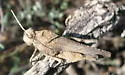
Mexican Oak-leaf Grasshopper
Tomonotus mexicanus
Identification: Very similar to T. ferruginosus except with fastigium proportionately wider and shorter, body proportionately slightly more slender, wings of a darker more reddish orange to red or pink. The pronotum is more roughened, with the top l
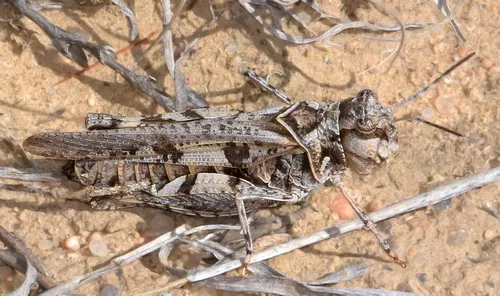
Trachyrhachys aspera
Trachyrhachys aspera
Identification: Very similar to Trachyrhachys kiowa , but less common, a bit stockier, with the inner face of the hind femur always black with a single light cross band near the "knee", and with wing yellow at the base and dark on approximately the e
Kiowa Grasshopper
Trachyrhachys kiowa
Identification: Smallish (largest in the Southwest), slender, with prominent broken ridges on top of smallish saddle-shaped pronotum, and with relatively large and prominent head (top of head is held above top of pronotum). Lateral lobes of pronotum
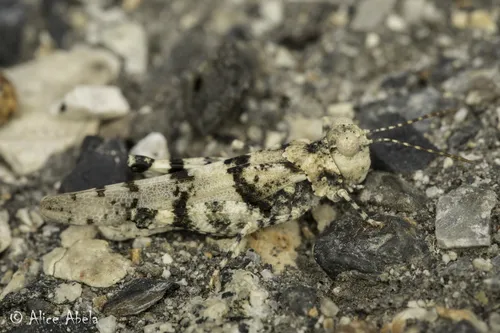
McNeill's White Grasshopper
Trimerotropis albescens
Identification: Varied color, usually pale whitish, but sometimes pinkish, reddish, brown, or even bluish. Small, with distinct narrow cross bands on the tegmina that cross over the top. The band closest to the wing base and the one in middle are f
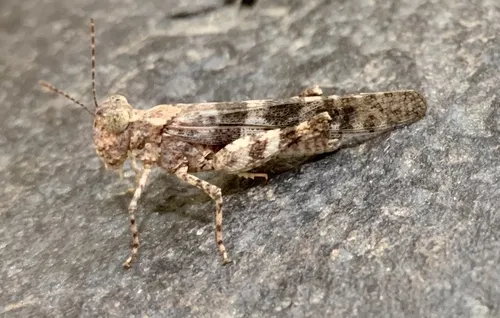
Colorado River Blue-wing Grasshopper
Trimerotropis arizonensis
Identification: Very similar to Trimerotropis cyaneipennis , but with narrower transparent blue-green to blue wings. Hind tibia varies from greenish to blue usually with dark near the top and bottom, plus a pale ring near the top. Pronotum with rea
Masked Grasshopper
Trimerotropis cincta
Identification: Relatively small, distinct sharply defined dark cross bands on tegmina usually don't cross top as seen when folded. Wings relatively narrow, transparent yellow, usually with a greenish tinge, and with dark band narrow and curving. O
Blue-winged Grasshopper
Trimerotropis cyaneipennis
This is often a common and conspicuous species of rocky places in the lower mountain and canyon areas of the west, where it's blue wings and noisy flight are bound to grab attention. It's habits are such that it is often met in areas frequented by v
Geyser Grasshopper
Trimerotropis diversellus
Identification: Not likely to be confused with any other species that occur with it. Small, slender, shades of white, gray, & light brown with dark cross bands on tegmina. Hind tibiae yellow occasionally to brownish. Hind wing yellow with dark band
Fontana Grasshopper
Trimerotropis fontana
Makes an interrupted buzzing ("pulse-buzz") sound when flying; not particularly loud or harsh. Will often fly through branches of trees and shrubs to escape. The distinction of this "species" from " Trimerotropis cincta " seems artificial. The only
Pine Bluffs Grasshopper
Trimerotropis fratercula
Identification: Identical to Trimerotropis cyaneipennis , except wings are yellow (sometimes a bit greenish) and hind tibiae may be brownish, yellow, green, or to the south in Colorado and northern New Mexico blue (normally blue in T. cyaneipennis )
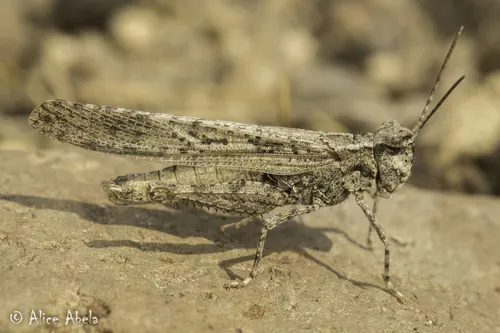
Thomas' Slender Grasshopper
Trimerotropis gracilis
Confused badly in the literature with a similar, but different species (see Trimerotropis "unnamed species A"). T. gracilis is distinguished from the other by having hind wings distinctly yellow with a prominent dark cross band. The wings are usuall
Helfer's Dune Grasshopper
Trimerotropis helferi
Identification: Rather wide-bodied and short-winged for a Trimerotropis , distinctly hairy (mostly sides and below). Coloring usually light grayish, covered with dark speckling and small spots, and with dark diagonal cross bands on hind femora. As
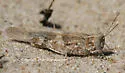
Lake Huron Locust
Trimerotropis huroniana
Identification: Very similar to Trimerotropis maritima , but occurs further north, and has yellowish, never red hind tibiae (often red in T. maritima). The wings are not as strongly pigmented, with the dark band usually narrower in T. huroniana . Ve
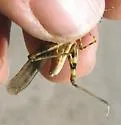
Inconspicuous Grasshopper
Trimerotropis inconspicua
Identification: Small size and contrasting pattern make this fairly easy to recognize. The hind wings are pale yellow with a narrow curved dark band, and the hind tibiae vary from yellow (most common east) to blue (most common west). Flight crepita
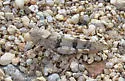
Inyo Grasshopper
Trimerotropis inyo
Perhaps, based upon appearance, morphology, and behavior, most closely akin to T. occidentalis . Moderately abundant, and associated often with Circotettix undulatus , C. maculatus , and Trimerotropis albescens .
Koebele's Grasshopper
Trimerotropis koebelei
Identification: Not reliably distinguishable from T. cincta , except by location ( T. cincta is in the Rocky Mountain region). However, overall "look" averages somewhat different. Distinguished from T. fontana by often somewhat more contrasting patt
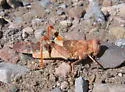
Broad-banded Grasshopper
Trimerotropis latifasciata
A very active and often difficult to approach grasshopper, noticeable in flight due to coloration and sound produced. Often comes to lights at night, sometimes in large numbers.
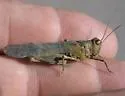
Inyo Blue-wing Grasshopper
Trimerotropis leucophaea
Identification: Like T. sparsa in most features, and perhaps only a regional variant of that species. Specimens were usually refered to that species or to T. cyaneipennis before the name " leucophaea " was published. The only differences that appea
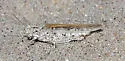
Seaside Grasshopper
Trimerotropis maritima
Identification: In most areas, a medium-sized speckled grasshopper looking much like the sand it is living on, with reddish hind tibiae and yellow wings crossed by a broad black band is likely to be this species. This species will often crepitate in
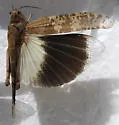
Black-winged Grasshopper
Trimerotropis melanoptera
Identification: Only likely to be confused with Trimerotropis latifasciata (see comments under that species ). The reddish abdomen and underside, and the broad black band that nearly dominates the otherwise pale wings are distinctive features. Resemb
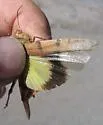
Modest Grasshopper
Trimerotropis modesta
Identification: Habitat and distribution make confusion with most other species unlikely. The most similar is Spharagemon campestris , which occurs mostly further north, and which has a pattern usually more broken and irregular looking (see comments
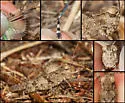
Trimerotropis occidentiloides
Trimerotropis occidentiloides
Identification: Similar to T. fontana , but pronotum with median crest of prozona more elevated (noticeable in profile). Dark cross bands on the tegmina are usually quite slender, and often broken into spots, and they usually don't cross the top (wh
Lompoc Grasshopper
Trimerotropis occulens
Identification: Small size; pale color; narrow usually clearly defined dark bands (sometimes faint) usually do not cross top of folded tegmina; wings wide, disk yellow, usually tinged greenish, with dark cross band usually faint to cloudy and situate
Trimerotropis pacifica
Trimerotropis pacifica
Identification: Body shades of gray or light brown with contrasting darker cross bands on tegmina; hind wings yellow with strong dark cross band; hind tibiae yellow; sides of pronotum with tooth at lower margin of hind angle. T. titusi is basically i
Pallid-winged Grasshopper
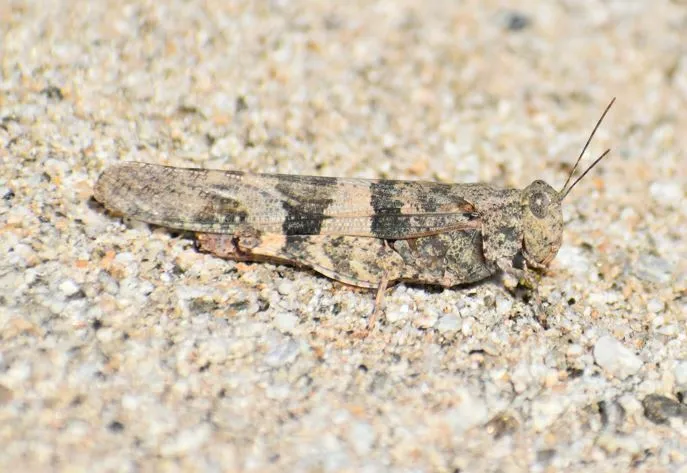
Trimerotropis pallidipennis
Identification: Variable, mostly gray or gray-brown. Note dark bands usually present on forewing, yellowish hind tibiae. Hind wings are long and narrow (roughly twice as long as wide), pale yellow, sometimes greenish or bluish at base, with dark ban
Trimerotropis pallidipennis-B
Trimerotropis pallidipennis-b
Identification: Differs (at least on average) from "regular" Trimerotropis pallidipennis in having proportionately shorter wings, wider hind wings, wider dark band across hind wing, and proportionately slightly larger head. The over-all size average
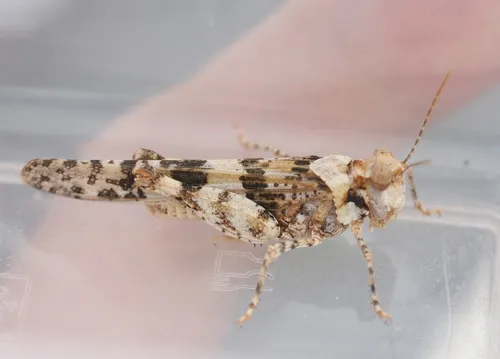
Caerulean-winged Grasshopper
Trimerotropis pseudofasciata
Although wings are usually blue, this species is very close to the yellow-winged species of the T. pallidipennis group, and has very similar appearance and behavior to those species. It produces a rapid, relatively high-pitched, loud, and interrupte
Lichen Grasshopper
Trimerotropis saxatilis
The coloration is highly variable from individual to individual, but tends to match the rocks upon which the insects live. Green pigmented specimens are quite striking. Such green specimens apparently do not occur west of extreme eastern Oklahoma a
Gulf Dune Grasshopper
Trimerotropis schaefferi
Identification: Very much like Trimerotropis salina which occurs further north, and reliably distinguished probably only by it's occurrence near the Gulf Coast in Texas, though the dark band of the hind wing is rarely so broad in T. salina . From T.
Badlands Grasshopper
Trimerotropis sparsa
In an area in southern Idaho, T. sparsa, T. cyaneipennis, T. suffusa, T. gracilis, T. pseudofasciata , and T . "unnamed species a" can all be found relatively near to, or with one another, and the situation can become very confused there. It is also
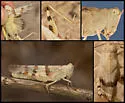
Titus' Grasshopper
Trimerotropis titusi
Identification: Pale coloring; reduced dark cross band of hind wings; yellow hind tibiae; pronotum with tooth at lower hind angle of sides. Closely related to T. californica and T. pacifica . Distinction as a species separate from T. pacifica is dub
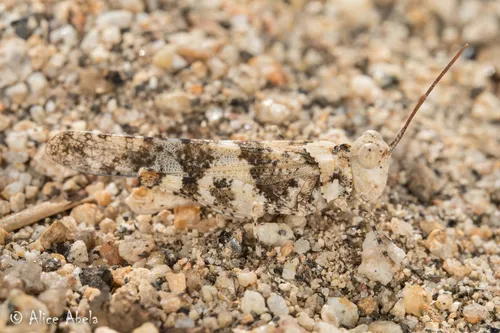
Topanga Grasshopper
Trimerotropis topanga
Identification: Most like T. bifasciata , except with color pattern more varied; slightly more slender with head averaging smaller; with top of abdomen usually dark and often distinctly blue; often, but not always with a small projection or a tooth a
Gypsum Grasshopper
Trimerotropis undescribed-species-b
Identification: Small for the genus. Eyes prominent. Antennae noticeably long, especially in males, ringed pale and brown. Coloration variable, but usually white to pale gray or pale brownish with darker brown mottling. Tegmina with irregular and us
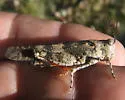
Limestone Grasshopper
Trimerotropis undescribed-species-c
The similarity to the other unnamed species found on gypsum in the same region as these (and often in adjoining habitats) is striking, but these larger insects are clearly different from those. The potential relationship to T. latifasciata should be
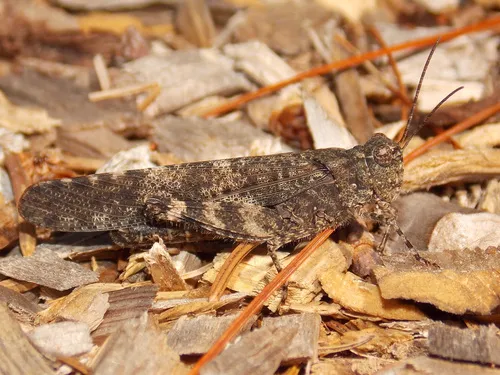
Crackling Forest Grasshopper
Trimerotropis verruculata
Identification: Trimerotropis sparsa and fratercula may be similar, but hind wings are narrower and the apex of the wings are usually mostly clear. The dark band across the hind wing is usually weak and ill-defined in T. sparsa . Circotettix species
White's Dune Grasshopper
Trimerotropis whitei
Identification: Small with wide pronotum flared to the sides. Identical to T. arenacea, but hind tibiae yellow to red instead of green to blue. Should be considered a synonym or at best a regional variant of T. arenacea , differing only in leg color
Great Crested Grasshopper
Tropidolophus formosus
Identification: High pronotal crest with serrations and orange hind wings separates this sp. from others (Ball et al., 1942) Nymph Unlike most Oedipodinae, lives primarily on vegetation that it matches closely in color
Xanthippus aquilonius
Xanthippus aquilonius
Very closely related to and similar to Xanthippus corallipes and perhaps should be treated as a regional variant or subspecies. However, not much is known about X. aquilonius yet. There is also a resemblance in coloring to Pardalophora apiculata .
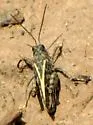
Xanthippus brooksi
Xanthippus brooksi
Closely related to X. aquilonius and X. corallipes , and perhaps should be treated as a regional variant or subspecies of X. corallipes [as it was originally described], but not much is known about X. brooksi . Quite similar to some high elevation p
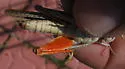
Sandhills Band-wing Grasshopper
Xanthippus montanus
Identification: This applies to the insect from the Great Plains and Colorado Plateaus that is called X. montanus in most literature (see discussion above). From X. corallipes it differs primarily in narrower top of pronotum with margins sharply defi
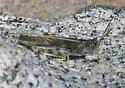
Sierra Grasshopper
Xanthippus sierra
Identification: Usually appearing dark brownish or sometimes grayish in color, lighter on sides and below than above. Tegmina dark brown, or sometimes lighter with irregular dark spots (especially southward), with two pale yellowish stripes along to
Long-headed Toothpick Grasshopper
Achurum carinatum
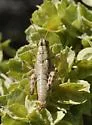
Colorado Plateaus Saltbush Grasshopper
Aeoloplides chenopodii
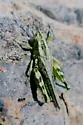
Elegant Saltbush Grasshopper
Aeoloplides elegans
Narrow-winged Saltbush Grasshopper
Aeoloplides tenuipennis
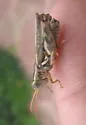
Thistle Grasshopper
Aeoloplides turnbulli
Aeropedellus arcticus
Aeropedellus arcticus
Short-wing Big-headed Grasshopper
Ageneotettix brevipennis
White-whiskered Grasshopper
Ageneotettix deorum
Agnostokasia sublima
Agnostokasia sublima
Lubberly Band-winged Grasshopper
Agymnastus ingens
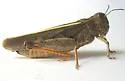
Agymnastus venerabilis
Agymnastus venerabilis
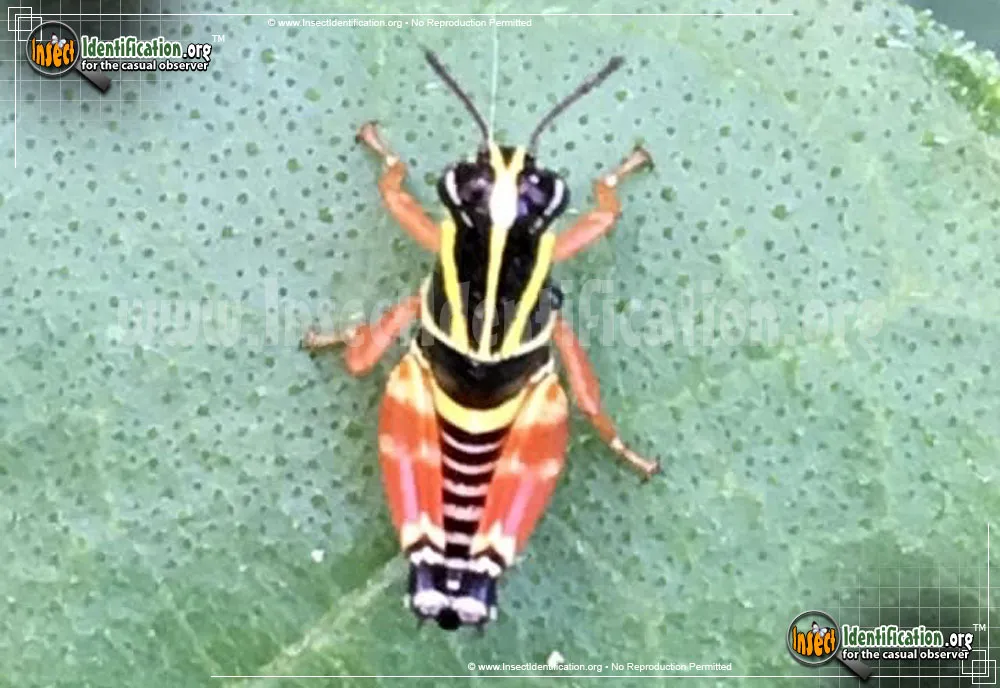
Aztec Spur-throat Grasshopper
Aidemona azteca
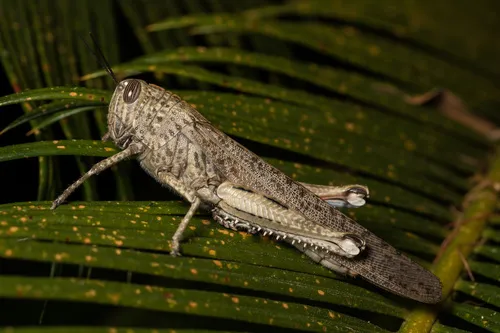
Egyptian Bird Grasshopper
Anacridium aegyptium
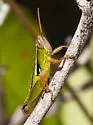
Aptenopedes appalachee
Aptenopedes appalachee
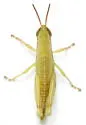
Aptenopedes chefixico
Aptenopedes chefixico
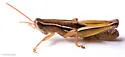
Aptenopedes clara
Aptenopedes clara
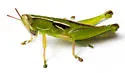
Aptenopedes rufovittata
Aptenopedes rufovittata
Aptenopedes yoholoi
Aptenopedes yoholoi
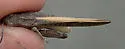
Speckle-winged Rangeland Grasshopper
Arphia conspersa
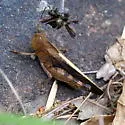
Southern Yellow-winged Grasshopper
Arphia granulata
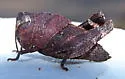
Sulphur-winged Grasshopper
Arphia sulphurea
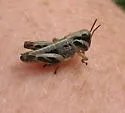
Asemoplus montanus
Asemoplus montanus
Asemoplus sierranus
Asemoplus sierranus
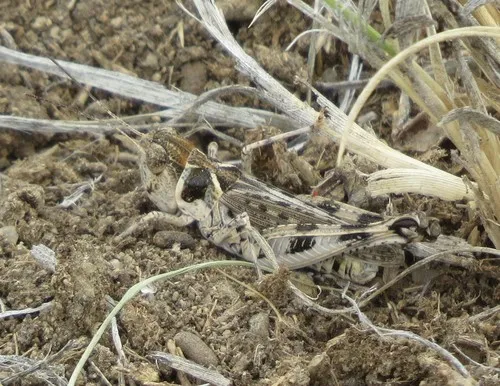
White-crossed Grasshopper
Aulocara femoratum
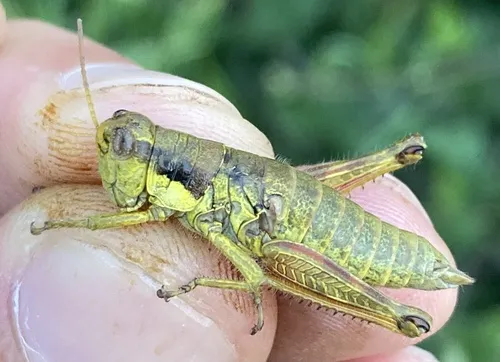
Marys Peak Wingless Grasshopper
Booneacris alticola
Willamette Wingless Grasshopper
Booneacris polita
Short-winged Boopie
Boopedon auriventris
Yellow-belly Boopie
Boopedon flaviventris
Bruner Slant-faced Grasshopper
Bruneria brunnea
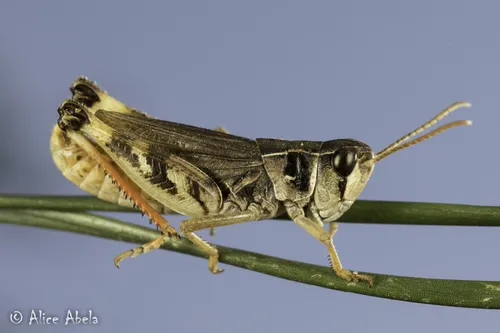
Shasta Slant-faced Grasshopper
Bruneria shastana
Buckellacris chilcotinae
Buckellacris chilcotinae
Buckell's Timberline Grasshopper
Buckellacris nuda
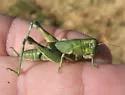
Fuzzy Olive-Green Grasshopper
Campylacantha olivacea
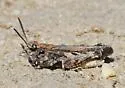
Painted Meadow Grasshopper
Chimarocephala pacifica
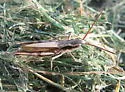
Chloealtis abdominalis
Chloealtis abdominalis
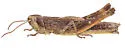
Siskiyou Slant-face Grasshopper
Chloealtis aspasma
Graceful Slant-face Grasshopper
Chloealtis gracilis
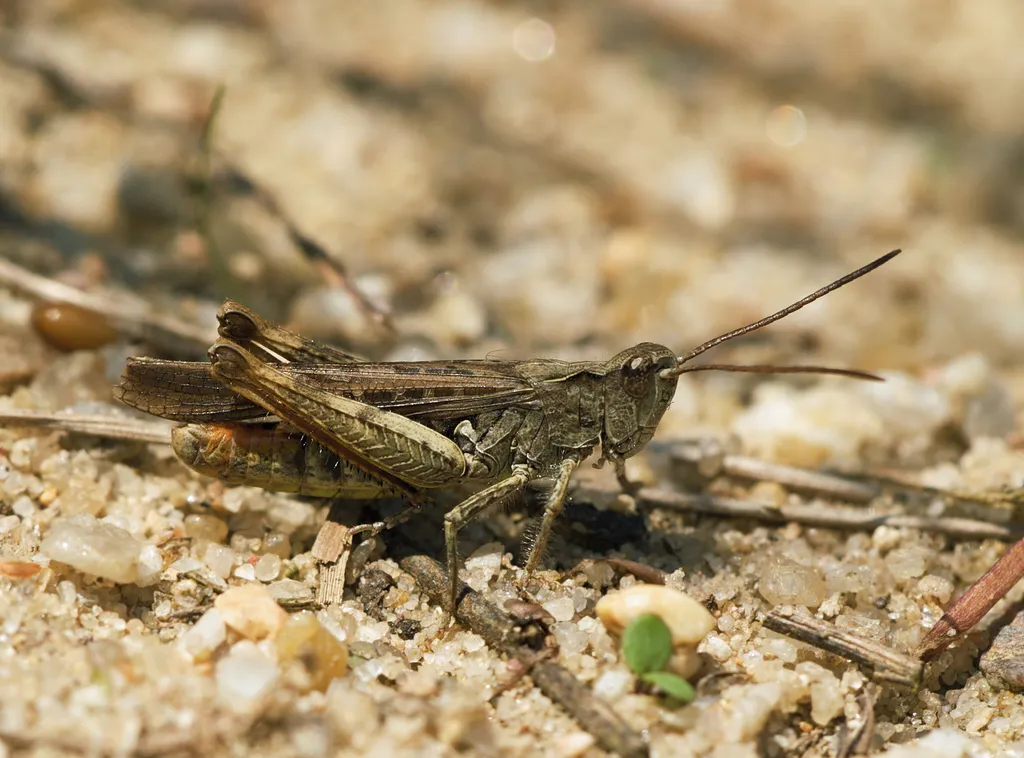
Common Field Grasshopper
Chorthippus brunneus
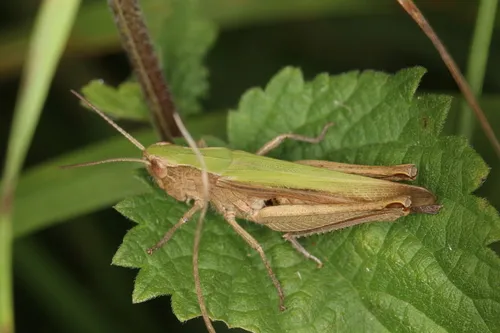
Steppe Grasshopper
Chorthippus dorsatus
Chrysochraon petraea
Chrysochraon petraea
Cream Grasshopper
Cibolacris parviceps
Wrangler Grasshopper
Circotettix rabula
Circotettix stenometopus
Circotettix stenometopus