
Black-winged Grasshopper
Trimerotropis melanoptera
This record describes Trimerotropis melanoptera (species). Recorded family: Acrididae. Recorded order: Orthoptera.
Identification and Appearance
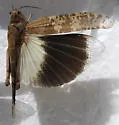
Only likely to be confused with Trimerotropis latifasciata (see comments under that species ). The reddish abdomen and underside, and the broad black band that nearly dominates the otherwise pale wings are distinctive features. Resembles Spharagemon equale rather closely with wings folded, but it is a bit more slender, the top of the pronotum is less roof-like and more flat, the median ridge on the pronotum is lower, and the hind wing coloration is quite different. Like T. latifasciata and several Spharagemon species, this one has an attractive collared form in which the rear half of the pronotum, face and sides of head, and bands across legs can be pale pinkish, tan, or nearly white. One of the most striking species of grasshoppers in North America, often very abundant, and yet for some reason not often noticed, perhaps because people tend not to frequent its prefered dusty habitats. It sometimes turns up on athletic fields and vacant lots in towns, perhaps because they resemble it's habitat, and because it is often attracted to bright lights. It has a tendency to stand tall and display it's reddish abdomen, a behavior that is apparently not studied yet. It is an alert, highly active species, rather difficult to catch and to photograph. It is noisy in flight, producing a loud harsh interrupted buzzing (pulse buzz). Apparently closely related to T. latifasciata , and also apparently to Spharagemon .
Classification
- Kingdom
- Animalia
- Phylum
- Arthropoda
- Class
- Insecta
- Order
- Orthoptera (Grasshoppers, Crickets, Katydids)
- Suborder
- Caelifera
- Family
- Acrididae (Short-horned Grasshoppers)
- Subfamily
- Oedipodinae
- Tribe
- Trimerotropini
- Genus
- Trimerotropis
Imported taxonomy record. Source availability varies; see the source references and editorial policy below.
Habitat and Range
Habitat
Usually in valley bottoms and flats on bare silty, eroded, tilled, or slightly saline soils, usually with sparse grass cover. Often found gathered in large numbers on relatively level disturbed bare patches such as around cattle watering ponds or tanks, ant hills, Prairie Dog towns, tops of gentle dirt banks along roads or arroyos, etc.
Geographic Range
Short-grass steppe regions. Roughly south of the North Platte River in se. Wyoming and sw. Nebraska, southward across e. Colorado e. New Mexico, westernmost Kansas, Oklahoma Panhandle, and Western Texas, and across much of the upland interior of Mexico. West across southern New Mexico and northwest Chihuahua to south-central Arizona and north-central Sonora.
Seasonal Activity
Overwinters as eggs. Adults summer to frost, but usually most common in July or August.
Additional species information
Species notes from the sources
Etymology: The name " melanoptera " refers to the largely black wings.
About Grasshoppers, Crickets, Katydids: the wider group
Order-level background for Orthoptera, the group containing Trimerotropis melanoptera. Species-specific details appear above.
Group overview
Orthoptera includes ~28,000 described species of grasshoppers, crickets, and katydids. Desert locusts can form swarms covering 460 square miles containing up to 80 million individuals per square kilometer.
Ecological role of the group
Grasshoppers and crickets are a primary food source for birds, reptiles, and small mammals. Cricket farming is a growing industry - crickets require 12× less feed than cattle to produce the same amount of protein, using 2,000× less water.
Economic and practical significance of the group
A single large locust swarm can consume the same amount of food in one day as 35,000 people. The 2019-2021 East Africa locust crisis affected food security for 42 million people across multiple countries. Global crop losses from locusts can reach billions annually.
Recorded sources for this group: FAO, UN World Food Programme, research publications. Imported estimates may describe particular regions or reporting periods.
Photos of Black-winged Grasshopper (5)
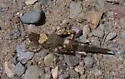
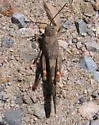
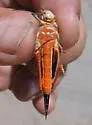
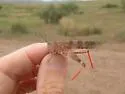
Photo credits: Contributed by Brad Barnd; Additional contributions by David Ferguson
Frequently Asked Questions About Black-winged Grasshopper
What is Black-winged Grasshopper?
Black-winged Grasshopper (Trimerotropis melanoptera) is a species in the family Acrididae, within the order Orthoptera.
How do you identify Black-winged Grasshopper?
Only likely to be confused with Trimerotropis latifasciata (see comments under that species ). The reddish abdomen and underside, and the broad black band that nearly dominates the otherwise pale wings are distinctive features. Resembles Spharagemon equale rather closely with wings folded, but it is a bit more slender, the top of the pronotum is less roof-like and more flat, the median ridge on the pronotum is lower, and the hind wing coloration is quite different. Like T. latifasciata and several Spharagemon species, this one has an attractive collared form in which the rear half of the pronotum, face and sides of head, and bands across legs can be pale pinkish, tan, or nearly white.
Where is Black-winged Grasshopper found?
| Feature | Details |
|---|---|
| Habitat | Usually in valley bottoms and flats on bare silty, eroded, tilled, or slightly saline soils, usually with sparse grass cover. Often found gathered in large numbers on relatively level disturbed bare patches such as around cattle watering ponds or tanks, ant hills, Prairie Dog towns, tops of gentle dirt banks along roads or arroyos, etc. |
| Range | Short-grass steppe regions. Roughly south of the North Platte River in se. Wyoming and sw. Nebraska, southward across e. Colorado e. New Mexico, westernmost Kansas, Oklahoma Panhandle, and Western Texas, and across much of the upland interior of Mexico. West across southern New Mexico and northwest Chihuahua to south-central Arizona and north-central Sonora. |
When is Black-winged Grasshopper active?
Black-winged Grasshopper: seasonal activity - Overwinters as eggs. Adults summer to frost, but usually most common in July or August..