
Gulf Dune Grasshopper
Trimerotropis schaefferi
This record describes Trimerotropis schaefferi (species). Recorded family: Acrididae. Recorded order: Orthoptera.
Identification and Appearance
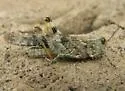
Very much like Trimerotropis salina which occurs further north, and reliably distinguished probably only by it's occurrence near the Gulf Coast in Texas, though the dark band of the hind wing is rarely so broad in T. salina . From T. maritima , with which it may occur, it differs in usually having more distinct dark bands across the tegmina, yellowish hind tibiae (usually red in maritima ) and the much wider black band across the hind wings. T. maritima has a proportionately smaller head as well. T. pallidipennis may occasionally be found with T. schaefferi , and differs in having a proportionately smaller head, and a much narrower dark band across the longer/narrower hind wing. T. saxatilis is smaller, with a narrower wing band, and occurs on rock exposures further inland. The coloring is usually (but not always) more contrasting. The two will probably never be found together in the same area. The distinction of this species from Trimerotropis salina seems dubious as there is little to distinguish them other than where they are found and the width of the dark hind wing band. T. salina occurs inland from Texas north at least to South Dakota and Wyoming in bare seasonally moist alkali and saline areas of the grasslands of the Great Plains, and in a somewhat different form in similar habitats of the Great Basin. Most populations of T. salina tend have most individuals more plain in coloring of the body and tegmina, but this is an average difference, and not constant. Alkali and salt flats in Texas should be explored to see if there is a break between the two species. Texas Parks & Wildlife considers this to be a Species of Greatest Conservation Need (SGCN)
Classification
- Kingdom
- Animalia
- Phylum
- Arthropoda
- Class
- Insecta
- Order
- Orthoptera (Grasshoppers, Crickets, Katydids)
- Suborder
- Caelifera
- Family
- Acrididae (Short-horned Grasshoppers)
- Subfamily
- Oedipodinae
- Tribe
- Trimerotropini
- Genus
- Trimerotropis
Imported taxonomy record. Source availability varies; see the source references and editorial policy below.
Habitat and Range
Habitat
Primarily found in alkali / salt mud flats along and a short distance inland from the Gulf Coast. Reported from coastal dunes (and "areas behind the dunes") along the coast, but this is mostly bare sand or grassland, and is not favored habitat.
Geographic Range
Texas Gulf Coast from Galveston to Brownsville, and almost certainly following the coast south into Mexico. - Map (TL: Brownsville)
Additional species information
Species notes from the sources
Etymology: Trimerotropis schaefferi Caudell, 1904
About Grasshoppers, Crickets, Katydids: the wider group
Order-level background for Orthoptera, the group containing Trimerotropis schaefferi. Species-specific details appear above.
Group overview
Orthoptera includes ~28,000 described species of grasshoppers, crickets, and katydids. Desert locusts can form swarms covering 460 square miles containing up to 80 million individuals per square kilometer.
Ecological role of the group
Grasshoppers and crickets are a primary food source for birds, reptiles, and small mammals. Cricket farming is a growing industry - crickets require 12× less feed than cattle to produce the same amount of protein, using 2,000× less water.
Economic and practical significance of the group
A single large locust swarm can consume the same amount of food in one day as 35,000 people. The 2019-2021 East Africa locust crisis affected food security for 42 million people across multiple countries. Global crop losses from locusts can reach billions annually.
Recorded sources for this group: FAO, UN World Food Programme, research publications. Imported estimates may describe particular regions or reporting periods.
Photos of Gulf Dune Grasshopper (5)
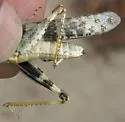
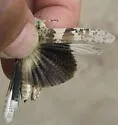
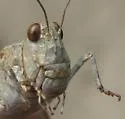
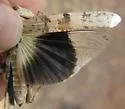
Photo credits: Contributed by David J. Ferguson; Additional contributions by Mike Quinn
Frequently Asked Questions About Gulf Dune Grasshopper
What is Gulf Dune Grasshopper?
Gulf Dune Grasshopper (Trimerotropis schaefferi) is a species in the family Acrididae, within the order Orthoptera.
How do you identify Gulf Dune Grasshopper?
Very much like Trimerotropis salina which occurs further north, and reliably distinguished probably only by it's occurrence near the Gulf Coast in Texas, though the dark band of the hind wing is rarely so broad in T. salina . From T. maritima , with which it may occur, it differs in usually having more distinct dark bands across the tegmina, yellowish hind tibiae (usually red in maritima ) and the much wider black band across the hind wings. T. maritima has a proportionately smaller head as well. T. pallidipennis may occasionally be found with T. schaefferi , and differs in having a proportionately smaller head, and a much narrower dark band across the longer/narrower hind wing. T. saxatilis is smaller, with a narrower wing band, and occurs on rock exposures further inland. The coloring is usually (but not always) more contrasting. The two will probably never be found together in the same area.
Where is Gulf Dune Grasshopper found?
| Feature | Details |
|---|---|
| Habitat | Primarily found in alkali / salt mud flats along and a short distance inland from the Gulf Coast. Reported from coastal dunes (and areas behind the dunes) along the coast, but this is mostly bare sand or grassland, and is not favored habitat. |
| Range | Texas Gulf Coast from Galveston to Brownsville, and almost certainly following the coast south into Mexico. - Map (TL: Brownsville) |