
Family Short-horned Grasshoppers (Acrididae)
Acrididae is a family in the order Orthoptera. Browse 502 named species recorded in this family, or open an individual profile for its available identification and natural-history information.
Species in Acrididae (502)
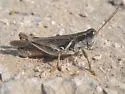
Narrow-winged Spur-throat Grasshopper
Melanoplus angustipennis
Identification: Very similar to M. foedus & packardii , but much smaller (averaging well under 30 mm long), usually without prominent median dark stripe on top of pronotum and head, and without white stripes along top margins of pronotum; male furcul
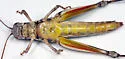
Apalachicola Short-wing Grasshopper
Melanoplus apalachicolae
Identification: Melanoplus apalachicolae is brownish to grayish dorsally and yellow below; dark stripe from behind the eye across the pronotum and widening slightly towards the posterior of the pronotum; flightless, with elongate-oval vestigial wings
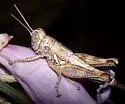
Arid Lands Spur-Throat Grasshopper
Melanoplus aridus
Identification: Smallish (mostly under 1 inch, but sometimes longer in the south). Antennae and eyes are usually brown, often strongly reddish. With very short wings, and the tegmina oval and usually widely separated. The bar behind the eyes on th
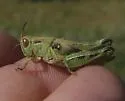
Arizona Spur-Throat Grasshopper
Melanoplus arizonae
Identification: Melanoplus arizonae is similar to M. sanguinipes . Averages more boldly and brightly patterned, but coloration is highly variable. Less likely to be greenish/bluish. Less likely to have a solid dark bar on thorax behind eyes. Aver
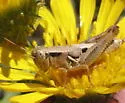
Striking Short-wing Grasshopper
Melanoplus aspasmus
Identification: The most common short-winged species of Melanoplus along the Coast Ranges in much of California, so most likely to be encountered, but best distinguished by looking at end of male abdomen. With tegmina (front wings) oval and separate
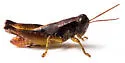
Melanoplus bonita
Melanoplus bonita
Identification: A member of the 'puer group' and best distinguished by male genitalia and range.
Sacramento Short-wing Grasshopper
Melanoplus calidus
Identification: Smallish, with short wings (most often just touching over back, and slightly longer than pronotum). Usually dull olive greenish in color (sometimes bluish, golden tinged or especially in females dull brownish) with dark markings not
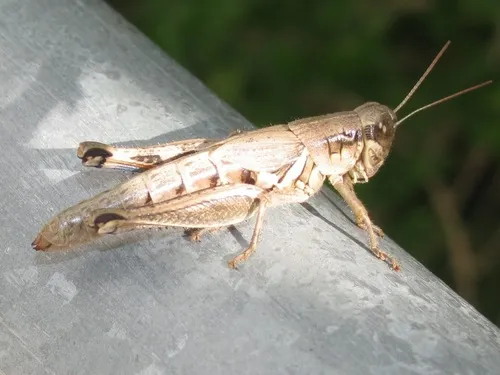
Brownsville Short-wing Grasshopper
Melanoplus cameronis
Identification: Differs from M. plebejus in male cerci narrower; male furculae averaging shorter (basically peg-like but still diverging in M. cameronis ); tegmina, when short-winged, with apex drawn into a longer and more acute point. Differs from M
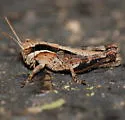
Sylvan Short-wing Grasshopper
Melanoplus celatus
A member of the Mancus Group , which also includes islandicus, divergens, mancus, & serrulatus . Divers in distribution and details of male furculae and cercae.
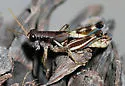
Chiricahua Short-wing Grasshopper
Melanoplus chiricahuae
Identification: Adult male Adult female Tip of male abdomen
Shield-tailed Grasshopper
Melanoplus clypeatus
Identification: Very similar to Melanoplus yarrowii , except eastern, occuring across southern Georgia and northern Florida. Could perhaps be confused with M. punctulatus in structure, but much plainer in coloration. Somewhat similar to M. nigrescen
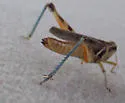
Pasture Grasshopper
Melanoplus confusus
Identification: Adult: body gray and brown with black patches; underside cream-colored; shiny black patch behind eye on side of head and on pronotal lobe; white diagonal stripe on side of thorax behind pronotum; wings long; outer surface of hind femu
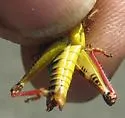
Dawson's Grasshopper
Melanoplus dawsoni
Identification: Rather similar to M. borealis and M. femurrubrum , but differing in details of subgenital plate of male, and usually considerably smaller. Wings are nearly always short. Underside is yellow, upper side dark, abdomen above usually ap
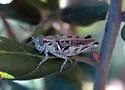
Devastating Grasshopper
Melanoplus devastator
Identification: A fully winged species, roughly between 2 and 3 cm long. Basically identical to Melanoplus sanguinipes (but usually a bit more contrasting in coloring) and replacing it near the Pacific Coast. Differs from other species found with i
Lobecercus Short-wing Grasshopper
Melanoplus divergens
A member of the Mancus Group , which also includes M. celatus, islandicus, mancus, & serrulatus . M. mancus differs from these in the distinctive shape of the male cercus.
Dodge's Short-wing Grasshopper, and others
Melanoplus dodgei-species-group
Identification: Found at high elevation; broad-bodied insects; wings short (usually not or only slightly longer than pronotum), overlapping at top; sometimes with pale stripe along sides of top of pronotum and wings (stripes most prominent in norther
Canyon Grasshopper
Melanoplus eumera
Identification: Melanoplus thomasi is usually a richer green or bluish color, has more striking pale stripes along the margins of the upper side, and has a longitudinal dark stripe on the outer hind femur instead of dark cross bands. Similar to M. di
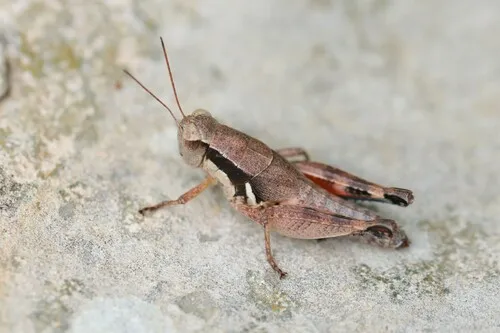
Dallas Short-wing Grasshopper
Melanoplus flabellatus
Identification: Contrasting dark bars behind eyes; blue hind tibiae; short wings usually touch over abdomen; male cerci triangular, longer than wide, tapering entire length to narrow tip. Tip of male abdomen
Sandbar Grasshopper
Melanoplus fluviatilis
Often treated as a subspecies of M. foedus , but behaves as if a different species with different habitat preferences. The two are easily distinguished where they occur in the same areas. It is possible that there is some hybridization between them
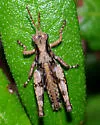
Toothcercus Shortwing Grasshopper
Melanoplus forcipatus
Identification: Male cercus distinctive Sympatric with M. tequestae on the Lake Wales Ridge
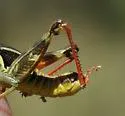
San Francisco Short-wing Grasshopper
Melanoplus franciscanus
These grasshoppers tend to look a little different in each mountain range they occupy, and it is possible that at least some of these populations are distinct enough to deserve species ranking. However, for the time being they are all grouped togeth
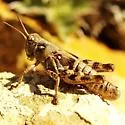
Nordic Mountain Grasshopper
Melanoplus frigidus
Identification: Few other species of Melanoplus occur in the same region. M. frigidus is fairly stocky in build, greenish, grayish, or light brownish with the usual dark bar reaching back from the eyes, but not to the rear of the pronotum; tegmina sh
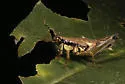
Graceful Grasshopper
Melanoplus gracilis
Identification: Slender form with unique combination of long antennae; very short rounded wings separated over the back; bold dark patterning on abdomen; and green legs, including slender green hind femora. Paroxya may look very similar, but adults h
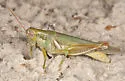
Arrowweed Grasshopper
Melanoplus herbaceus
Identification: Similar to M. cinereus, M. bowditchi, & M. pictus , all of which might occur with it. Those species all favor Composite shrubs, but tend to be mostly in semi-arid to arid habitats, often sandy and usually dry in nature. They are usu
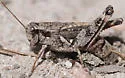
Huron Short-wing Grasshopper
Melanoplus huroni
Identification: Can easily be confused with M. fasciatus (especially females), but this species is usually less contrastingly marked, more speckled, and averages wider in body proportions. M. fasciatus usually has longer and broader wings, but not al
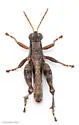
Spinecercus Short-wing Grasshopper
Melanoplus indicifer
Identification: Tip of male abdomen Deyrup (1996) found the species on only 3 vacant lots and speculated that it might soon become extinct - but it still occurs in at least two protected areas as of 2022.
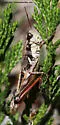
Island Short-wing Grasshopper
Melanoplus islandicus
A member of the Mancus Group , which also includes celatus, mancus, divergens, & serrulatus . Differs in distribution and details of male furculae and cercae.
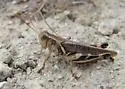
Keeler's Spur-throat Grasshopper
Melanoplus keeleri
Identification: Male cerci are distinctive, "bifurcate with the dorsal arm larger than the ventral" More at the references below.
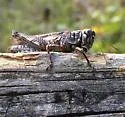
McClung's Juniper Grasshopper
Melanoplus macclungi
Similar to Melanoplus punctulatus and M. splendidus . Larger, with male cerci distinctly more slender.
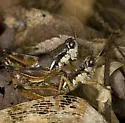
Smith's Short-wing Grasshopper
Melanoplus mancus
Identification: Male cerci A member of the Mancus Group , which also includes celatus, islandicus, divergens, & serrulatus . Differs in distribution and details of male furculae and cercae.
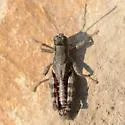
Montana Short-wing Grasshopper
Melanoplus montanus-species-group
Nearly identical Melanoplus oreophilus occurs in the Cascades of Washington and Oregon, and M. washingtonius is in ne. Washington and adjacent British Columbia and Idaho.
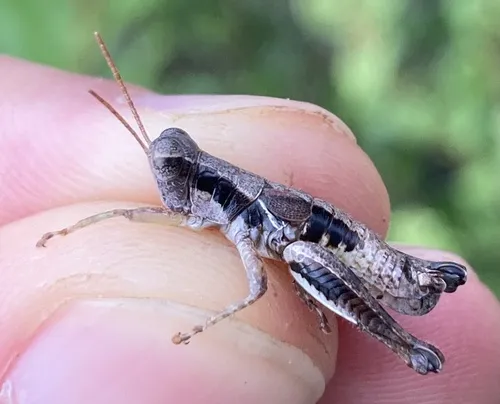
Ocala Clawcercus Grasshopper
Melanoplus nanciae
Identification: Male cercus highly distinctive, hence the common name
Dark-sided Grasshopper
Melanoplus nigrescens
Identification: Hind tibiae red; hind femur distinctly cross-banded dark on outer side. Tegmina short, but longer than pronotum, overlapping above, usually (when folded) light on top and contrastingly darker (often nearly black) on sides. Very simila
Oregon Short-wing Grasshopper
Melanoplus oregonensis
Identification: Dark, often blackish, with pattern usually little contrasting, wings about as long as or shorter than pronotum, widely separated over the back, and roughly oval in shape. Hind tibiae brownish blue to blue. Males with cerci rounded ob
Mount Hood Short-wing Grasshopper
Melanoplus oreophilus
A member of the Montanus Species Group , containing 30 additional species. These are reliably separable only by examining male genitalia, or sometimes by knowing collection location. M. oreophilus & M. oregonis are separated from the rest by geograp
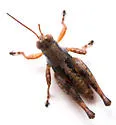
Melanoplus peninsularis
Melanoplus peninsularis
Identification: A member of the 'puer group' and best distinguished by male genitalia and range. Strikingly purple hind tibiae in adults.
Whitney Short-wing Grasshopper
Melanoplus platycercus
Similar to M. rileyanus , but found in the southern Sierra Nevada (Montane elevations in Mt. Whitney area), with male cerci broader and with lobe on upper side smaller. Male subgenital plate shorter.
Plebeian Short-wing Grasshopper
Melanoplus plebejus
Identification: The overlapping, relatively pointed tegmina (not pointed in long-winged individuals), the relatively plain coloration (usually), bluish hind tibiae, plus the shape of the male cerci, with the male furculae being divergent, tiny and pe
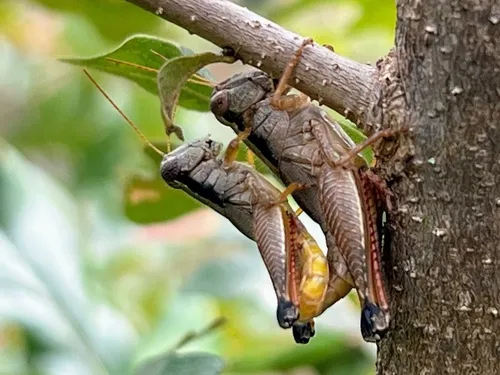
Oak-loving Short-wing Grasshopper
Melanoplus quercicola
Identification: Closely related to Melanoplus davisi , and perhaps just a subspecies. Distinguished by more easterly distribution ( M. davisi occurs west from Walton County), narrower apex of male cerci, and tegmina more even in coloring. Relatively
Oak Spur-throat Grasshopper
Melanoplus querneus
Identification: Hind tibiae red; hind femur distinctly cross-banded dark on outer side. Tegmina short, but longer than pronotum, overlapping above, usually (when folded) light on top and contrastingly darker on sides. Very similar to M. nigrescens ,
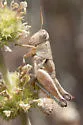
Riley's Short-wing Grasshopper
Melanoplus rileyanus
Identification: Usually contrastingly colored light brown or grayish with dark nearly black bar extending back from eyes and down sides of abdomen. With tegmina short oval, sometimes bluntly pointed apically, usually touching or nearly so over the b
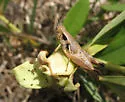
Round-winged Grasshopper
Melanoplus rotundipennis
Identification: The long fairly wide cerci and the erect conical "pallium" at the tip of the abdomen are characteristics of this species Tip of male abdomen
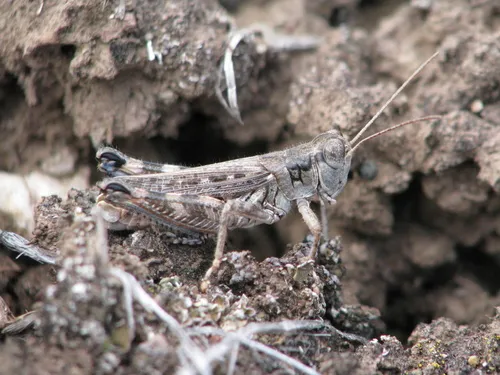
Nevada Sage Grasshopper
Melanoplus rugglesi
Identification: Females are difficult to separate from similar species. Males have greatly expanded cerci and short furculae, and within the species' distribution can only be confused with the very closely related M. occidentalis . M. rugglesi usual
Obovate-winged Grasshopper
Melanoplus rusticus-decoratus-species-group
Identification: Hind tibiae greenish to bluish, pale near base. Wings oval, usually separated above. Pronotum above with portion in front of principal sulcus much longer than part behind, widening gently toward the rear in males, noticeably in fema
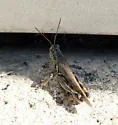
Migratory Grasshopper
Melanoplus sanguinipes
Identification: Very similar to several other species, and females in particular can be very difficult to distinguish. This species is best determinded by looking at males, in which the abdomen is only moderately swollen toward the tip. The subgeni
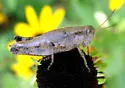
Scudder's Short-wing Grasshopper
Melanoplus scudderi
Identification: Wings short, shorter than pronotum or slightly longer. Coloration brown to reddish brown. Hind femorae do not have bands on their outer faces, as in many Melanoplus , but may have two dark spots on top. Tibiae reddish. The oval forewi
Nantahala Short-wing Grasshopper
Melanoplus serrulatus
A member of the Mancus Group . Perhaps intermediate between M. celatus & M. divergens . Also very similar and closely related to M. islandicus & M. mancus . All of these differing by where found, and by details of male genitalia.
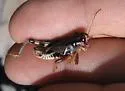
Snow's Short-wing Grasshopper
Melanoplus snowi
Identification: Closely related to M. femurnigrum . Wings reduced, very short, with tegmina ovoid and widest toward tip, usually not touching. Hind tibiae blue, or at least bluish. Hind femur with much of outer face black, and contrastingly yellow
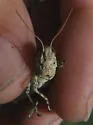
Juniper Grasshopper
Melanoplus splendidus
Identification: Closely resembles Melanoplus punctulatus , and may just be regional variant of that species. However, M. splendidus is slightly larger in size, males have smaller cerci, and is found further west. It is also structurally similar to
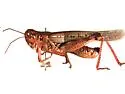
Rocky Mountain Locust
Melanoplus spretus
Identification: A long-winged and rather dull-patterned Melanoplus , notable for its fantastic swarms and damage to agriculture. It was one of the most abundant large insects in North America (and the world), but is now believed to be extinct. Histor
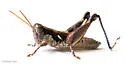
Tequestae Scrub Grasshopper
Melanoplus tequestae
Identification: Male cercus Sympatric with M. forcipatus on the Lake Wales Ridge
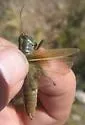
Thomas's Two-striped Grasshopper
Melanoplus thomasi
Identification: Moderately large for the genus, green, often bright bluish green, with two pale stripes along sides of top, and with bright red hind tibiae. M. bivittatus from the northeast and from near the West Coast may look similar, but are never
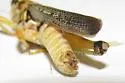
Quanah Grasshopper
Melanoplus tuberculatus
Described from Quanah, Hardeman County and Wichita Falls, Wichita County, Texas
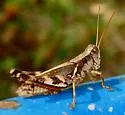
Tunica Spur-throat Grasshopper
Melanoplus tunicae
Identification: The name M. tunicae was applied to insects found at the southeast extreme of the distribution of M. ponderosus from Tennessee to the Gulf Coast in Mississippi and eastern Louisiana (west as far as Lafayette). The distinctions from M.
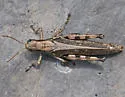
from Georgia & Carolina
Melanoplus unknown-species
Identification: Shows similarities to M. differentialis and has been found in northern Georgia and in North Carolina. Perhaps a form of M. clypeatus , but pattern (especially on hind legs) is different. Resembles Mexican M. sumichrasti . Perhaps a
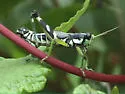
Green-legged Grasshopper
Melanoplus viridipes-species-group
Identification: Adult: solid green forelegs & midlegs; black lateral stripe running full length of pronotum; short wings covering less than half of abdomen (this combination of characteristics is diagnostic). Lower half of side of pronotum white, an
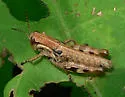
Walsh's Short-wing Grasshopper
Melanoplus walshii
Identification: Hind tibiae red; hind femur distinctly cross-banded with dark on outer side. Tegmina short, but roughly same length as pronotum, overlapping above, usually (when folded) with pale stripes along top edge that continue forward along sid
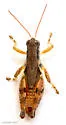
Warner's Spur-throat Grasshopper
Melanoplus warneri
Identification: Tip of male abdomen Described from a large series of specimens collected near College Station, Brazos Co, Texas
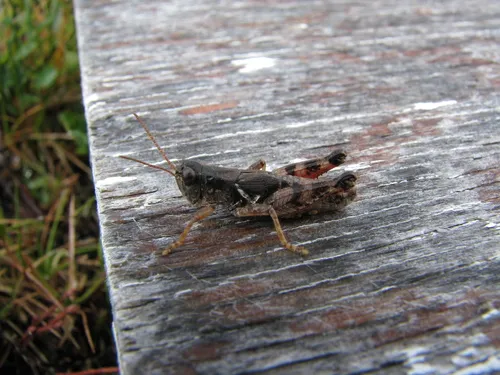
Washington Short-wing Grasshopper
Melanoplus washingtonius
Very closely related to, and perhaps not a distinct species from M. montanus , which occurs further to the east, and M. oreophlius from the Cascades. NOTE: In 2012, Daniel Otte published numerous names for related "species", and resurrected some name
Withlacoochee Grasshopper
Melanoplus withlacoocheensis
Identification: Male cerci are swollen distally, with a small ventral downward-facing tooth. This species has a large and erect pallium which is only seen in this species and M. rotundipennis Tip of male abdomen
Yarrow's Grasshopper
Melanoplus yarrowii
Identification: Similar to M. differentialis, but with no herringbone pattern on hind femur and with red hind tibiae. Usually there is a narrow dark stripe back from the eyes onto the pronotum and there are often at least faint diagonal dark bands a
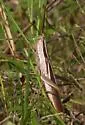
Eastern Mermiria
Mermiria intertexta
Identification: body long, narrow; face strongly slanted; antennae sword-shaped; dark middorsal line from front of head to rear of pronotum (a distinguishing characteristic); lacks distinct lateral ridges on dorsal surface of pronotum; dark brown or
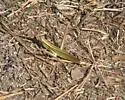
Lively Mermiria
Mermiria picta
Identification: body long, narrow, greenish or brownish; face strongly slanted; antennae sword-shaped; dark middorsal line from front of head to rear of pronotum; distinct lateral ridges on dorsal surface of pronotum (a diagnostic characteristic); da
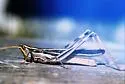
Texas Mermiria
Mermiria texana
Identification: dorsum of head and thorax has two pale ivory or cream-colored bands, converging at midsection of forewings; forewing (tegmen) has 2 white streaks near costa [a short streak over base of hind leg, and a longer one over abdomen] and a l
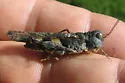
Mestobregma impexum
Mestobregma impexum
Identification: Differs from M. plattei in larger somewhat rounder head; frontal costa strongly narrowed just above antennae; fastigium more strongly closed off and separate from frontal costa at front; tegmina with dark bands often tending to cross
Clip-wing Grasshopper
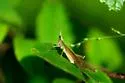
Metaleptea brevicornis
Identification: Slant-faced, angled forewing tips, sword-like antennae, short rear-pointing spines on hind knees are distinctive: Color variable brown and green. Hindwing has no pigment. Flies, seldom leaps. This species is nearly unique among North
Little Buzzer Grasshopper
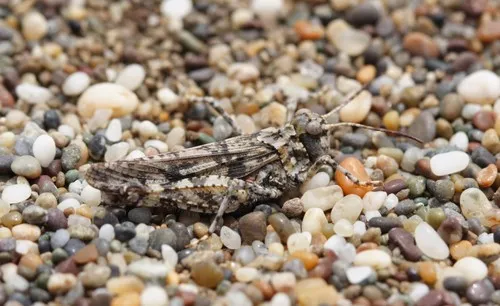
Microtes occidentalis
Identification: Small, stocky (especially females), wings moderately short (but exceeding tip of hind femora significantly); hairy, especially sides and below; pale, speckled to match sand, with two or three dark spots or bars in sides of folded wing
Microtes pogonata
Microtes pogonata
Identification: Very similar to M. occidentalis . Differing in tegmina usually equaling or only slightly surpasing end of hind femora; head a bit more rounded in profile; body is apparently more hairy, even on top; pronotal crest perhaps averaging l
Pale Clouded Grasshopper
Nebulatettix pallidus
Identification: Similar to E. subgracilis but with head larger and somewhat more smoothly rounded, with ground coloring paler (often slightly yellowish in life), and usually with two distinct pale stripes at sides of top of pronotum. In most regions
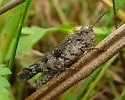
Southwestern Dusky Grasshopper
Nebulatettix subgracilis
Identification: Can be difficult to separate from other Encoptolophus (see discussion under genus for separation from other genera). E. pallidus & robustus replace it westward, and are unlikely to be found with it. E. pallidus is in the Mojave Desert
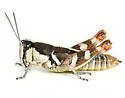
Netrosoma fusiformis
Netrosoma fusiformis
Type Locality: Monclova [Montelovez in error], Coahuila [Chihuahua in error], Mexico, September 20; E. Palmer; Scudder Collection. (Hebard, 1917)
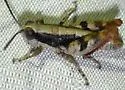
Black-striped Desert Grasshopper
Netrosoma nigropleura
Identification: Small, wingless, with rear margin of pronotum emarginate. Males dark brown on whitish in color; appearing nearly black with due to dark wide stripe from eye onto base of abdomen; with pale yellowish white to off-white markings on face
Atascosa Grasshopper
Opeia atascosa
Identification: Similar to O. obscura , but more slender with face more strongly slanting; wings shorter than in most O. obscura .
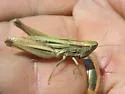
Obscure Grasshopper
Opeia obscura
Identification: Very similar to Eritettix simplex . O. obscura is usually found as nymphs in spring and adults in summer and fall, while E. simplex is found as nymphs in fall and adults in spring. O. obscura has the margins of the top of the pronotum
Orphulella punctata
Orphulella punctata
Identification: Lateral pronotal carinae cut by 2 (sometimes 3) sulci (as in O. pelidna); forewings extending beyond end of abdomen; hind femora usually with spots along the lower outer carinula and with one or two larger spots along the top marginal
Paraidemona olsoni
Paraidemona olsoni
Identification: Distinction from P. mimica is weak, with the only obvious difference apparently being a more "wavy" margin to the supra-anal plate of the male.
Paraidemona species-a
Paraidemona species-a
Identification: Early season. Appears to be more stocky with more contrasting markings in males.
Paraidemona species - b
Paraidemona species-b
Identification: Perhaps the same as "species B". So far only mating pairs posted, so can't see end of abdomens. Early season, appears to be less hairy. Male face seems more "flat" in profile (less convex).
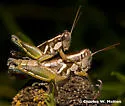
P. mimica ?
Paraidemona species-c
Late season. Hairy. Male head rounded, small, strongly sloping, with compound eyes very large. Abdomen with much yellow color; rear margin of segments pale.
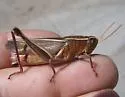
Paratylotropidia brunneri
Paratylotropidia brunneri
Behavior and appearance is rather similar to Melanoplus bivittatus until closely examined, and perhaps this species is not often noticed because of the resemblance to that very common species. Unlike that species the head is squared (almost pointed)
Paratylotropidia morsei
Paratylotropidia morsei
Identification: Very similar to P. brunneri , except tegmina (always?) short and with tip rounded instead of pointed. Considering the variation in wings seen in populations of P. brunneri (particularly in eastern Oklahoma), the distinction seems min
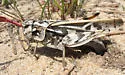
Coral-winged Grasshopper
Pardalophora apiculata
Guide TBA--PC. In high elevation and northern regions, wings are shorter (notably on females) and females may be reluctant or even unable to fly. In most regions both genders are powerful fliers and hard to catch. Size is largest on the sandhills o
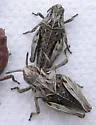
Haldeman's Grasshopper
Pardalophora haldemanii
Identification: Very similar to Xanthippus corallipes , but somewhat "smoother" looking; pronotum with median carina fairly evenly elevated and usually only cut once; hind femur slender (not widened strongly along lower margin); hind tibia and inner
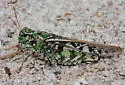
Orange-winged grasshopper
Pardalophora phoenicoptera
Identification: Large gray/brown or green, dark spots on forewings. Hind femur mostly blue with darker near black cross bands and one subapical yellow to orange band. Hind tibia yellow to orange. Bright red-orange to red hindwing. Adults in spring.
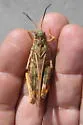
Saussure's Grasshopper
Pardalophora saussurei
Biologically P. saussurei is a southern subspecies of P. haldemanii , but it is treated as a separate species in publications, and the two have never officially been combined under one species as yet. Attracted to lights at night. There is an attract
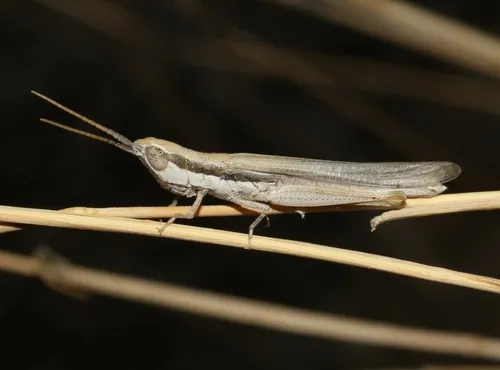
Pale Toothpick Grasshopper
Paropomala pallida
Identification: Much as in P. virgata except hind femora shorter and not reaching tips of abdomen and often not wings. Wings varied in length, but usually at least reaching past tips of hind femora, or nearly so. As in P. virgata , dark stripe is n
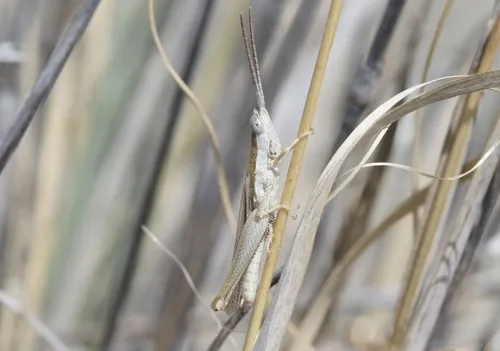
Virgata Toothpick Grasshopper
Paropomala virgata
Identification: Light green, gray, brown or combinations of these. With dark band narrower than eye extending back from upper part of eye across upper sides of pronotum and onto folded wings. Very slender with short front and middle legs, and with
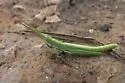
Wyoming Toothpick Grasshopper
Paropomala wyomingensis
Identification: Small (under 2 inch), very slender "toothpick" grasshopper with large head. Head is approximately 1.3 times longer than pronotum and wider than rest of body (head is approaches twice as long as pronotum in related Prorocorypha snowi
Atlantic Grasshopper
Paroxya atlantica
Identification: Yellowish brown, often tending towards reddish on upper side; dark tripe behind eye; resembling a Melanoplus , but pronotum is much longer, as are male antennae. Smaller and less greenish than Olive-green Swamp Grasshopper, Paroxya cl
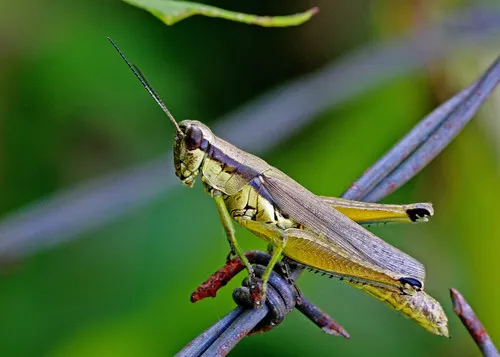
Olive-green Swamp Grasshopper
Paroxya clavuliger
Identification: Greenish to greenish-black with dark stripe through eye. Long antennae, especially in males. Hind tibiae are bluish green. Larger than P. atlanticus . In male P. clavuliger antennae are longer than hind femora, while shorter in P. atl
Phaedrotettix concinnus
Phaedrotettix concinnus
Identification: The shapes of the parts of the male "terminalia" at the end of the abdomen are distinctive in this species, and should separate it from P. accola , which has much narrower wings and slender, nearly pointed cerci. P. dumicola has the "
Phaedrotettix palmeri
Phaedrotettix palmeri
Identification: Similar to P. dumicola (and P. concinnus ) but supposed to be smaller in size. Has the cerci narrowed toward the tip (but still wide, not pointed); the pallium is prominent but less developed; and the subgenital plate has a small tub
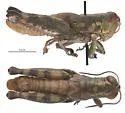
Phaulotettix ablusus
Phaulotettix ablusus
Identification: Similar to P. compressus , but the male cerci and phallic complex are different. Only 3 specimens known. More surveying is needed to determine the full range of this species.
Black-striped Grasshopper
Philocleon nigrovittatus
Identification: Robust, tegmina tiny and narrow. Color yellowish with broad contrasting black stripes. Hind tibiae bluish to red and bluish.
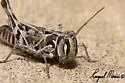
Four-spotted Grasshopper
Phlibostroma quadrimaculatum
Can become economically important in high densities
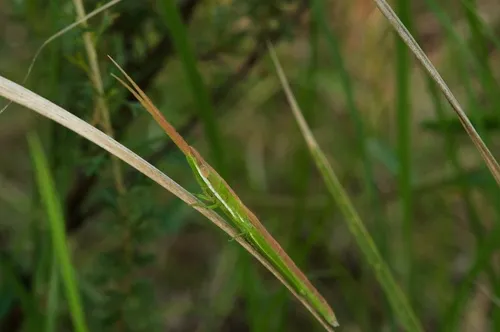
Snow's toothpick grasshopper
Prorocorypha snowi
Identification: Very similar to Paropomala wyomingensis , color pattern about the same, but somewhat more slender and averaging longer; head is more than 1.5 times as long as pronotum; male subgenital plate is roughly half as long as abdomen; wings u
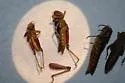
Cascade Timberline Grasshopper
Prumnacris rainierensis
Identification: Very similar and probably very closely related to Buckellacris ; however, with tiny elongate tegmina (front wings) present. If tegmina are missing, it will key out to B. nuda , from which it differs by occuring in the Cascades, and i
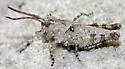
Longhorn Band-wing Grasshopper
Psinidia fenestralis
Identification: Smallish, slender body; lateral lobes (sides) of pronotum with lower hind angle (not rounded); antennae long, broad, and flattened; wings usually bright orange to near red; in the northeastern states, sometimes yellow. Typical orange
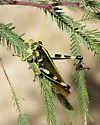
White-lined Bird Grasshopper
Schistocerca albolineata
Identification: Similar to S. lineata and venusta , but more contrastingly marked, with bold dark bars on the hind femora. This species is dark olive green or brown to black, with contrasting pale yellowish markings, and bold contrasting markings on
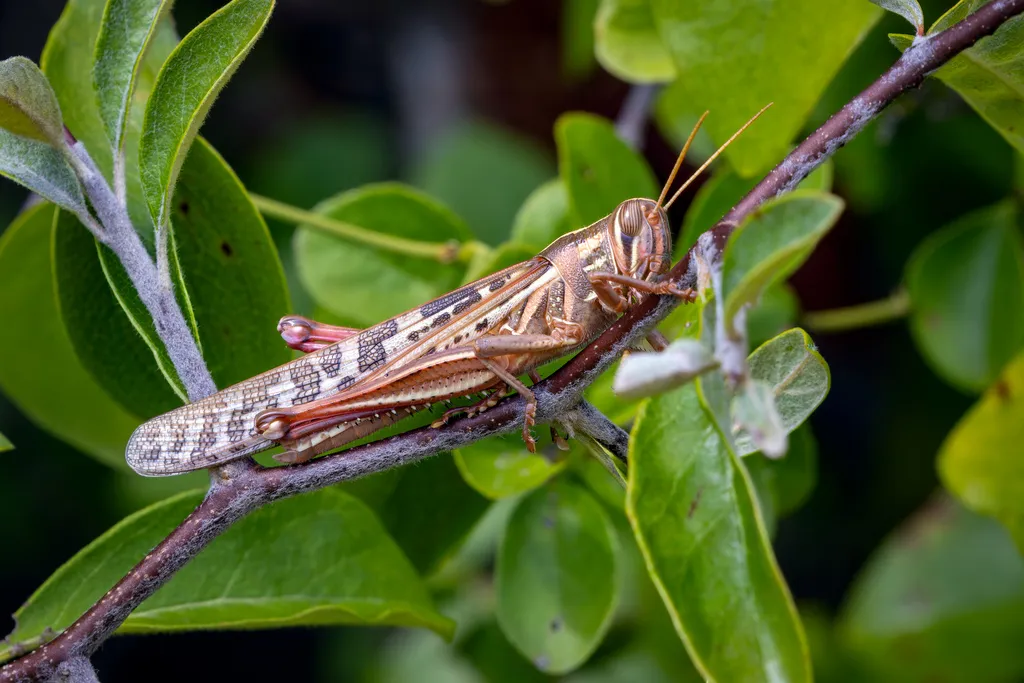
American Bird Grasshopper
Schistocerca americana
Identification: Large, usually has creamy strip extending from head to forewings. Characteristically flies up and into trees when disturbed, behavior quite different from most other grasshoppers. Prosternal spine thick, whitish, only slightly bending