
Ledge Grasshopper
Spharagemon saxatile
This record describes Spharagemon saxatile (species). Recorded family: Acrididae. Recorded order: Orthoptera.
Identification and Appearance
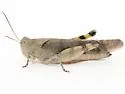
Basically identical to Spharagemon equale , but with inner hind femur usually yellow (usually orange in S. equale ) with three black cross bars more strongly developed. Northern insects that have been called subspecies saxatile have the median crest on the metazona of the pronotum somewhat more distinct, with the rear edge of the portion in front of the cut often overlapping the front edge of the portion behind. More southern insects that have been called subspecies planum ) have a lower pronotal crest with the cut more vertical. The distinction sounds obvious, but in practice it is hard to apply many insects from most any population (but especially from places like Pennsylvania, New York, and Maryland) to one name or the other. Likely to be confused only with other species of Spharagemon . However, Trimerotropis maritima is somewhat similar, but with the top of the pronotum more flattened, with the median ridge low and strongly twice cut (once or only slightly notched a second time in S. saxatile ); the lower rear margins of the sides of the pronotum usually have a bit of a projection or tooth; and the habitat is usually sandy lowland areas. Spharagemon collare and S. bolli have the pronotal crest more strongly elevated (decidedly lower in S. saxatile , and especially so on the metazona. S. bolli usually has a distinct dark ring near the base of the hind tibiae. S. collare is usually found in different sandy environments. S. marmorata has the pronotal crest even lower, and the top of the pronotum is flatter with more pronounced sharp edges forming shoulders at the sides. The color pattern is distinctive, with folded tegmina usually with the sides dark with contrasting light patches along the lower margin, while the top may be contrastingly light to equally dark. There is usually a distinct dark ring near the base of the hind tibae. The names S. saxatile and S. planum have been treated as synonyms, as varieties of one species, and also as distinct species. S. saxatile is perhaps very closely related to S. equale , but is also confusingly similar to S. bolli . These relationships should be studied in more depth.
Classification
- Kingdom
- Animalia
- Phylum
- Arthropoda
- Class
- Insecta
- Order
- Orthoptera (Grasshoppers, Crickets, Katydids)
- Suborder
- Caelifera
- Family
- Acrididae (Short-horned Grasshoppers)
- Subfamily
- Oedipodinae
- Tribe
- Trimerotropini
- Genus
- Spharagemon
Imported taxonomy record. Source availability varies; see the source references and editorial policy below.
Habitat and Range
Habitat
Exposed rock outcroppings and ledges, rocky slopes, old quarries, etc. Often in company with S. bolli , but more restricted to sunny rocky sites.
Geographic Range
Broken rocky terrain, mostly in mountains, from eastern Tennessee and western North Carolina northward into Ohio southeastern Quebec, and New England. Should be watched for in far northwestern Georgia as well.
Diet and Behavior
Diet: Undocumented, but probably mostly grasses.
Life History
Overwinters as eggs, with adults from late June or July to frost.
About Grasshoppers, Crickets, Katydids: the wider group
Order-level background for Orthoptera, the group containing Spharagemon saxatile. Species-specific details appear above.
Group overview
Orthoptera includes ~28,000 described species of grasshoppers, crickets, and katydids. Desert locusts can form swarms covering 460 square miles containing up to 80 million individuals per square kilometer.
Ecological role of the group
Grasshoppers and crickets are a primary food source for birds, reptiles, and small mammals. Cricket farming is a growing industry - crickets require 12× less feed than cattle to produce the same amount of protein, using 2,000× less water.
Economic and practical significance of the group
A single large locust swarm can consume the same amount of food in one day as 35,000 people. The 2019-2021 East Africa locust crisis affected food security for 42 million people across multiple countries. Global crop losses from locusts can reach billions annually.
Recorded sources for this group: FAO, UN World Food Programme, research publications. Imported estimates may describe particular regions or reporting periods.
Photos of Ledge Grasshopper (5)
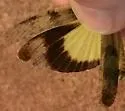
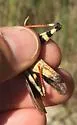
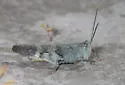
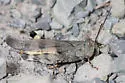
Photo credits: Contributed by Eric R. Eaton; Additional contributions by David Ferguson , metrioptera
Frequently Asked Questions About Ledge Grasshopper
What is Ledge Grasshopper?
Ledge Grasshopper (Spharagemon saxatile) is a species in the family Acrididae, within the order Orthoptera.
How big is Ledge Grasshopper?
males about 30 mm females about 40 mm
How do you identify Ledge Grasshopper?
Basically identical to Spharagemon equale , but with inner hind femur usually yellow (usually orange in S. equale ) with three black cross bars more strongly developed. Northern insects that have been called subspecies saxatile have the median crest on the metazona of the pronotum somewhat more distinct, with the rear edge of the portion in front of the cut often overlapping the front edge of the portion behind. More southern insects that have been called subspecies planum ) have a lower pronotal crest with the cut more vertical. The distinction sounds obvious, but in practice it is hard to apply many insects from most any population (but especially from places like Pennsylvania, New York, and Maryland) to one name or the other. Likely to be confused only with other species of Spharagemon . However, Trimerotropis maritima is somewhat similar, but with the top of the pronotum more flattened, with the median ridge low and strongly twice cut (once or only slightly notched a second time in S. saxatile ); the lower rear margins of the sides of the pronotum usually have a bit of a projection or tooth; and the habitat is usually sandy lowland areas. Spharagemon collare and S. bolli have the pronotal crest more strongly elevated (decidedly lower in S. saxatile , and especially so on the metazona. S. bolli usually has a distinct dark ring near the base of the hind tibiae. S. collare is usually found in different sandy environments. S. marmorata has the pronotal crest even lower, and the top of the pronotum is flatter with more pronounced sharp edges forming shoulders at the sides. The color pattern is distinctive, with folded tegmina usually with the sides dark with contrasting light patches along the lower margin, while the top may be contrastingly light to equally dark. There is usually a distinct dark ring near the base of the hind tibae.
Where is Ledge Grasshopper found?
| Feature | Details |
|---|---|
| Habitat | Exposed rock outcroppings and ledges, rocky slopes, old quarries, etc. Often in company with S. bolli , but more restricted to sunny rocky sites. |
| Range | Broken rocky terrain, mostly in mountains, from eastern Tennessee and western North Carolina northward into Ohio southeastern Quebec, and New England. Should be watched for in far northwestern Georgia as well. |
What does Ledge Grasshopper eat?
The diet of the Ledge Grasshopper includes Undocumented, but probably mostly grasses..
What is the life cycle of a Ledge Grasshopper?
Overwinters as eggs, with adults from late June or July to frost.