
Ridgeback grasshopper
Spharagemon cristatum
This record describes Spharagemon cristatum (species). Recorded family: Acrididae. Recorded order: Orthoptera.
Identification and Appearance
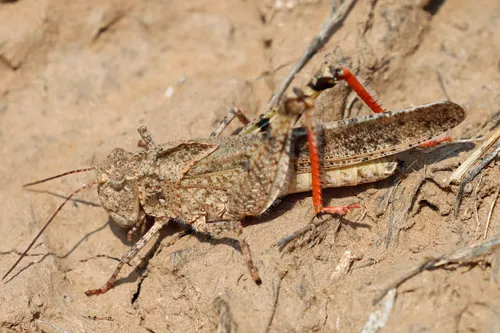
| Feature | Description |
|---|---|
| Additional details | Brownish or grayish grasshopper usually somewhat speckled with darker color, sometimes with indications of broken dark bands across the tegmina. |
| Wings | Wings yellow with a bold curving dark cross band that has a spur pointing toward the base. With hind tibiae orange to red. |
| Pronotum | Pronotum with a prominent arching median crest that is cut only once and with the cut usually diagonal, not perpendicular. Those in less sandy or more vegetated habitats tend to be less speckled, more even, and often darker in coloring. These more even colored populations are more likely to have individuals with the collared phase that has pale whitish or tan on the rear of the pronotum, sides of the face, legs, etc. This color phase is less common in this species than in more northern S. collare . Distinguished from S. collare only by more southerly distribution and somewhat higher pronotal crest, together with the rear angle of the pronotum averaging somewhat more accute. S. bolli and S. crepitans have the pronotal ridge more straight along the top edge in profile, with the cut nearer to vertical (oblique in this species, and often with the front and back sides of the notch overlapping a bit). Also, these two usually have a dark ring near the base of the hind tibiae, which is lacking or only faintly indicated on S. cristatum . Dissosteira carolina and D. longipennis are larger with longer wings, they do not have reddish hind tibiae, and both have black (not yellow) hind wings. Arphia species do not have the pronotal crest deeply cut, do not have reddish hind tibiae, and the dark wing band of the hind wing follows around the outer margin instead of crossing the middle. Also, wings are often of other colors, not only yellow. The distinction between S. cristatum and S. collare as species is weak, and based on perceived behavioral differences (that may or may not be constant) along with larger size and slightly different shape of southern populations as compared to northern. Across the central Great Plains from the Rockies to the southern Ozarks, these characteristics blend, and individuals are often difficult to place into one species or the other, because most are intermediate in character. The same is seen in the Carolinas along the eastern seaboard, and can perhaps also be seen in regions between. However, neither species is often seen from the Ozarks to the Appalachians, and may be missing from much of the region from the Gulf Coastal Plain north through to Ohio Valley. Spharagemon cristatum are usually a noisy fliers, producing a loud sharp nearly continuous buzzing. They can fly silently, and females are more likely to be quiet than males. |
Classification
- Kingdom
- Animalia
- Phylum
- Arthropoda
- Class
- Insecta
- Order
- Orthoptera (Grasshoppers, Crickets, Katydids)
- Suborder
- Caelifera
- Family
- Acrididae (Short-horned Grasshoppers)
- Subfamily
- Oedipodinae
- Tribe
- Trimerotropini
- Genus
- Spharagemon
Imported taxonomy record. Source availability varies; see the source references and editorial policy below.
Habitat and Range
Habitat
Sandy areas, often on sand bars of stream beds, near lake shores, in dune areas, along sandy roads or ditch banks, etc.
Geographic Range
Roughly south of a line from North Carolina to southeast Colorado, and from the Atlantic coast to the east base of the Rocky Mountains and central Mountains of New Mexico. South well into northeastern Mexico. However, whether real or simply because the insects are more rare there, there seems to be a large gap in the combined distributions of S. collare & cristatum in roughly the Ozark - Cumberland - Appalachian region (and valleys in between), with S. collare ranging around the north side, S. cristatum around the south side, and the two meeting and blending on either side.
Additional species information
Species notes from the sources
Etymology: Spharagemon cristatum Scudder 1875
About Grasshoppers, Crickets, Katydids: the wider group
Order-level background for Orthoptera, the group containing Spharagemon cristatum. Species-specific details appear above.
Group overview
Orthoptera includes ~28,000 described species of grasshoppers, crickets, and katydids. Desert locusts can form swarms covering 460 square miles containing up to 80 million individuals per square kilometer.
Ecological role of the group
Grasshoppers and crickets are a primary food source for birds, reptiles, and small mammals. Cricket farming is a growing industry - crickets require 12× less feed than cattle to produce the same amount of protein, using 2,000× less water.
Economic and practical significance of the group
A single large locust swarm can consume the same amount of food in one day as 35,000 people. The 2019-2021 East Africa locust crisis affected food security for 42 million people across multiple countries. Global crop losses from locusts can reach billions annually.
Recorded sources for this group: FAO, UN World Food Programme, research publications. Imported estimates may describe particular regions or reporting periods.
Photos of Ridgeback grasshopper (2)
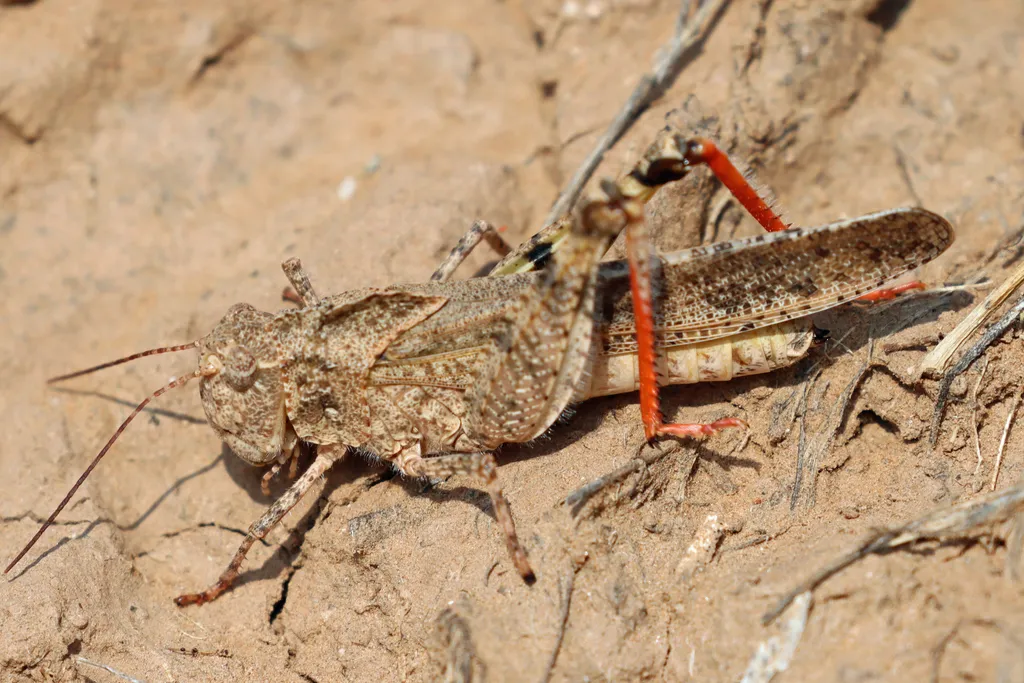
Photo credits: Contributed by Eric R. Eaton; Additional contributions by David Ferguson , v belov
Frequently Asked Questions About Ridgeback grasshopper
What is Ridgeback grasshopper?
Ridgeback grasshopper (Spharagemon cristatum) is a species in the family Acrididae, within the order Orthoptera.
How do you identify Ridgeback grasshopper?
| Feature | Description |
|---|---|
| Additional details | Brownish or grayish grasshopper usually somewhat speckled with darker color, sometimes with indications of broken dark bands across the tegmina. |
| Wings | Wings yellow with a bold curving dark cross band that has a spur pointing toward the base. With hind tibiae orange to red. |
| Pronotum | Pronotum with a prominent arching median crest that is cut only once and with the cut usually diagonal, not perpendicular. Those in less sandy or more vegetated habitats tend to be less speckled, more even, and often darker in coloring. These more even colored populations are more likely to have individuals with the collared phase that has pale whitish or tan on the rear of the pronotum, sides of the face, legs, etc. This color phase is less common in this species than in more northern S. collare . Distinguished from S. collare only by more southerly distribution and somewhat higher pronotal crest, together with the rear angle of the pronotum averaging somewhat more accute. S. bolli and S. crepitans have the pronotal ridge more straight along the top edge in profile, with the cut nearer to vertical (oblique in this species, and often with the front and back sides of the notch overlapping a bit). Also, these two usually have a dark ring near the base of the hind tibiae, which is lacking or only faintly indicated on S. cristatum . Dissosteira carolina and D. longipennis are larger with longer wings, they do not have reddish hind tibiae, and both have black (not yellow) hind wings. Arphia species do not have the pronotal crest deeply cut, do not have reddish hind tibiae, and the dark wing band of the hind wing follows around the outer margin instead of crossing the middle. Also, wings are often of other colors, not only yellow. |
Where is Ridgeback grasshopper found?
| Feature | Details |
|---|---|
| Habitat | Sandy areas, often on sand bars of stream beds, near lake shores, in dune areas, along sandy roads or ditch banks, etc. |
| Range | Roughly south of a line from North Carolina to southeast Colorado, and from the Atlantic coast to the east base of the Rocky Mountains and central Mountains of New Mexico. South well into northeastern Mexico. However, whether real or simply because the insects are more rare there, there seems to be a large gap in the combined distributions of S. collare & cristatum in roughly the Ozark - Cumberland - Appalachian region (and valleys in between), with S. collare ranging around the north side, S. cristatum around the south side, and the two meeting and blending on either side. |