
Sierra Grasshopper
Xanthippus sierra
This record describes Xanthippus sierra (species). Recorded family: Acrididae. Recorded order: Orthoptera.
Identification and Appearance
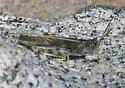
| Feature | Description |
|---|---|
| Additional details | Usually appearing dark brownish or sometimes grayish in color, lighter on sides and below than above. Tegmina dark brown, or sometimes lighter with irregular dark spots (especially southward), with two pale yellowish stripes along top edges of folded tegmina. |
| Wings | Wings red (mostly south of Yosemite NP), yellow (mostly north from Yosemite NP), or orange (mostly where yellow and red meet in the central Sierra Nevada); with dark band usually (? always) narrow and running close to wing margin but with apex mostly clear. Outer hind femur with distinct alternating light and dark diagonal cross bands (dark ones widest near top); inner hind femur yellowish with dark cross bands (sometimes reddish). Hind tibia (and often all tibiae) yellowish, sometimes varying to orange, or hind tibia sometimes red on inner side. |
| Pronotum | Pronotum with lateral lobes with front and back margins usually roughly parallel, sometimes widening somewhat downward. Found mostly in mountains, often at high elevation, and even above timberline. Adults in summer and autumn (usually maturing at the end of June or in July). Male Agymnastus are very similar, but occur mostly in earlier in spring and have the lower flange of the hind femur broader and often prominently expanded (relative slender in X. sierra . Cratypedes neglectus has lateral lobes of pronotum distinctly wider toward the bottom, and wings always yellow with usually a very wide bold dark border (and often the tip of the wings are dark). X. lateritius can be similar, but usually more grizzled in appearance with a more irregular pattern, often lacking the pale stripes, and with the pronotum usually much rougher in texture. It occurs in spring, and mostly at lower elevations in Sagebrush country. Other similar species occur at lower elevations, and are adult in late winter and spring (usually gone by July), and mostly they are larger in size and different in coloring. This species has been lumped into the concept of Cratypedes lateritius , but differs in the environment which it favors, is colored differently, and occurs as adult after spring. The images posted on BugGuide were problematic when attempts were made to place them, and the species is added to the treatment here to accommodate them; roughly following the treatment in Strohecker, Middlekauff, and Rentz. The treatment here is tentative, and is meant mainly to give these insects a place of their own on BugGuide, and to point out some of the confusion and issues involved in sorting out their names. |
Classification
- Kingdom
- Animalia
- Phylum
- Arthropoda
- Class
- Insecta
- Order
- Orthoptera (Grasshoppers, Crickets, Katydids)
- Suborder
- Caelifera
- Family
- Acrididae (Short-horned Grasshoppers)
- Subfamily
- Oedipodinae
- Tribe
- Hippiscini
- Genus
- Xanthippus
Imported taxonomy record. Source availability varies; see the source references and editorial policy below.
Habitat and Range
Geographic Range
California: Sierra Nevada and Cascades from Kern County to Shasta County and White/Inyo Mountains in Mono and Inyo Counties. Probably also in higher mountains of westernmost Nevada from the Carson Range to the White Mountains.
Seasonal Activity
Apparently overwinters as eggs, hatching in spring, with adults first appearing mostly in the last week of June or early July. Often still abundant in September with some living into October.
Additional species information
Species notes from the sources
Etymology: The name X. calthulus was described from Nevada, and seems more likely to apply to one of the low elevation spring flying species; however, if it is applicable to this species (as applied by Strohecker, Middlekauff, & Rentz, 1968), then it is the older name for this type of insect and would replace X. sierra as the proper name. This species may be better treated as a member of the genus Cratypedes , but has never been officially moved to that genus. Daniel Otte in his 1984 'Grasshoppers of North America, and the treatment in the OSF , treat these names as synonyms of Cratypedes lateritius , but they are very distinctly different insects, and are treated here more as in Strohecker, Middlekauff, & Rentz, 'The Grasshoppers of California'; except that the two names X. sierra and X. calthulus were treated as distinct species differing in wing color there (but it was pointed out that they likely intergraded in the Yosemite NP area). No other real difference seems to exist between yellow and red winged populations and they are tentatively put together here.
About Grasshoppers, Crickets, Katydids: the wider group
Order-level background for Orthoptera, the group containing Xanthippus sierra. Species-specific details appear above.
Group overview
Orthoptera includes ~28,000 described species of grasshoppers, crickets, and katydids. Desert locusts can form swarms covering 460 square miles containing up to 80 million individuals per square kilometer.
Ecological role of the group
Grasshoppers and crickets are a primary food source for birds, reptiles, and small mammals. Cricket farming is a growing industry - crickets require 12× less feed than cattle to produce the same amount of protein, using 2,000× less water.
Economic and practical significance of the group
A single large locust swarm can consume the same amount of food in one day as 35,000 people. The 2019-2021 East Africa locust crisis affected food security for 42 million people across multiple countries. Global crop losses from locusts can reach billions annually.
Recorded sources for this group: FAO, UN World Food Programme, research publications. Imported estimates may describe particular regions or reporting periods.
Photos of Sierra Grasshopper (5)
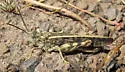
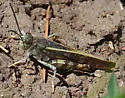
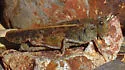
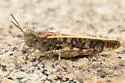
Photo credits: Contributed by David J. Ferguson
Frequently Asked Questions About Sierra Grasshopper
What is Sierra Grasshopper?
Sierra Grasshopper (Xanthippus sierra) is a species in the family Acrididae, within the order Orthoptera.
How do you identify Sierra Grasshopper?
| Feature | Description |
|---|---|
| Additional details | Usually appearing dark brownish or sometimes grayish in color, lighter on sides and below than above. Tegmina dark brown, or sometimes lighter with irregular dark spots (especially southward), with two pale yellowish stripes along top edges of folded tegmina. |
| Wings | Wings red (mostly south of Yosemite NP), yellow (mostly north from Yosemite NP), or orange (mostly where yellow and red meet in the central Sierra Nevada); with dark band usually (? always) narrow and running close to wing margin but with apex mostly clear. Outer hind femur with distinct alternating light and dark diagonal cross bands (dark ones widest near top); inner hind femur yellowish with dark cross bands (sometimes reddish). Hind tibia (and often all tibiae) yellowish, sometimes varying to orange, or hind tibia sometimes red on inner side. |
| Pronotum | Pronotum with lateral lobes with front and back margins usually roughly parallel, sometimes widening somewhat downward. Found mostly in mountains, often at high elevation, and even above timberline. Adults in summer and autumn (usually maturing at the end of June or in July). Male Agymnastus are very similar, but occur mostly in earlier in spring and have the lower flange of the hind femur broader and often prominently expanded (relative slender in X. sierra . Cratypedes neglectus has lateral lobes of pronotum distinctly wider toward the bottom, and wings always yellow with usually a very wide bold dark border (and often the tip of the wings are dark). X. lateritius can be similar, but usually more grizzled in appearance with a more irregular pattern, often lacking the pale stripes, and with the pronotum usually much rougher in texture. It occurs in spring, and mostly at lower elevations in Sagebrush country. Other similar species occur at lower elevations, and are adult in late winter and spring (usually gone by July), and mostly they are larger in size and different in coloring. |
Where is Sierra Grasshopper found?
Range: California: Sierra Nevada and Cascades from Kern County to Shasta County and White/Inyo Mountains in Mono and Inyo Counties. Probably also in higher mountains of westernmost Nevada from the Carson Range to the White Mountains.
When is Sierra Grasshopper active?
Sierra Grasshopper: seasonal activity - Apparently overwinters as eggs, hatching in spring, with adults first appearing mostly in the last week of June or early July. Often still abundant in September with some living into October..