
Green Bird Grasshopper
Schistocerca shoshone
This record describes Schistocerca shoshone (species). Recorded family: Acrididae. Recorded order: Orthoptera.
Identification and Appearance
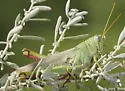
Nearly solid green in color, usually rather pale and dull; eyes usually blue (when alive); usually lacking yellowish dots on thorax, yellowish spot on side of thorax, and pale mid-dorsal stripe (stripe may be faintly developed on pronotum and head); mostly lacking black markings, except on knee of hind femur and sometimes sutures and sulci on sides and tops of pronotum and thorax (faint bluish markings may sometimes occur where other blackish markings usually occur on related species); male fore femur and middle femur inflated.
Classification
- Kingdom
- Animalia
- Phylum
- Arthropoda
- Class
- Insecta
- Order
- Orthoptera (Grasshoppers, Crickets, Katydids)
- Suborder
- Caelifera
- Family
- Acrididae (Short-horned Grasshoppers)
- Subfamily
- Cyrtacanthacridinae
- Genus
- Schistocerca (Bird Grasshoppers)
Imported taxonomy record. Source availability varies; see the source references and editorial policy below.
Habitat and Range
Habitat
Mostly streamside (riparian) habitats in desert regions; also frequently found in tall lush vegetation in agricultural and residential areas.
Geographic Range
Trans-Pecos Texas, New Mexico, sw. Utah, s. Nevada, s. California, south into northern Mexico.
Seasonal Activity
June or July into late autumn or early winter.
Diet and Behavior
Diet: prefers various woody plants; adults stay on an individual host plant for most of the day, remaining motionless when not feeding Highly polyphagous as a species but populations are monophagous. The difference is probably based on genetic differences between the insects.
Life History
one generation per year; eggs hatch over an extended period in spring and early summer; late instar nymphs and adults are seen by June, and these gradually die through the late summer, some often lasting into November or even December.
Additional species information
Species notes from the sources
Etymology: After Dirsh's publication in 1974, treated as a subspecies Schistocerca alutacea shoshone , but originaly described at species rank by Thomas in 1873 and treated again at species level by more recent authors. [see Internet References section below]
About Grasshoppers, Crickets, Katydids: the wider group
Order-level background for Orthoptera, the group containing Schistocerca shoshone. Species-specific details appear above.
Group overview
Orthoptera includes ~28,000 described species of grasshoppers, crickets, and katydids. Desert locusts can form swarms covering 460 square miles containing up to 80 million individuals per square kilometer.
Ecological role of the group
Grasshoppers and crickets are a primary food source for birds, reptiles, and small mammals. Cricket farming is a growing industry - crickets require 12× less feed than cattle to produce the same amount of protein, using 2,000× less water.
Economic and practical significance of the group
A single large locust swarm can consume the same amount of food in one day as 35,000 people. The 2019-2021 East Africa locust crisis affected food security for 42 million people across multiple countries. Global crop losses from locusts can reach billions annually.
Recorded sources for this group: FAO, UN World Food Programme, research publications. Imported estimates may describe particular regions or reporting periods.
Photos of Green Bird Grasshopper (5)
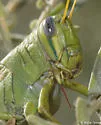
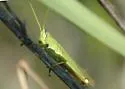
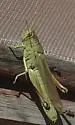
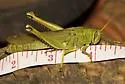
Photo credits: Contributed by Robin McLeod; Additional contributions by David Ferguson , KenW , Marci Hess
Frequently Asked Questions About Green Bird Grasshopper
What is Green Bird Grasshopper?
Green Bird Grasshopper (Schistocerca shoshone) is a species in the family Acrididae, within the order Orthoptera.
How do you identify Green Bird Grasshopper?
Nearly solid green in color, usually rather pale and dull; eyes usually blue (when alive); usually lacking yellowish dots on thorax, yellowish spot on side of thorax, and pale mid-dorsal stripe (stripe may be faintly developed on pronotum and head); mostly lacking black markings, except on knee of hind femur and sometimes sutures and sulci on sides and tops of pronotum and thorax (faint bluish markings may sometimes occur where other blackish markings usually occur on related species); male fore femur and middle femur inflated.
Where is Green Bird Grasshopper found?
| Feature | Details |
|---|---|
| Habitat | Mostly streamside (riparian) habitats in desert regions; also frequently found in tall lush vegetation in agricultural and residential areas. |
| Range | Trans-Pecos Texas, New Mexico, sw. Utah, s. Nevada, s. California, south into northern Mexico. |
What does Green Bird Grasshopper eat?
The diet of the Green Bird Grasshopper includes prefers various woody plants; adults stay on an individual host plant for most of the day, remaining motionless when not feeding Highly polyphagous as a species but populations are monophagous. The difference is probably based on genetic differences between the insects..
When is Green Bird Grasshopper active?
Green Bird Grasshopper: seasonal activity - June or July into late autumn or early winter..
What is the life cycle of a Green Bird Grasshopper?
one generation per year; eggs hatch over an extended period in spring and early summer; late instar nymphs and adults are seen by June, and these gradually die through the late summer, some often lasting into November or even December.