
Trimerotropis pallidipennis-B
Trimerotropis pallidipennis-b
This record describes Trimerotropis pallidipennis-b (species). Recorded family: Acrididae. Recorded order: Orthoptera.
Identification and Appearance
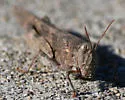
Differs (at least on average) from regular Trimerotropis pallidipennis in having proportionately shorter wings, wider hind wings, wider dark band across hind wing, and proportionately slightly larger head. The over-all size averages smaller, but is well within the range exhibited by typical T. pallidipennis . It is likely that more specimens of this type are represented among those still posted under the name T. pallidipennis here on BugGuide. It is also possible that some of those posted here now (but without hind wings showing) are really typical T. pallidipennis ; there is no way to be absolutely certain without seeing at least the hind wings, though better would be examining the actual specimens. These insects need more detailed study to determine their exact relationship to T. pallidipennis and their level of distinction. This should be regarded as a tentative category.
Classification
- Kingdom
- Animalia
- Phylum
- Arthropoda
- Class
- Insecta
- Order
- Orthoptera (Grasshoppers, Crickets, Katydids)
- Suborder
- Caelifera
- Family
- Acrididae (Short-horned Grasshoppers)
- Subfamily
- Oedipodinae
- Tribe
- Trimerotropini
- Genus
- Trimerotropis
Imported taxonomy record. Source availability varies; see the source references and editorial policy below.
Habitat and Range
Habitat
Varied, usually open sunny exposed areas that are not too steeply sloping. Often common on rocky or gravelly alluvial areas, along back side of beaches, and among low hills. In the south mostly within about 50 or 60 miles of the coast, but further north reaching through the Sierra Nevada and Cascades to the west edge of the Modoc Plateau / Great Basin.
Geographic Range
near Pacific Coast from Baja California north to at least southern Oregon, and perhaps to Victoria Island and Vancouver in British Columbia (see those placed in type "C").
Seasonal Activity
Eggs hatch in spring, with the first adults maturing in some southern locations as early as May, but later in most areas. Mostly uncommon by October, but occasional adults survive at least into November.
Additional species information
Species notes from the sources
Etymology: This is a temporary (and tentative) name designation to give a separate heading for these somewhat different insects. It is likely that this type of insect has actually received a name [see above], but it is difficult to determine which, if any of the "synonyms" of T. pallidipennis might apply here without examining the type specimens of each name (which in more than one instance do not exist). Only one name, T. pilosa McNeill, seems a likely candidate though. This form was considered as a part of an expanded definition of Trimerotropis diversellus by Daniel Otte in his 1984 book, along with certain other populations from the northern Plains that are perhaps referable to T. salina . However, the "species" T. diversellus was described from Yellowstone National Park from high elevation, and it is associated with white rock and gravel deposits and outcroppings (most often deposits left by geysers and mineral hot springs). T. diversellus as found at it's type locality is a smaller insect much more like T. saxatilis (and likely not distinct from that species). The Pacific coastal insects occur in more varied habitats, are larger in size than T. diversellus , and can be difficult to segregate from typical T. pallidipennis (especially in photos not showing the open hind wing). The two often occur alongside of one another in the same habitats. It is not clear if this is a distinct species from T. pallidipennis , or simply a regional variant, nor is it even clear if perhaps the two interbreed, or remain completely distinct from each other. This type of insect has mostly been ignored taxonomically, except by Otte, and it clearly needs more study. There are perhaps some seasonal and behavioral distinctions as well, but this also is not clear.
About Grasshoppers, Crickets, Katydids: the wider group
Order-level background for Orthoptera, the group containing Trimerotropis pallidipennis-b. Species-specific details appear above.
Group overview
Orthoptera includes ~28,000 described species of grasshoppers, crickets, and katydids. Desert locusts can form swarms covering 460 square miles containing up to 80 million individuals per square kilometer.
Ecological role of the group
Grasshoppers and crickets are a primary food source for birds, reptiles, and small mammals. Cricket farming is a growing industry - crickets require 12× less feed than cattle to produce the same amount of protein, using 2,000× less water.
Economic and practical significance of the group
A single large locust swarm can consume the same amount of food in one day as 35,000 people. The 2019-2021 East Africa locust crisis affected food security for 42 million people across multiple countries. Global crop losses from locusts can reach billions annually.
Recorded sources for this group: FAO, UN World Food Programme, research publications. Imported estimates may describe particular regions or reporting periods.
Photos of Trimerotropis pallidipennis-B (5)
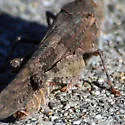
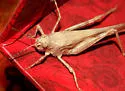
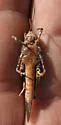
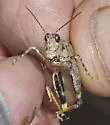
Photo credits: Contributed by David J. Ferguson
Frequently Asked Questions About Trimerotropis pallidipennis-B
What is Trimerotropis pallidipennis-B?
Trimerotropis pallidipennis-B (Trimerotropis pallidipennis-b) is a species in the family Acrididae, within the order Orthoptera.
How do you identify Trimerotropis pallidipennis-B?
Differs (at least on average) from regular Trimerotropis pallidipennis in having proportionately shorter wings, wider hind wings, wider dark band across hind wing, and proportionately slightly larger head. The over-all size averages smaller, but is well within the range exhibited by typical T. pallidipennis .
Where is Trimerotropis pallidipennis-B found?
| Feature | Details |
|---|---|
| Habitat | Varied, usually open sunny exposed areas that are not too steeply sloping. Often common on rocky or gravelly alluvial areas, along back side of beaches, and among low hills. In the south mostly within about 50 or 60 miles of the coast, but further north reaching through the Sierra Nevada and Cascades to the west edge of the Modoc Plateau / Great Basin. |
| Range | near Pacific Coast from Baja California north to at least southern Oregon, and perhaps to Victoria Island and Vancouver in British Columbia (see those placed in type C). |
When is Trimerotropis pallidipennis-B active?
Trimerotropis pallidipennis-B: seasonal activity - Eggs hatch in spring, with the first adults maturing in some southern locations as early as May, but later in most areas. Mostly uncommon by October, but occasional adults survive at least into November..