
Spotted Bird Grasshopper
Schistocerca lineata
This record describes Schistocerca lineata (species). Recorded family: Acrididae. Recorded order: Orthoptera.
Identification and Appearance
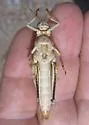
In Wyoming, Colorado and New Mexico the typical form blends with the green western form that was formerly most often known as S. venusta ; with green venusta occurring mostly in and west of the Rockies, and typical brownish lineata eastward from the mountains. Southward, the venusta type overlaps distribution with S. shoshone , yet remains distinct, and behave as a species biologically separate from it. There is an aposematic form , which is yellowish with contrasting dark, often blackish or bluish markings that is found in Oklahoma and Texas (and perhaps in adjacent Tamaulipas), and which is given it's own heading here. In fact there seem to be two distinct aposematic forms that differ in color pattern. Intermediates between normal coloring and the aposematic form are not uncommon, and may resemble S. obscura ; however, the contrasting yellowish and dark coloring, and often blue eyes (along with swollen front and middle femora in males) are usually enough to separate them from that species. This form has also been confused with S. albolineata , but occurs further to the east, and is different in color pattern and morphology. In the northeastern U.S. there is a form in which the coloring is often much like that of S. rubiginosa , but with the morphology of S. lineata . This northeastern form tends to be rather smallish with wings shorter than average, and seems to favor open sandy habitats in places such as pine barrens and along the coast. Inland, it is difficult to decide where this form ends and typical lineata begins. There is probably also confusion with both S. alutacea and S. rubiginosa .
Classification
- Kingdom
- Animalia
- Phylum
- Arthropoda
- Class
- Insecta
- Order
- Orthoptera (Grasshoppers, Crickets, Katydids)
- Suborder
- Caelifera
- Family
- Acrididae (Short-horned Grasshoppers)
- Subfamily
- Cyrtacanthacridinae
- Genus
- Schistocerca (Bird Grasshoppers)
Imported taxonomy record. Source availability varies; see the source references and editorial policy below.
Habitat and Range
Habitat
Often abundant in sandy areas but is also frequently found in other sunny, well-vegetated habitats such as shrubland, riparian areas, ditch-banks, etc. Rarely found in forested or desert environments, but enters these areas where acceptable habitats occur with them.
Geographic Range
This is the most widely distributed species of Schistocerca in North America , occurring from California, Oregon, and Washington east to the northern U.S. Atlantic Coast, and from southern Canada to Texas and northern Mexico. There are differences quoted in the literature as to it's eastern limits, probably based entirely on confusion between S. lineata and other species. Song examined specimens collected from Arizona, Arkansas, Connecticut, Colorado, Delaware, Georgia, Indiana, Illinois, Idaho, Iowa, Kansas, Kentucky, Massachusetts, Maryland, Michigan, Minnesota, Mississippi, Nebraska, New Jersey, New Hampshire, New Mexico, New York, North Dakota, Ohio, Oklahoma, Rhode Island, South Dakota, Texas, Utah, Virginia, and Wisconsin. Its distribution extends north to Manitoba and Alberta, Canada. (From internet source #1) To this list can also be added: Alberta, Baja California, California, Chihuahua, Louisiana, Manitoba, Missouri, Nevada, North Carolina, Pennsylvania, Saskatchewan, Sonora, Washington, West Virginia, and perhaps others.
Diet and Behavior
Life History
Overwinters as eggs in soil, hatches in late spring, and usually matures in about June or July. Most abundant as adults in summer, but many live until hard freezes of autumn or early winter finally kill them. Some individuals in far south survive until the following spring, but not so often seen in winter as are some other species.
About Grasshoppers, Crickets, Katydids: the wider group
Order-level background for Orthoptera, the group containing Schistocerca lineata. Species-specific details appear above.
Group overview
Orthoptera includes ~28,000 described species of grasshoppers, crickets, and katydids. Desert locusts can form swarms covering 460 square miles containing up to 80 million individuals per square kilometer.
Ecological role of the group
Grasshoppers and crickets are a primary food source for birds, reptiles, and small mammals. Cricket farming is a growing industry - crickets require 12× less feed than cattle to produce the same amount of protein, using 2,000× less water.
Economic and practical significance of the group
A single large locust swarm can consume the same amount of food in one day as 35,000 people. The 2019-2021 East Africa locust crisis affected food security for 42 million people across multiple countries. Global crop losses from locusts can reach billions annually.
Recorded sources for this group: FAO, UN World Food Programme, research publications. Imported estimates may describe particular regions or reporting periods.
Photos of Spotted Bird Grasshopper (5)
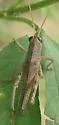
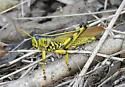
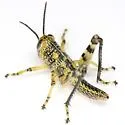
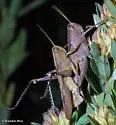
Photo credits: Contributed by Tom Bentley; Additional contributions by Mike Quinn , David Ferguson , metrioptera
Frequently Asked Questions About Spotted Bird Grasshopper
What is Spotted Bird Grasshopper?
Spotted Bird Grasshopper (Schistocerca lineata) is a species in the family Acrididae, within the order Orthoptera.
How big is Spotted Bird Grasshopper?
Male. Medium size (TL 32-50 mm), Female. Much larger than Male (TL 45-69 mm).
Where is Spotted Bird Grasshopper found?
| Feature | Details |
|---|---|
| Habitat | Often abundant in sandy areas but is also frequently found in other sunny, well-vegetated habitats such as shrubland, riparian areas, ditch-banks, etc. Rarely found in forested or desert environments, but enters these areas where acceptable habitats occur with them. |
| Range | This is the most widely distributed species of Schistocerca in North America , occurring from California, Oregon, and Washington east to the northern U.S. Atlantic Coast, and from southern Canada to Texas and northern Mexico. There are differences quoted in the literature as to it's eastern limits, probably based entirely on confusion between S. lineata and other species. Song examined specimens collected from Arizona, Arkansas, Connecticut, Colorado, Delaware, Georgia, Indiana, Illinois, Idaho, Iowa, Kansas, Kentucky, Massachusetts, Maryland, Michigan, Minnesota, Mississippi, Nebraska, New Jersey, New Hampshire, New Mexico, New York, North Dakota, Ohio, Oklahoma, Rhode Island, South Dakota, Texas, Utah, Virginia, and Wisconsin. Its distribution extends north to Manitoba and Alberta, Canada. (From internet source #1) To this list can also be added: Alberta, Baja California, California, Chihuahua, Louisiana, Manitoba, Missouri, Nevada, North Carolina, Pennsylvania, Saskatchewan, Sonora, Washington, West Virginia, and perhaps others. |
What is the life cycle of a Spotted Bird Grasshopper?
Overwinters as eggs in soil, hatches in late spring, and usually matures in about June or July. Most abundant as adults in summer, but many live until hard freezes of autumn or early winter finally kill them. Some individuals in far south survive until the following spring, but not so often seen in winter as are some other species.