
Masked Grasshopper
Trimerotropis cincta
This record describes Trimerotropis cincta (species). Recorded family: Acrididae. Recorded order: Orthoptera.
Identification and Appearance
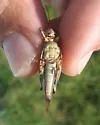
Relatively small, distinct sharply defined dark cross bands on tegmina usually don't cross top as seen when folded. Wings relatively narrow, transparent yellow, usually with a greenish tinge, and with dark band narrow and curving. Often with dark cloudy coloring near tip of wing. Face with a mask created by blackish lines crossing face. Hind tibiae blue (sometimes yellow or green east from Continental Divide), pale at base, often with a darker ring near the base. Usually found in open conifer woodland and forest, or at least near trees, usually in grassy patches under or between trees. Produces a not too loud, usually interrupted, buzzing sound in flight. T. fontana and T. koebelei are probably merely regional variants or subspecies of T. cincta and differ only in coloration. T. koebelei is distinguished from T. cincta only by its more western distribution, from southern Washington through California. However, it does average lighter and more strongly contrasting in coloring. It is probably the same species, but is currently usually treated as distinct. T. fontana differs in lacking the mask across the face (usually), averaging less contrasting in coloration, and in occurring primarily further west. T. fontana and T. cincta intergrade freely where their ranges overlap, and many individuals in these areas are not clearly one nor the other. Conozoa species may look similar, but usually occur in different habitats, hind tibia color varies, but may be orange or red (not orange or red in T. cincta ), and usually have the rear lower angles of the pronotum projecting downward to a corner or toothed (rounded in T. cincta ). Usually the dark tegminal bands are limited to the coastal half or less (when folded - the lower edge); normally more than half in T. cincta .
Classification
- Kingdom
- Animalia
- Phylum
- Arthropoda
- Class
- Insecta
- Order
- Orthoptera (Grasshoppers, Crickets, Katydids)
- Suborder
- Caelifera
- Family
- Acrididae (Short-horned Grasshoppers)
- Subfamily
- Oedipodinae
- Tribe
- Trimerotropini
- Genus
- Trimerotropis
Imported taxonomy record. Source availability varies; see the source references and editorial policy below.
Habitat and Range
Habitat
Most often found in "Montane/Tranzition" Zone areas, in openings of wooded and forested areas, sometimes in areas of tall shrub thickets such as Gambel Oak or Cliffrose. Typically, but not always, in association with Pines. Generally there will be open grassy areas and brush present. When disturbed, this species (and closely related T. fontana ) will often fly into or through the brush. When areas have been cleared of brush and small trees, this species will most often disappear from the area.
Geographic Range
Primarily in the Rocky Mountains from British Columbia and Alberta south to Arizona and southern New Mexico. Also in Black Hills and Pine Ridge region of Wyoming, Nebraska, and South Dakota. Blending with T. fontana toward the west side of the Rockies in Arizona, Utah, Idaho, Montana, and British Columbia. Occasionally individuals fit T. fontana throughout the range of T. cincta and visa-versa.
About Grasshoppers, Crickets, Katydids: the wider group
Order-level background for Orthoptera, the group containing Trimerotropis cincta. Species-specific details appear above.
Group overview
Orthoptera includes ~28,000 described species of grasshoppers, crickets, and katydids. Desert locusts can form swarms covering 460 square miles containing up to 80 million individuals per square kilometer.
Ecological role of the group
Grasshoppers and crickets are a primary food source for birds, reptiles, and small mammals. Cricket farming is a growing industry - crickets require 12× less feed than cattle to produce the same amount of protein, using 2,000× less water.
Economic and practical significance of the group
A single large locust swarm can consume the same amount of food in one day as 35,000 people. The 2019-2021 East Africa locust crisis affected food security for 42 million people across multiple countries. Global crop losses from locusts can reach billions annually.
Recorded sources for this group: FAO, UN World Food Programme, research publications. Imported estimates may describe particular regions or reporting periods.
Photos of Masked Grasshopper (5)
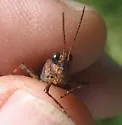
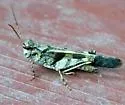
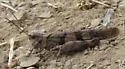
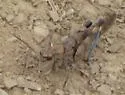
Photo credits: Contributed by Tom Bentley; Additional contributions by David Ferguson
Frequently Asked Questions About Masked Grasshopper
What is Masked Grasshopper?
Masked Grasshopper (Trimerotropis cincta) is a species in the family Acrididae, within the order Orthoptera.
How do you identify Masked Grasshopper?
Relatively small, distinct sharply defined dark cross bands on tegmina usually don't cross top as seen when folded. Wings relatively narrow, transparent yellow, usually with a greenish tinge, and with dark band narrow and curving. Often with dark cloudy coloring near tip of wing. Face with a mask created by blackish lines crossing face. Hind tibiae blue (sometimes yellow or green east from Continental Divide), pale at base, often with a darker ring near the base. Usually found in open conifer woodland and forest, or at least near trees, usually in grassy patches under or between trees. Produces a not too loud, usually interrupted, buzzing sound in flight. T. fontana and T. koebelei are probably merely regional variants or subspecies of T. cincta and differ only in coloration. T. koebelei is distinguished from T. cincta only by its more western distribution, from southern Washington through California. However, it does average lighter and more strongly contrasting in coloring. It is probably the same species, but is currently usually treated as distinct. T. fontana differs in lacking the mask across the face (usually), averaging less contrasting in coloration, and in occurring primarily further west. T. fontana and T. cincta intergrade freely where their ranges overlap, and many individuals in these areas are not clearly one nor the other. Conozoa species may look similar, but usually occur in different habitats, hind tibia color varies, but may be orange or red (not orange or red in T. cincta ), and usually have the rear lower angles of the pronotum projecting downward to a corner or toothed (rounded in T. cincta ). Usually the dark tegminal bands are limited to the coastal half or less (when folded - the lower edge); normally more than half in T. cincta .
Where is Masked Grasshopper found?
| Feature | Details |
|---|---|
| Habitat | Most often found in Montane/Tranzition Zone areas, in openings of wooded and forested areas, sometimes in areas of tall shrub thickets such as Gambel Oak or Cliffrose. Typically, but not always, in association with Pines. Generally there will be open grassy areas and brush present. When disturbed, this species (and closely related T. fontana ) will often fly into or through the brush. When areas have been cleared of brush and small trees, this species will most often disappear from the area. |
| Range | Primarily in the Rocky Mountains from British Columbia and Alberta south to Arizona and southern New Mexico. Also in Black Hills and Pine Ridge region of Wyoming, Nebraska, and South Dakota. Blending with T. fontana toward the west side of the Rockies in Arizona, Utah, Idaho, Montana, and British Columbia. Occasionally individuals fit T. fontana throughout the range of T. cincta and visa-versa. |