
Inyo Blue-wing Grasshopper
Trimerotropis leucophaea
This record describes Trimerotropis leucophaea (species). Recorded family: Acrididae. Recorded order: Orthoptera.
Identification and Appearance
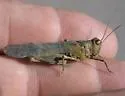
Like T. sparsa in most features, and perhaps only a regional variant of that species. Specimens were usually refered to that species or to T. cyaneipennis before the name leucophaea was published. The only differences that appear to be reliable are geographic distribution further west and (?always) blue hind tibiae [yellowish in T. sparsa ]. The head of T. leucophaea seems to average proportionately larger than in T. sparsa as well, and there is often blue coloring on the abdomen. T. leucophaea is mostly a rather plain brownish to grayish grasshopper. It has relatively long transparent blue hind wings, with the dark cross bands of the tegmina ill-defined and weak to not developed at all. T. cyaneipennis, T. arizonensis, & T. pseudofasciata , are also somewhat similar, but differ in proportions and all nearly always have well-defined contrasting tegminal cross bands. T. cyaneipennis & arizonensis both are usually smaller with proportionately shorter wings, and have the dark band of the hind wing usually darker and better developed, while T. pseudofasciata has the crest toward the front of the pronotum significantly more elevated than behind, and usually has a tooth at the lower rear angles of the sides of the pronotum (absent in the others).
Classification
- Kingdom
- Animalia
- Phylum
- Arthropoda
- Class
- Insecta
- Order
- Orthoptera (Grasshoppers, Crickets, Katydids)
- Suborder
- Caelifera
- Family
- Acrididae (Short-horned Grasshoppers)
- Subfamily
- Oedipodinae
- Tribe
- Trimerotropini
- Genus
- Trimerotropis
Imported taxonomy record. Source availability varies; see the source references and editorial policy below.
Habitat and Range
Habitat
Mid to high elevation exposed slopes and scree, little to sparse vegetation. In some sites may be associated with soft or eroded rocky soil in arroyos and canyons. Generally these ecozones are established with open Pinon-Juniper Woodland or Great Basin Scrub in mountain areas.
Geographic Range
Known from the Benton Range, White Mountains, and Panamint Range in southern Mono, Inyo, and northern San Bernardino Counties, California. Perhaps also further north near the west edge of the Great Basin in western Nevada and northeastern California to Lassen and Modoc Counties.
Seasonal Activity
Overwinters as eggs, with adults in summer (apparently mostly August & September).
About Grasshoppers, Crickets, Katydids: the wider group
Order-level background for Orthoptera, the group containing Trimerotropis leucophaea. Species-specific details appear above.
Group overview
Orthoptera includes ~28,000 described species of grasshoppers, crickets, and katydids. Desert locusts can form swarms covering 460 square miles containing up to 80 million individuals per square kilometer.
Ecological role of the group
Grasshoppers and crickets are a primary food source for birds, reptiles, and small mammals. Cricket farming is a growing industry - crickets require 12× less feed than cattle to produce the same amount of protein, using 2,000× less water.
Economic and practical significance of the group
A single large locust swarm can consume the same amount of food in one day as 35,000 people. The 2019-2021 East Africa locust crisis affected food security for 42 million people across multiple countries. Global crop losses from locusts can reach billions annually.
Recorded sources for this group: FAO, UN World Food Programme, research publications. Imported estimates may describe particular regions or reporting periods.
Photos of Inyo Blue-wing Grasshopper (5)
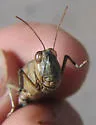
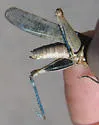
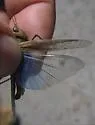
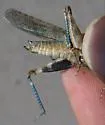
Photo credits: Contributed by David J. Ferguson; Additional contributions by James Bailey
Frequently Asked Questions About Inyo Blue-wing Grasshopper
What is Inyo Blue-wing Grasshopper?
Inyo Blue-wing Grasshopper (Trimerotropis leucophaea) is a species in the family Acrididae, within the order Orthoptera.
How do you identify Inyo Blue-wing Grasshopper?
Like T. sparsa in most features, and perhaps only a regional variant of that species. Specimens were usually refered to that species or to T. cyaneipennis before the name leucophaea was published. The only differences that appear to be reliable are geographic distribution further west and (?always) blue hind tibiae [yellowish in T. sparsa ]. The head of T. leucophaea seems to average proportionately larger than in T. sparsa as well, and there is often blue coloring on the abdomen. T. leucophaea is mostly a rather plain brownish to grayish grasshopper. It has relatively long transparent blue hind wings, with the dark cross bands of the tegmina ill-defined and weak to not developed at all. T. cyaneipennis, T. arizonensis, & T. pseudofasciata , are also somewhat similar, but differ in proportions and all nearly always have well-defined contrasting tegminal cross bands. T. cyaneipennis & arizonensis both are usually smaller with proportionately shorter wings, and have the dark band of the hind wing usually darker and better developed, while T. pseudofasciata has the crest toward the front of the pronotum significantly more elevated than behind, and usually has a tooth at the lower rear angles of the sides of the pronotum (absent in the others).
Where is Inyo Blue-wing Grasshopper found?
| Feature | Details |
|---|---|
| Habitat | Mid to high elevation exposed slopes and scree, little to sparse vegetation. In some sites may be associated with soft or eroded rocky soil in arroyos and canyons. Generally these ecozones are established with open Pinon-Juniper Woodland or Great Basin Scrub in mountain areas. |
| Range | Known from the Benton Range, White Mountains, and Panamint Range in southern Mono, Inyo, and northern San Bernardino Counties, California. Perhaps also further north near the west edge of the Great Basin in western Nevada and northeastern California to Lassen and Modoc Counties. |
When is Inyo Blue-wing Grasshopper active?
Inyo Blue-wing Grasshopper: seasonal activity - Overwinters as eggs, with adults in summer (apparently mostly August & September)..