
Helfer's Dune Grasshopper
Trimerotropis helferi
This record describes Trimerotropis helferi (species). Recorded family: Acrididae. Recorded order: Orthoptera.
Identification and Appearance
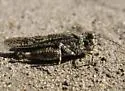
Rather wide-bodied and short-winged for a Trimerotropis , distinctly hairy (mostly sides and below). Coloring usually light grayish, covered with dark speckling and small spots, and with dark diagonal cross bands on hind femora. As seen with wings folded, there is commonly a pale mid-longitudinal stripe. Hind tibiae yellowish to brownish; hind wings clear, nearly colorless, but in good lighting a faint yellowish to greenish tinge may be seen, with narrow cloudy curved dark cross band. Similar in appearance to Microtes species, which occur further south along the coast in similar habitats. Microtes are even broader in proportions, with top of pronotum wider, flatter, and more sharply margined laterally; with wings often proportionately shorter; with dark portion of hind wing nearer to apex. Very well camouflaged in sand, and often very difficult to see. Often not noticed due to small size and inconspicuous coloration, even when flying. Males are alert, and even though flights are usually relatively short, they are quick difficult to approach. Females are equally alert, but often stay still rather than flying. They are somewhat clumsy fliers, and often choose to simply hop, rather than to take to the air, even when they do move away. They may be seen trying to bury themselves by kicking sand away with their legs. They can bury themselves rather quickly, apparently not just to sleep or avoid heat or cold, but also to hide.
Classification
- Kingdom
- Animalia
- Phylum
- Arthropoda
- Class
- Insecta
- Order
- Orthoptera (Grasshoppers, Crickets, Katydids)
- Suborder
- Caelifera
- Family
- Acrididae (Short-horned Grasshoppers)
- Subfamily
- Oedipodinae
- Tribe
- Trimerotropini
- Genus
- Trimerotropis
Imported taxonomy record. Source availability varies; see the source references and editorial policy below.
Habitat and Range
Habitat
Found on sand in coastal dune areas. Seems to be associated with dune inhabiting Artemisia species.
Geographic Range
Pacific Coast; recorded from Grays Harbor County in Washington to Mendocino County in California.
Diet and Behavior
Life History
Overwinters as eggs, hatching in spring or summer, with adults late June to mid October
Additional species information
Species notes from the sources
Etymology: This species strongly resembles members of Microtes in morphology, habitat choice, and behavior, and was moved to that genus by Otte. However, the similarities in appearance may be convergent adaptations to a sand habitat, and not due to close kinship. Based on chromosome configuration [with metacentric chromosomes], this species appears to belong within "Section B" of Trimerotropis as that genus is currently circumscribed. However, it is also possible that the chromosome similarities are coincidental (unlikely, but definitely possible), and that this really is a species of Microtes . A proper resolution of this question will require more study.
About Grasshoppers, Crickets, Katydids: the wider group
Order-level background for Orthoptera, the group containing Trimerotropis helferi. Species-specific details appear above.
Group overview
Orthoptera includes ~28,000 described species of grasshoppers, crickets, and katydids. Desert locusts can form swarms covering 460 square miles containing up to 80 million individuals per square kilometer.
Ecological role of the group
Grasshoppers and crickets are a primary food source for birds, reptiles, and small mammals. Cricket farming is a growing industry - crickets require 12× less feed than cattle to produce the same amount of protein, using 2,000× less water.
Economic and practical significance of the group
A single large locust swarm can consume the same amount of food in one day as 35,000 people. The 2019-2021 East Africa locust crisis affected food security for 42 million people across multiple countries. Global crop losses from locusts can reach billions annually.
Recorded sources for this group: FAO, UN World Food Programme, research publications. Imported estimates may describe particular regions or reporting periods.
Photos of Helfer's Dune Grasshopper (5)
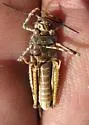
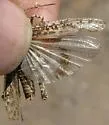
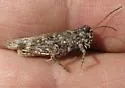
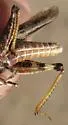
Photo credits: Contributed by David J. Ferguson
Frequently Asked Questions About Helfer's Dune Grasshopper
What is Helfer's Dune Grasshopper?
Helfer's Dune Grasshopper (Trimerotropis helferi) is a species in the family Acrididae, within the order Orthoptera.
How big is Helfer's Dune Grasshopper?
about 20 to 35 mm (females distinctly larger and stockier than males).
How do you identify Helfer's Dune Grasshopper?
Rather wide-bodied and short-winged for a Trimerotropis , distinctly hairy (mostly sides and below). Coloring usually light grayish, covered with dark speckling and small spots, and with dark diagonal cross bands on hind femora. As seen with wings folded, there is commonly a pale mid-longitudinal stripe. Hind tibiae yellowish to brownish; hind wings clear, nearly colorless, but in good lighting a faint yellowish to greenish tinge may be seen, with narrow cloudy curved dark cross band. Similar in appearance to Microtes species, which occur further south along the coast in similar habitats. Microtes are even broader in proportions, with top of pronotum wider, flatter, and more sharply margined laterally; with wings often proportionately shorter; with dark portion of hind wing nearer to apex.
Where is Helfer's Dune Grasshopper found?
| Feature | Details |
|---|---|
| Habitat | Found on sand in coastal dune areas. Seems to be associated with dune inhabiting Artemisia species. |
| Range | Pacific Coast; recorded from Grays Harbor County in Washington to Mendocino County in California. |
What is the life cycle of a Helfer's Dune Grasshopper?
Overwinters as eggs, hatching in spring or summer, with adults late June to mid October