
Pallid-winged Grasshopper
Trimerotropis pallidipennis
This record describes Trimerotropis pallidipennis (species). Recorded family: Acrididae. Recorded order: Orthoptera.
Identification and Appearance
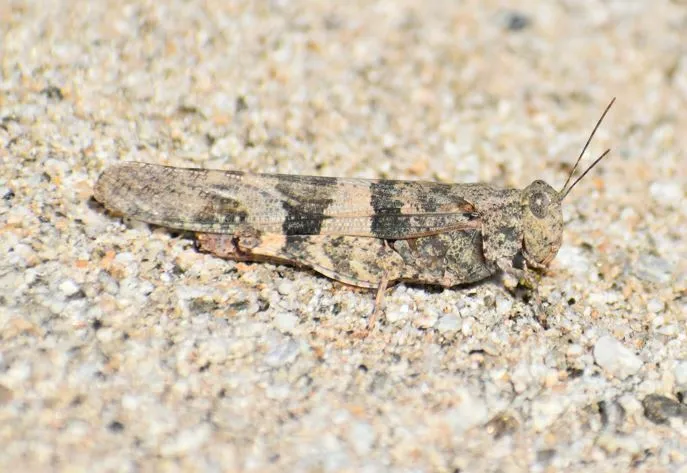
Variable, mostly gray or gray-brown. Note dark bands usually present on forewing, yellowish hind tibiae. Hind wings are long and narrow (roughly twice as long as wide), pale yellow, sometimes greenish or bluish at base, with dark band relatively narrow to quite narrow and curving around to or almost to the inner angle, and with a spur that reaches about half way to the base. Strong flier, it disperses widely and is sometimes found at lights in large numbers. Has periodic population booms when it can occur in large numbers. It is capable of extended flights, and appears sometimes (following thermals upward?) at very high elevations in the southern Rockies (to 12000 ft), even when there is still snow on the ground as early as March or April in the spring.
Wikipedia reference for Trimerotropis pallidipennis: http://en.wikipedia.org/wiki/Pallid-winged_grasshopper.
Classification
- Kingdom
- Animalia
- Phylum
- Arthropoda
- Class
- Insecta
- Order
- Orthoptera (Grasshoppers, Crickets, Katydids)
- Suborder
- Caelifera
- Family
- Acrididae (Short-horned Grasshoppers)
- Subfamily
- Oedipodinae
- Tribe
- Trimerotropini
- Genus
- Trimerotropis
Imported taxonomy record. Source availability varies; see the source references and editorial policy below.
Habitat and Range
Habitat
Most often grasslands and deserts, usually with some shrubs, and some bare ground. Occurs up to 8500 feet (or more), but generally found at lower elevations. May occur in weedy lots in cities. This particular species isn't picky and turns up all over the place in dry open habitats from sea level (along the Pacific, and in Patagonia along the Atlantic) to high in the mountains.
Geographic Range
Southern British Columbia, south through western United States into Mexico. Found also in South America. A stray swarm landed in Hawaii and persisted for a couple of years in the 1960's.
Seasonal Activity
June-October in northern part of range, all year farther south.
Diet and Behavior
Diet: Feeds on grasses and forbs.
Life History
In north overwinters as eggs laid in ground and matures in late spring or early summer and lasts until frost. Probably only one brood. South from Colorado and Utah it may produce two to several broods, and in mild winter areas (Albuquerque, Page, Kingman, and milder) overwinters in all stages.
Additional species information
Species notes from the sources
Etymology: Author of species is Burmeister.
About Grasshoppers, Crickets, Katydids: the wider group
Order-level background for Orthoptera, the group containing Trimerotropis pallidipennis. Species-specific details appear above.
Group overview
Orthoptera includes ~28,000 described species of grasshoppers, crickets, and katydids. Desert locusts can form swarms covering 460 square miles containing up to 80 million individuals per square kilometer.
Ecological role of the group
Grasshoppers and crickets are a primary food source for birds, reptiles, and small mammals. Cricket farming is a growing industry - crickets require 12× less feed than cattle to produce the same amount of protein, using 2,000× less water.
Economic and practical significance of the group
A single large locust swarm can consume the same amount of food in one day as 35,000 people. The 2019-2021 East Africa locust crisis affected food security for 42 million people across multiple countries. Global crop losses from locusts can reach billions annually.
Recorded sources for this group: FAO, UN World Food Programme, research publications. Imported estimates may describe particular regions or reporting periods.
Photos of Pallid-winged Grasshopper (3)
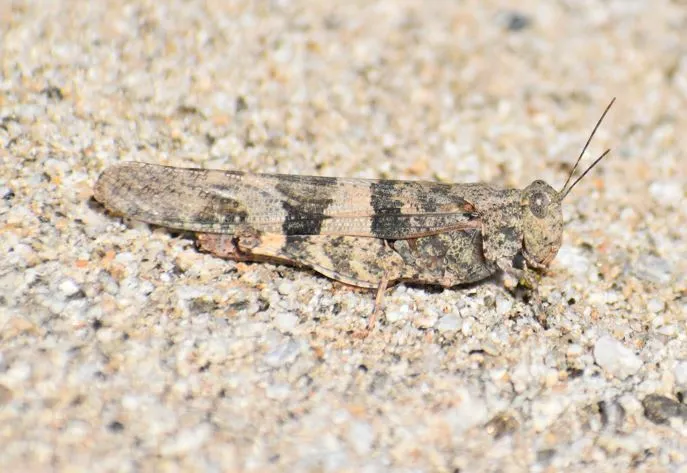
Photo credits: Contributed by Mike Boone; Additional contributions by cotinis , Bug Eric , David Ferguson
Frequently Asked Questions About Pallid-winged Grasshopper
What is Pallid-winged Grasshopper?
Pallid-winged Grasshopper (Trimerotropis pallidipennis) is a species in the family Acrididae, within the order Orthoptera.
How big is Pallid-winged Grasshopper?
| Feature | Details |
|---|---|
| Males | 25-35 mm |
| Females | 30-45 mm |
How do you identify Pallid-winged Grasshopper?
Variable, mostly gray or gray-brown. Note dark bands usually present on forewing, yellowish hind tibiae. Hind wings are long and narrow (roughly twice as long as wide), pale yellow, sometimes greenish or bluish at base, with dark band relatively narrow to quite narrow and curving around to or almost to the inner angle, and with a spur that reaches about half way to the base.
Where is Pallid-winged Grasshopper found?
| Feature | Details |
|---|---|
| Habitat | Most often grasslands and deserts, usually with some shrubs, and some bare ground. Occurs up to 8500 feet (or more), but generally found at lower elevations. May occur in weedy lots in cities. This particular species isn't picky and turns up all over the place in dry open habitats from sea level (along the Pacific, and in Patagonia along the Atlantic) to high in the mountains. |
| Range | Southern British Columbia, south through western United States into Mexico. Found also in South America. A stray swarm landed in Hawaii and persisted for a couple of years in the 1960's. |
What does Pallid-winged Grasshopper eat?
The diet of the Pallid-winged Grasshopper includes Feeds on grasses and forbs..
When is Pallid-winged Grasshopper active?
Pallid-winged Grasshopper: seasonal activity - June-October in northern part of range, all year farther south..
What is the life cycle of a Pallid-winged Grasshopper?
In north overwinters as eggs laid in ground and matures in late spring or early summer and lasts until frost. Probably only one brood. South from Colorado and Utah it may produce two to several broods, and in mild winter areas (Albuquerque, Page, Kingman, and milder) overwinters in all stages.