
Kiowa Grasshopper
Trachyrhachys kiowa
This record describes Trachyrhachys kiowa (species). Recorded family: Acrididae. Recorded order: Orthoptera.
Identification and Appearance
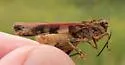
Smallish (largest in the Southwest), slender, with prominent broken ridges on top of smallish saddle-shaped pronotum, and with relatively large and prominent head (top of head is held above top of pronotum). Lateral lobes of pronotum produced down into a distinct angle at the rear. Folded wings with main veins on top raised and very prominent. Color pattern varies, but often with folded tegmina pale on top area, or with pale stripes along top margins. Sometimes green or partly so, often with pink markings. Wings transparent window-like with disk yellow, with curved dark band near middle and long dark spur; or, in much of Great Plains and Rocky Mountain region westward wings clear to yellow with no dark band. Hind femur slender, very slender in apical half, with inner side usually mostly black, pale at edges and crossed by one or two pale bands on half toward knee (one often chevron-shaped), sometimes mostly pale crossed by dark bands (again one often chevron-shaped). Hind tibiae most often blue, but varied and sometimes yellowish or brownish. Often a very common species, but even when abundant often not much noticed due to small size and the fact that they fly low and silently. The variation in pattern is often striking, with some individuals looking so unique as to be easily thought to be different species from the rest. Commonly comes to bright lights in numbers on warm moonless evenings.
Classification
- Kingdom
- Animalia
- Phylum
- Arthropoda
- Class
- Insecta
- Order
- Orthoptera (Grasshoppers, Crickets, Katydids)
- Suborder
- Caelifera
- Family
- Acrididae (Short-horned Grasshoppers)
- Subfamily
- Oedipodinae
- Tribe
- Psinidiini
- Genus
- Trachyrhachys
Imported taxonomy record. Source availability varies; see the source references and editorial policy below.
Habitat and Range
Habitat
Varied, but most often in open areas in with patchwork of grasses and bare ground in mostly flat or at least gentle terrain.
Geographic Range
Wide-ranging from southern New England and North Carolina west (south of the Great Lakes) to California into drier parts of southwest Canada, and south through most of Mexico. Absent from much of the Southeast (mostly coastal plain between North Carolina and Louisiana), from much of California, and from Baja California Norte.
Seasonal Activity
Apr-Nov in TX (BG data)
Diet and Behavior
Diet: The Kiowa grasshopper feeds almost exclusively on grasses and sedges. In the mixed-grass and short-grass prairies blue grama is its principal host, making up 84 to 100 percent of the diet. In other grasslands where blue grama occurs, it is again the preferred host plant. (Pfadt, 1994)
Life History
Overwinter as eggs, with adults from late spring or early summer until frost. Most common in most regions in early summer. In Southwest may produce two broods in one year, and often delays egg hatching until summer rains (making adults most common in some years in late summer or autumn).
Additional species information
Species notes from the sources
Etymology: The number of names and name recombinations given to this species are a testiment to how variable it is in color pattern and from region to region.
About Grasshoppers, Crickets, Katydids: the wider group
Order-level background for Orthoptera, the group containing Trachyrhachys kiowa. Species-specific details appear above.
Group overview
Orthoptera includes ~28,000 described species of grasshoppers, crickets, and katydids. Desert locusts can form swarms covering 460 square miles containing up to 80 million individuals per square kilometer.
Ecological role of the group
Grasshoppers and crickets are a primary food source for birds, reptiles, and small mammals. Cricket farming is a growing industry - crickets require 12× less feed than cattle to produce the same amount of protein, using 2,000× less water.
Economic and practical significance of the group
A single large locust swarm can consume the same amount of food in one day as 35,000 people. The 2019-2021 East Africa locust crisis affected food security for 42 million people across multiple countries. Global crop losses from locusts can reach billions annually.
Recorded sources for this group: FAO, UN World Food Programme, research publications. Imported estimates may describe particular regions or reporting periods.
Photos of Kiowa Grasshopper (5)
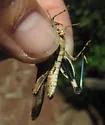
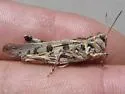
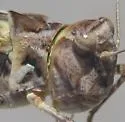
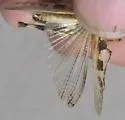
Photo credits: Contributed by Eric R. Eaton; Additional contributions by Robin McLeod , Mike Quinn , David Ferguson , Tyler Hedlund
Frequently Asked Questions About Kiowa Grasshopper
What is Kiowa Grasshopper?
Kiowa Grasshopper (Trachyrhachys kiowa) is a species in the family Acrididae, within the order Orthoptera.
How big is Kiowa Grasshopper?
18 to 40 mm (most often about 20 to 28 mm), with males smaller than females. Highly varied, usually smallish (about an inch - plus or minus), but in the Southwest (central NM to far west TX, and se. AZ) the largest females can reach 40 mm in a good season.
How do you identify Kiowa Grasshopper?
Smallish (largest in the Southwest), slender, with prominent broken ridges on top of smallish saddle-shaped pronotum, and with relatively large and prominent head (top of head is held above top of pronotum). Lateral lobes of pronotum produced down into a distinct angle at the rear. Folded wings with main veins on top raised and very prominent. Color pattern varies, but often with folded tegmina pale on top area, or with pale stripes along top margins. Sometimes green or partly so, often with pink markings. Wings transparent window-like with disk yellow, with curved dark band near middle and long dark spur; or, in much of Great Plains and Rocky Mountain region westward wings clear to yellow with no dark band. Hind femur slender, very slender in apical half, with inner side usually mostly black, pale at edges and crossed by one or two pale bands on half toward knee (one often chevron-shaped), sometimes mostly pale crossed by dark bands (again one often chevron-shaped). Hind tibiae most often blue, but varied and sometimes yellowish or brownish.
Where is Kiowa Grasshopper found?
| Feature | Details |
|---|---|
| Habitat | Varied, but most often in open areas in with patchwork of grasses and bare ground in mostly flat or at least gentle terrain. |
| Range | Wide-ranging from southern New England and North Carolina west (south of the Great Lakes) to California into drier parts of southwest Canada, and south through most of Mexico. Absent from much of the Southeast (mostly coastal plain between North Carolina and Louisiana), from much of California, and from Baja California Norte. |
What does Kiowa Grasshopper eat?
The diet of the Kiowa Grasshopper includes The Kiowa grasshopper feeds almost exclusively on grasses and sedges. In the mixed-grass and short-grass prairies blue grama is its principal host, making up 84 to 100 percent of the diet. In other grasslands where blue grama occurs, it is again the preferred host plant. (Pfadt, 1994).
When is Kiowa Grasshopper active?
Kiowa Grasshopper: seasonal activity - Apr-Nov in TX (BG data).
What is the life cycle of a Kiowa Grasshopper?
Overwinter as eggs, with adults from late spring or early summer until frost. Most common in most regions in early summer. In Southwest may produce two broods in one year, and often delays egg hatching until summer rains (making adults most common in some years in late summer or autumn).