
Thomas' Slender Grasshopper
Trimerotropis gracilis
This record describes Trimerotropis gracilis (species). Recorded family: Acrididae. Recorded order: Orthoptera.
Identification and Appearance
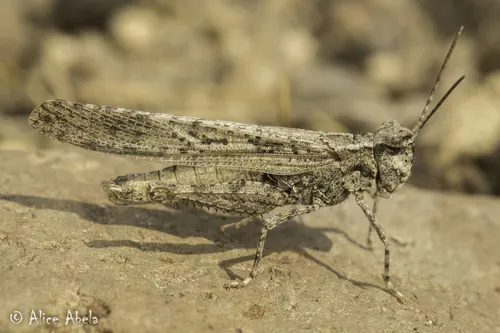
Confused badly in the literature with a similar, but different species (see Trimerotropis unnamed species A). T. gracilis is distinguished from the other by having hind wings distinctly yellow with a prominent dark cross band. The wings are usually longer. And, it ticks loudly when it flies. The unnamed species has nearly clear wings tinted bluish, greenish, or most often yellowish, with no band or a blurred indication of one. It makes a pulsed crackling sound when it flies, and it flies faster and further. Relationships between the two types need further study. Trimerotropis sparsa is somewhat similar, especially east from the Rockies where it may have yellow hind wings and a dark band across the wings. The hind wings of T. sparsa are generally more slender. T. sparsa is less strongly sculptured on the head and pronotum with the shoulders of the pronotum rounded or nearly so, and not sharply angled as in T. gracilis . In T. gracilis the pronotum also has the median crest sharp and raised and bilobed on the front part (it is lower and much less pronounced on T. sparsa ). T. gracilis usually has a streaky speckled appearance, while T. sparsa does not. T. sparsa usually has dark bands at least faintly developed across the tegmina (front wings). In most areas T. sparsa has blue wings without a band, and T. gracilis has yellow with a dark band; however, wing coloring in T. sparsa is highly varied, especially in the Upper Rio Grande, upper Arkansas, and upper Missouri drainages. T. gracilis is a species primarily of sagebrush covered country in the Rocky Mountain and Colorado Plateaus regions, and occurs also in appropriate environments in the northern Great Plains.
Classification
- Kingdom
- Animalia
- Phylum
- Arthropoda
- Class
- Insecta
- Order
- Orthoptera (Grasshoppers, Crickets, Katydids)
- Suborder
- Caelifera
- Family
- Acrididae (Short-horned Grasshoppers)
- Subfamily
- Oedipodinae
- Tribe
- Trimerotropini
- Genus
- Trimerotropis
Imported taxonomy record. Source availability varies; see the source references and editorial policy below.
Habitat and Range
Habitat
Associated with Artemisia tridentata (sometimes other species of Artemisia ) in semiarid scrub to open woodland conditions, mostly in gentle terrain in mountainous regions.
Geographic Range
Northwestern Great Plains, Rocky Mountains, Colorado Plateaus from se. corner of British Columbia,s. Alberta & sw. Saskatchewan to n. Arizona and cent. New Mexico. East as far as sw. South Dakota and w. Nebraska.
Diet and Behavior
Diet: Possibly primarily Artemisia , but not verified.
Life History
Overwinter as eggs laid in the ground, hatching in spring, with adults late spring or summer to frost.
About Grasshoppers, Crickets, Katydids: the wider group
Order-level background for Orthoptera, the group containing Trimerotropis gracilis. Species-specific details appear above.
Group overview
Orthoptera includes ~28,000 described species of grasshoppers, crickets, and katydids. Desert locusts can form swarms covering 460 square miles containing up to 80 million individuals per square kilometer.
Ecological role of the group
Grasshoppers and crickets are a primary food source for birds, reptiles, and small mammals. Cricket farming is a growing industry - crickets require 12× less feed than cattle to produce the same amount of protein, using 2,000× less water.
Economic and practical significance of the group
A single large locust swarm can consume the same amount of food in one day as 35,000 people. The 2019-2021 East Africa locust crisis affected food security for 42 million people across multiple countries. Global crop losses from locusts can reach billions annually.
Recorded sources for this group: FAO, UN World Food Programme, research publications. Imported estimates may describe particular regions or reporting periods.
Photos of Thomas' Slender Grasshopper (2)
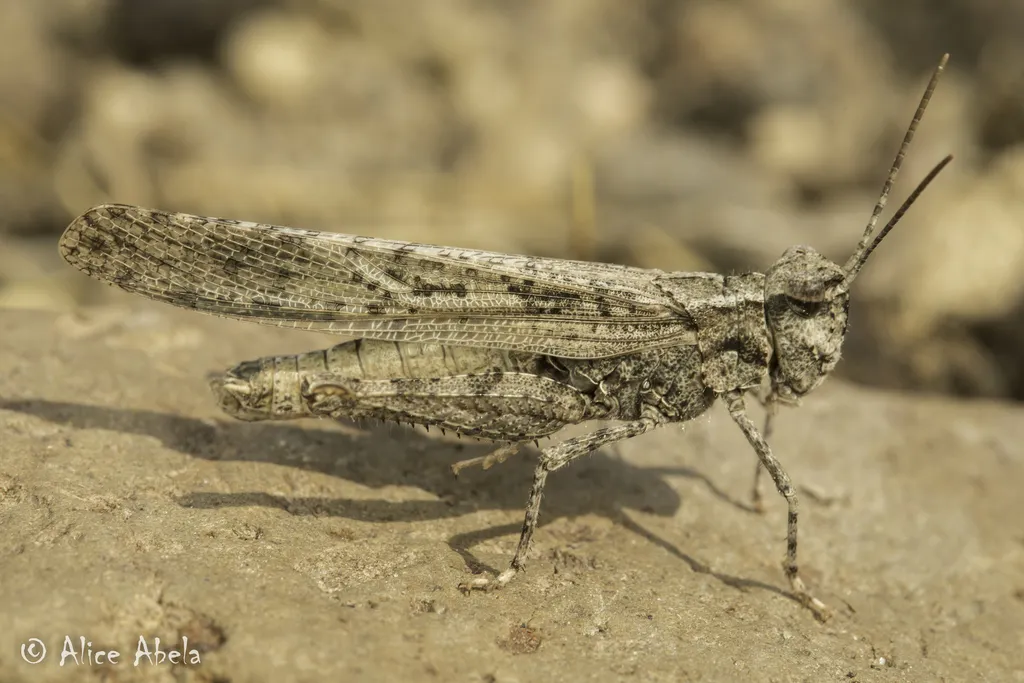
Photo credits: Contributed by Lynette Elliott; Additional contributions by David Ferguson
Frequently Asked Questions About Thomas' Slender Grasshopper
What is Thomas' Slender Grasshopper?
Thomas' Slender Grasshopper (Trimerotropis gracilis) is a species in the family Acrididae, within the order Orthoptera.
Where is Thomas' Slender Grasshopper found?
| Feature | Details |
|---|---|
| Habitat | Associated with Artemisia tridentata (sometimes other species of Artemisia ) in semiarid scrub to open woodland conditions, mostly in gentle terrain in mountainous regions. |
| Range | Northwestern Great Plains, Rocky Mountains, Colorado Plateaus from se. corner of British Columbia,s. Alberta & sw. Saskatchewan to n. Arizona and cent. New Mexico. East as far as sw. South Dakota and w. Nebraska. |
What does Thomas' Slender Grasshopper eat?
The diet of the Thomas' Slender Grasshopper includes Possibly primarily Artemisia , but not verified..
What is the life cycle of a Thomas' Slender Grasshopper?
Overwinter as eggs laid in the ground, hatching in spring, with adults late spring or summer to frost.