
Mottled Sand Grasshopper
Spharagemon collare
This record describes Spharagemon collare (species). Recorded family: Acrididae. Recorded order: Orthoptera.
Identification and Appearance
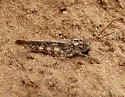
Shaped like Carolina Grasshoppers (pronotum with a fairly high crest, cut deeply once at an angle), but smaller, with red hind tibiae, proportionately shorter wings. Hind wings yellow with a curved black cross band. This one often makes a harsh fairly loud buzzing noise when it flies, and Carolinas don't. S. cristatum is basically identical, but averages larger, has a higher pronotal crest, and the hind angle of the pronotum on top is usually more acute. [The two species intergrade north to south where they meet, with S. cristatum replacing S. collare east of the Rockies in the south.] Other Spharagemon have lower pronotal crests; or, if close to as high (i.e. S. bolli ) it is cut perpendicularly. Other species may have a dark ring near the base of the hind tibiae, S. collare doesn't. Arphia species do not have red hind tibiae, and the dark band across the wings is closer to the outer margin (nearer the middle in Spharagemon ). Most populations are on sandy habitats and individuals tend to be speckled and mottled to match. Those with more plain patterning are most often found on less sandy sites, often with more vegetation. Coloring may vary from pale grays and browns to dark reddish or blackish hues, tending to match well the soil on which they are found. A collared form is common, in which the sides of the face, the rear half of the pronotum, and bands across the femora may be pale creamy or pinkish in color. This is particularly striking on otherwise dark-colored individuals. Several related species currently placed in Spharagemon , and Trimerotropis have similar color forms.
Classification
- Kingdom
- Animalia
- Phylum
- Arthropoda
- Class
- Insecta
- Order
- Orthoptera (Grasshoppers, Crickets, Katydids)
- Suborder
- Caelifera
- Family
- Acrididae (Short-horned Grasshoppers)
- Subfamily
- Oedipodinae
- Tribe
- Trimerotropini
- Genus
- Spharagemon
Imported taxonomy record. Source availability varies; see the source references and editorial policy below.
Habitat and Range
Habitat
Most any open sunny habitat with some bare ground will do; however, there is a definite preference for sandy grassland habitats. The species is often particularly common in sandy areas along river bottoms, in old sandy fields, and on dunes.
Geographic Range
Southern British Columbia, eastern Washington, Idaho, Utah, and Arizona east to the north Atlantic Coast (north from Virginia). In the west found through the Rocky Mountain region south through New Mexico and eastern Arizona perhaps to Chihuahua. East of the Rockies found roughly north of a line through eastern Colorado, Kansas, Missouri, and the Ohio Valley.
Seasonal Activity
Overwinters as eggs, hatching mostly late spring. Adults mostly in summer, but some until frost, and in southern locations sometimes common as early as late June.
Additional species information
Species notes from the sources
Etymology: An amazingly large number of name combinations and synonyms for a species that is not particularly varied. It seems to be a species that attracted a lot of attention among late nineteenth century entomologists.
About Grasshoppers, Crickets, Katydids: the wider group
Order-level background for Orthoptera, the group containing Spharagemon collare. Species-specific details appear above.
Group overview
Orthoptera includes ~28,000 described species of grasshoppers, crickets, and katydids. Desert locusts can form swarms covering 460 square miles containing up to 80 million individuals per square kilometer.
Ecological role of the group
Grasshoppers and crickets are a primary food source for birds, reptiles, and small mammals. Cricket farming is a growing industry - crickets require 12× less feed than cattle to produce the same amount of protein, using 2,000× less water.
Economic and practical significance of the group
A single large locust swarm can consume the same amount of food in one day as 35,000 people. The 2019-2021 East Africa locust crisis affected food security for 42 million people across multiple countries. Global crop losses from locusts can reach billions annually.
Recorded sources for this group: FAO, UN World Food Programme, research publications. Imported estimates may describe particular regions or reporting periods.
Photos of Mottled Sand Grasshopper (5)
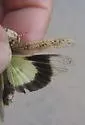
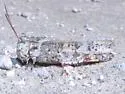
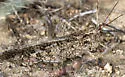
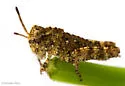
Photo credits: Contributed by Tom Bentley; Additional contributions by David Ferguson
Frequently Asked Questions About Mottled Sand Grasshopper
What is Mottled Sand Grasshopper?
Mottled Sand Grasshopper (Spharagemon collare) is a species in the family Acrididae, within the order Orthoptera.
How do you identify Mottled Sand Grasshopper?
Shaped like Carolina Grasshoppers (pronotum with a fairly high crest, cut deeply once at an angle), but smaller, with red hind tibiae, proportionately shorter wings. Hind wings yellow with a curved black cross band. This one often makes a harsh fairly loud buzzing noise when it flies, and Carolinas don't. S. cristatum is basically identical, but averages larger, has a higher pronotal crest, and the hind angle of the pronotum on top is usually more acute. [The two species intergrade north to south where they meet, with S. cristatum replacing S. collare east of the Rockies in the south.] Other Spharagemon have lower pronotal crests; or, if close to as high (i.e. S. bolli ) it is cut perpendicularly. Other species may have a dark ring near the base of the hind tibiae, S. collare doesn't. Arphia species do not have red hind tibiae, and the dark band across the wings is closer to the outer margin (nearer the middle in Spharagemon ).
Where is Mottled Sand Grasshopper found?
| Feature | Details |
|---|---|
| Habitat | Most any open sunny habitat with some bare ground will do; however, there is a definite preference for sandy grassland habitats. The species is often particularly common in sandy areas along river bottoms, in old sandy fields, and on dunes. |
| Range | Southern British Columbia, eastern Washington, Idaho, Utah, and Arizona east to the north Atlantic Coast (north from Virginia). In the west found through the Rocky Mountain region south through New Mexico and eastern Arizona perhaps to Chihuahua. East of the Rockies found roughly north of a line through eastern Colorado, Kansas, Missouri, and the Ohio Valley. |
When is Mottled Sand Grasshopper active?
Mottled Sand Grasshopper: seasonal activity - Overwinters as eggs, hatching mostly late spring. Adults mostly in summer, but some until frost, and in southern locations sometimes common as early as late June..