
Modest Grasshopper
Trimerotropis modesta
This record describes Trimerotropis modesta (species). Recorded family: Acrididae. Recorded order: Orthoptera.
Identification and Appearance
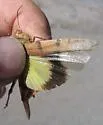
Habitat and distribution make confusion with most other species unlikely. The most similar is Spharagemon campestris , which occurs mostly further north, and which has a pattern usually more broken and irregular looking (see comments under that species). Trimerotropis pistrinaria has the pronotum more rounded on top with a much lower (even faint) median ridge, and usually is much more boldly and contrastingly patterned, with the band across the hind wing more curved and the tip less likely to be clouded with dark color. Trimerotropis californica has markings usually bolder and more contrasting, but if not there is a tooth at the lower rear margin of the sides of the pronotum that is usually present, but not in T. modesta . Spharagemon species that might occur with this species have a more roof-shaped pronotum (nearly flat in this species) with a higher carina (crest) that is cut only once (twice in this species). Trimerotropis tolteca from further south in Mexico is also very closely related, but usually more plainly marked with more blurry wing band, with the tip of the wing almost always dark, and with most of inner hind femur dark. In early literature, there was much confusion between various species of Trimerotropis and Spharagemon with red hind tibiae, and older records for several species are often questionable; many are definitely based on misidentified specimens. This species was often involved. Very closely related to Spharagemon campestris , and seems to take on some of the character of that species in the north where the two come close together. Perhaps they are variants of one species??? As with most related species mentioned, this species produces a relatively loud and harsh continuous crackling (or call it a buzzing) sound when it flies.
Classification
- Kingdom
- Animalia
- Phylum
- Arthropoda
- Class
- Insecta
- Order
- Orthoptera (Grasshoppers, Crickets, Katydids)
- Suborder
- Caelifera
- Family
- Acrididae (Short-horned Grasshoppers)
- Subfamily
- Oedipodinae
- Tribe
- Trimerotropini
- Genus
- Trimerotropis
Imported taxonomy record. Source availability varies; see the source references and editorial policy below.
Habitat and Range
Habitat
Mostly in mountain areas on gravelly grassy ground in open woodlands.
Geographic Range
Southern Mexico north in mountains to Utah and Colorado.
About Grasshoppers, Crickets, Katydids: the wider group
Order-level background for Orthoptera, the group containing Trimerotropis modesta. Species-specific details appear above.
Group overview
Orthoptera includes ~28,000 described species of grasshoppers, crickets, and katydids. Desert locusts can form swarms covering 460 square miles containing up to 80 million individuals per square kilometer.
Ecological role of the group
Grasshoppers and crickets are a primary food source for birds, reptiles, and small mammals. Cricket farming is a growing industry - crickets require 12× less feed than cattle to produce the same amount of protein, using 2,000× less water.
Economic and practical significance of the group
A single large locust swarm can consume the same amount of food in one day as 35,000 people. The 2019-2021 East Africa locust crisis affected food security for 42 million people across multiple countries. Global crop losses from locusts can reach billions annually.
Recorded sources for this group: FAO, UN World Food Programme, research publications. Imported estimates may describe particular regions or reporting periods.
Photos of Modest Grasshopper (5)
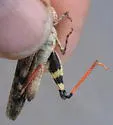
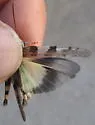
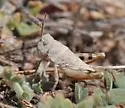
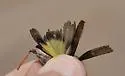
Photo credits: Contributed by Tom Bentley; Additional contributions by David Ferguson
Frequently Asked Questions About Modest Grasshopper
What is Modest Grasshopper?
Modest Grasshopper (Trimerotropis modesta) is a species in the family Acrididae, within the order Orthoptera.
How do you identify Modest Grasshopper?
Habitat and distribution make confusion with most other species unlikely. The most similar is Spharagemon campestris , which occurs mostly further north, and which has a pattern usually more broken and irregular looking (see comments under that species). Trimerotropis pistrinaria has the pronotum more rounded on top with a much lower (even faint) median ridge, and usually is much more boldly and contrastingly patterned, with the band across the hind wing more curved and the tip less likely to be clouded with dark color. Trimerotropis californica has markings usually bolder and more contrasting, but if not there is a tooth at the lower rear margin of the sides of the pronotum that is usually present, but not in T. modesta . Spharagemon species that might occur with this species have a more roof-shaped pronotum (nearly flat in this species) with a higher carina (crest) that is cut only once (twice in this species). Trimerotropis tolteca from further south in Mexico is also very closely related, but usually more plainly marked with more blurry wing band, with the tip of the wing almost always dark, and with most of inner hind femur dark. In early literature, there was much confusion between various species of Trimerotropis and Spharagemon with red hind tibiae, and older records for several species are often questionable; many are definitely based on misidentified specimens. This species was often involved.
Where is Modest Grasshopper found?
| Feature | Details |
|---|---|
| Habitat | Mostly in mountain areas on gravelly grassy ground in open woodlands. |
| Range | Southern Mexico north in mountains to Utah and Colorado. |