
Campestral Grasshopper
Spharagemon campestris
This record describes Spharagemon campestris (species). Recorded family: Acrididae. Recorded order: Orthoptera.
Identification and Appearance
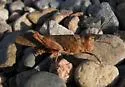
Similar to other Spharagemon , but differs in smaller size than most of those, smalish head and nearly flat top of pronotum with median ridge low and cut twice instead of (usually) once. Also, other species of Spharagemon have the inner side of the dark band on the hind wing curved, and it is usually nearly straight with the band not curving as far around the margin in S. campestris . Most similar to Trimerotropis modesta , differing primarily in coloration and favoring more open grassland habitats. T. modesta is generally not as speckled; usually has more sharply defined dark bands crossing tegmina, not as irregular or broken, often narrower, and with front band more angled in orientation. Hind femur has inside usually mostly black with yellow cross bands; in S. campestris ) usually orange, sometimes yellow, often but not always with dark markings. Hind wing with tip most often at least somewhat clouded dark in T. modesta , clear in S. campestris . T. modesta favors gravelly grassland and open woodland habitats, often on sloping ground, in mountains mostly south of the distribution of S. campestris . Other similar related Trimerotropis species include T. maritima, T. latifasciata, T. melanoptera , etc., which all differ in usually larger size, longer wings, details of coloration (wings, hind legs, etc.), and so on. In early literature, there was much confusion between various species of Trimerotropis and Spharagemon with red hind tibiae, and older records for several species are often questionable; many are definitely based on misidentified specimens. This species was often involved. Distinction of Spharagemon from Trimerotropis would seem simple, but a number of species, including this one, sit on the fence, and could go either way. This species was traditionally placed in Trimerotropis until relatively recently, and it's closest relatives (nearly identical in morphology and behavior) are T. modesta , and T. tolteca . Otte moved T. campestris to Spharagemon , which is reasonable, but the others remained in Trimerotropis . Other related species that are still included in Trimerotropis , but should perhaps be considered as species of Spharagemon (but with a low mid pronotal ridge) include T. pistrinaria, T. inconspicua , and perhaps T. bifasciata. Trimerotropis californica, pacifica, & topanga are also sitting on the fence, but favor the Trimerotropis side. Ironically, the type species of Trimerotropis (T. maritima ) is very closely related to these, and can be very similar to T. campestris as well (differing in larger size, usually yellow inner side of hind femur, and more curved band on longer hind wing). All of these species can be confused with one another and with Spharagemon equale , and have been variously confused and misidentified in many collections and publications. However, they usually can be recognized by certain fairly obvious characteristics, and Daniel Otte's book is very helpful in distinguishing them.
Classification
- Kingdom
- Animalia
- Phylum
- Arthropoda
- Class
- Insecta
- Order
- Orthoptera (Grasshoppers, Crickets, Katydids)
- Suborder
- Caelifera
- Family
- Acrididae (Short-horned Grasshoppers)
- Subfamily
- Oedipodinae
- Tribe
- Trimerotropini
- Genus
- Spharagemon
Imported taxonomy record. Source availability varies; see the source references and editorial policy below.
Habitat and Range
Habitat
Semiarid northern and (southward) high elevation grasslands. Often most abundant in slightly irregular areas in otherwise nearly flat terrain.
Geographic Range
Southwest US (southern New Mexico, central Arizona, to ne. California) to southern Canada (British Columbia, to Manitoba). Perhaps Trans Pecos Texas.
Seasonal Activity
Adults in summer to frost.
Diet and Behavior
Life History
Overwinters as eggs laid in ground.
About Grasshoppers, Crickets, Katydids: the wider group
Order-level background for Orthoptera, the group containing Spharagemon campestris. Species-specific details appear above.
Group overview
Orthoptera includes ~28,000 described species of grasshoppers, crickets, and katydids. Desert locusts can form swarms covering 460 square miles containing up to 80 million individuals per square kilometer.
Ecological role of the group
Grasshoppers and crickets are a primary food source for birds, reptiles, and small mammals. Cricket farming is a growing industry - crickets require 12× less feed than cattle to produce the same amount of protein, using 2,000× less water.
Economic and practical significance of the group
A single large locust swarm can consume the same amount of food in one day as 35,000 people. The 2019-2021 East Africa locust crisis affected food security for 42 million people across multiple countries. Global crop losses from locusts can reach billions annually.
Recorded sources for this group: FAO, UN World Food Programme, research publications. Imported estimates may describe particular regions or reporting periods.
Photos of Campestral Grasshopper (5)
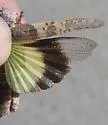
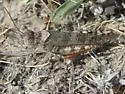
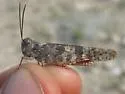
Photo credits: Contributed by Lynette Elliott; Additional contributions by David Ferguson
Frequently Asked Questions About Campestral Grasshopper
What is Campestral Grasshopper?
Campestral Grasshopper (Spharagemon campestris) is a species in the family Acrididae, within the order Orthoptera.
How do you identify Campestral Grasshopper?
Similar to other Spharagemon , but differs in smaller size than most of those, smalish head and nearly flat top of pronotum with median ridge low and cut twice instead of (usually) once. Also, other species of Spharagemon have the inner side of the dark band on the hind wing curved, and it is usually nearly straight with the band not curving as far around the margin in S. campestris . Most similar to Trimerotropis modesta , differing primarily in coloration and favoring more open grassland habitats. T. modesta is generally not as speckled; usually has more sharply defined dark bands crossing tegmina, not as irregular or broken, often narrower, and with front band more angled in orientation. Hind femur has inside usually mostly black with yellow cross bands; in S. campestris ) usually orange, sometimes yellow, often but not always with dark markings. Hind wing with tip most often at least somewhat clouded dark in T. modesta , clear in S. campestris . T. modesta favors gravelly grassland and open woodland habitats, often on sloping ground, in mountains mostly south of the distribution of S. campestris . Other similar related Trimerotropis species include T. maritima, T. latifasciata, T. melanoptera , etc., which all differ in usually larger size, longer wings, details of coloration (wings, hind legs, etc.), and so on. In early literature, there was much confusion between various species of Trimerotropis and Spharagemon with red hind tibiae, and older records for several species are often questionable; many are definitely based on misidentified specimens. This species was often involved.
Where is Campestral Grasshopper found?
| Feature | Details |
|---|---|
| Habitat | Semiarid northern and (southward) high elevation grasslands. Often most abundant in slightly irregular areas in otherwise nearly flat terrain. |
| Range | Southwest US (southern New Mexico, central Arizona, to ne. California) to southern Canada (British Columbia, to Manitoba). Perhaps Trans Pecos Texas. |
When is Campestral Grasshopper active?
Campestral Grasshopper: seasonal activity - Adults in summer to frost..
What is the life cycle of a Campestral Grasshopper?
Overwinters as eggs laid in ground.