
McNeill's White Grasshopper
Trimerotropis albescens
This record describes Trimerotropis albescens (species). Recorded family: Acrididae. Recorded order: Orthoptera.
Identification and Appearance
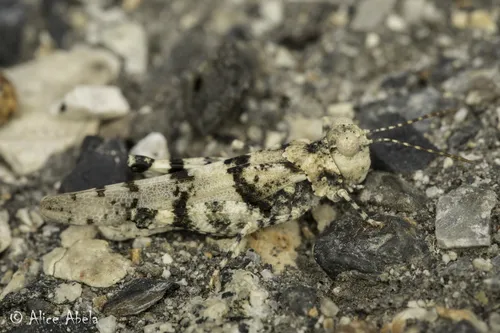
Varied color, usually pale whitish, but sometimes pinkish, reddish, brown, or even bluish. Small, with distinct narrow cross bands on the tegmina that cross over the top. The band closest to the wing base and the one in middle are further apart near the costal margin (bottom edge with wings folded) than at the anal margin (top when folded). The third band usually broken and irregular. Often with dark markings on the pronotum and often dark bands on on all of the femora. Hind tibia blue. Hind wings pale yellow with dark cross band often faded looking and not curving much if any around the outer margin of the wing toward the base. Pronotum with lower rear corners on side flared outward (best seen from above). Similar in coloration to T. incospicua (which is found mostly further east) and T. bifasciata (found mostly further west, and is stockier with top of pronotum more rounded and head larger), but differs from both in the flared out sides on the pronotum. The flight crepitation is an uninterrupted relatively loud and harsh buzzing (especially for the small size of the insect). T. arenacea and T. whitei are very similar in size and structurally, but are less strongly and sharply contrasing in coloration, and the cross bands of the tegmina are usually less developed. T. whitei has yellow to red hind tibiae. Both occur on sand further to the east. Can be confused with a few other small banded Trimerotropis with bluish hind tibiae, but most occur further west or (in south) can be distinguished by habitat preference, different behavior and lack of the flared out pronotum. Most often in those species the dark bands do not cross the top of the folded tegmina, but there are exceptions. Closely related to Trimerotropis arenacea and T. whitei , but those are from further east, and have different markings different ( T. albescens usually has more distinct bands across the tegmina and is smoother less speckled looking). It is likely, but unproven, that T. albescens intergrades with T. arenacea to the north and east, just as T. whitei likely blends with T. arenacea in Utah and Arizona. For some reason this species seems to not often be noticed, photographed, nor collected, even though it occurs in well-populated places such as the Los Angeles area.
Classification
- Kingdom
- Animalia
- Phylum
- Arthropoda
- Class
- Insecta
- Order
- Orthoptera (Grasshoppers, Crickets, Katydids)
- Suborder
- Caelifera
- Family
- Acrididae (Short-horned Grasshoppers)
- Subfamily
- Oedipodinae
- Tribe
- Trimerotropini
- Genus
- Trimerotropis
Imported taxonomy record. Source availability varies; see the source references and editorial policy below.
Habitat and Range
Habitat
Gravelly or sandy patches in open woodland and grasslands, mostly slopes and hilly areas above the desert.
Geographic Range
Mostly eastern Californa and adjacent Nevada along the east side of the Sierra Nevada; further south in southern California and northern Baja California occurs west of the deserts to near the coast.
Seasonal Activity
Adults June to frost (usually uncommon after mid September)
Diet and Behavior
Life History
Overwinters as eggs laid in ground.
About Grasshoppers, Crickets, Katydids: the wider group
Order-level background for Orthoptera, the group containing Trimerotropis albescens. Species-specific details appear above.
Group overview
Orthoptera includes ~28,000 described species of grasshoppers, crickets, and katydids. Desert locusts can form swarms covering 460 square miles containing up to 80 million individuals per square kilometer.
Ecological role of the group
Grasshoppers and crickets are a primary food source for birds, reptiles, and small mammals. Cricket farming is a growing industry - crickets require 12× less feed than cattle to produce the same amount of protein, using 2,000× less water.
Economic and practical significance of the group
A single large locust swarm can consume the same amount of food in one day as 35,000 people. The 2019-2021 East Africa locust crisis affected food security for 42 million people across multiple countries. Global crop losses from locusts can reach billions annually.
Recorded sources for this group: FAO, UN World Food Programme, research publications. Imported estimates may describe particular regions or reporting periods.
Photos of McNeill's White Grasshopper (2)
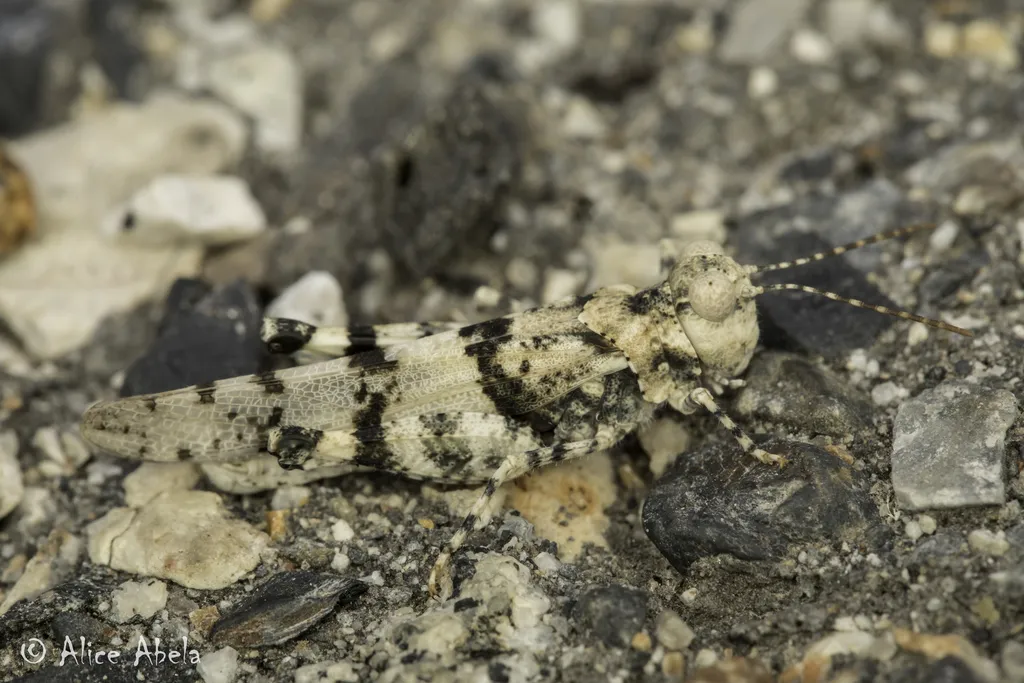
Photo credits: Contributed by David J. Ferguson
Frequently Asked Questions About McNeill's White Grasshopper
What is McNeill's White Grasshopper?
McNeill's White Grasshopper (Trimerotropis albescens) is a species in the family Acrididae, within the order Orthoptera.
How do you identify McNeill's White Grasshopper?
Varied color, usually pale whitish, but sometimes pinkish, reddish, brown, or even bluish. Small, with distinct narrow cross bands on the tegmina that cross over the top. The band closest to the wing base and the one in middle are further apart near the costal margin (bottom edge with wings folded) than at the anal margin (top when folded). The third band usually broken and irregular. Often with dark markings on the pronotum and often dark bands on on all of the femora. Hind tibia blue. Hind wings pale yellow with dark cross band often faded looking and not curving much if any around the outer margin of the wing toward the base. Pronotum with lower rear corners on side flared outward (best seen from above). Similar in coloration to T. incospicua (which is found mostly further east) and T. bifasciata (found mostly further west, and is stockier with top of pronotum more rounded and head larger), but differs from both in the flared out sides on the pronotum. The flight crepitation is an uninterrupted relatively loud and harsh buzzing (especially for the small size of the insect). T. arenacea and T. whitei are very similar in size and structurally, but are less strongly and sharply contrasing in coloration, and the cross bands of the tegmina are usually less developed. T. whitei has yellow to red hind tibiae. Both occur on sand further to the east. Can be confused with a few other small banded Trimerotropis with bluish hind tibiae, but most occur further west or (in south) can be distinguished by habitat preference, different behavior and lack of the flared out pronotum. Most often in those species the dark bands do not cross the top of the folded tegmina, but there are exceptions.
Where is McNeill's White Grasshopper found?
| Feature | Details |
|---|---|
| Habitat | Gravelly or sandy patches in open woodland and grasslands, mostly slopes and hilly areas above the desert. |
| Range | Mostly eastern Californa and adjacent Nevada along the east side of the Sierra Nevada; further south in southern California and northern Baja California occurs west of the deserts to near the coast. |
When is McNeill's White Grasshopper active?
McNeill's White Grasshopper: seasonal activity - Adults June to frost (usually uncommon after mid September).
What is the life cycle of a McNeill's White Grasshopper?
Overwinters as eggs laid in ground.