
Limestone Grasshopper
Trimerotropis undescribed-species-c
This record describes Trimerotropis undescribed-species-c (species). Recorded family: Acrididae. Recorded order: Orthoptera.
Identification and Appearance
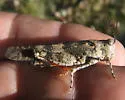
The similarity to the other unnamed species found on gypsum in the same region as these (and often in adjoining habitats) is striking, but these larger insects are clearly different from those. The potential relationship to T. latifasciata should be investigated, but since that species is also found in some of the same areas, but in different habitats, and yet is quite distinctly different, it seems unlikely that this is a variant of that species. This appears to be a wide-ranging Chihuahuan Desert species that has gone unrecognized because of confusion with other species. It would probably key out to Trimerotropis modesta or perhaps T. maritima in most identification keys, but it is very distinct from those species as well.
Classification
- Kingdom
- Animalia
- Phylum
- Arthropoda
- Class
- Insecta
- Order
- Orthoptera (Grasshoppers, Crickets, Katydids)
- Suborder
- Caelifera
- Family
- Acrididae (Short-horned Grasshoppers)
- Subfamily
- Oedipodinae
- Tribe
- Trimerotropini
- Genus
- Trimerotropis
Imported taxonomy record. Source availability varies; see the source references and editorial policy below.
Habitat and Range
Geographic Range
Known from Chaves & Eddy Counties, New Mexico, and there are specimens (labeled mostly as T. latifasciata ) in the Academy of Natural Sciences in Philadelphia from the Chihuahuan Desert region in Mexico. Ernest R. Tinkham, in 'The American Midland Naturalist' 40: 593, 1948, reported insects from the area of Marfa, Brewster county, Texas as " Trimerotropis laticincta " that may have been this species, since in his key he distinguished them as having narrow dark wing bands, but also describing them as having "wing band broader than average for this group". He included no illustration of these. These Eddy County specimens definitely do not belong to that name as traditionally applied to Great Plains specimens with very wide wing bands and the top of the abdomen often reddish (the name T. laticincta is now treated as synonym of T. latifasciata , though the two may prove to be distinct.).
Seasonal Activity
probably about July to frost, but so far seen only in mid October.
Diet and Behavior
Diet: unknown
Life History
probably overwinter as eggs
About Grasshoppers, Crickets, Katydids: the wider group
Order-level background for Orthoptera, the group containing Trimerotropis undescribed-species-c. Species-specific details appear above.
Group overview
Orthoptera includes ~28,000 described species of grasshoppers, crickets, and katydids. Desert locusts can form swarms covering 460 square miles containing up to 80 million individuals per square kilometer.
Ecological role of the group
Grasshoppers and crickets are a primary food source for birds, reptiles, and small mammals. Cricket farming is a growing industry - crickets require 12× less feed than cattle to produce the same amount of protein, using 2,000× less water.
Economic and practical significance of the group
A single large locust swarm can consume the same amount of food in one day as 35,000 people. The 2019-2021 East Africa locust crisis affected food security for 42 million people across multiple countries. Global crop losses from locusts can reach billions annually.
Recorded sources for this group: FAO, UN World Food Programme, research publications. Imported estimates may describe particular regions or reporting periods.
Photos of Limestone Grasshopper (5)
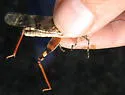
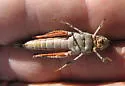
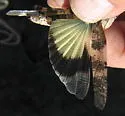
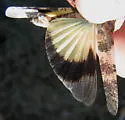
Photo credits: Contributed by David J. Ferguson
Frequently Asked Questions About Limestone Grasshopper
What is Limestone Grasshopper?
Limestone Grasshopper (Trimerotropis undescribed-species-c) is a species in the family Acrididae, within the order Orthoptera.
How big is Limestone Grasshopper?
males about 35 - 40 mm females about 40 - 45 mm
Where is Limestone Grasshopper found?
Range: Known from Chaves & Eddy Counties, New Mexico, and there are specimens (labeled mostly as T. latifasciata ) in the Academy of Natural Sciences in Philadelphia from the Chihuahuan Desert region in Mexico. Ernest R. Tinkham, in 'The American Midland Naturalist' 40: 593, 1948, reported insects from the area of Marfa, Brewster county, Texas as Trimerotropis laticincta that may have been this species, since in his key he distinguished them as having narrow dark wing bands, but also describing them as having wing band broader than average for this group. He included no illustration of these. These Eddy County specimens definitely do not belong to that name as traditionally applied to Great Plains specimens with very wide wing bands and the top of the abdomen often reddish (the name T. laticincta is now treated as synonym of T. latifasciata , though the two may prove to be distinct.).
What does Limestone Grasshopper eat?
The diet of the Limestone Grasshopper includes unknown.
When is Limestone Grasshopper active?
Limestone Grasshopper: seasonal activity - probably about July to frost, but so far seen only in mid October..
What is the life cycle of a Limestone Grasshopper?
probably overwinter as eggs