
Sandhills Band-wing Grasshopper
Xanthippus montanus
This record describes Xanthippus montanus (species). Recorded family: Acrididae. Recorded order: Orthoptera.
Identification and Appearance
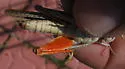
This applies to the insect from the Great Plains and Colorado Plateaus that is called X. montanus in most literature (see discussion above). From X. corallipes it differs primarily in narrower top of pronotum with margins sharply defined and rear angle averaging more acute; narrower fastigium with sides prominently elevated; hind femora more slender with the lower flange less flaring; and by more irregular and smaller dark spots on tegmina that tend to run together and parallel to it's length. In areas where found together, X. corallipes is generally stockier, often somewhat larger, and has a distinctly pantherine (leapard-spot) color pattern. This species is usually found on sand (occasionally on other loose mineral soils), while X. corallipes tends to avoid sand in the regions where both occur. Pardalophora species might be confused too, but all usually have the pronotal crest cut only once and more evenly elevated. P. apiculata has pink wings, usually fewer and larger spots on the tegmina. P. haldemani & saussurei have a pantherine pattern similar to Xanthippus corallipes . Pardalophora often have the inner hind femur darkened (rarely so in X. montanus ). West of the range of X. montanus , X. corallipes may sometimes occur on sand, and may show a similar color pattern, which has added to confusion between the two. Cratypedes lateritius is quite different and so far as known never occurs with X. montanus , but the two have been confused in literature. They may meet on the Arizona Strip north of the Grand Canyon in Arizona or Utah. In this area C. lateritius would occur higher in elevation, normally in non-sand habitats, and would be much smaller in size.
Classification
- Kingdom
- Animalia
- Phylum
- Arthropoda
- Class
- Insecta
- Order
- Orthoptera (Grasshoppers, Crickets, Katydids)
- Suborder
- Caelifera
- Family
- Acrididae (Short-horned Grasshoppers)
- Subfamily
- Oedipodinae
- Tribe
- Hippiscini
- Genus
- Xanthippus
Imported taxonomy record. Source availability varies; see the source references and editorial policy below.
Habitat and Range
Habitat
Sand dunes, mostly semi-stabilized and with permanent perennial vegetation of grasses and forbs. Occasionally on other similarly loose soils or on large sand areas of other types.
Geographic Range
This applies to the insect from the Great Plains and Colorado Plateaus that is called X. montanus in most literature (see discussion above). South Dakota and eastern Wyoming southward into northwestern Texas and central New Mexico. West across New Mexico into northern Arizona and north into the Canyonlands portion of Utah and Colorado. Perhaps in northern Chihuahua, but not verified from there yet. Apparently not in the Great Basin, but should be looked for in dune fields of southwestern Utah. Probably not north of Wyoming or South Dakota on the Great Plains, but records for the northern Great Plains are confused and specimens need to be examined closely to determine if this species is actually there or not (it may or may not reach southern Canada on the Plains?). Recorded from the San Luis Valley in southern Colorado, but only X. corallipes has been verified from there (some colored rather like X. montanus , but not that species). Insects recorded as X. montanus from west of the Rockies, and from west of the Great Plains in Wyoming are not the same species, and represent either X. corallipes or C. lateritius .
Diet and Behavior
Diet: Probably mostly grasses.
Life History
Overwinter as nearly mature nymphs, with adults appearing in April (sometimes March) and most common in April and May in most areas, usually gone by sometime in June. The species is common in many areas where it is not often collected because of its early adult appearance.
About Grasshoppers, Crickets, Katydids: the wider group
Order-level background for Orthoptera, the group containing Xanthippus montanus. Species-specific details appear above.
Group overview
Orthoptera includes ~28,000 described species of grasshoppers, crickets, and katydids. Desert locusts can form swarms covering 460 square miles containing up to 80 million individuals per square kilometer.
Ecological role of the group
Grasshoppers and crickets are a primary food source for birds, reptiles, and small mammals. Cricket farming is a growing industry - crickets require 12× less feed than cattle to produce the same amount of protein, using 2,000× less water.
Economic and practical significance of the group
A single large locust swarm can consume the same amount of food in one day as 35,000 people. The 2019-2021 East Africa locust crisis affected food security for 42 million people across multiple countries. Global crop losses from locusts can reach billions annually.
Recorded sources for this group: FAO, UN World Food Programme, research publications. Imported estimates may describe particular regions or reporting periods.
Photos of Sandhills Band-wing Grasshopper (5)
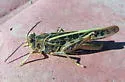
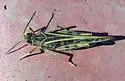
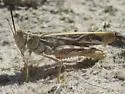
Photo credits: Contributed by Eric R. Eaton; Additional contributions by David Ferguson
Frequently Asked Questions About Sandhills Band-wing Grasshopper
What is Sandhills Band-wing Grasshopper?
Sandhills Band-wing Grasshopper (Xanthippus montanus) is a species in the family Acrididae, within the order Orthoptera.
How big is Sandhills Band-wing Grasshopper?
30 - 61 mm, larger in south and at low elevations than northward, and females considerably larger than males.
How do you identify Sandhills Band-wing Grasshopper?
This applies to the insect from the Great Plains and Colorado Plateaus that is called X. montanus in most literature (see discussion above). From X. corallipes it differs primarily in narrower top of pronotum with margins sharply defined and rear angle averaging more acute; narrower fastigium with sides prominently elevated; hind femora more slender with the lower flange less flaring; and by more irregular and smaller dark spots on tegmina that tend to run together and parallel to it's length. In areas where found together, X. corallipes is generally stockier, often somewhat larger, and has a distinctly pantherine (leapard-spot) color pattern. This species is usually found on sand (occasionally on other loose mineral soils), while X. corallipes tends to avoid sand in the regions where both occur. Pardalophora species might be confused too, but all usually have the pronotal crest cut only once and more evenly elevated. P. apiculata has pink wings, usually fewer and larger spots on the tegmina. P. haldemani & saussurei have a pantherine pattern similar to Xanthippus corallipes . Pardalophora often have the inner hind femur darkened (rarely so in X. montanus ). West of the range of X. montanus , X. corallipes may sometimes occur on sand, and may show a similar color pattern, which has added to confusion between the two. Cratypedes lateritius is quite different and so far as known never occurs with X. montanus , but the two have been confused in literature. They may meet on the Arizona Strip north of the Grand Canyon in Arizona or Utah. In this area C. lateritius would occur higher in elevation, normally in non-sand habitats, and would be much smaller in size.
Where is Sandhills Band-wing Grasshopper found?
| Feature | Details |
|---|---|
| Habitat | Sand dunes, mostly semi-stabilized and with permanent perennial vegetation of grasses and forbs. Occasionally on other similarly loose soils or on large sand areas of other types. |
| Range | This applies to the insect from the Great Plains and Colorado Plateaus that is called X. montanus in most literature (see discussion above). South Dakota and eastern Wyoming southward into northwestern Texas and central New Mexico. West across New Mexico into northern Arizona and north into the Canyonlands portion of Utah and Colorado. Perhaps in northern Chihuahua, but not verified from there yet. Apparently not in the Great Basin, but should be looked for in dune fields of southwestern Utah. Probably not north of Wyoming or South Dakota on the Great Plains, but records for the northern Great Plains are confused and specimens need to be examined closely to determine if this species is actually there or not (it may or may not reach southern Canada on the Plains?). Recorded from the San Luis Valley in southern Colorado, but only X. corallipes has been verified from there (some colored rather like X. montanus , but not that species). Insects recorded as X. montanus from west of the Rockies, and from west of the Great Plains in Wyoming are not the same species, and represent either X. corallipes or C. lateritius . |
What does Sandhills Band-wing Grasshopper eat?
The diet of the Sandhills Band-wing Grasshopper includes Probably mostly grasses..
What is the life cycle of a Sandhills Band-wing Grasshopper?
Overwinter as nearly mature nymphs, with adults appearing in April (sometimes March) and most common in April and May in most areas, usually gone by sometime in June. The species is common in many areas where it is not often collected because of its early adult appearance.