
Pine Bluffs Grasshopper
Trimerotropis fratercula
This record describes Trimerotropis fratercula (species). Recorded family: Acrididae. Recorded order: Orthoptera.
Identification and Appearance
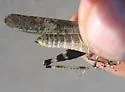
Identical to Trimerotropis cyaneipennis , except wings are yellow (sometimes a bit greenish) and hind tibiae may be brownish, yellow, green, or to the south in Colorado and northern New Mexico blue (normally blue in T. cyaneipennis ) T. sparsa can also be similar in w. Nebraska, ne. Wyoming, w. South Dakota, near Pueblo, Colorado, and north of Santa Fe, New Mexico. It is usually larger (especially southward) with a plainer pattern and longer wings (hind wings usually narrower as well). The dark band on the hind wings is usually faint or absent. The habitat is usually more open and eroded areas. T. sparsa usually has blue wings, but in these areas they can vary to green or yellow. Hind tibiae are never blue. T. verruculata usually has longer and even wider wings, with the outer part (beyond the band) usually clouded or black (usually mostly clear in T. fratercula ). It is found usually at higher elevations in wooded areas (but they sometimes occur together), and it is usually much darker with dark brownish to black (sometimes blue or purplish) hind tibiae. Rare individuals in areas of contact appear to be hybrids. T. inyo (greenish yellow wings) and T. bernardi (yellow wings) in southern California are similar, but are separated from T. fratercula by great distance. Both are in the mountains of southern California. These species, along with other close relatives are very close to Circotettix , and cytological evidence supports this. They probably should not be placed in Trimerotropis , but it will take time and more study to sort this complicated group of genera and species out more naturally. Otte's system is decidedly the best so far, but there are still unresolved issues as to what species belongs with what. Species status for T. fratercula is highly questionable. It blends with T. cyaneipennis in northern and central New Mexico, and the two should probably be considered subspecies of a single species. There is a difference in chromosome number which is the same as the difference between T. verruculata verruculata and T. verruculata suffusa (which are closely related to this species). However, this number difference does not correlate well with the change-over in coloration. The higher chromosome number of T. fratercula is found well southward into the region of blue wings, and males with 23, 22, and 21 chromosomes can be found together in some New Mexico populations (matching females will have one more). As a side note, the lower chromosome number found in much of the range of T. cyaneipennis is technically not really different, because everything is still there. Two chromosomes in each set (there are two sets in each cell) have fused together to make one (so there appear to be two less chromosomes per cell). They still match the corresponding chromosomes in individuals with the higher number. The 22 chromosome individuals have the unfused pair in one set of chromosomes, and the fused chromosome in the other set, so they have the apparent intermediate total number of chromosomes.
Classification
- Kingdom
- Animalia
- Phylum
- Arthropoda
- Class
- Insecta
- Order
- Orthoptera (Grasshoppers, Crickets, Katydids)
- Suborder
- Caelifera
- Family
- Acrididae (Short-horned Grasshoppers)
- Subfamily
- Oedipodinae
- Tribe
- Trimerotropini
- Genus
- Trimerotropis
Imported taxonomy record. Source availability varies; see the source references and editorial policy below.
Habitat and Range
Habitat
Rock outcroppings, ledges, canyons, steep hot rocky slopes, etc. along east base of Rockies and northward out into the Great Plains as far east as the Nebraska Panhandle.
Geographic Range
northern New Mexico to se. Wyoming and sw. South Dakota on the east side of the Rockies.
Seasonal Activity
early summer to frost
Diet and Behavior
Life History
eggs in winter
About Grasshoppers, Crickets, Katydids: the wider group
Order-level background for Orthoptera, the group containing Trimerotropis fratercula. Species-specific details appear above.
Group overview
Orthoptera includes ~28,000 described species of grasshoppers, crickets, and katydids. Desert locusts can form swarms covering 460 square miles containing up to 80 million individuals per square kilometer.
Ecological role of the group
Grasshoppers and crickets are a primary food source for birds, reptiles, and small mammals. Cricket farming is a growing industry - crickets require 12× less feed than cattle to produce the same amount of protein, using 2,000× less water.
Economic and practical significance of the group
A single large locust swarm can consume the same amount of food in one day as 35,000 people. The 2019-2021 East Africa locust crisis affected food security for 42 million people across multiple countries. Global crop losses from locusts can reach billions annually.
Recorded sources for this group: FAO, UN World Food Programme, research publications. Imported estimates may describe particular regions or reporting periods.
Photos of Pine Bluffs Grasshopper (5)
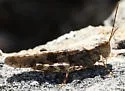
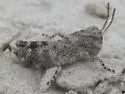
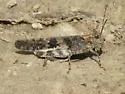
Photo credits: Contributed by David J. Ferguson
Frequently Asked Questions About Pine Bluffs Grasshopper
What is Pine Bluffs Grasshopper?
Pine Bluffs Grasshopper (Trimerotropis fratercula) is a species in the family Acrididae, within the order Orthoptera.
How big is Pine Bluffs Grasshopper?
male 25 - 33 mm female 28 - 38 mm
How do you identify Pine Bluffs Grasshopper?
Identical to Trimerotropis cyaneipennis , except wings are yellow (sometimes a bit greenish) and hind tibiae may be brownish, yellow, green, or to the south in Colorado and northern New Mexico blue (normally blue in T. cyaneipennis ) T. sparsa can also be similar in w. Nebraska, ne. Wyoming, w. South Dakota, near Pueblo, Colorado, and north of Santa Fe, New Mexico. It is usually larger (especially southward) with a plainer pattern and longer wings (hind wings usually narrower as well). The dark band on the hind wings is usually faint or absent. The habitat is usually more open and eroded areas. T. sparsa usually has blue wings, but in these areas they can vary to green or yellow. Hind tibiae are never blue. T. verruculata usually has longer and even wider wings, with the outer part (beyond the band) usually clouded or black (usually mostly clear in T. fratercula ). It is found usually at higher elevations in wooded areas (but they sometimes occur together), and it is usually much darker with dark brownish to black (sometimes blue or purplish) hind tibiae. Rare individuals in areas of contact appear to be hybrids. T. inyo (greenish yellow wings) and T. bernardi (yellow wings) in southern California are similar, but are separated from T. fratercula by great distance. Both are in the mountains of southern California. These species, along with other close relatives are very close to Circotettix , and cytological evidence supports this. They probably should not be placed in Trimerotropis , but it will take time and more study to sort this complicated group of genera and species out more naturally. Otte's system is decidedly the best so far, but there are still unresolved issues as to what species belongs with what.
Where is Pine Bluffs Grasshopper found?
| Feature | Details |
|---|---|
| Habitat | Rock outcroppings, ledges, canyons, steep hot rocky slopes, etc. along east base of Rockies and northward out into the Great Plains as far east as the Nebraska Panhandle. |
| Range | northern New Mexico to se. Wyoming and sw. South Dakota on the east side of the Rockies. |
When is Pine Bluffs Grasshopper active?
Pine Bluffs Grasshopper: seasonal activity - early summer to frost.
What is the life cycle of a Pine Bluffs Grasshopper?
eggs in winter