
Butterflies and Moths
Order Lepidoptera
The Butterflies and Moths (Order Lepidoptera) includes 11,813 species across 112 families and 2,787 genera in our directory.
About Butterflies and Moths
Lepidoptera includes approximately 180,000 described species of butterflies and moths. Moths outnumber butterflies roughly 10:1. The monarch butterfly's eastern population has declined by more than 80% since the mid-1990s, and the western population by over 95% since the 1980s. The IUCN lists the migratory monarch as Vulnerable.
Economic Impact
Lepidoptera are critical pollinators. In Europe, grassland butterfly species have declined by almost 50% since the early 1990s. In the UK, three-quarters of butterflies are in decline. In the U.S., five butterfly species have gone extinct since 1950, with 29 listed as endangered.
Ecological Role
Butterflies and moths are essential indicators of ecosystem health. As caterpillars, they are a primary food source for birds - a single nest of blue tit chicks requires ~10,000 caterpillars. Adult moths pollinate many night-blooming plants.
Families in Lepidoptera (112)
Species in Lepidoptera (11,813)
Glaucina spaldingata - Hodges#6503
Glaucina spaldingata
Identification: Description of Glaucina spaldingata (Cassino & Swett) is available online in PDF.
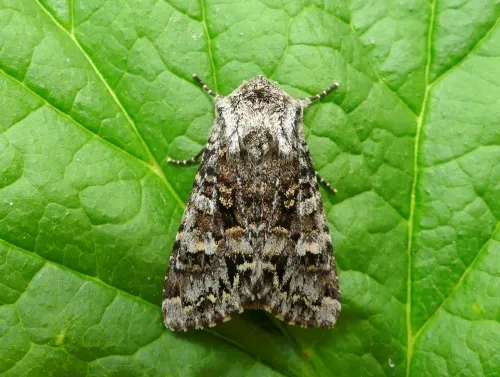
Glaucous Shears
Papestra biren
A moorland moth. The moths quite often rest in the open on fenceposts, tree trunks and rocks. The adults fly during May and June, and can be attracted by light. A wide range of moorland plants are used as food, including Heather (Calluna) and Bog-myr
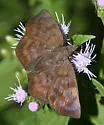
Glazed Pellicia - Hodges#3927
Pellicia arina
Identification: FW are pointed. Wings are black; upperside has an iridescent purple sheen and faint mottling. (BAMONA)
Glena furfuraria - Hodges#6446
Glena furfuraria
Identification: Forewings light gray to grayish brown with obscure maculation.
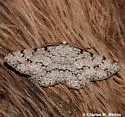
Glena grisearia - Hodges#6445
Glena grisearia
Glena grisearia - Hodges#6445 (Glena grisearia) is a species in the family Geometridae, commonly known as geometrid moths, belonging to the order Lepidoptera (Butterflies and Moths). It is classified within the subfamily Ennominae, tribe Boarmiini, s
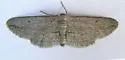
Glena interpunctata - Hodges#6451
Glena interpunctata
Identification: One of the largest species in the group. The specimens from Arizona to Texas have only dots for a postmedial line and the northern population has a bolder solid line. When the median line is visible it converges with the postmedial li
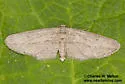
Glena mcdunnougharia - Hodges#6454
Glena mcdunnougharia
Identification: Detailed description by Rindge as subspecies mcdunnougharia and kirkwoodaria can be found at the link in citations below. Original description by Sperry can be found at link in citations below.
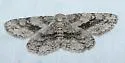
Glena nigricaria - Hodges#6448
Glena nigricaria
Identification: Adult - forewing light to dark gray with black lines, variably sharp and distinct to diffuse and indistinct; AM line does not extend onto hindwing; first abdominal segment same color as remaining segments (not pale). Specimens identif
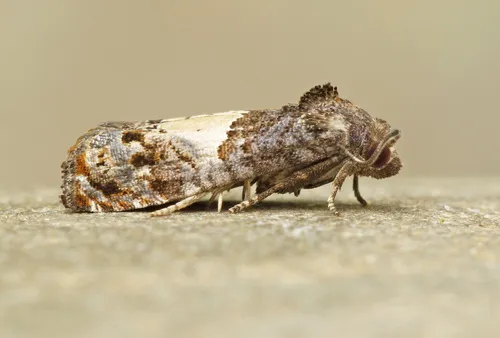
Glenn's Epiblema - Hodges#3184.1
Epiblema glenni
Identification: Adult : FW predominantly dark with a distinctly salmon colored interfascial spot at the middle of the dorsal margin, with its width narrowing markedly above the fold. In females , it continues forward to the costa as a narrower band.
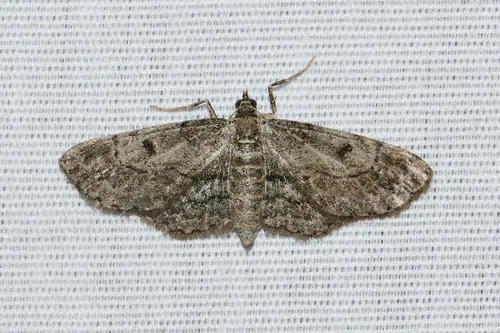
Glenoides lenticuligera - Hodges#6444
Glenoides lenticuligera
Identification: Blanchard (1973) stated "The new species is quite close to Glenoides texanaria , the only other taxon in the genus; the pattern of maculation is nearly the same, but the transverse lines of texanaria are much better defined and its ba
Gloanna hecate - Hodges#9844.1
Gloanna hecate
Identification: Blanchard & Knudson description of the adult, including genitalia, is available in PDF.
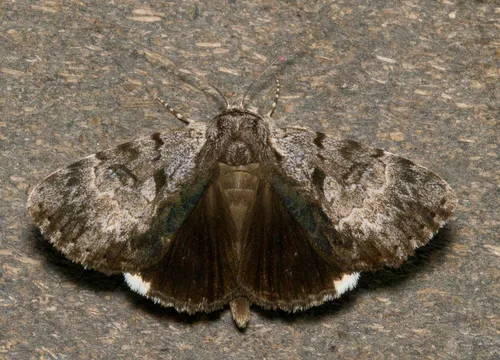
Gloomy Underwing - Hodges#8849
Catocala andromedae
Identification: Adult - forewing light gray with dark inner margin; very dark "flying saucer" shape joining subreniform spot to midpoint of AM line; PM line with short blunt "teeth" outwardly edged with white; ST line outwardly edged with white. Unde
Glorious Habrosyne - Hodges#6236
Habrosyne gloriosa
Identification: adult very similar to the more common H. scripta but has a 90 degree jog midway along the AM line (whereas in H. scripta , the AM line is a relatively smooth curve for its entire length
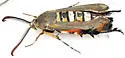
Glorious Squash Vine Borer - Hodges#2540
Eichlinia gloriosa
Identification: Male & Female both: Melittia gloriosa Hy. Edwards Det. R. S. Fleischer
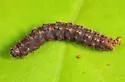
Glossy Black Idia - Hodges#8334
Idia lubricalis
Identification: Similar to, but larger than, the Smoky Idia, I. scobialis.
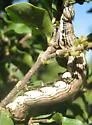
Glossy Prominent - Hodges#7948
Elymiotis notodontoides
Identification: Adults are sexually dimorphic. Wings have a glossy appearance; female's are greenish.
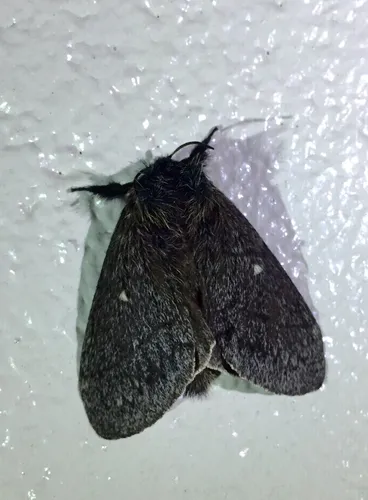
Gloveria gargamelle - Hodges#7695
Gloveria gargamelle
Identification: Adult - female forewing dark gray mixed with pale gray scales; AM and PM lines black, almost straight; subterminal line jagged, irregular; small white discal spot close to AM line; male forewing dark brown except for large pale gray
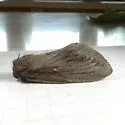
Gloveria sphingiformis - Hodges#7697
Gloveria sphingiformis
Identification: Barnes & McDunnough original description is available online. Barnes & McDunnough stated Gloveria sphingiformis "Differs from all other members of the genus in that the outer margin of primaries is convex below the apex." (possibly on
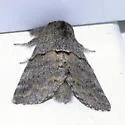
Gluphisia severa - Hodges#7935
Gluphisia severa
Identification: Specimen identified by DNA analysis:
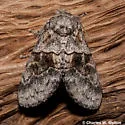
Gluphisia wrightii - Hodges#7932
Gluphisia wrightii
Identification: Specimen identified by DNA analysis: Threatened or rare species.
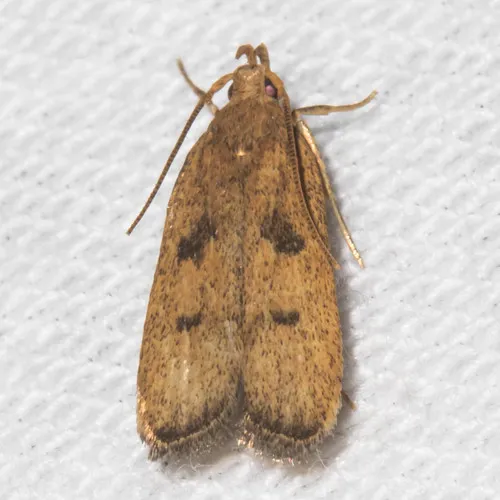
Glyphidocera democratica - Hodges#1137
Glyphidocera democratica
Glyphidocera democratica is a moth in the Autostichidae family. It was described by Meyrick in 1929. It is found in North America, where it has been recorded from Alabama, Arkansas, Florida, Kentucky, Louisiana, Mississippi, North Carolina, Tennessee
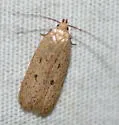
Glyphidocera dimorphella - Hodges#1143
Glyphidocera dimorphella
Identification: From Busck’s description: “Forewings light straw-yellow, sparsely sprinkled with dark brown atoms, with a blackish brown round dot on the middle of the cell, another similar dot at the end of the cell and a more or less complete serie
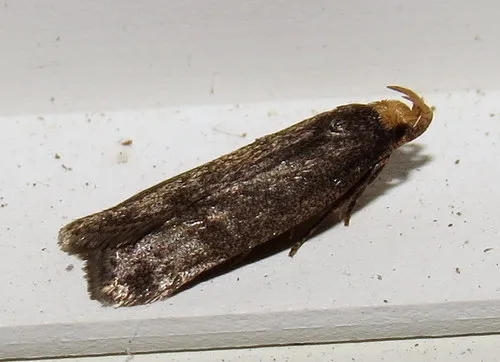
Glyphidocera lithodoxa - Hodges#1140
Glyphidocera lithodoxa
Glyphidocera lithodoxa is a moth in the Autostichidae family. It was described by Meyrick in 1929. It is found in North America, where it has been recorded from Maine, Massachusetts, Ontario, Pennsylvania and Texas.
Glyphidocera meyrickella - Hodges#1141
Glyphidocera meyrickella
Identification: Identification from photos is difficult to impossible in this genus. Specimen identified by DNA analysis (BOLD).
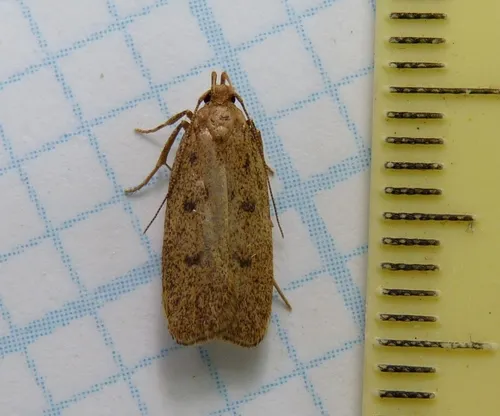
Glyphidocera septentrionella - Hodges#1142
Glyphidocera septentrionella
Glyphidocera septentrionella is a moth of the Autostichidae family. It is known from North America, including British Columbia, California, Illinois, New York, Oklahoma, Pennsylvania, South Carolina and Texas.
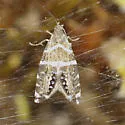
Glyphipterix bifasciata - Hodges#2339
Glyphipterix bifasciata
Identification: Forewing basal half has two white bands fully crossing the wing and three white subapical chevron shaped patches at the coastal margin. (distinctive) Large photo of pinned adult at University of California, Berkeley Diurnal but adults
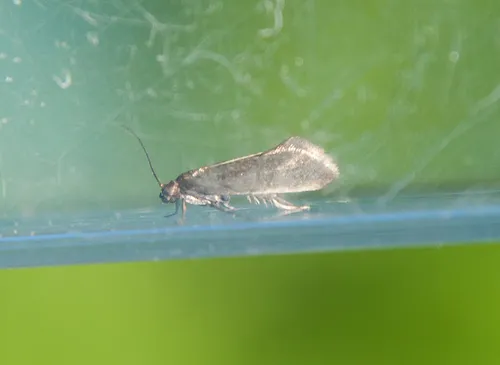
Glyphipterix fuscoviridella
Glyphipterix fuscoviridella
Wingspan 10 to16 mm. A relatively plain pale buff species with a slight metallic sheen. It occupies dry grassland habitats and flower meadows, especially where the larval foodplant is present. A day flying species that can be found on the wing in May
Glyphipterix saurodonta - Hodges#2343
Glyphipterix saurodonta
Identification: See original description in print references below .
Glyphipterix sistes - Hodges#2341.1
Glyphipterix sistes
Identification: Specimen identified by DNA analysis:
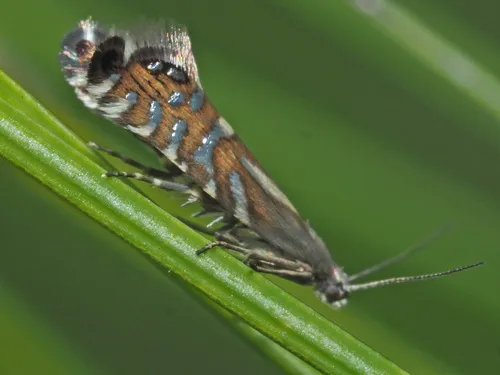
Glyphipterix thrasonella
Glyphipterix thrasonella
Wingspan 11-15 mm. A rather distinctive species of Glyphipterix, with its silver and black markings against a bronzy forewing and peculiarly indented termen. Aquatic habitats, wetland and marshy areas where Juncus species are present. The moths can b
Glyphocystis viridivallis - Hodges#5765
Glyphocystis viridivallis
Identification: Blanchard original description is in PDF. Close to Catastia but with "considerable differences in the female genitalia"
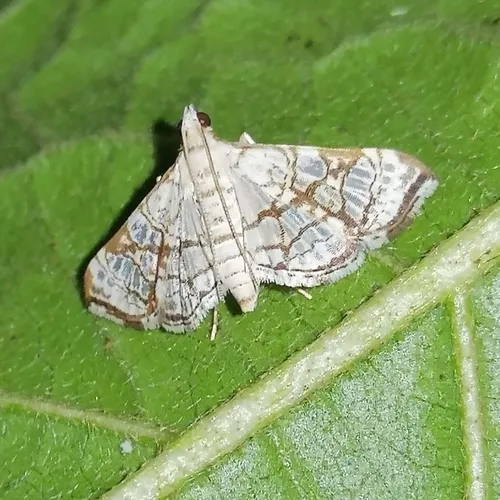
Glyphodes floridalis - Hodges#5199
Glyphodes floridalis
Type locality: USA, Florida, Palm Beach and Key West
Glyphodes onychinalis - Hodges#5199.1
Glyphodes onychinalis
Known since 2000 in California (Newport Beach), larvae on jasmine and oleander and probably other plants. Originally from Afro-Asian Region (India, Sri Lanka, Indonesia, Australia, New Zealand). Based on molecular data a new genus may be required for
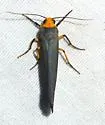
Gnamptonychia ventralis - Hodges#8057
Gnamptonychia ventralis
Identification: The original description of Gnamptonychia ventralis Barnes & Lindsey, is available online in the print references below. Diurnal .
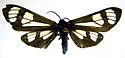
Gnophaela aequinoctialis - Hodges#8035
Gnophaela aequinoctialis
First US record per Kendall (1974), "While collecting in Panther Canyon above Landa Park, New Braunfels, Comal County, Texas, W. W. McGuire took one female on 9 April 1972. This specimen is now in the collection of Andre Blanchard of Houston, Texas."
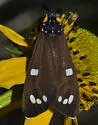
Gnophaela clappiana - Hodges#8033
Gnophaela clappiana
Identification: Forewing is much less marked than the other Gnophaela species in North America. Abdomen is iridescent blue. ( 3 ) Comstock (1937) description of the larva is in PDF. ( 4 )
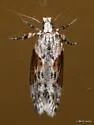
Gnorimoschema gallaeasterella - Hodges#1985
Gnorimoschema gallaeasterella
Identification: The original description as Gelechia gallaeasterella Kellicott is available in the print references below. Specimen identified by DNA analysis (BOLD). ( 3 ) Genitalia: Gnorimoschema gallaeasterella is the host for at least two Copidos
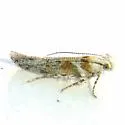
Gnorimoschema octomaculella - Hodges#1995
Gnorimoschema octomaculella
Identification: Forewing is pale gray, and peppered with small black dots. Three rust colored transverse bands or pairs of spots. Basal band often faint. Busck mentions the specific name chosen by Chambers is not accurate because the holotype was act
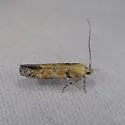
Gnorimoschema paternale - Hodges#1995.2
Gnorimoschema paternale
According to Vazrick Nazari, this is a complex of at least three species, two of which are still undescribed.
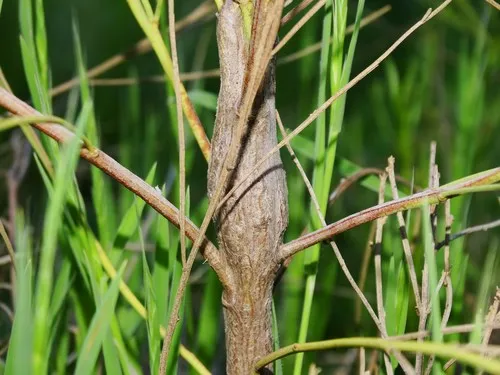
Gnorimoschema powelli - Hodges#1996.5
Gnorimoschema powelli
Gnorimoschema powelli - Hodges#1996.5 (Gnorimoschema powelli) is a species in the family Gelechiidae, commonly known as twirler moths, belonging to the order Lepidoptera (Butterflies and Moths). It is classified within the subfamily Gelechiinae, trib
Gnorimoschema saphirinella - Hodges#1998
Gnorimoschema saphirinella
Identification: The original description as Gelechia saphirinella Chambers is available online in the print references below. Specimen identified by DNA analysis (BOLD). ( 5 )
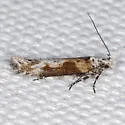
Gnorimoschema septentrionella - Hodges#2000
Gnorimoschema septentrionella
Identification: Vazrick Nazari identified Nolie Schneider's moth as Gnorimoschema septentrionella Fyles, 1911. "It is a gall-maker on Aster and is part of a complex of species that includes gallaesolidaginis, gallaesterella, gibsonella, salinaris etc
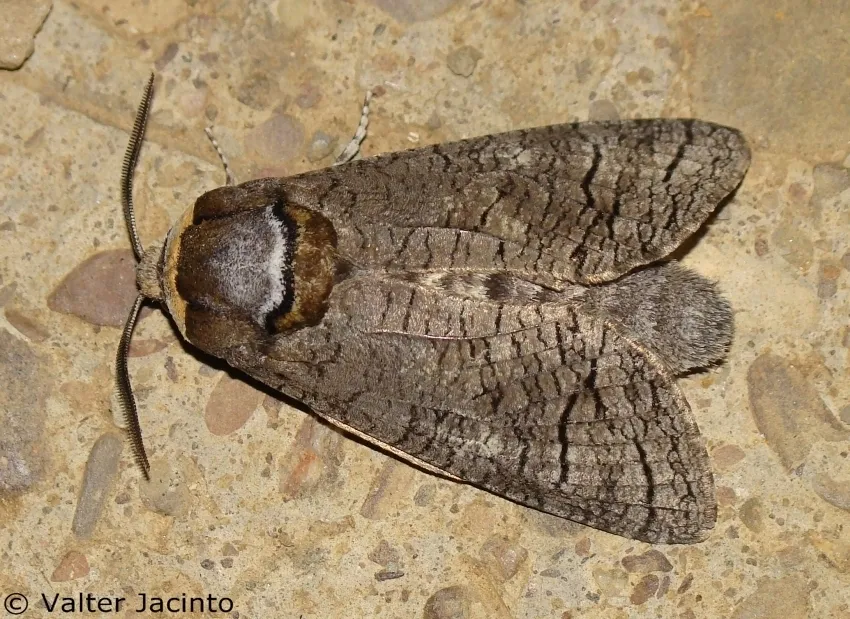
Goat Moth
Cossus cossus
Wingspan 68 to 96 mm. The Goat Moth gets its English name from the strong 'goat-like' odour of the caterpillar and is one of the heaviest British moths. Good photographs and/or the specimen required. The caterpillar burrows into the trunks of various
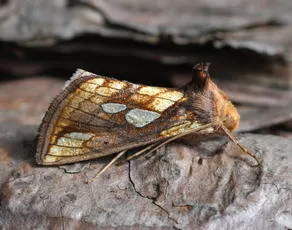
Gold Spot
Plusia festucae
Wingspan 34-46 mm. A distinctive and colourful species. Marshes, fens, woodland rides and upland grassland and, on heathland, moorland and river-banks It has two generations in the south, sometimes only one in the north, flying between June and Septe
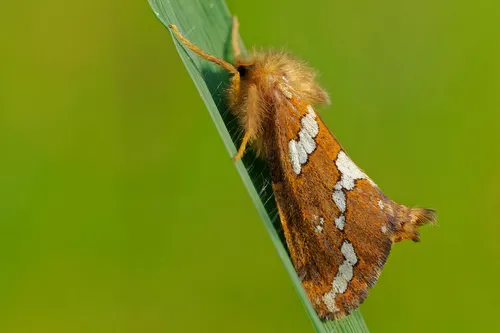
Gold Swift
Phymatopus hecta
The gold swift (Phymatopus hecta) is a species of moth belonging to the family Hepialidae. Until recently it was placed in the genus Hepialus. It is a widespread species of Europe, its distribution following that of its foodplant, bracken.
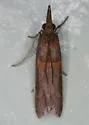
Gold-banded Etiella Moth - Hodges#5744
Etiella zinckenella
Identification: Adult : FW variably colored, red-brown to black-brown. White costal streak usually present. AM fascia orange brown to orange-red, fascia edged with black on AM side, frequently gold iridescence on fascia. Specimens of zinckenella vary
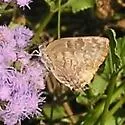
Gold-bordered Hairstreak - Hodges#4297
Rekoa palegon
Identification: Underwings are pale gray-brown with streaks of darker brown, sometimes reddish, and a wide golden-orange band along the edge. Upperwings are bright blue in males, pale blue-gray to brown in females.
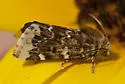
Gold-edged Gem - Hodges#11100
Schinia avemensis
Identification: Dyar (1904) original description as Pseudotamila avemensis is available in the print references. Adults are (diurnal) . Reported as endangered in Canada (2006). ( 3 )
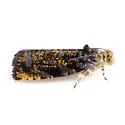
Gold-headed Leafroller - Hodges#2830
Olethreutes auricapitana
Identification: Adult - Except for gold edging along the apex and lustrous blue-gray interfascial scaling, the forewing appears black. ( 3 ) . DNA analysis at BOLD indicates there are two species going under this name. It appears that true auricapita
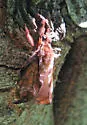
Gold-spotted Ghost Moth - Hodges#0022
Sthenopis pretiosus
Identification: forewing yellowish-brown with 3 small gold spots in subterminal area, a larger single spot in the medial area, and 3 more small gold spots forming an antemedial (AM) line near the base; PM line represented by an indistinct whitish, pi
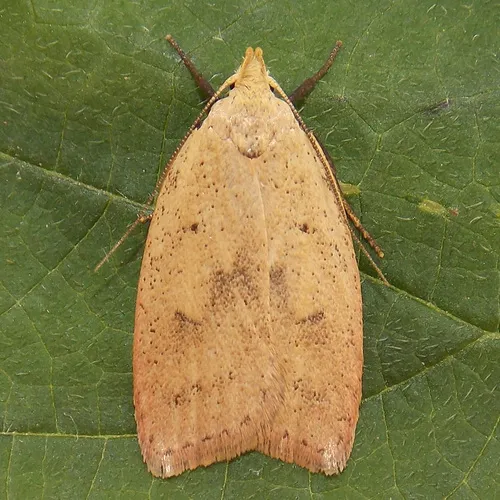
Gold-striped Leaftier Moth
Machimia tentoriferella
The gold-striped leaftier moth (Machimia tentoriferella) is a moth of the Depressariidae family. It is found in North America from Nova Scotia to North Carolina and Tennessee, west to Mississippi and Iowa, north to Ontario.
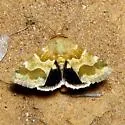
Golden Aster Flower Moth - Hodges#11116
Schinia tuberculum
Identification: Photo identified by Bob Patterson and confirmed by Chuck Harp. Reported as diurnal but adults are often seen at lights. Listed on the New York State Department of Environmental Conservation Rare Animal Status List.
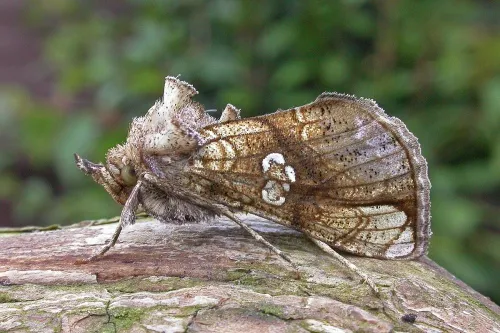
Golden Plusia
Polychrysia moneta
Wingspan 32 to 37 mm. Fine pattern on broad, golden yellow forewing, large kidney mark outlined in silver white and large fan like scale tufts on the thorax are diagnostic. Generally a garden species, especially where Delphinium are grown. It is on t
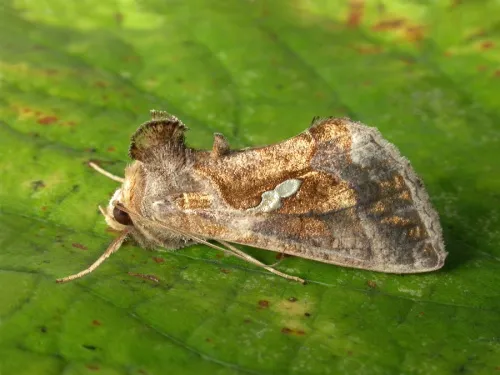
Golden Twin-spot
Chrysodeixis chalcites
An immigrant species that is usually found near to the coast. The most typical time of occurrence is between September and November, when moths are sometimes found at light-traps. On the continent, the caterpillars feed on such plants as chrysanthemu
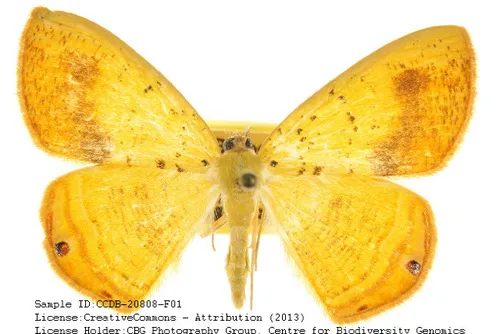
Golden-winged Palyas Moth - Hodges#6670
Phrygionis auriferaria
Identification: Adult : Palpi, head,and antennae brownish yellow. Wings golden yellow, with five lines of small purple spots on inner two thirds of FW. The first line close to the base, the second and third extra basal, parallel near each other, wave
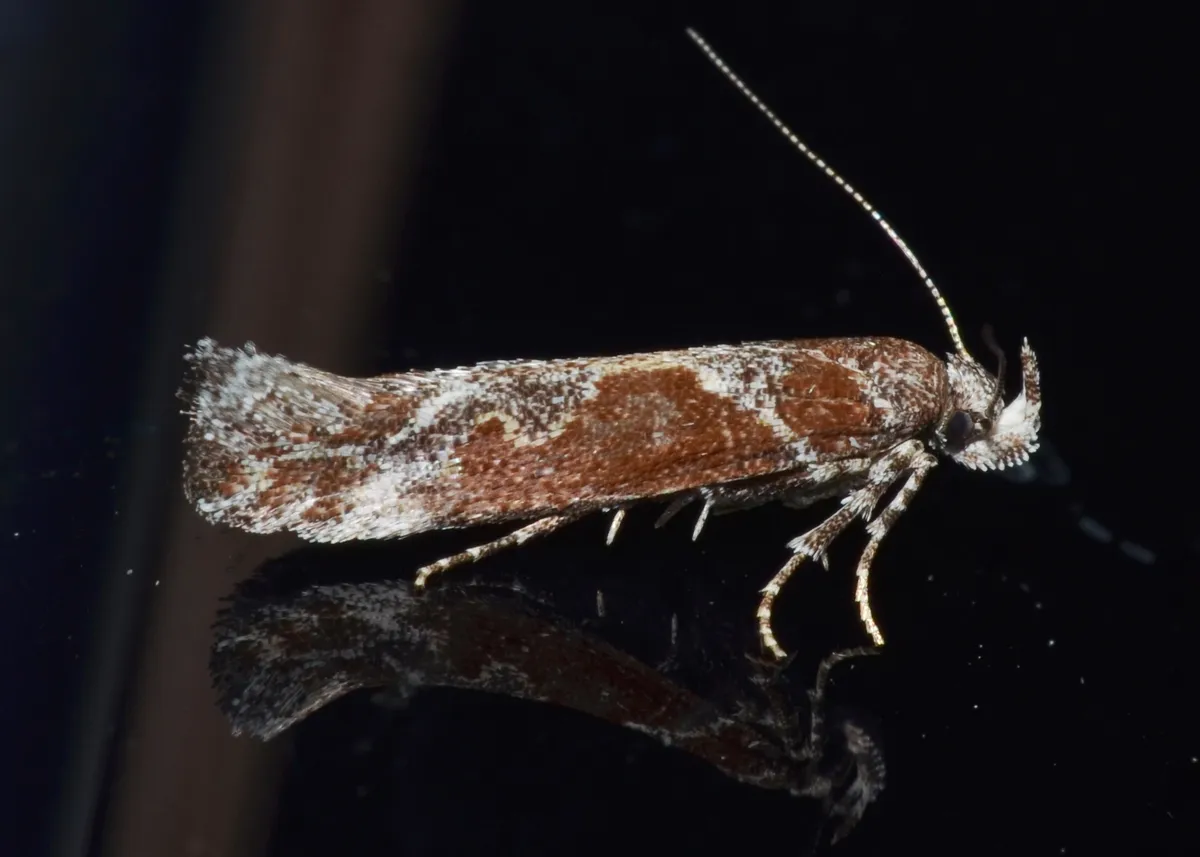
Goldenrod Elliptical-Gall Moth
Gnorimoschema gallaesolidaginis
Gnorimoschema gallaesolidaginis, the solidago gall moth, goldenrod gall moth or goldenrod gallmaker, is a moth in the Gelechiidae family. It was described by Riley in 1869. It is found in North America, where it has been recorded from Alberta, Britis
Goldenrod Flower Moth - Hodges#11177
Schinia nundina
Identification: Adult : FW white with bands of pale green or brownish-green shading • Small, black orbicular spot • Hourglass-shaped reniform is boldly outlined in black • Terminal line is series of blackish dots ( 3 )
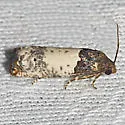
Goldenrod Gall Moth - Hodges#3186
Epiblema scudderiana
Identification: Description in PDF: Rests with wings rolled around body in shape of cylinder; basal third is dark brown or black, middle third is off-white, distal third is light bluish-gray; series of short diagonal stripes along outer third of cost
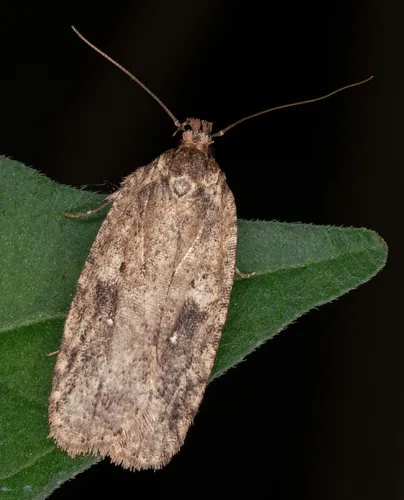
Goldenrod Leaffolder Moth
Agonopterix pulvipennella
Agonopterix pulvipennella is a moth of the Depressariidae family. It is found in North America, where it has been recorded from Quebec and New Brunswick to North Carolina, west to Colorado and north to Saskatchewan.
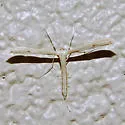
Goldenrod Plume Moth - Hodges#6212
Hellinsia kellicottii
Identification: Wings: Pale yellowish-brown; very few darker brownish scales near wing tips. Tips pointed. Larger dark brown dot at cleft or split in wings, and another very tiny one at tip end. Two very tiny brown spots on outer (costal) edge near w
Gondysia telma - Hodges#8726.1
Gondysia telma
Identification: Adults: Unless you have evidence of rearing, dissection or a DNA test, the images of moths in these two species should be placed ----> here Genitalia: Larvae:
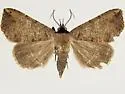
Goniocarsia electrica - Hodges#8580
Goniocarsia electrica
Identification: Blanchard & Knudson (1985) noted the adults are medium brown with a violet tinge, and highly variable. Postmedial line nearly white. ( 3 )
Gonioterma crambitella - Hodges#1033
Gonioterma crambitella
Identification: Duckworth original description is available in the print references. White forewing with apex being fairly acute.
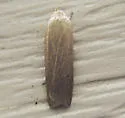
Gonioterma mistrella - Hodges#1032
Gonioterma mistrella
Identification: Larva - Pink with dark dorsal stripe and chestnut head. See Miller (1940) in Print references.
Gonocausta sabinalis - Hodges#5078.1
Gonocausta sabinalis
Gonocausta sabinalis - Hodges#5078.1 (Gonocausta sabinalis) is a species in the family Crambidae, commonly known as crambid snout moths, belonging to the order Lepidoptera (Butterflies and Moths). It is classified within the subfamily Spilomelinae, t
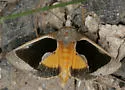
Gonodonta sinaldus - Hodges#8538
Gonodonta sinaldus
Identification: Adult: forewing has large dark brown to blackish patch with smoothly curved distal edge; lighter grayish-brown shading at base of wing, along costa, beyond PM line, and in small semicircular patch along inner margin; whitish line para
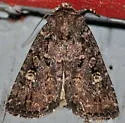
Goodell's Arches Moth - Hodges#10289
Orthodes goodelli
Identification: Adult : Similar to O. detracta , except goodelli has a smaller claviform spot, less distinct lines/spots, lacks a basal dash, and the male antenna is bead-like rather than bipectinate.
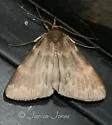
Gopher tortoise moth - Hodges#8336
Idia gopheri
Identification: Smith (1899) original description as Epizeuxis gopheri is online and linked in the print references. Uncommon to rare. ( 3 )
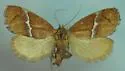
Graceful Slug Moth - Hodges#4664
Lithacodes gracea
Identification: Adult : FW reddish brown, with a narrow, white rigid line, slightly oblique line beyond the middle, followed by a narrow purple brown border. HW dark ocher.
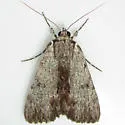
Graceful Underwing - Hodges#8847
Catocala gracilis
Identification: Adult - FW mottled and heavilly shaded along inner margin. Usually has a basal dash. HW inner black band on yellow forms an incomplete loop.
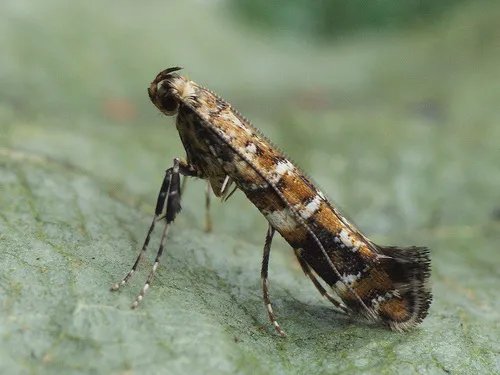
Gracillaria syringella
Gracillaria syringella
Wingspan 10-13 mm. This is another distinctive Caloptilia. Although quite variable, this is the best marked of the group. The larva mines the leaves of Lilac, Ash, Privet and Jasmine, often gregariously, in a large blotch mine. The adults fly in May
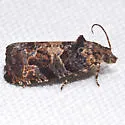
Grape Berry Moth - Hodges#2712
Paralobesia viteana
Identification: Inner half of front wing uniformly lilac or leaden-blue, crossed by well-defined narrow brown lines. Ground color of outer half of front wing pale yellowish-brown. Genitalia: ♂ There is a narrow sclerotized lobe projecting from the ba
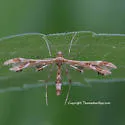
Grape Flower Plume Moth - Hodges#6090
Sphenarches ontario
Identification: See the identification key for Oxyptilini . See the species accounts in Landry , Landry , and McDunnough as Pterophorus ontario . Sphenarches ontario adults have: a forewing second lobe that is broader with a well developed, curved ou
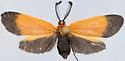
Grape Leaf Skeletonizer - Hodges#4626
Neoalbertia constans
Identification: "Primaries bright orange, with narrow marginal border of black, widest at the apex. Secondaries black, with narrow costal margin of orange. Antennae black. Thorax black on the disc, the outer margin orange. Abdomen black. Tibiae whiti
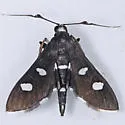
Grape Leafroller - Hodges#5160
Desmia maculalis
Identification: From Brian Scholtens: "The character that I use is the extent of the white patch on the underside of the abdomen. D. funeralis individuals have a solid white patch on the underside of the abdomen on segments 1-5 (or may have a slight
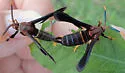
Grape Root Borer - Hodges#2530
Vitacea polistiformis
Identification: Adult - excellent mimic of a paper wasp.
Graphic Moth - Hodges#8618
Drasteria graphica
Identification: forewing may be uniformly gray or light and dark gray with black AM and PM lines; AM line deeply bow-shaped; diffuse brown medial line may be present; PM line highly convoluted, merges with outer edge of reniform spot; ST line almost
Grapholita angleseana - Hodges#3430
Ephippiphora angleseana
Identification: Adult - see original description on Print References.
Grapholita compositella
Grapholita compositella
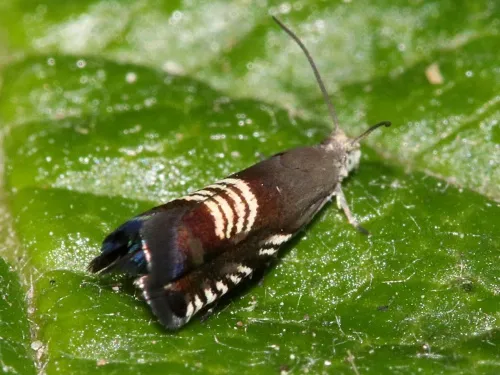
Wingspan 9-10 mm. A small but very attractive Tortricid , being all dark except for four long white strigulae on the dorsum and eight short ones on the leading forewing edge. There is also a leaden metallic patch, or ocellus towards the rear of the w
Grapholita fana - Hodges#3434
Grapholita fana
Identification: Adult- see original description in Print References.
Grapholita internana
Grapholita internana
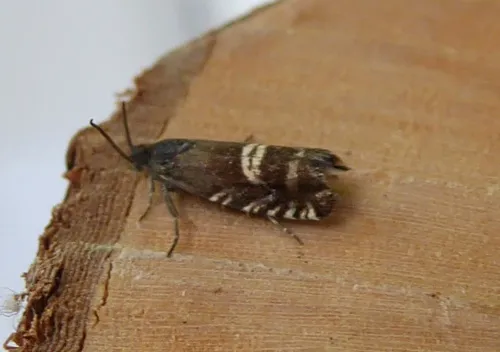
Unless identified by a recognised expert, a photo is required. If the photo doesn't show the key ID features then in the comments box describe the size and identifying characters you have observed. If recorded on, or near to, Gorse please state this
Grapholita janthinana
Grapholita janthinana
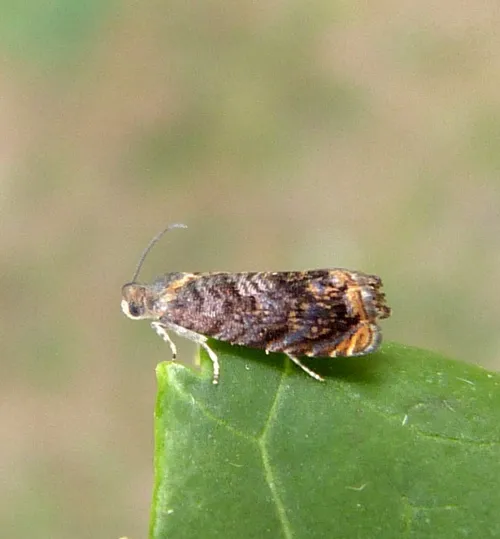
Wingspan 9-11 mm. A small moth with a mottling of browns, oranges and greys. This moth flies during the afternoon and early evening and is at large during July and early August. The larva feeds in the berries of Hawthorn, spinning two or three berrie
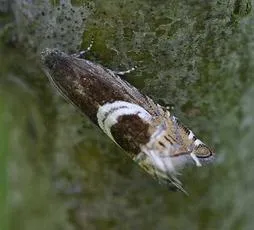
Grapholita jungiella
Grapholita jungiella
Wingspan 10-13 mm. The moths fly low over the foodplants in sunshine and have conspicuously white hindwings. A springtime species, flying in April and May in the north, whilst in the south a later second generation also occurs. The larvae feed on Bit
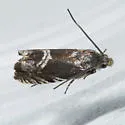
Grapholita lana - Hodges#3441
Grapholita lana
Grapholita edwardsiana (Kearfott, 1907) and Grapholita lana (Kearfott, 1907) are probably races of a single species.
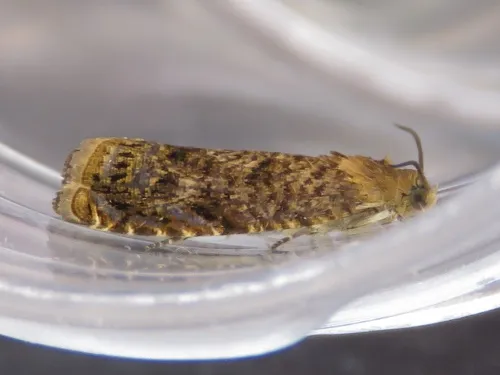
Grapholita lobarzewskii
Grapholita lobarzewskii
Records for this species must be confirmed by genitalia examination. Probably most likely to be encountered where the larval foodplant fruit trees occur. Flight period is typically in May and June. The larvae feed in the fruits of Plum and Cherry, an
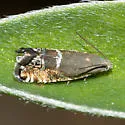
Grapholita lunatana - Hodges#3437
Ephippiphora lunatana
Identification: Adult - males have pale grey to white hindwing, females dark brown hindwing. ( 3 )
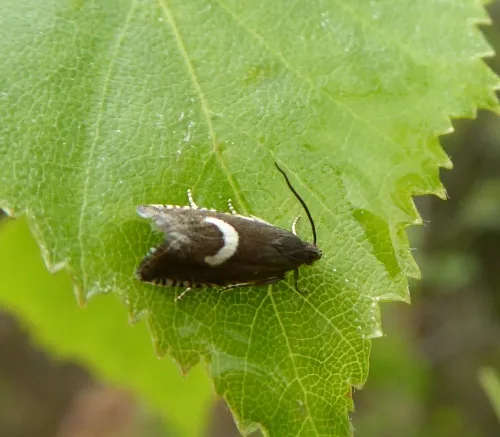
Grapholita lunulana
Grapholita lunulana
Wingspan 11 to 17 mm. The white crescent shape wing marking in distinctive. Good photograph required. Please retain specimen until identification is confirmed. In view of the scarcity of this species in VC55 any records should be supported by photogr
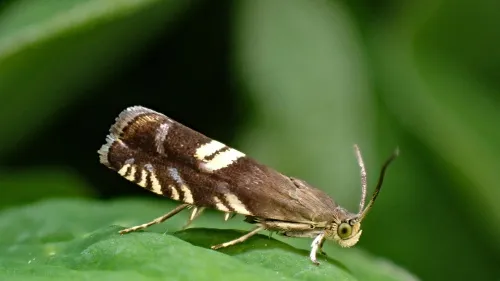
Grapholita pallifrontana
Grapholita pallifrontana
It is similar in appearance to Grapholita internana and care must be taken with identification. This is a rare species in VC55 and records must be supported by good photographs. If your record is not of a moth in association with its foodplant gen de
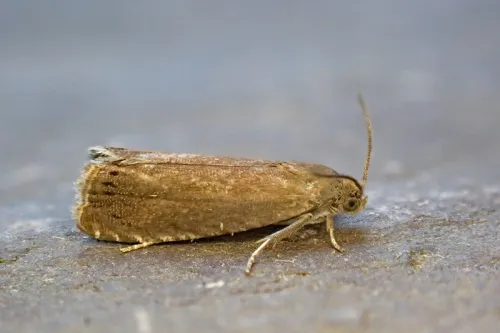
Grapholita tenebrosana
Grapholita tenebrosana
Wingspan 12 - 14 mm. This is a small purple brown species, it sometimes shows a reddish tinge. It can easily be confused with Grapholita funebrana . They can be separated by the colour of the palps; dull greyish brown in G. funebrana, greyish white o
Grapholita vitrana - Hodges#3433
Ephippiphora vitrana
Identification: Walsingham (1879) description is online in the print references. Specimen determined by DNA analysis (BOLD). ( 3 )
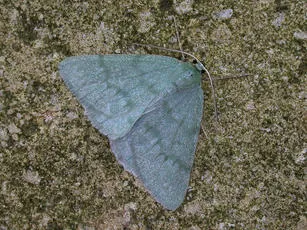
Grass Emerald
Pseudoterpna pruinata
Wingspan 30 to 35 mm. Although bright bluish-green when freshly emerged, this species fades quickly and becomes rather greyish. It occurs in open country such as heathland, moorland and commons. Fairly frequent from southern Scotland southwards. In a
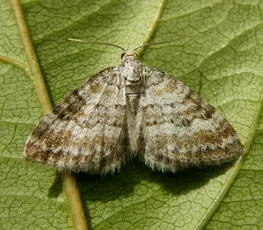
Grass Rivulet
Perizoma albulata
Wingspan 20 to 26 mm. A small species with wing barred with pale gold-green. The preferred habitats of this moth are open, dry grassy areas, limestone hills and sandy or shingle beaches. The flight period is from May to July, when the moths are on th
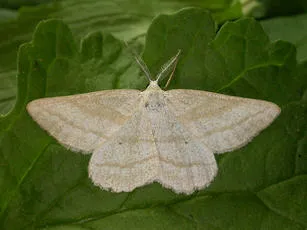
Grass Wave
Perconia strigillaria
A species which occupies moors and heaths, as well as open woodland. There is just one brood, flying in June and July, when the moths are on the wing from dusk into the night. The caterpillars overwinter and feed predominantly on heather and heath as
Grateful Midget - Hodges#9684
Elaphria grata
Identification: Forewing reddish-brown with whitish lines. Dark gray dots in reniform and orbicular spots. .
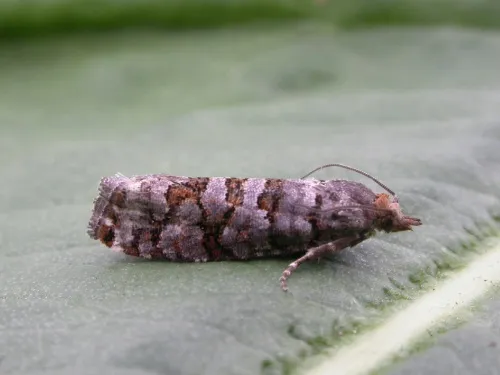
Gravitarmata margarotana
Gravitarmata margarotana
A migrant. Abroad it favours areas where the larval foodplants are found. Typically it is on the wing on the continent in April and May. The larval host plants are various coniferous trees including pine and spruce. The first record of this species f
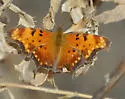
Gray Comma - Hodges#4429
Polygonia progne
Identification: Upperside is bright orange-brown; summer form has hindwing with a wide dark border, winter form has the border covering only about 1/4 of the wing; both enclosing a few small yellow spots. Underside is charcoal gray with fine dark str
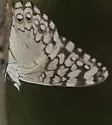
Gray Cracker - Hodges#4542
Hamadryas februa
Identification: Like other crackers, this species has a row of eyespots along the edge of the hindwing. This species, within those spots, has black crescents rather than complete black circles. It lands on tree trunks, wings spread, head downward.
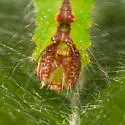
Gray Dagger - Hodges#9212
Acronicta grisea
Identification: forewing dark gray with black basal and anal margin dashes; postmedial line with sharply-dentate margin hindwing white
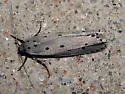
Gray Ethmia - Hodges#0987
Ethmia monticola
Identification: Adult - see original description in Print References. Not strongly attracted to lights.
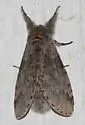
Gray Furcula - Hodges#7937
Furcula cinerea
Identification: Adult: forewing light gray with low-contrast medium gray median and subterminal areas, or completely medium gray in some individuals; AM, PM, and terminal lines a series of black dots; small amounts of yellow or orange often present o