
Gold-headed Leafroller - Hodges#2830
Olethreutes auricapitana
This record describes Olethreutes auricapitana (species). Recorded family: Tortricidae. Recorded order: Lepidoptera.
Identification and Appearance
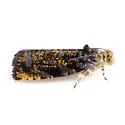
Adult - Except for gold edging along the apex and lustrous blue-gray interfascial scaling, the forewing appears black. ( 3 ) . DNA analysis at BOLD indicates there are two species going under this name. It appears that true auricapitana is a fern feeding species, and there is an undescribed species near auricapitana that feeds on birch. BOLD:AAI3236 is referable to the fern feeding phenotype, and BOLD:AAF4647 corresponds to the birch feeding phenotype. While the species seen on this page is more likely than not to be true auricapitana , this conclusion is far from definitive. The type specimen is apparently in the British Museum, and examination of it would make the proper association clear. (With information from M. Sabourin, pers. comm. to A. Hunt, 6-8 vii 2020.) One of several Nearctic Olethreutes s. l. species with iridescent spots on the forewings: [missing] [missing] [missing] astrologana coruscana ferrolineana metallica nordeggana sordidana galaxana [missing] siderana concretana auricapitana nr. auricapitana albiciliana agilana
Classification
- Kingdom
- Animalia
- Phylum
- Arthropoda
- Class
- Insecta
- Order
- Lepidoptera (Butterflies and Moths)
- Superfamily
- Tortricoidea
- Family
- Tortricidae (Tortricid Moths)
- Subfamily
- Olethreutinae
- Tribe
- Olethreutini
- Genus
- Olethreutes
Imported taxonomy record. Source availability varies; see the source references and editorial policy below.
Habitat and Range
Geographic Range
Nova Scotia to Missouri, south to Virginia and Alabama.
Diet and Behavior
Diet: When larvae feed on fronds of ostrich fern ( Matteuccia struthiopteris ), they cause a gall within the last ten or so pinnae of the unfurling frond (Aderkas and Peterson 1987). Larvae reported by Heinruch, 1926 to to feed on yellow birch ( Betula alleghaniensis Britton var. alleghaniensis , = lutea ). This is thought to refer to the undescribed species (see remarks section).
Additional species information
Species notes from the sources
Etymology: Specific epithet from Latin meaning "gold-headed" for the "bright orange-yellow" head.
About Butterflies and Moths: the wider group
Order-level background for Lepidoptera, the group containing Olethreutes auricapitana. Species-specific details appear above.
Group overview
Lepidoptera includes approximately 180,000 described species of butterflies and moths. Moths outnumber butterflies roughly 10:1. The monarch butterfly's eastern population has declined by more than 80% since the mid-1990s, and the western population by over 95% since the 1980s. The IUCN lists the migratory monarch as Vulnerable.
Ecological role of the group
Butterflies and moths are essential indicators of ecosystem health. As caterpillars, they are a primary food source for birds - a single nest of blue tit chicks requires ~10,000 caterpillars. Adult moths pollinate many night-blooming plants.
Economic and practical significance of the group
Lepidoptera are critical pollinators. In Europe, grassland butterfly species have declined by almost 50% since the early 1990s. In the UK, three-quarters of butterflies are in decline. In the U.S., five butterfly species have gone extinct since 1950, with 29 listed as endangered.
Recorded sources for this group: IUCN Red List, Xerces Society, USFWS, PNAS, WWF. Imported estimates may describe particular regions or reporting periods.
Photos of Gold-headed Leafroller - Hodges#2830 (5)
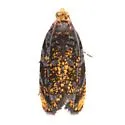

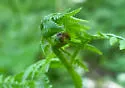
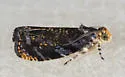
Photo credits: Contributed by Charley Eiseman; Additional contributions by Steve Nanz , Randy Hardy , Kyhl Austin , Blocky
Frequently Asked Questions About Gold-headed Leafroller - Hodges#2830
What is Gold-headed Leafroller - Hodges#2830?
Gold-headed Leafroller - Hodges#2830 (Olethreutes auricapitana) is a species in the family Tortricidae, within the order Lepidoptera.
How big is Gold-headed Leafroller - Hodges#2830?
Wingspan 10-12 mm.
How do you identify Gold-headed Leafroller - Hodges#2830?
Adult - Except for gold edging along the apex and lustrous blue-gray interfascial scaling, the forewing appears black. ( 3 ) .
Where is Gold-headed Leafroller - Hodges#2830 found?
Range: Nova Scotia to Missouri, south to Virginia and Alabama.
What does Gold-headed Leafroller - Hodges#2830 eat?
The diet of the Gold-headed Leafroller - Hodges#2830 includes When larvae feed on fronds of ostrich fern ( Matteuccia struthiopteris ), they cause a gall within the last ten or so pinnae of the unfurling frond (Aderkas and Peterson 1987). Larvae reported by Heinruch, 1926 to to feed on yellow birch ( Betula alleghaniensis Britton var. alleghaniensis , = lutea ). This is thought to refer to the undescribed species (see remarks section)..