
Grape Leafroller - Hodges#5160
Desmia maculalis
This record describes Desmia maculalis (species). Recorded family: Crambidae. Recorded order: Lepidoptera.
Identification and Appearance
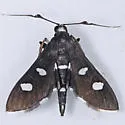
From Brian Scholtens: The character that I use is the extent of the white patch on the underside of the abdomen. D. funeralis individuals have a solid white patch on the underside of the abdomen on segments 1-5 (or may have a slight break on segment 3). D. maculalis individuals have a broken white patch, where about 1/2 of segments 3 and 4 are clearly dark. Basically, maculalis looks striped on the underside, whereas funeralis looks like it is basically solid white. There is considerable size overlap between male Desmia maculalis and female D. funeralis so it is necessary to sex the moth to be able to identify the species. Fortunately, sexing the 2 species is relatively easy. Males of D. funeralis and D. maculalis have a distinct notch or joint at about the mid-point of each antenna. The hindwing spot on the females of both species is pinched in the middle and on rare occasions may be divided into 2 smaller spots. To add your record to this page, you must provide: 1. a dorsal photo that clearly shows the antennae or the spot on the hindwing so the moth can be sexed. 2. a ventral photo clearly showing the markings on the abdomen. The moth does not have to be killed or chilled to get a photo of the underside. A jar with flat sides works great for this purpose and also makes it easy to get accurate measurements. 3. an accurate measurement of the wingspan. Records that do not meet these 3 requirements should go in the Desmia funeralis/maculalis group location. Of course specimens identified through DNA barcoding do not need a photo of the underside or wingspan measurements to be added to this page. Photo of the underside showing the banded abdomen. Specimens identified by DNA analysis (BOLD).
Classification
- Kingdom
- Animalia
- Phylum
- Arthropoda
- Class
- Insecta
- Order
- Lepidoptera (Butterflies and Moths)
- Superfamily
- Pyraloidea
- Family
- Crambidae (Crambid Snout Moths)
- Subfamily
- Spilomelinae
- Tribe
- Nomophilini
- Genus
- Desmia
Imported taxonomy record. Source availability varies; see the source references and editorial policy below.
Habitat and Range
Geographic Range
across southern United States to California; in the east, occurs north to Maryland, Ontario, and Michigan. ,
Seasonal Activity
adults fly May-September ( 4 )
Diet and Behavior
Diet: Found and reared on Seedbox ( Ludwigia alternifolia ) and Virginia Creeper ( Parthenocissus quinquefolia ). Presumably other members of Onagraceae and Vitaceae are utilized as well.
About Butterflies and Moths: the wider group
Order-level background for Lepidoptera, the group containing Desmia maculalis. Species-specific details appear above.
Group overview
Lepidoptera includes approximately 180,000 described species of butterflies and moths. Moths outnumber butterflies roughly 10:1. The monarch butterfly's eastern population has declined by more than 80% since the mid-1990s, and the western population by over 95% since the 1980s. The IUCN lists the migratory monarch as Vulnerable.
Ecological role of the group
Butterflies and moths are essential indicators of ecosystem health. As caterpillars, they are a primary food source for birds - a single nest of blue tit chicks requires ~10,000 caterpillars. Adult moths pollinate many night-blooming plants.
Economic and practical significance of the group
Lepidoptera are critical pollinators. In Europe, grassland butterfly species have declined by almost 50% since the early 1990s. In the UK, three-quarters of butterflies are in decline. In the U.S., five butterfly species have gone extinct since 1950, with 29 listed as endangered.
Recorded sources for this group: IUCN Red List, Xerces Society, USFWS, PNAS, WWF. Imported estimates may describe particular regions or reporting periods.
Photos of Grape Leafroller - Hodges#5160 (5)
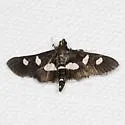
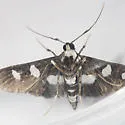
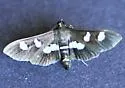
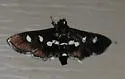
Photo credits: Contributed by Cotinis; Additional contributions by Steve Nanz , Robin McLeod , gretchengrammer , Maury Heiman , ceiseman , Ken Childs , George Smiley
Frequently Asked Questions About Grape Leafroller - Hodges#5160
What is Grape Leafroller - Hodges#5160?
Grape Leafroller - Hodges#5160 (Desmia maculalis) is a species in the family Crambidae, within the order Lepidoptera.
How big is Grape Leafroller - Hodges#5160?
| Feature | Details |
|---|---|
| Males | Live wingspan 20mm - 24mm |
| Females | Live wingspan 18mm - 20mm |
How do you identify Grape Leafroller - Hodges#5160?
From Brian Scholtens: The character that I use is the extent of the white patch on the underside of the abdomen. D. funeralis individuals have a solid white patch on the underside of the abdomen on segments 1-5 (or may have a slight break on segment 3). D. maculalis individuals have a broken white patch, where about 1/2 of segments 3 and 4 are clearly dark. Basically, maculalis looks striped on the underside, whereas funeralis looks like it is basically solid white. There is considerable size overlap between male Desmia maculalis and female D. funeralis so it is necessary to sex the moth to be able to identify the species. Fortunately, sexing the 2 species is relatively easy. Males of D. funeralis and D. maculalis have a distinct notch or joint at about the mid-point of each antenna. The hindwing spot on the females of both species is pinched in the middle and on rare occasions may be divided into 2 smaller spots. To add your record to this page, you must provide: 1. a dorsal photo that clearly shows the antennae or the spot on the hindwing so the moth can be sexed. 2. a ventral photo clearly showing the markings on the abdomen. The moth does not have to be killed or chilled to get a photo of the underside. A jar with flat sides works great for this purpose and also makes it easy to get accurate measurements. 3. an accurate measurement of the wingspan. Records that do not meet these 3 requirements should go in the Desmia funeralis/maculalis group location. Of course specimens identified through DNA barcoding do not need a photo of the underside or wingspan measurements to be added to this page. Photo of the underside showing the banded abdomen. Specimens identified by DNA analysis (BOLD).
Where is Grape Leafroller - Hodges#5160 found?
Range: across southern United States to California; in the east, occurs north to Maryland, Ontario, and Michigan. ,
What does Grape Leafroller - Hodges#5160 eat?
The diet of the Grape Leafroller - Hodges#5160 includes Found and reared on Seedbox ( Ludwigia alternifolia ) and Virginia Creeper ( Parthenocissus quinquefolia ). Presumably other members of Onagraceae and Vitaceae are utilized as well..
When is Grape Leafroller - Hodges#5160 active?
Grape Leafroller - Hodges#5160: seasonal activity - adults fly May-September ( 4 ).