
Goldenrod Plume Moth - Hodges#6212
Hellinsia kellicottii
This record describes Hellinsia kellicottii (species). Recorded family: Pterophoridae. Recorded order: Lepidoptera.
Identification and Appearance
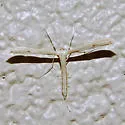
| Feature | Description |
|---|---|
| Wings | Wings: Pale yellowish-brown; very few darker brownish scales near wing tips. Tips pointed. Larger dark brown dot at cleft or split in wings, and another very tiny one at tip end. Two very tiny brown spots on outer (costal) edge near wing tip – barely visible. Inner wing margin dark. Fringe white. |
| Hindwings | Hindwings brown, silky. Fringes darker. |
| Legs | Legs: Fore and middle legs brownish yellow, darker on underside of front & middle legs. |
| Abdomen | Abdomen: Yellowish-tan. Slightly darker, but faint line down middle, may also have faint dots. Side edges have a darker line, broken at all segment lower margins. Types: Lectotype as Lioptilus kellicottii male by Fish, 1881. Type Locality: New York. In the United States National Museum of Natural History, Smithsonian, Washington, D.C. No abdomen. Female paralectotype also in museum. Holotype as Pterophorus chlorias by Meyrick, 1907. Type Locality: Colorado. In the British Museum of Natural History, London, England. |
Classification
- Kingdom
- Animalia
- Phylum
- Arthropoda
- Class
- Insecta
- Order
- Lepidoptera (Butterflies and Moths)
- Superfamily
- Pterophoroidea
- Family
- Pterophoridae (Plume Moths)
- Subfamily
- Pterophorinae
- Tribe
- Oidaematophorini
- Genus
- Hellinsia
Imported taxonomy record. Source availability varies; see the source references and editorial policy below.
Habitat and Range
Habitat
Forest edges, meadows.
Geographic Range
eastern half of U.S. and Ontario.
Seasonal Activity
May to July in the north; all season in the south.
Diet and Behavior
Diet: Goldenrod Solidago
Life History
Larvae bore in stems, branches and roots. 12 to 14 mm long. Light yellow with pink streaks down length. Streaks turn brownish when mature. Segment 8 pink on margin. Very few hairs on body. Tip black with ring of long brown hairs, and two hooks in the middle of ring. Larvae plug entrance hole in stem when ready to pupate. Pupa white, spined; top (head) dark. Overwintering larva move to base of plant and bore into main stalk, then down to roots.
Additional species information
Species notes from the sources
Etymology: Author: Fish, 1881
About Butterflies and Moths: the wider group
Order-level background for Lepidoptera, the group containing Hellinsia kellicottii. Species-specific details appear above.
Group overview
Lepidoptera includes approximately 180,000 described species of butterflies and moths. Moths outnumber butterflies roughly 10:1. The monarch butterfly's eastern population has declined by more than 80% since the mid-1990s, and the western population by over 95% since the 1980s. The IUCN lists the migratory monarch as Vulnerable.
Ecological role of the group
Butterflies and moths are essential indicators of ecosystem health. As caterpillars, they are a primary food source for birds - a single nest of blue tit chicks requires ~10,000 caterpillars. Adult moths pollinate many night-blooming plants.
Economic and practical significance of the group
Lepidoptera are critical pollinators. In Europe, grassland butterfly species have declined by almost 50% since the early 1990s. In the UK, three-quarters of butterflies are in decline. In the U.S., five butterfly species have gone extinct since 1950, with 29 listed as endangered.
Recorded sources for this group: IUCN Red List, Xerces Society, USFWS, PNAS, WWF. Imported estimates may describe particular regions or reporting periods.
Photos of Goldenrod Plume Moth - Hodges#6212 (5)
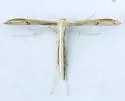
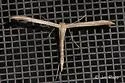
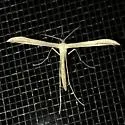
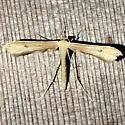
Photo credits: Contributed by Charley Eiseman; Additional contributions by lee_penner , treichard , Blocky
Frequently Asked Questions About Goldenrod Plume Moth - Hodges#6212
What is Goldenrod Plume Moth - Hodges#6212?
Goldenrod Plume Moth - Hodges#6212 (Hellinsia kellicottii) is a species in the family Pterophoridae, within the order Lepidoptera.
How big is Goldenrod Plume Moth - Hodges#6212?
| Feature | Description |
|---|---|
| Wingspan | Wingspan 28 to 30 mm. |
| Wingspan | wingspan; 12 to 14 mm long |
How do you identify Goldenrod Plume Moth - Hodges#6212?
| Feature | Description |
|---|---|
| Wings | Wings: Pale yellowish-brown; very few darker brownish scales near wing tips. Tips pointed. Larger dark brown dot at cleft or split in wings, and another very tiny one at tip end. Two very tiny brown spots on outer (costal) edge near wing tip – barely visible. Inner wing margin dark. Fringe white. |
| Hindwings | Hindwings brown, silky. Fringes darker. |
| Legs | Legs: Fore and middle legs brownish yellow, darker on underside of front & middle legs. |
| Abdomen | Abdomen: Yellowish-tan. Slightly darker, but faint line down middle, may also have faint dots. Side edges have a darker line, broken at all segment lower margins. |
Where is Goldenrod Plume Moth - Hodges#6212 found?
| Feature | Details |
|---|---|
| Habitat | Forest edges, meadows. |
| Range | eastern half of U.S. and Ontario. |
What does Goldenrod Plume Moth - Hodges#6212 eat?
The diet of the Goldenrod Plume Moth - Hodges#6212 includes Goldenrod Solidago.
When is Goldenrod Plume Moth - Hodges#6212 active?
Goldenrod Plume Moth - Hodges#6212: seasonal activity - May to July in the north; all season in the south..
What is the life cycle of a Goldenrod Plume Moth - Hodges#6212?
Larvae bore in stems, branches and roots. 12 to 14 mm long. Light yellow with pink streaks down length. Streaks turn brownish when mature. Segment 8 pink on margin. Very few hairs on body. Tip black with ring of long brown hairs, and two hooks in the middle of ring. Larvae plug entrance hole in stem when ready to pupate. Pupa white, spined; top (head) dark. Overwintering larva move to base of plant and bore into main stalk, then down to roots.