
Primitive Winged Insects
Order Coleoptera
The Primitive Winged Insects (Order Coleoptera) includes 15,720 species across 160 families and 3,716 genera in our directory.
About Primitive Winged Insects
Coleoptera is the largest order of insects with over 400,000 described species, representing ~25% of all known animal species and ~40% of all insects. In the U.S. alone, nearly 30,000 beetle species have been identified.
Economic Impact
Beetles have major economic significance: leaf beetles (Chrysomelidae) and weevils (Curculionoidea) are among the most destructive agricultural pests globally, costing billions annually, while predatory species like ladybugs provide natural pest control.
Ecological Role
Beetles are prominent decomposers, especially in forests, breaking down dead wood and recycling nutrients. As predators, they reduce populations of pest insects. Many species are also important pollinators of flowering plants.
Families in Coleoptera (160)
Species in Coleoptera (15,720)
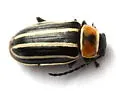
Disonycha pensylvanica
Disonycha pensylvanica
Identification: The three species of the D. pensylvanica -group are hard to tell apart; in some cases examining male genitalia is the only way. Common features: Head completely, or for the most part, black; pronotum reddish, usually with central dark
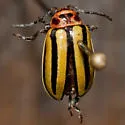
Disonycha pluriligata
Disonycha pluriligata
closely related to D. alternata , and basically similar. D. pluriligata has two forms / subspecies, the southwestern (sonoran?) pura LeConte, 1858 [NM - CA, probably extending into Mexico], and the nominate form of more eastern range [west to IL -
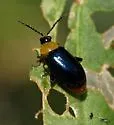
Disonycha politula
Disonycha politula
Identification: lustrous and closely punctate green or blue elytra; prothorax pale, undersurface mostly dark, the abdominal margin, anterior femora, and basal half of posterior femora pale. elytra more or less blue this may be known by the very disti
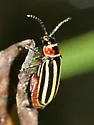
Disonycha procera
Disonycha procera
Identification: See info page for Disonycha pensylvanica Disonycha procera : - head usually red anteriour of antennal base; - legs usually with red femora, also tibiae can be partly red; (dark varieties with legs all dark occur) - abdomen usually com
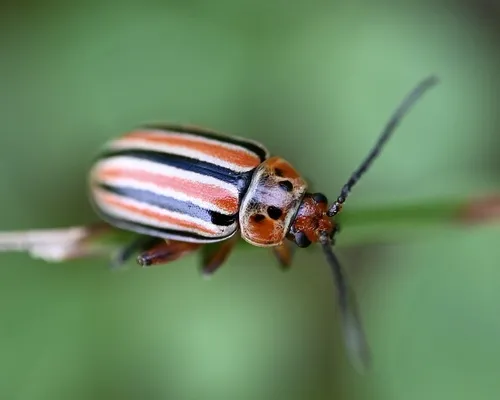
Disonycha punctigera
Disonycha punctigera
Identification: Elytra with narrow black stripes, the submarginal usually not extending beyond median at apex. Pronotum with (usually) 4 spots, head with dark base (difference vs. D. caroliniana ); Elytra distinctly, and quite densely punctured (name
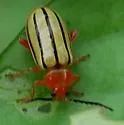
Disonycha quinquelineata
Disonycha quinquelineata
Identification: Yellow elytra with five narrow, free-ending black vittae; legs completely red , though tarsi may be deeper in colour .
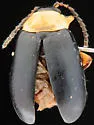
Disonycha semicarbonata
Disonycha semicarbonata
Identification: Essentially, same characteristics as D. collata ; differs in: - abdomen dark, except for terminal segment - head yellow in front - dorsum distinctly punctured - elytra rather black, and less shiny.
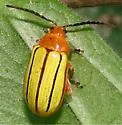
Disonycha stenosticha
Disonycha stenosticha
Identification: Det. E. G. Riley, 2009 Texas considers this sp. a SGCN ( 6 ) Type Locality: "Brownsville," Cameron Co., Texas on January 17, 1923. (Schaeffer 1931)
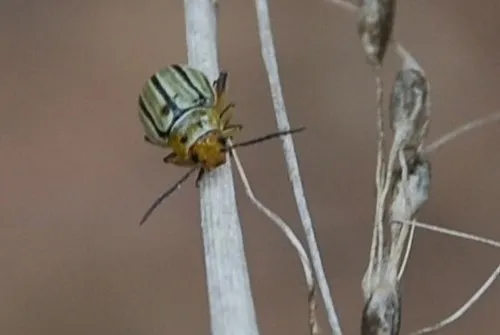
Disonycha tenuicornis
Disonycha tenuicornis
Identification: true tenuicornis . Note: that when alive, tenuicornis is yellowish, not the blood reddish color of some other vittate Disonycha . Det. E. G. Riley, 2022 All the current Bugguide images of D. tenuicornis are not tenuicornis . I am not
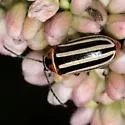
Disonycha uniguttata
Disonycha uniguttata
Identification: See info page for Disonycha pensylvanica
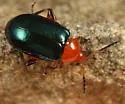
Disonycha varicornis
Disonycha varicornis
Identification: lustrous blue or purple, rarely green elytra [emphasis added], and pale head, prothorax, and undersurface, except for darkened tibiae and tarsi and apex of hind femora. ( 3 ) Four basal antennomeres are pale as well as one or two term
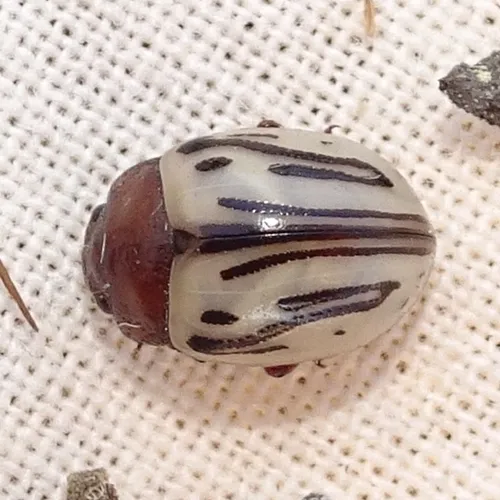
Disrupted Leaf Beetle
Calligrapha disrupta
Calligrapha disrupta is a species of leaf beetle belonging to the family Chrysomelidae, in the subgenus Zygogramma, which was formerly a genus.
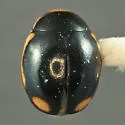
Dissolute Lady Beetle
Hyperaspis dissoluta
Identification: Gordon's figures for dissoluta Gordon's figures for nevadica
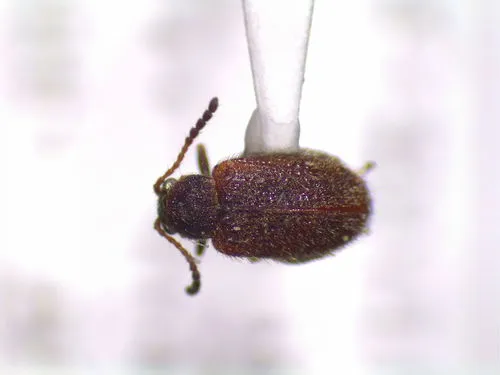
Distigmoptera borealis
Distigmoptera borealis
Distigmoptera borealis is a species of flea beetle in the family Chrysomelidae. It is found in North America.
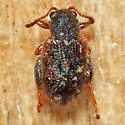
Distigmoptera impennata
Distigmoptera impennata
Identification: Varying from yellow to dark brown, densely punctate, pubescent; the striate punctures of elytra well separated by distinct intervals; Males either wingless or with wings reduced. (Blake 1943) Type locality: Isle au Haut, Maine, collec
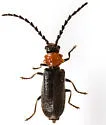
Ditemnus bidentatus
Ditemnus bidentatus
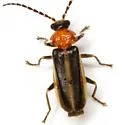
Ditemnus bidentatus (Ditemnus bidentatus) is a species in the family Cantharidae, commonly known as soldier beetles, belonging to the order Coleoptera (Beetles). It is classified within the subfamily Silinae, tribe Silini, suborder Polyphaga, superfa
Ditemnus fossiger 0
Ditemnus fossiger
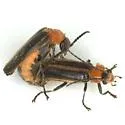
Identification: Elytra black, lateral borders narrowly pale. , see type Type Locality: Texas
Ditemnus freemani
Ditemnus freemani
Identification: note the destinctive pronotal margin, and range - males not in GBIF
Dogwood Systena
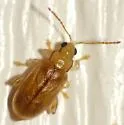
Systena corni
Identification: differs from the similar S. marginalis by weaker markings and association with Cornus florida
Dogwood Twig Borer
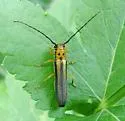
Oberea tripunctata
Identification: pronotum with a pair of black calli and a basal black spot near the scutellum, underside mostly dark, and outer margin of mandibles nearly straight
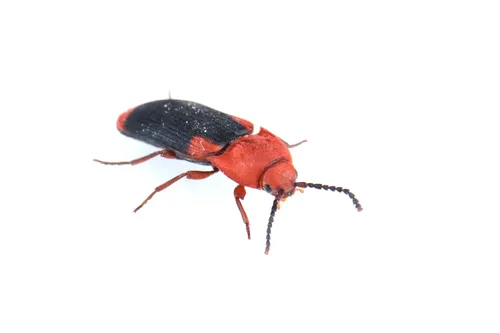
Dohrn's Elegant Eucnemid Beetle
Palaeoxenus dohrnii
Identification: Bright blood red and black colorations, large size and Californian range will distinguish the species from all other Nearctic Eucnemidae. While searching for additional information for the genus on the internet, a website was found.
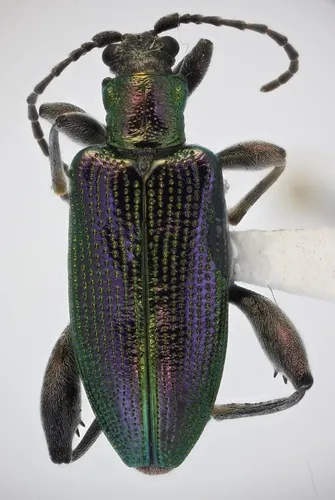
Donacia (Mergodonacia) magnifica
Donacia magnifica
Identification: Recognized by completely dark green color, dense punctures of pronotum, and striking multicolor of elytra and pronotum, metafemora of male bidentate, legs entirely dark • Holotype Not commonly seen or collected because the host plant
Donacia assimilis
Donacia assimilis
Identification: metallic green, antennae mostly black legs reddish, femora metallic at apex elytra shiny, subtruncate at base; punctures moderately coarse near base, finer near apex hind femur without tooth, markedly clavate
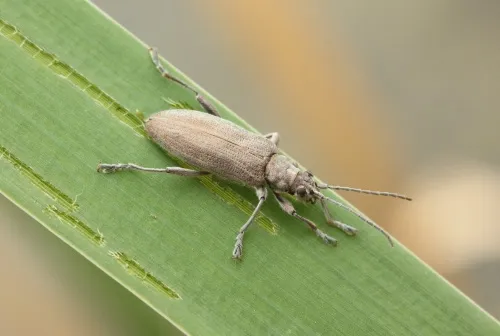
Donacia cinerea
Donacia cinerea
7.5 to 11 mm. Most easily identified among the UK Donaciinae by the finely and densely pubescent dorsal surface which gives the species a silky or grey appearance in the field. Elongate with sub-parallel elytra, entirely dull bronze or, occasionally,
Donacia clavipes
Donacia clavipes
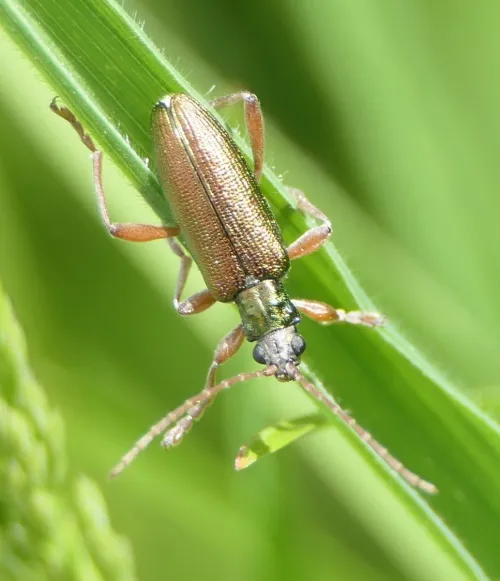
Size: 8.3 to 10.5 mm. A shiny metallic brassy-green to coppery beetle with red-brown legs. Unless identified by a recognised expert, a photo is required. If the photo doesn't show the key ID features then in the comments box describe the size and ide
Donacia cuprea
Donacia cuprea
Identification: Diagnostic character: epipleuron of elytra is convex and wide, often distinctly wider than the elytral interval next it. Pronotum quadrate or wider than long, with super dense punctures; elytra quite rugose; legs generally entirely pa
Donacia edentata
Donacia edentata
Identification: This species is very distinct from any other known so far. By description and superficially it resembles parvidens somewhat, but the form is more elongate, the prothorax always dull, the antennal joints longer and narrower, the poster
Donacia fulgens
Donacia fulgens
Identification: habitus photos Among species of the D subtilis group, D fulgens is recognizeable most easily by its brilliant green color, produced by dense fine rugosity of the elytra. Median line of pronotum mostly obscured by dense punctuation, th
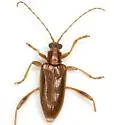
Donacia hypoleuca
Donacia hypoleuca
Identification: Uniform very fine microsculpture of pronotal surface, hind pronotal margin wider than anterior and with hind setiferous tubercle quite prominent; slender but distinctly clavate metafemora, sometimes toothless metafemora; basal protar
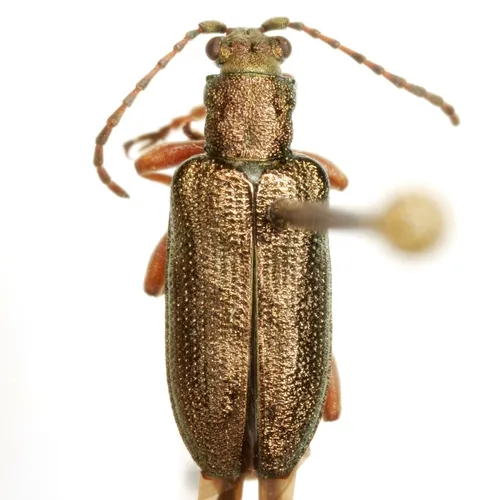
Donacia liebecki
Donacia liebecki
Identification: It resembles megacornis more than any other of our species but differs from that by more depressed form less, stouter antennal joints, posterior femora moderately clavate with a small acute tooth in both sexes and mesosternal process
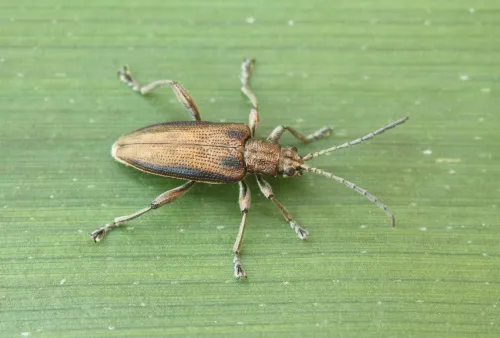
Donacia marginata
Donacia marginata
Size: 8 to 10mm. Elytra usually golden bronze, with variable reddish-purple patches and sides. Unless identified by a recognised expert, a photo is required and the specimen should be examined with a microscope. In the comments box, state the key or
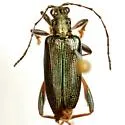
Donacia palmata
Donacia palmata
Identification: first tarsomere of male is “palmate”, very much widened, but not so in female. Pronotum is alutaceous, with well developed sulci.
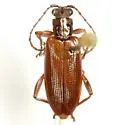
Donacia parvidens
Donacia parvidens
Identification: This distinct species [...] is apt to be confused with cincticornis . However, the antennae are heavier , the prothorax has a different shape and sculpture, the posterior femora are much shorter and have only a single feeble tooth (em
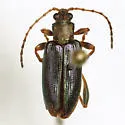
Donacia piscatrix
Donacia piscatrix
Identification: Variable in coloration and external features; males have a noticeable tooth on the mesotibia adjacent to the spur
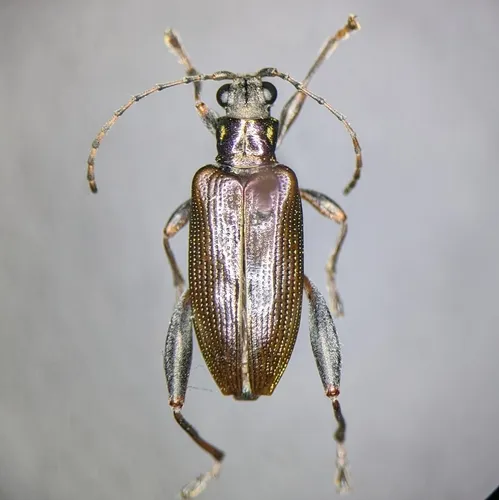
Donacia proxima
Donacia proxima
Donacia proxima is a species of aquatic leaf beetle in the family Chrysomelidae. It is found in North America.
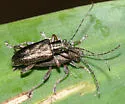
Donacia rugosa
Donacia rugosa
Identification: Coarsely and densely punctate pronotum, forming rugae laterally; strongly rugose elytra; legs entirely reddish pale, though can have darkened subapical areas of femora.
Donacia semicuprea
Donacia semicuprea
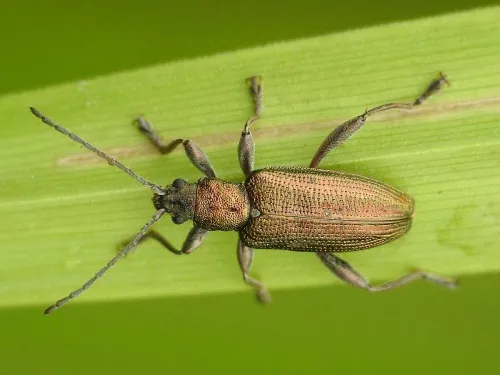
Length 6 to 9mm. Upper surface is metallic bronze. The pronotum has a central longitudinal groove and is shining between the punctures. The underside has a covering of short white hairs giving it a grey appearance. Wet areas where Reed Sweet-grass is
Donacia simplex
Donacia simplex
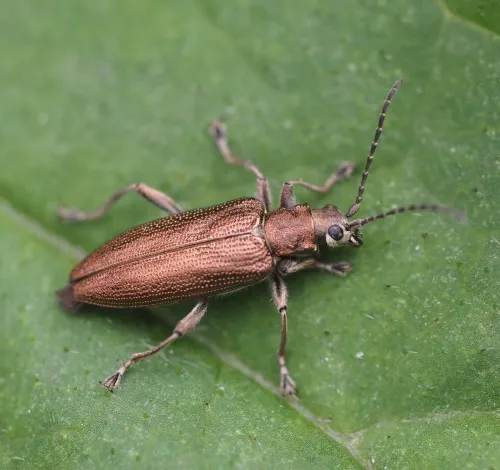
A medium sized (7 or 8 mm) metallic brown beetle. Elytral apices are truncate, c.f. slightly sinuate or wavy in D. vulgaris . On the edges of pools and canals where it can be found on emergent and marginal vegetation. It is particularly associated wi
Donacia thalassina
Donacia thalassina
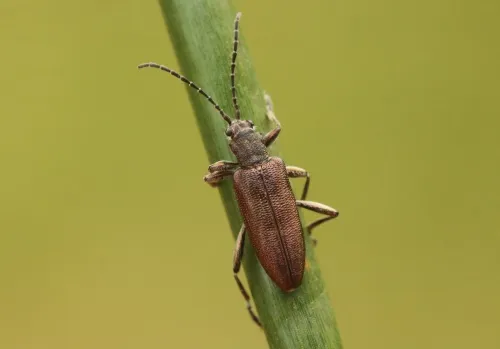
Size 6.5 to 8.5 mm. Shiny bronze, usually with a coppery tinge, sometimes greyish or greenish on the pronotum and elytra. Unless identified by a recognised expert, a photo is required and the specimen should be examined with a microscope. In the comm
Donacia tuberculata
Donacia tuberculata
Identification: Unusual for the subgenus in lacking strongly confluent punctuation of the pronotum, and elytral apex indistinctly truncate. Pronotum much wider across the anterior calli than across the base. Pronotum with indistinct median sulcus, i
Donacia tuberculifrons
Donacia tuberculifrons
Identification: Pronotum with anterolateral calli and posterolateral calli distinct, not exceeded by the setiferous tubercles so the side appears bisinuate; median pronotal line fairly distinct, disc with smooth rugae laterally; elytra curving relati
Donacia versicolorea
Donacia versicolorea
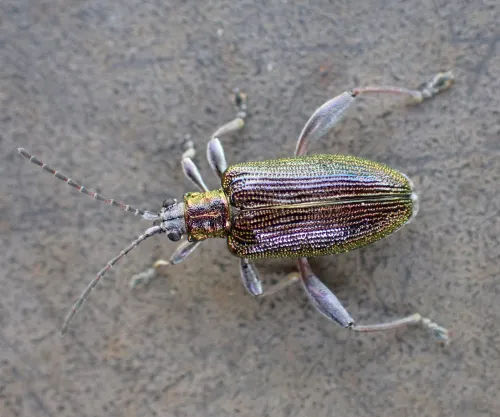
Size: 6.2 to 8.9 mm. The elytra can give a dark purplish or bronzy appearance depending on light conditions. Unless identified by a recognised expert, a photo is required and the specimen should be examined with a microscope. In the comments box, sta
Donacia vulgaris
Donacia vulgaris
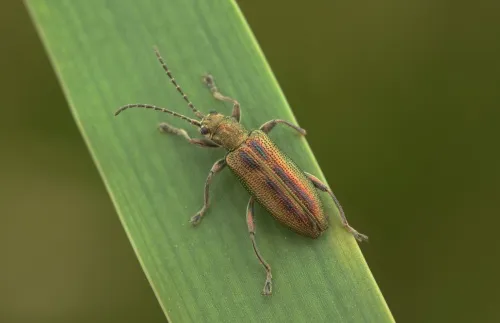
Length up to 12mm with females being larger than males. This Reed Beetle has coppery elytra, with a metallic reddish or bluish central area, though the female is less colourful. Donacia semicuprea is similar but the pronotum has a central longitudina
Dorcaschema cinereum
Dorcaschema cinereum
Identification: Antenna: Black, extremely long, twice as long as body; black. Thorax: Densely covered with grayish-brown pile. Hind margin wavy. Black line down middle. Wings: Densely covered with grayish-brown pile. May have a small black mark on ea
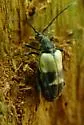
Dorcasina matthewsi
Dorcasina matthewsi
Identification: The species was described from pinned specimens so the color of the elytra is said to be testaceous, note that the living specimen is actually yellow. The females tend to have black antennae and legs, while the males are reddish brown
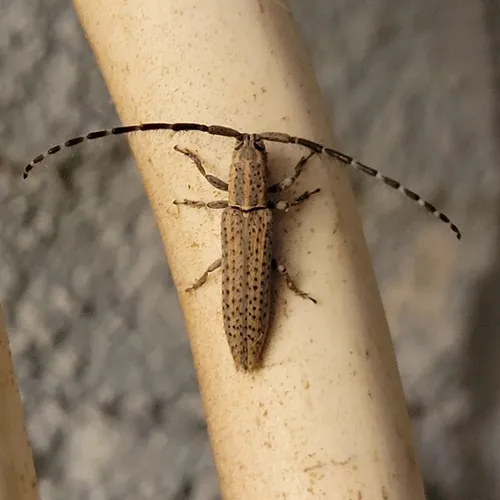
Dorcasta cinerea
Dorcasta cinerea
Dorcasta cinerea (Dorcasta cinerea) is a species in the family Cerambycidae, commonly known as longhorn beetles, belonging to the order Coleoptera (Beetles). It is classified within the subfamily Lamiinae, tribe Apomecynini, suborder Polyphaga, super
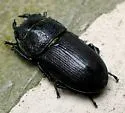
Dorcus brevis
Dorcus brevis
Identification: Humerus with a large tooth projecting forward and outward
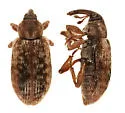
Dorytomus brevicollis
Dorytomus brevicollis
Identification: Det. Charles O'Brien, 2009 image shows the relative size of the two most common Dorytomus spp. in Texas. Dorytomus brevisetosus Casey is also present in w. TX. Dorytomus brevicollis LeConte - small Dorytomus mucidus (Say) ------- larg
Dorytomus filirostris
Dorytomus filirostris
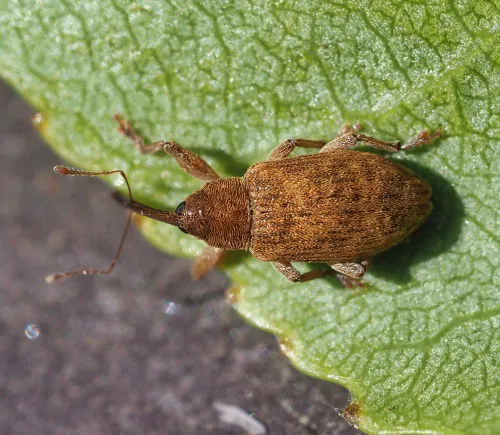
A slender, long‑snouted weevil specialised for life on poplars and willows - particularly Black Poplar and Hybrid Black Polar. It is 4-5mm (excluding the long rostrum) and tawny brown with the upper side covered in patchy pale and decumbent (lying fl
Dorytomus ictor
Dorytomus ictor
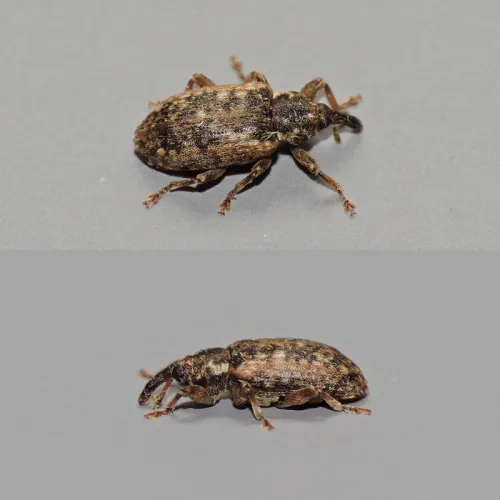
Unless identified by a recognised expert, photographic evidence is required and the specimen should be examined with a microscope. In the comments box, state the key or ID method used. Note the beetle's size and describe the identifying characters. I
Dorytomus longimanus
Dorytomus longimanus
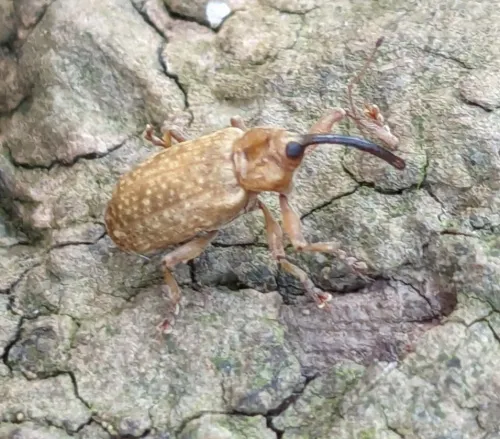
A brown weevil with light and dark forms. Characteristic long first leg. No additional images available for this species.
Dorytomus mucidus
Dorytomus mucidus
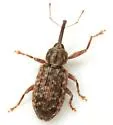
Identification: (female) Det. M. A. Quinn, 2021 image shows the relative size of the two most common Dorytomus spp. in Texas. Dorytomus brevisetosus Casey is also present in w. TX. Dorytomus brevicollis LeConte - small Dorytomus mucidus (Say) -------
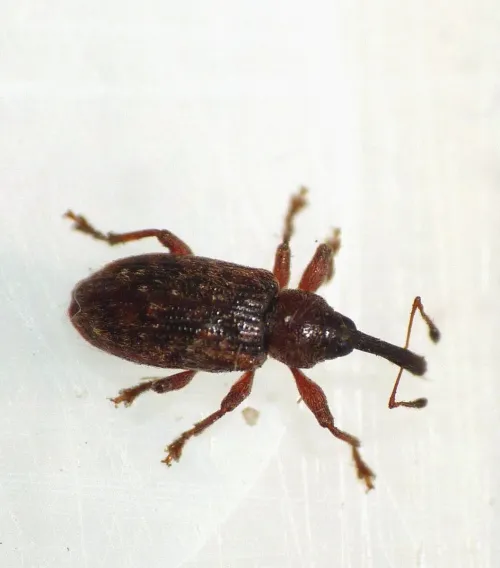
Dorytomus taeniatus
Dorytomus taeniatus
A small weevil with a mottled dark and light brown appearance. Unless identified by a recognised expert, photographic evidence is required and the specimen should be examined with a microscope. In the comments box, state the key or ID method used. No
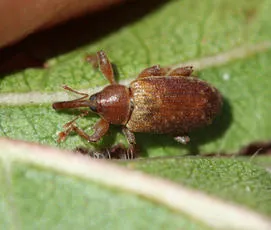
Dorytomus tortrix
Dorytomus tortrix
About 5 mm long, this is a reddish brown weevil. There are other very similar species in this genus which means that detailed examination of an actual specimen is generally needed to identify the exact species. A red box around the image indicates th
Douglas-fir Beetle
Dendroctonus pseudotsugae
Deters conspecifics by an antiaggregation pheromone, which is released by each sex at the sonic stimulus of the other sex.
Drapetes niger
Drapetes niger
Identification: first joint of antennae pale (Schaeffer, 1916) immediately recognized in our fauna by its elongate shape and long cinereous pubescence giving a grizzled appearance, usually elytra with pubescence forming a band just posterior of mid-l
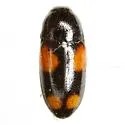
Drapetes quadripustulatus
Drapetes quadripustulatus
Identification: the only Neactic species with four elytral maculae, two on each elytron.
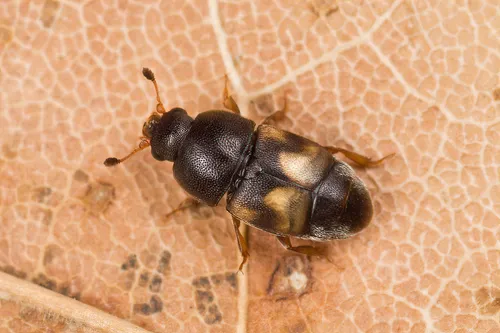
Dried-fruit Beetle
Carpophilus hemipterus
Dried-fruit Beetle (Carpophilus hemipterus) is a species in the family Nitidulidae, commonly known as sap-feeding beetles, belonging to the order Coleoptera (Beetles). It is classified within the subfamily Carpophilinae, suborder Polyphaga, superfami
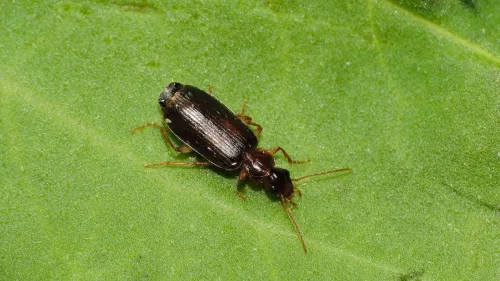
Dromius meridionalis
Dromius meridionalis
It is an arboreal species found on a variety of tree species such as Sycamore, Horse-chestnut and Spruce where it can often be located under bark. Fairly frequent and widespread in the southern half of Britain. No additional images available for this
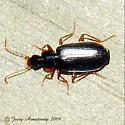
Dromius piceus
Dromius piceus
Identification: Flat uniformly brown elytra; lateral margins of pronotum translucent; claws denticulate
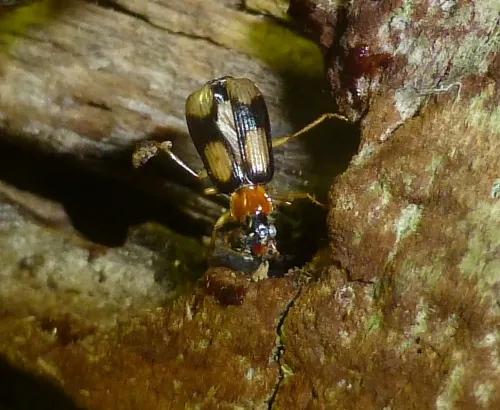
Dromius quadrimaculatus
Dromius quadrimaculatus
Length 5 to 6 mm. This beetle has a blackish head, but a shiny red pronotum. The legs and antennae are pale straw coloured. The dark elytra show two large pale patches on each and are sharply truncate leaving the terminal abdominal segment exposed. G
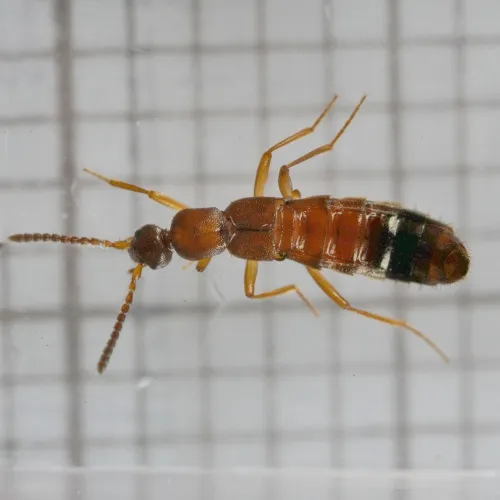
Drusilla canaliculata
Drusilla canaliculata
A small (about 5 mm), slender rove beetle. It is predominantly reddish brown but the rear of the abdomen is darker than the rest of the body. The legs are reddish-yellow and rather long. Abdomen is broadest in the middle. Found in a wide range of hab
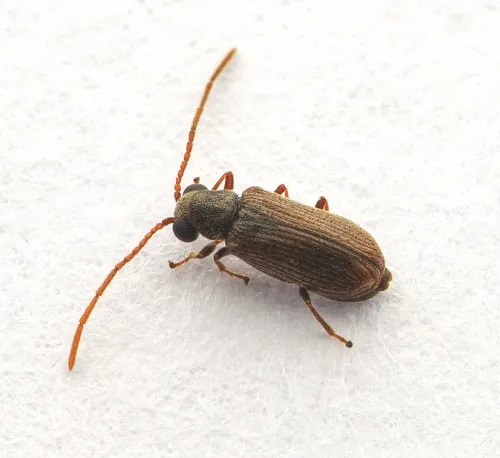
Dryophilus pusillus
Dryophilus pusillus
2.5 to 4 mm. Pronotum quadrate, scutellum with white scale-like pubescence. Antennomeres 4 to 8 transverse. Apex of basal sternite very strongly curved. Detailed photographs required to support records please. Associated with various conifers, especi
Dryophthorus americanus
Dryophthorus americanus
Dryophthorus americanus (Dryophthorus americanus) is a species in the family Curculionidae, commonly known as snout and bark beetles, belonging to the order Coleoptera (Beetles). It is classified within the subfamily Dryophthorinae, tribe Dryophthori
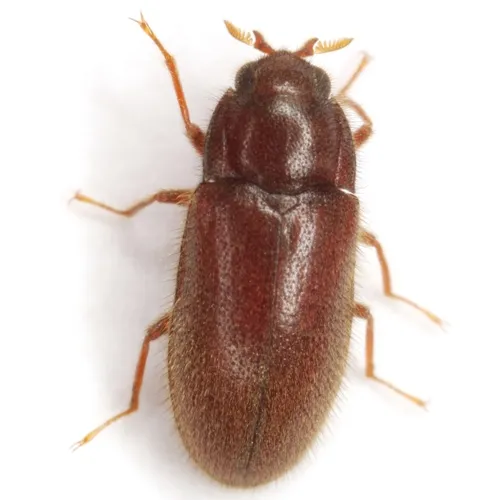
Dryops arizonensis
Dryops arizonensis
Identification: Pronotum on each side with a conspicuous, complete sublateral longitudinal sulcus; pubescent; brown Det. M. A. Quinn, 2013 Type Locality: Phoenix, Arizona
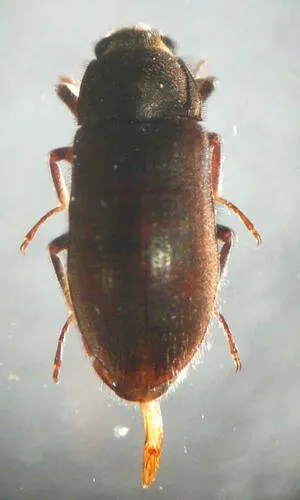
Dryops luridus
Dryops luridus
Length about 4 mm. Covered in hairs and with hook-like claws for crawling on under-water vegetation. Along the banks of various water bodies, typically amongst moss. All year round, but most likely to be recorded in summer. Records on NBN suggest tha
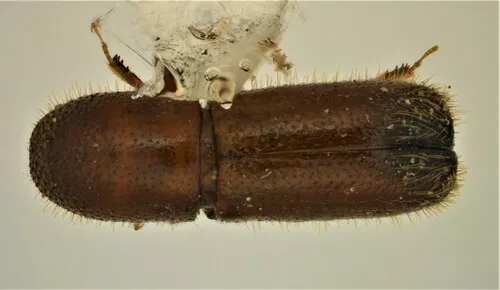
Dryoxylon onoharaense
Dryoxylon onoharaense
Identification: see earliest record in our area: LA 1982
Dubiraphia parva
Dubiraphia parva
considered a "Species of Greatest Conservation Need" in LA & OK
Dylobolus rotundicollis
Dylobolus rotundicollis
Identification: pale elytral sutural line can be present or absent Type Locality: Texas
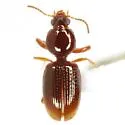
Dyschirius abbreviatus
Dyschirius abbreviatus
Identification: characterized by combination of elytra without discal setigerous punctures + pronotum with lateral bead very short anteriorly. (PW Messer, 2.i.2013) According to Whitehead (1970: 185), specimens of D. darlingtoni Kult from Mexico are
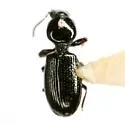
Dyschirius alticola
Dyschirius alticola
Dyschirius alticola is a species of ground beetle in the subfamily Scaritinae. It was described by Lindroth in 1961.
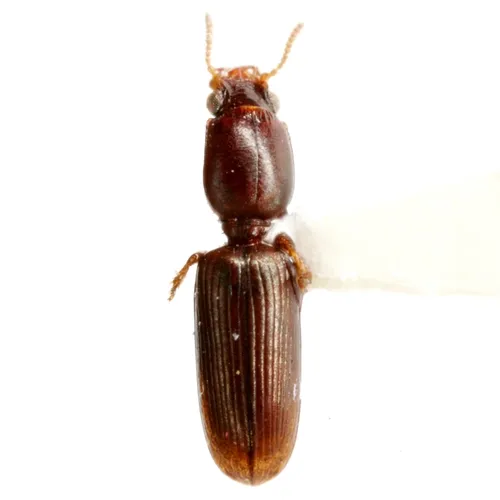
Dyschirius exochus
Dyschirius exochus
Dyschirius exochus is a species of ground beetle in the subfamily Scaritinae. It was described by Whitehead in 1970.
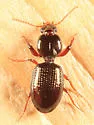
Dyschirius globulosus
Dyschirius globulosus
Identification: indistinguishable from D. longulus based on external morphology
Dyschirius longulus 0
Dyschirius longulus
Dyschirius longulus is a species of ground beetle in the subfamily Scaritinae. It was described by Leconte in 1850.
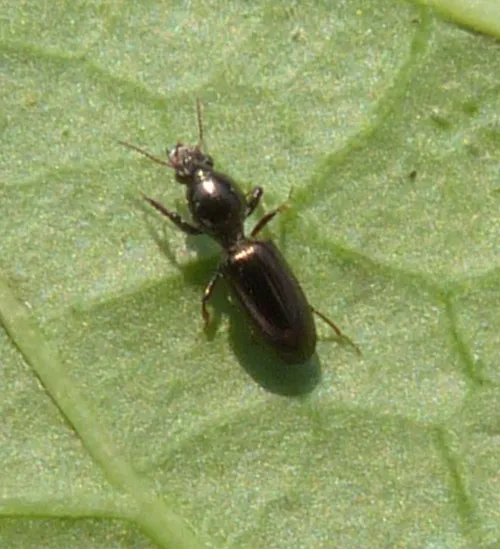
Dyschirius politus
Dyschirius politus
A small (4 to 5mm), bronze black burrowing ground beetle. Prefers sandy places often on the coast. It is predatory on rove beetles of the genus Bledius.
Dyschirius quadrimaculatus 0
Dyschirius quadrimaculatus
Dyschirius quadrimaculatus is a species of ground beetle in the subfamily Scaritinae. It was described by Lindroth in 1961.
Dyschirius terminatus
Dyschirius terminatus
Dyschirius terminatus is a species of ground beetle in the subfamily Scaritinae. It was described by Leconte in 1848.
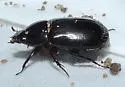
Dyscinetus laevicollis
Dyscinetus laevicollis
Identification: Pronotum nearly impunctate; rugose clypeus Adults attracted to lights
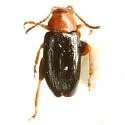
Dysphenges oblivius
Dysphenges oblivius
Identification: PARATYPE Type Locality: TEXAS: McLennan Co.: 3 mi N Moody, IV-29-2001, E. G. Riley-976, on Desmanthus illinoensis .
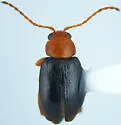
Dysphenges penrosei
Dysphenges penrosei
Identification: PARATYPE Type Locality: ARIZONA: Cochise Co.: Sunnyside Cyn., VII-9-86, A. J. Gilbert.
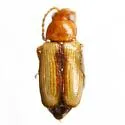
Dysphenges rileyi
Dysphenges rileyi
Identification: PARATYPE: only one U.S. spmn (and two from Mexico) in the University of Arizona Insect Collection (Gene Hall, pers. comm. to MAQ, 2016)
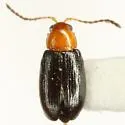
Dysphenges secretus
Dysphenges secretus
Identification: PARATYPE Type Locality: Texas: Uvalde Co., 9 mi N Sabinal, IV-9-1995, E. G. Riley
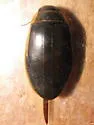
Dytiscus circumcinctus
Dytiscus circumcinctus
Identification: Large and elongate, sometimes with a greenish sheen; ventral surface mostly yellow without expanded black markings on abdominal sterna (margins of sterna narrowly black); metacoxal lobes acuminate (pointed); inner margins of the eyes
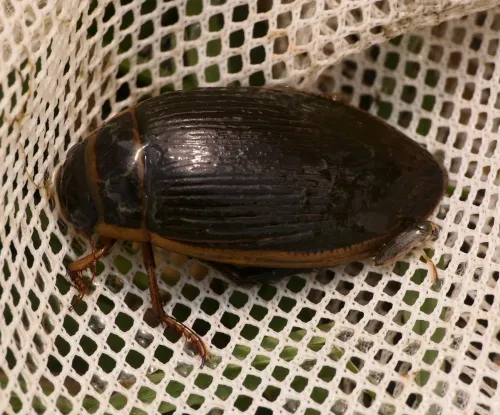
Dytiscus circumflexus
Dytiscus circumflexus
In this species the metacoxal plates are sharply pointed. It is 30 mm or more in length and the pronotum has narrow yellow borders front and back with the sides being only a little wider. Other distinguishing features are the underside of the beetle
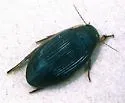
Dytiscus cordieri
Dytiscus cordieri
Identification: Moderate size; pronotum and elytra broadly lined with yellow laterally; ventral surface mostly yellow with few dark markings; hind coxal lobes rounded .
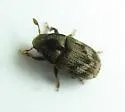
Eastern Ash Bark Beetle
Hylesinus aculeatus
The most commonly encountered ash-breeding bark beetle in eastern North America (T. Atkinson, pers. comm. to MAQ, 2011) at high risk of endangerment due to the EAB ( 4 )
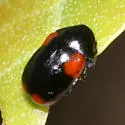
Eastern Babia
Babia quadriguttata
Identification: This is the only black and red Clytrini in e. US. The short serrate antennae and shiny, feebly punctate upper surface will separate it from other black and red Cryptocephalinae. Det. M. A. Quinn, 2010
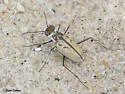
Eastern Beach Tiger Beetle
Habroscelimorpha dorsalis
Identification: Dorsal Coloration: white elytra with greenish-bronze complete maculations. One subspecies, C. d. dorsalis , is federally listed as threatened
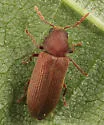
Eastern Deathwatch Beetle
Hemicoelus carinatus
Identification: Elytra with well impressed and regular serial punctures (vs. similar Oligomerus spp.). ID on species level is tricky, and often tentative unless male genitalia are studied. H.(Cacotemnus) umbrosus is extremely similar, and safe separa
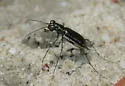
Eastern Pinebarrens Tiger Beetle
Cicindelidia abdominalis
Identification: Tiny. Shiny blackish with some blue above, whitish crescents at tip of elytra .
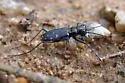
Eastern Red-bellied Tiger Beetle
Cicindelidia rufiventris
Identification: abdomen under the elytra is bright red, especially towards the rear
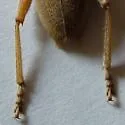
Eburia haldemani
Eburia haldemani
Identification: Highly variable and anomalous forms do occur Det. S. Vitanza, 2015 comes to lights and fermenting molasses ( 3 )
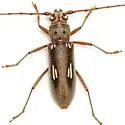
Eburia ovicollis
Eburia ovicollis
Identification: Det. M. A. Quinn, 2011 Adults come to lights
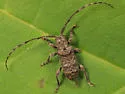
Ecyrus dasycerus
Ecyrus dasycerus
Identification: Variable in size and color, but the combination of body shape and the dark, inverted arc-like (although sometimes faint) marking at the elytral base is distinctive among eastern longhorns comes to lights
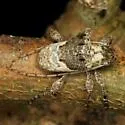
Ecyrus penicillatus
Ecyrus penicillatus
Identification: uncommon sp. resembles a bird dropping when resting on dead twigs or in a death-feigning posture (legs and antennae drawn tight to the body) on the beating sheet ( 4 ) attracted to lights ( 4 )
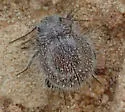
Edrotes leechi
Edrotes leechi
Identification: Spatulate process on the first protarsomere is diagnostic
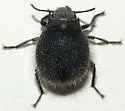
Edrotes rotundus
Edrotes rotundus
variable species, described by Casey alone under 8 names
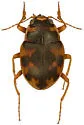
Effaced Round Sand Beetle
Omophron obliteratum
Identification: "V" shaped pale spot on head, 14 elytral striae
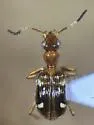
Ega laetula
Ega laetula
Identification: Elytral striae continue down the entire elytra Type Locality: ad flumina Colorado et Gila
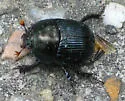
Eger's Earth Boring Beetle
Geotrupes egeriei
Identification: Black with blue or green hue; oval, convex. Pronotum deeply, coarsely punctate laterally. Elytral striae deep, differently colored.