
Disonycha tenuicornis
This record describes Disonycha tenuicornis (species). Recorded family: Chrysomelidae. Recorded order: Coleoptera.
Identification and Appearance
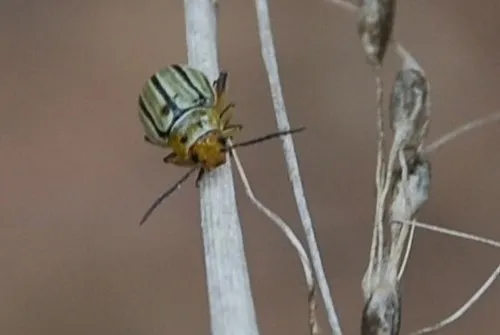
true tenuicornis . Note: that when alive, tenuicornis is yellowish, not the blood reddish color of some other vittate Disonycha . Det. E. G. Riley, 2022 All the current Bugguide images of D. tenuicornis are not tenuicornis . I am not entirely sure what they are, but they could be dark forms of figurata or possibly something else (to my knowledge, I have not seen figurata alive). (E. G. Riley, pers. com. to MAQ, 8/2022) (excerpt from redescription ) - Antennae unusually long, reaching to, or (in male) beyond middle of elytra, 4th segment 3 times as long as wide (measured in type); - Head completely pale (labrum included!); - Pronotum anteriourly with two small black spots; - Elytral pattern consists of very narrow sutural, and median vitta, a sublateral vitta is absent or incomplete, neither reaching humeri, nor suture. Type Locality: Arizona Curators'note : BugGuide images for D. tenuicornis do neither match the descriptions found, nor type linked below. The true identity of this lovely Flea beetle species is not yet clear, but has been narrowed down on only four possibilities (one still is D. tenuicornis ). Because it is only spotted in AZ, it could be assumed it is a species also found in Mexico. Indeed, it seems. More info found with our first: It is recommended to keep images under this name, until we have a better one.
Wikipedia reference for Disonycha tenuicornis: https://en.wikipedia.org/wiki/Disonycha tenuicornis.
Classification
- Kingdom
- Animalia
- Phylum
- Arthropoda
- Class
- Insecta
- Order
- Coleoptera (Beetles)
- Suborder
- Polyphaga
- Superfamily
- Chrysomeloidea
- Family
- Chrysomelidae (Leaf Beetles)
- Subfamily
- Galerucinae
- Tribe
- Alticini
- Genus
- Disonycha
Imported taxonomy record. Source availability varies; see the source references and editorial policy below.
Habitat and Range
Geographic Range
AZ to w. TX (nr. El Paso & Big Bend NP) / Mex. (E. G. Riley, pers. com. to MAQ, 2022)
Diet and Behavior
Life History
larvae feed on Salvia spp. (Lamiaceae) ( 4 )
Additional species information
Species notes from the sources
Etymology: Disonycha tenuicornis Horn, 1889
About Primitive Winged Insects: the wider group
Order-level background for Coleoptera, the group containing Disonycha tenuicornis. Species-specific details appear above.
Group overview
Coleoptera is the largest order of insects with over 400,000 described species, representing ~25% of all known animal species and ~40% of all insects. In the U.S. alone, nearly 30,000 beetle species have been identified.
Ecological role of the group
Beetles are prominent decomposers, especially in forests, breaking down dead wood and recycling nutrients. As predators, they reduce populations of pest insects. Many species are also important pollinators of flowering plants.
Economic and practical significance of the group
Beetles have major economic significance: leaf beetles (Chrysomelidae) and weevils (Curculionoidea) are among the most destructive agricultural pests globally, costing billions annually, while predatory species like ladybugs provide natural pest control.
Recorded sources for this group: Britannica, Smithsonian, NCSU Entomology. Imported estimates may describe particular regions or reporting periods.
Photos of Disonycha tenuicornis (3)
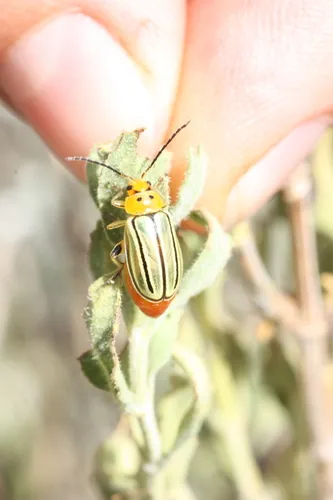
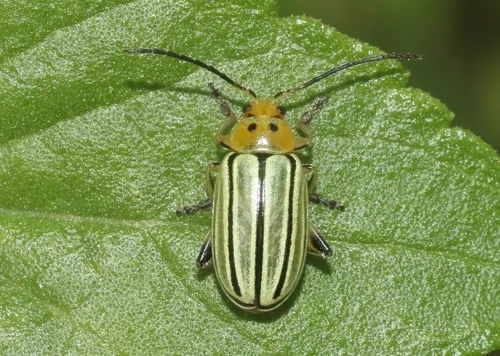
Photo credits: (c) James Bailey, some rights reserved (CC BY-NC), uploaded by James Bailey | (c) Terry Lee Crane, some rights reserved (CC BY-NC), uploaded by Terry Lee Crane | (c) Andrew Meeds, some rights reserved (CC BY), uploaded by Andrew Meeds | Contributed by Tom Bentley; Additional contributions by Mike Quinn , Boris Bueche
Frequently Asked Questions About Disonycha tenuicornis
What is Disonycha tenuicornis?
Disonycha tenuicornis is a species in the family Chrysomelidae, within the order Coleoptera.
How do you identify Disonycha tenuicornis?
true tenuicornis . Note: that when alive, tenuicornis is yellowish, not the blood reddish color of some other vittate Disonycha . Det. E. G. Riley, 2022 All the current Bugguide images of D. tenuicornis are not tenuicornis . I am not entirely sure what they are, but they could be dark forms of figurata or possibly something else (to my knowledge, I have not seen figurata alive). (E. G. Riley, pers. com. to MAQ, 8/2022) (excerpt from redescription ) - Antennae unusually long, reaching to, or (in male) beyond middle of elytra, 4th segment 3 times as long as wide (measured in type); - Head completely pale (labrum included!); - Pronotum anteriourly with two small black spots; - Elytral pattern consists of very narrow sutural, and median vitta, a sublateral vitta is absent or incomplete, neither reaching humeri, nor suture.
Where is Disonycha tenuicornis found?
Range: AZ to w. TX (nr. El Paso & Big Bend NP) / Mex. (E. G. Riley, pers. com. to MAQ, 2022)
What is the life cycle of a Disonycha tenuicornis?
larvae feed on Salvia spp. (Lamiaceae) ( 4 )