
Dorcaschema cinereum
This record describes Dorcaschema cinereum (species). Recorded family: Cerambycidae. Recorded order: Coleoptera.
Identification and Appearance
| Feature | Description |
|---|---|
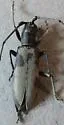
| Additional details | Antenna: Black, extremely long, twice as long as body; black. |
| Thorax | Thorax: Densely covered with grayish-brown pile. Hind margin wavy. Black line down middle. |
| Wings | Wings: Densely covered with grayish-brown pile. May have a small black mark on each elytra. Female has wing tips with a sharp point; male tips squarish. Hickory is the preferred larval host, but is has also been reared from mulberry and dogwood. Distinguished from other species in the genus by its uniform gray color (D. nigrum is black, while D. alternatum and D. wildii are patterned). … Ted C. MacRae, 8 June, 2007 - 11:33am Subspecies Dillon & Dillon (1948) erected a separate subspecies Hetoemis cinereum bimaculata. However, Linsley & Chemsak (1984), in transfering the species to the genus Dorcaschema, did not consider this a valid subspecies. … Ted C. MacRae, 21 December, 2007 - 11:41am Types: Holotype as Saperda cinerea by Olivier, 1795. Type Locality: North America. Most of Olivier’s collection is at the Museum National d'Histoire Naturelle in Paris, France. Holotype as Saperda trilineata by Say, 1825. Type Locality: U.S.A. Collection lost. Holotype as Hetoemis juglandis by Haldeman, 1853. Type Locality: Pennsylvania & Alabama. LeConte stated in a letter in 1875 to Agassiz (MCZ) that he owned all Haldeman type specimens. LeConte’s collection is in the Museum of Comparative Zoology, Harvard, Cambridge, Massachusetts. Holotype as Hetoemis cinerea bimaculata by Dillion & Dillion, 1947. Type Locality: Kansas. In the Kansas University Biodiversity Institute and Natural History Museum, Lawrence Kansas. |
Classification
- Kingdom
- Animalia
- Phylum
- Arthropoda
- Class
- Insecta
- Order
- Coleoptera (Beetles)
- Suborder
- Polyphaga
- Superfamily
- Chrysomeloidea
- Family
- Cerambycidae (Longhorn Beetles)
- Subfamily
- Lamiinae
- Tribe
- Dorcaschematini
- Genus
- Dorcaschema
Imported taxonomy record. Source availability varies; see the source references and editorial policy below.
Habitat and Range
Habitat
Forests.
Geographic Range
New York to the Rockies. Ontario (rare).
Seasonal Activity
May to July
Diet and Behavior
Diet: Mulberry, walnut, hickory, hackberry, basswood (Tilia) and Maple. Adults feed on leaves, larvae bore into branches.
Life History
Eggs deposited on dead branches and twigs up to 50 mm in diameter. Larvae excavate burrows under bark along surface and about 10 mm into the wood. One generation per year.
About Primitive Winged Insects: the wider group
Order-level background for Coleoptera, the group containing Dorcaschema cinereum. Species-specific details appear above.
Group overview
Coleoptera is the largest order of insects with over 400,000 described species, representing ~25% of all known animal species and ~40% of all insects. In the U.S. alone, nearly 30,000 beetle species have been identified.
Ecological role of the group
Beetles are prominent decomposers, especially in forests, breaking down dead wood and recycling nutrients. As predators, they reduce populations of pest insects. Many species are also important pollinators of flowering plants.
Economic and practical significance of the group
Beetles have major economic significance: leaf beetles (Chrysomelidae) and weevils (Curculionoidea) are among the most destructive agricultural pests globally, costing billions annually, while predatory species like ladybugs provide natural pest control.
Recorded sources for this group: Britannica, Smithsonian, NCSU Entomology. Imported estimates may describe particular regions or reporting periods.
Photos of Dorcaschema cinereum (5)
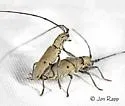
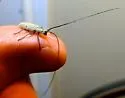
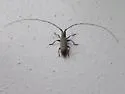
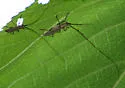
Photo credits: Contributed by john and jane balaban; Additional contributions by cotinis , Phillip Harpootlian , lee_penner
Frequently Asked Questions About Dorcaschema cinereum
What is Dorcaschema cinereum?
Dorcaschema cinereum is a species in the family Cerambycidae, within the order Coleoptera.
How big is Dorcaschema cinereum?
8 to 13 mm long.
How do you identify Dorcaschema cinereum?
| Feature | Description |
|---|---|
| Additional details | Antenna: Black, extremely long, twice as long as body; black. |
| Thorax | Thorax: Densely covered with grayish-brown pile. Hind margin wavy. Black line down middle. |
| Wings | Wings: Densely covered with grayish-brown pile. May have a small black mark on each elytra. Female has wing tips with a sharp point; male tips squarish. |
Where is Dorcaschema cinereum found?
| Feature | Details |
|---|---|
| Habitat | Forests. |
| Range | New York to the Rockies. Ontario (rare). |
What does Dorcaschema cinereum eat?
The diet of the Dorcaschema cinereum includes Mulberry, walnut, hickory, hackberry, basswood (Tilia) and Maple. Adults feed on leaves, larvae bore into branches..
When is Dorcaschema cinereum active?
Dorcaschema cinereum: seasonal activity - May to July.
What is the life cycle of a Dorcaschema cinereum?
Eggs deposited on dead branches and twigs up to 50 mm in diameter. Larvae excavate burrows under bark along surface and about 10 mm into the wood. One generation per year.