
Primitive Winged Insects
Order Coleoptera
The Primitive Winged Insects (Order Coleoptera) includes 15,720 species across 160 families and 3,716 genera in our directory.
About Primitive Winged Insects
Coleoptera is the largest order of insects with over 400,000 described species, representing ~25% of all known animal species and ~40% of all insects. In the U.S. alone, nearly 30,000 beetle species have been identified.
Economic Impact
Beetles have major economic significance: leaf beetles (Chrysomelidae) and weevils (Curculionoidea) are among the most destructive agricultural pests globally, costing billions annually, while predatory species like ladybugs provide natural pest control.
Ecological Role
Beetles are prominent decomposers, especially in forests, breaking down dead wood and recycling nutrients. As predators, they reduce populations of pest insects. Many species are also important pollinators of flowering plants.
Families in Coleoptera (160)
Species in Coleoptera (15,720)
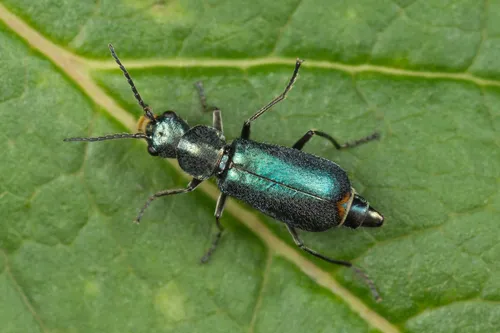
Cordylepherus viridis
Cordylepherus viridis
Similar in appearance to the more common Malachius bipustulatus, but can be separated with detailed examination. Cordylepherus viridis is slightly smaller and bluer than M. bipustulatus. Fairly frequent in England south of The Wash, much scarcer furt
Cordylospasta fulleri
Cordylospasta fulleri
Identification: Unique among nearctic Meloidae in having antennae with 8-10 segments
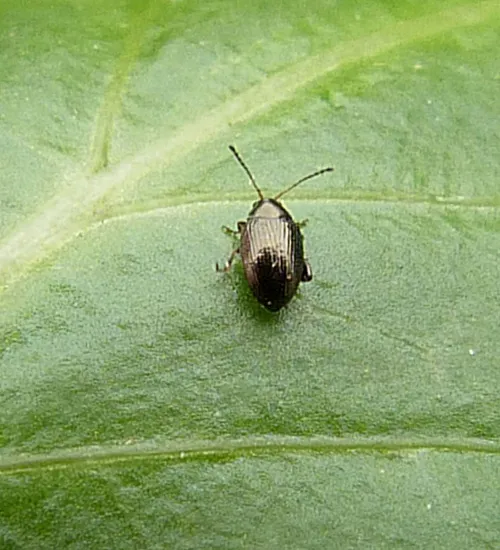
Corn Flea Beetle
Chaetocnema hortensis
1.6-2.3mm. The genus can be recognised by the external tooth on both the mid and hind tibia. Bronze uppers (can be coppery or metallic green). Antennal segments 1-5 are pale then black after this. Legs are pale brown but with darker femora. The punct
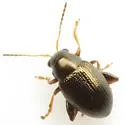
Corn Flea Beetle
Chaetocnema pulicaria
May damage corn crops; important in parts of the Midwest where it may transmit the bacterial agent of Stewart's wilt of corn ( 4 ) . It is also called the clover leaf beetle for feeding on this crop
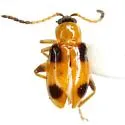
Cornulactica varicornis
Cornulactica varicornis
Apparently introduced into s. Louisiana ca. 2019 and recently spread to the Upper Coast of Texas and to s. Mississippi. (BG data)
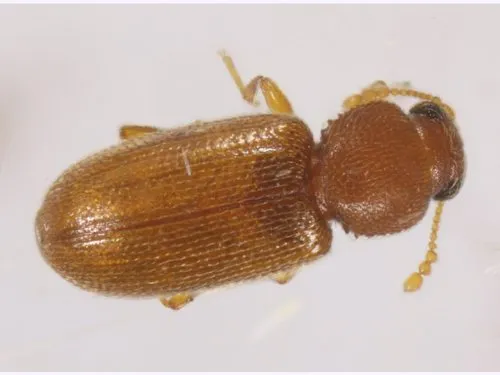
Corticaria elongata
Corticaria elongata
Identification: quadrate to slightly transverse pronotum with prominent teeth at the hind angles, sub-basal impression slight. color yellow-tan. earliest NA record: before 1899 (MA-PA, MI, IA, CA)
Corticaria ferruginea
Corticaria ferruginea
Identification: Ferruginous brown, the head often darker; elytral pubescence short, appressed, uniform; pronotum wider than long, widest before middle, sides broadly rounded and feebly serrulate.
Corticaria saginata 0
Corticaria saginata
Identification: adult habitus earliest NA record: NS 1924
Corticaria varicolor
Corticaria varicolor
Identification: "Color varying from yellowish brown to piceous, often uniform, but more commonly piceous brown, with the elytra (except the suture), antennae and legs paler . Form moderately stout and convex ; pubescence cinereous, rather long and co
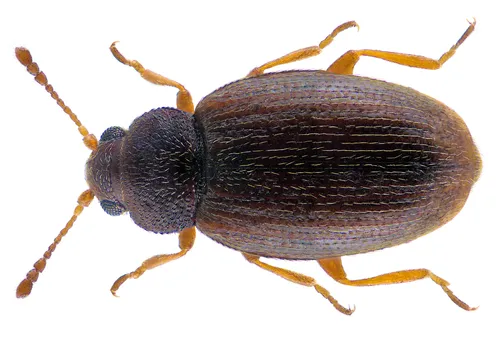
Corticarina minuta
Corticarina minuta
A tiny beetle measuring only about 1.5 mm. Unless identified by a recognised expert, a photo is required and the specimen should be examined with a microscope. In the comments box, state the key or ID method used and describe the size and identifying
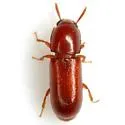
Corticeus glaber
Corticeus glaber
our only representative of the subgenus Tylophloeus Bremer 1998 ( 4 )
Corticeus subopacus
Corticeus subopacus
Identification: habitus photo holotype images at CNC
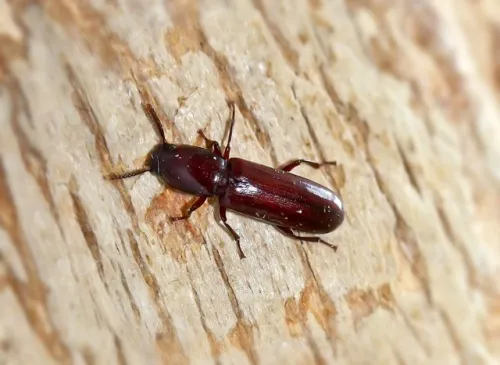
Corticeus unicolor
Corticeus unicolor
Size 5 to 7 mm. A deep red darkling beetle with finely punctate elytra and a blackish head. The pronotum is longer than it is broad. Underneath young bracket fungus and behind bark. Rare in Britain and with an RDB3 status (Species with small populati
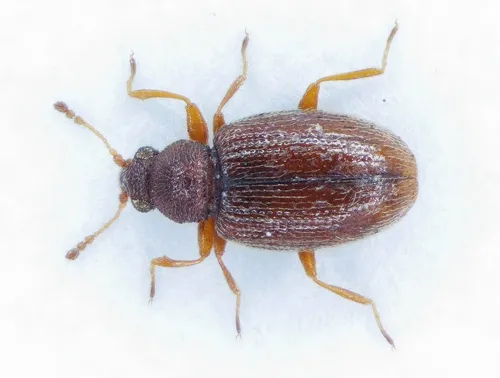
Cortinicara gibbosa
Cortinicara gibbosa
This is a minute scavenger beetle which is only 2 mm or less in length and has pitted brown elytra. Although it probably develops in decaying plant matter, it can also often be beaten in great numbers from Hawthorn flowers etc. All year round, but mo
Cortodera cubitalis
Cortodera cubitalis
Identification: species page rather variable, described under 10 names, most of them Casey's
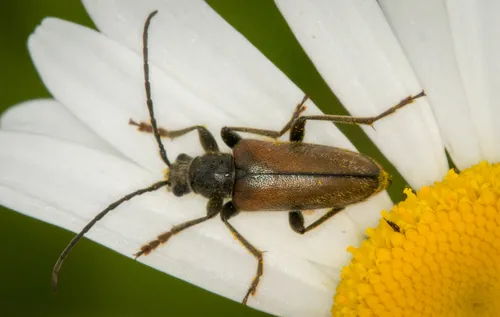
Cortodera militaris
Cortodera militaris
Cortodera militaris is a species of flower longhorn in the beetle family Cerambycidae. It is found in North America.
Coscinoptera aeneipennis
Coscinoptera aeneipennis
Identification: easily recognized by its brassy appearance , with the head, thorax, scutellum, and under side pubescent. Elytra with coarse punctures arranged in rather regular striae (emphasis added), but confused near the scutellum. Det. M. A. Quin
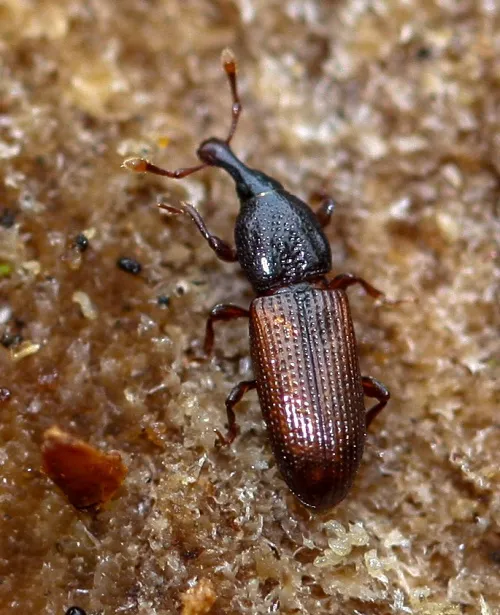
Cossonus linearis
Cossonus linearis
The weevil is 4 to 6 mm in length with a very flat and elongate body, dark brown punctate elytra and blackish pronotum. Its legs are dark red and the antennae are short and bent. Its pronotum is quite rectangular viewed from above and slightly narrow
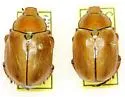
Cotalpa conclamara
Cotalpa conclamara
Identification: PARATYPES Type Locality: Gus Engeling Wildlife Management Area, Anderson Co., Texas (Young, 2003). Texas considers this a "Species of Greatest Conservation Need" (SGCN) ( 5 )
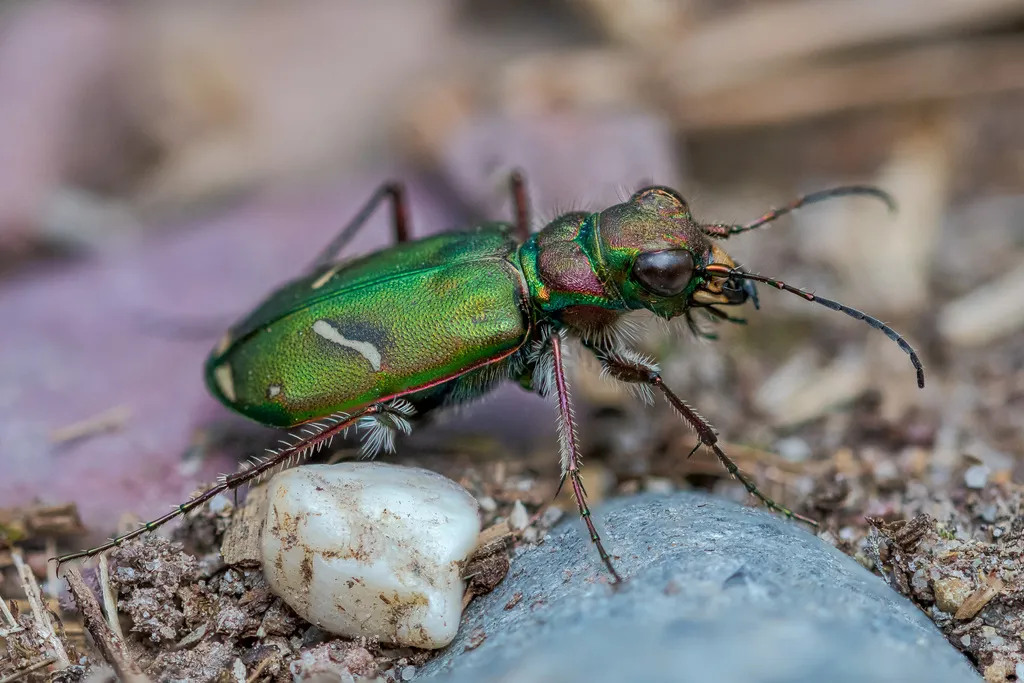
Cow Path Tiger Beetle
Cicindela purpurea
Identification: Purple, greenish-purple, or green. Shoulder marking absent; middle marking does not reach outside edge of elytron; apical marking short. The middle marking is curved, but not sharply elbowed as it is in C. limbalis . Unfortunately, so
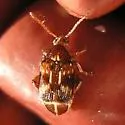
Cowpea Weevil
Callosobruchus maculatus
Identification: variable in coloration, leading to confusion with other species of Callosobruchus . Part of the variation is due to the presence of “two distinct adult forms, which differ not only in their morphology, but in physiology, behaviour, et
Cranberry White Grub
Phyllophaga anxia
Identification: Large, dark glabrous species with 10 antennomeres. Genitalia are quite variable, sometimes distinguished as "northern" and "southern" forms. Genitalia somewhat similar to P. implicata , but that species has a nine-segmented antennae
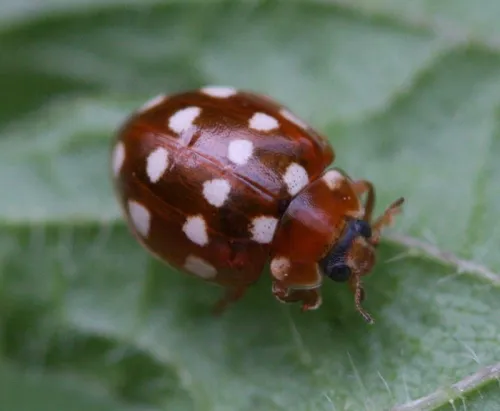
Cream Spot Ladybird
Calvia quattuordecimguttata
This ladybird has a maroon-brown casing with 14 creamy white spots. It has brown legs. This species is relatively easy to identify and is unlikely to be confused with anything else. However photos are always helpful to confirm your record. It feeds o
Cream-edged Tiger Beetle
Eunota circumpicta
Identification: Above red or copper brown, sometimes green or blue with a continuous white band along the edge of the elytra. The underside is metallic green/blue with white setae along the sides of the abdomen. Important food source of Asilid flies
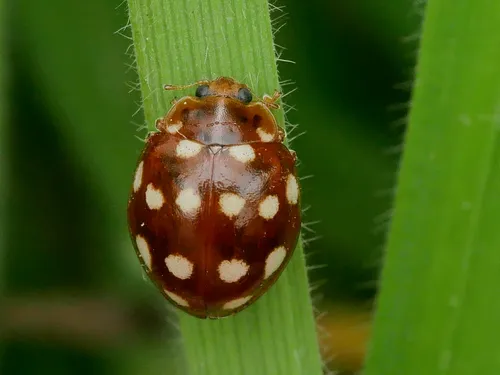
Cream-spotted Lady Beetle
Calvia quatuordecimguttata
Identification: Gordon's Figures Adult: It comes in great variety of color forms. These are the major pattern variations, starting with the cream-spotted form: Regardless of pattern, the pronotum is always shiny, and the underside is mostly black wit
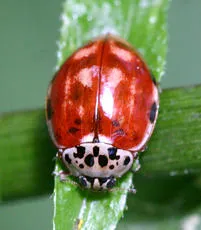
Cream-streaked Ladybird
Harmonia quadripunctata
This is a medium sized ladybird (5-6 mm), recognised by the black speckled pattern on its head and pronotum. Its body colour varies but is usually salmon, pink or yellow; the legs are brown. The number of spots is very variable. This species is relat
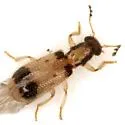
Cregya america
Cregya america
Identification: Det. M. A. Quinn, 2020 Type Locality: FLORIDA, Lee Co. Lehigh Acres, 26-IV-2011
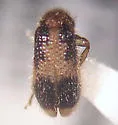
Cregya mixta
Cregya mixta
Identification: Pronotal sides dark brown, pronotal disc with 2 spots near base; elytral humeral dark marking extends to elytral middle Dets. of these LA & TX spmns by W. Opitz A narrow brown streak may connect the elytral humeral and preapical brown
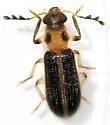
Cregya oculata
Cregya oculata
Identification: Elytral disc uniformly brown, elytral margins testaceous; pronotal disc with two brown spots comes to lights
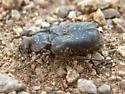
Cremastocheilus planipes
Cremastocheilus planipes
Identification: The broad, flat tibiae are diagnostic for this C. (Trinodia) species. (comment per Wm B. Warner, 2018)
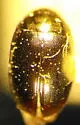
Crenitis morata
Crenitis morata
Identification: Relatively large body size, oval to elongate oval. Color black, slightly metallic. Microsculpture present on both head and pronotum. Hind femur with dense pubescent portion restricted to base. Examination of male genitalia is usually
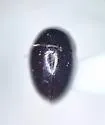
Crenitis paradigma
Crenitis paradigma
Identification: Body broadly convex, attenuate (tapered to a point) posteriorly. Microsculpture absent on head & pronotum; maxillary palps uniformly dark. Most reliably separated from other similar species by features of the male aedeagus
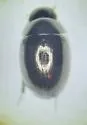
Crenitis rufiventris
Crenitis rufiventris
Identification: Form elongate oval; dorsum without microsculpture, palps black . Most similar to C. paradigma , which is overall smaller in size, has a more convex body form, and elytra attenuate posteriorly. Small individuals of C.rufiventris are be
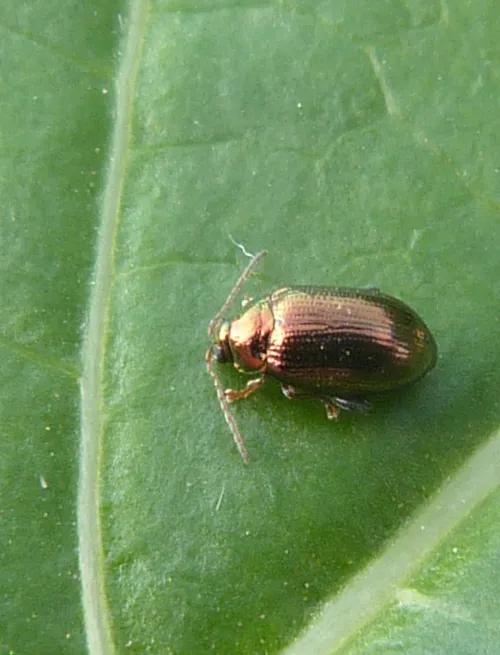
Crepidodera aurea
Crepidodera aurea
A tiny leaf beetle with very punctate elytra which can appear metallic green or maroon depending on the light. It will jump readily when disturbed. There are several similar species which makes potential identification difficult. Fairly frequent in s

Crepidodera browni
Crepidodera browni
Identification: last key couplet: Elytron at declivity bulging laterally, overhanging and hiding part of lateral margin (Fig. 8); dorsal surface metallic green, brassy-green, coppery-green, pure coppery, coppery-bronze or dark Greenish specimens rang
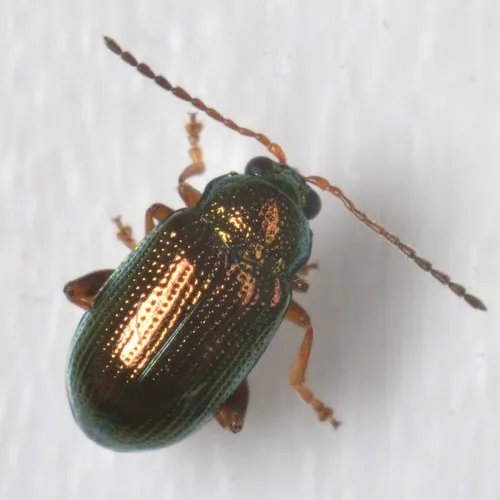
Crepidodera fulvicornis
Crepidodera fulvicornis
Length: 2.3-3.5mm. Upperside bright metallic green, with blue or coppery tones at the edges. As with other 'flea' beetles it has swollen hind legs which allow it to jump strongly when threatened. All Crepidodera have two short furrows on the pronotum
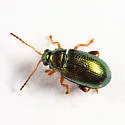
Crepidodera luminosa
Crepidodera luminosa
Identification: Very similar to C. nana, and only distinguishable by examination of the male or female genitalia.
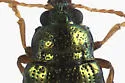
Crepidodera nana
Crepidodera nana
Identification: This species exhibits considerable variation. ( 3 ) Parry (1986) examined some 2000 nana spmns ( 3 )
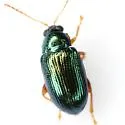
Crepidodera opulenta
Crepidodera opulenta
Identification: elytral margins narrow in dorsal view (as in Fig. 10) In the original description, LeConte described the colour of this species as "laete viridiaurea" or bright green-gold. The lectotype differs from this in having the dorsal surface
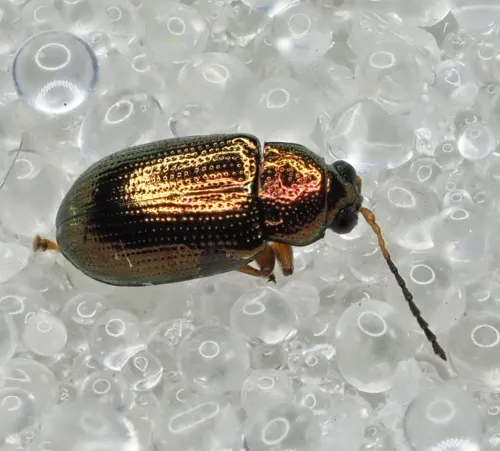
Crepidodera plutus
Crepidodera plutus
2.5 to 3.7 mm. Pronotum and elytra normally unicolourous although bicoloured specimens are not uncommon. Green, coppery sometimes blue, in the field often appearing purple.The antennae are distinctly bicoloured with segments 1-4 yellowish, the remain
Crescent Lady Beetle
Hippodamia lunatomaculata
Identification: Gordon's figures Pronotum parenthesis -type, black with white margin, isolated white basal spot, and anterior indent. Extent of black varies based on locality, and may be more extensive especially in the northern ssp. dobzhanskyi (Gor
Cribrate Weevil
Otiorhynchus cribricollis
Pest of grapevine, fruit trees, olives, citrus, fig
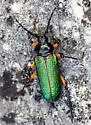
Crioprosopus rimosus
Crioprosopus rimosus
Adults rarely collected except from their pupal chambers (Vogt 1949)
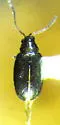
Crucifer Flea Beetle
Phyllotreta cruciferae
Identification: separated easily from other congeners by the absence of pale markings AND a bluish-green lustre An important pest

Crucifix Ground Beetle
Panagaeus cruxmajor
A largely black and rather bristly beetle, it is 8 to10 mm in length, with large red spots on its wing cases which give the appearance of a red background behind a black cross. Panagaeus bipustulatus is a commoner relative, looking very much alike ex
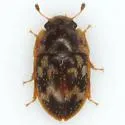
Cryptarcha concinna
Cryptarcha concinna
Identification: Prosternum narrowed between procoxae, not extending beyond middle of mesosternum; anterior margin of metasternum acutely rounded
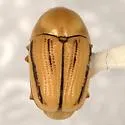
Cryptocephalus albicans
Cryptocephalus albicans
Identification: Elytra: Light orange or creamy yellow and with dark reddish to black markings. The six Florida specimens examined by White have the elytral intervals finely, transversely rugose; this significantly reduces the shininess of the elytra.
Cryptocephalus alternans
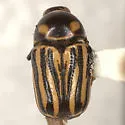
Cryptocephalus alternans
Identification: Dark markings of pronotum black, distinct, margins sometimes narrowly reddish Elytra: Background color light orange, dark markings black, sharply delimited. The external differences exhibited by this subspecies and two specimens of C.
Cryptocephalus amatus
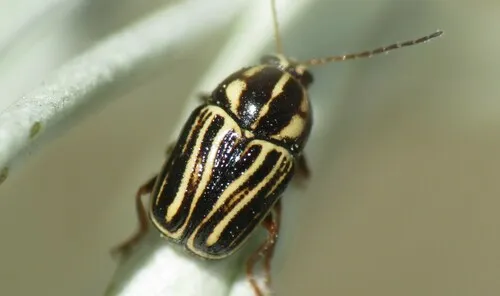
Cryptocephalus amatus
Cryptocephalus amatus is a species of case-bearing leaf beetle in the family Chrysomelidae. It is found in North America.
Cryptocephalus andrewsi
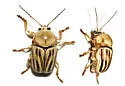
Cryptocephalus andrewsi
Identification: PARATYPE Type Locality: Del Mar, San Diego Co., CA
Cryptocephalus arizonensis
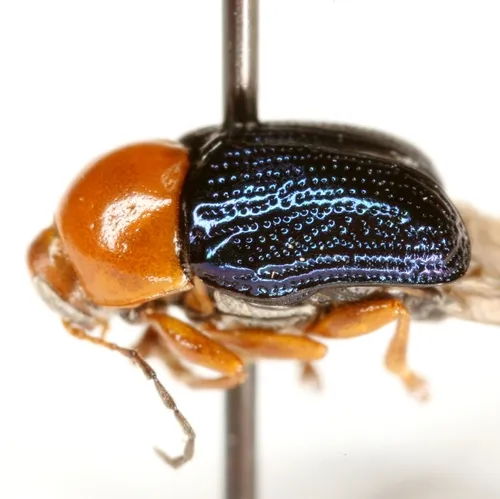
Cryptocephalus arizonensis
Identification: Elytra dark, shining metallic green or blue, epipleuron yellow to (more often) dark reddish [cite:212163] Type Locality: Pinal Mts., Cochise Co., AZ
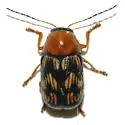
Cryptocephalus atrofasciatus
Cryptocephalus atrofasciatus
Identification: one of the most variable in the genus in coloration Pronotum: Light orange to red, usually with basal oblique spots and margins yellow or lighter than remainder, not sharply delimited. Elytra: Usually yellow or orange with three trans
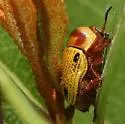
Cryptocephalus aulicus
Cryptocephalus aulicus
Identification: Pronotum: Red to orange with two basal oblique spots. Elytra: Creamy yellow to orange with dark spots. Forty specimens examined by White, all collected in Florida. Previous papers have included Georgia as part of the distribution of t
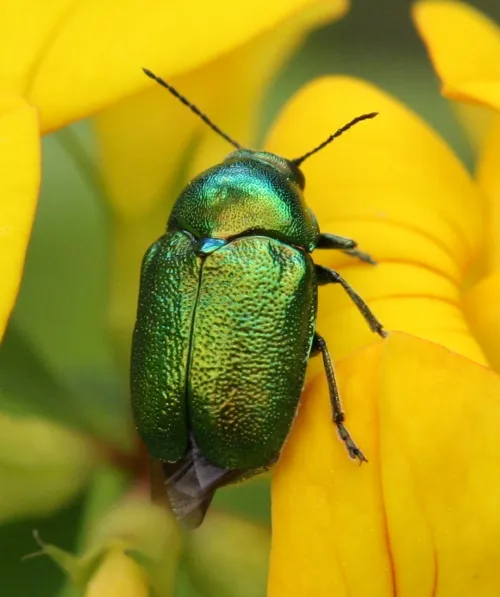
Cryptocephalus aureolus
Cryptocephalus aureolus
Length 6 to 8 mm. One of several similar species of metallic green beetles which have a short, cylindrical robust body and head hidden under the front edge of pronotum. Cryptocephalus hypochaeridis looks very similar but has is more blue-green in col
Cryptocephalus australobispinus
Cryptocephalus australobispinus
Identification: The pale ground color together with the pattern on the pronotum and elytra will distinguish this species from other Cryptocephalus found in America north of Mexico. It will run to C. bispinus Suffrian, couplet 81, in White's key and b
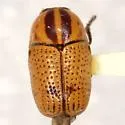
Cryptocephalus binotatus
Cryptocephalus binotatus
The species is described from ten specimens. The holotype (female, USNM type number 69248) was taken at Yuma, Arizona, in June, 1909 by A. McLachlan.
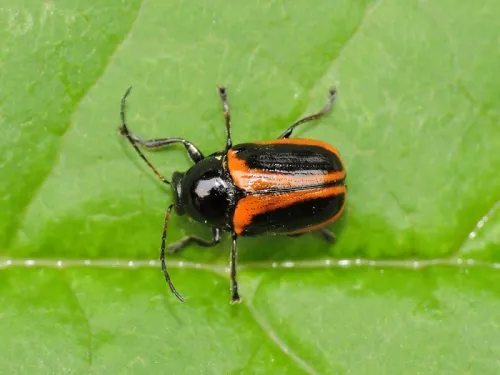
Cryptocephalus bipunctatus
Cryptocephalus bipunctatus
Size: 4 to 6 mm. Cryptocephalus bipunctatus is a black and orange red beetle, but markings can be rather variable. It may have one black longitudinal band on each elytron, or the band may be broken to form two spots, usually one on 'shoulder' and one
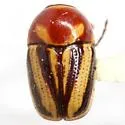
Cryptocephalus bispinus
Cryptocephalus bispinus
Identification: Outer elytral vitta complete Occurring in Texas [mostly]; males (fig. 72) bispinus Suffrian Occurring in eastern U.S.; males and females (fig. 73). calidus Suffrian - Figs. 72-73
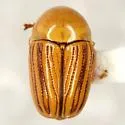
Cryptocephalus brunneovittatus
Cryptocephalus brunneovittatus
Lectotype Locality: "Esprza Rch., Brownsville, Tex."
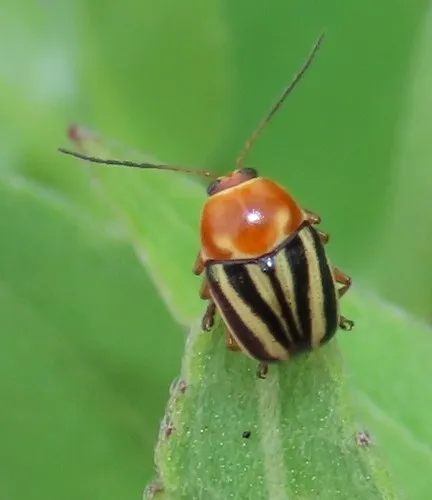
Cryptocephalus calidus
Cryptocephalus calidus
Identification: Outer elytral vitta complete Occurring in Texas [mostly]; males (fig. 72) bispinus Suffrian Occurring in eastern U.S.; males and females (fig. 73). calidus Suffrian - Figs. 72-73
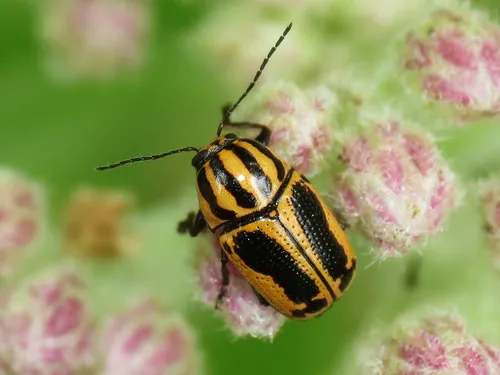
Cryptocephalus castaneus
Cryptocephalus castaneus
Identification: The alternately black and pale striped pronotum, elytral basal spots and medial spots of fused at suture key this one out. … John R. Watts, 8 July, 2008 At one extreme of development of the color pattern, each elytron bears two large
Cryptocephalus cerinus
Cryptocephalus cerinus
Identification: Pronotum: Almost uniformly light orange Elytra: Nearly uniformly light orange, punctures dark, intervals four and six sometimes vaguely darker, humerus more or less clouded.
Cryptocephalus confluentus
Cryptocephalus confluentus
Identification: Background color of elytra creamy yellow to light orange, vittae distinct, dark reddish to black; central states to California .... 75 Legs predominantly brownish or black (fig. 98). confluentus melanoscelus , new subspecies Legs pred
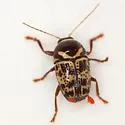
Cryptocephalus cribripennis
Cryptocephalus cribripennis
Identification: elytra yellow, with very large distant black punctures. The elytral punctures are largest and sparsest in cribripennis LeConte; in most species, the punctures are distinctly smaller and denser. Det. E. G. Riley, 2010
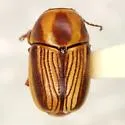
Cryptocephalus cuneatus
Cryptocephalus cuneatus
Identification: elytral vittae black, the lateral ones always intact - Det. Boris Büche, 2023 Fig. 50, C. trivitlatus Olivier; 51, C. cuneatus Fall Fall's single male type specimen was from Tybee Island, Georgia.
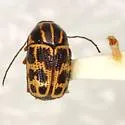
Cryptocephalus cupressi
Cryptocephalus cupressi
Identification: Det. E. G. Riley, 1985 Type Locality: New Orleans, LA
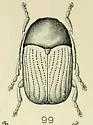
Cryptocephalus dorsatus
Cryptocephalus dorsatus
Identification: Ventral surface, legs, head, and pronotum unicolorous, very dull reddish orange, elytra creamy yellow (fig. 99); elytron behind humerus with one or two punctures in addition to regular rows - Fig. 99 Type Locality: one male and one fe
Cryptocephalus downiei
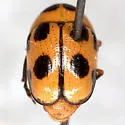
Cryptocephalus downiei
Identification: The stout body form, highly polished and weakly punctate dorsal surface as well as the unique color pattern will readily separate this species from all other Cryptocephalus found north of Mexico. (Riley & Gilbert 1999) PARATYPE Texas
Cryptocephalus duryi
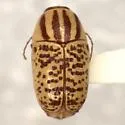
Cryptocephalus duryi
Identification: Det. M. A. Quinn, 2011 Type Locality: Brownsville, [Cameron Co.] Texas, May 5, 1903. (Schaeffer 1906), The seven specimens examined by White in the USNM are all from southern Texas.
Cryptocephalus falli
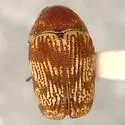
Cryptocephalus falli
Identification: Elytra: Dull creamy yellow but with striae, humerus, and irregular lateral spots reddish. Type Locality: Dunedin, Pinellas Co., Florida
Cryptocephalus fulguratus
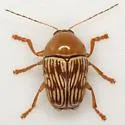
Cryptocephalus fulguratus
Identification: variable, but lacks the basal oblique pronotum spots of C. atrofasciatus , also note the thin pale pronotal margin White examined 130 spmns from TX, AR, KS , Riley et al. added OK, MO, and MS Type Locality: Texas
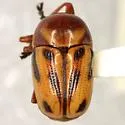
Cryptocephalus gibbicollis
Cryptocephalus gibbicollis
Identification: Elytral epipleuron all or mostly black, lateral raised margin dark or black; pronotum gibbous to strongly gibbous; Fig.
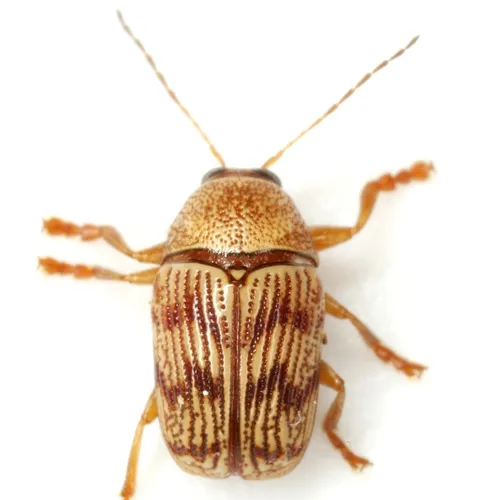
Cryptocephalus implacidus
Cryptocephalus implacidus
Identification: variable elytral band width, but note coarse pronotal punctation Type Locality: Mansura, Avoyelles Parish, Louisiana, on March 26, 1910.
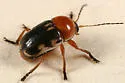
Cryptocephalus insertus
Cryptocephalus insertus
Identification: Outer elytral vitta interrupted once, twice, or nearly absent, sometimes confluent with inner vitta ; pronotum orange, red, or brown with lateral and apical [pale] margins and usually a pair of oblique basal maculae, vaguely yellowish
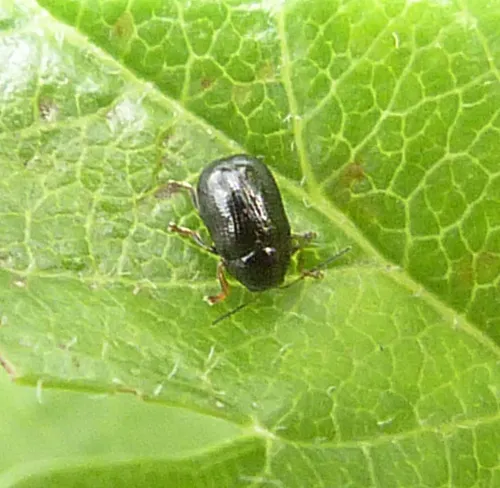
Cryptocephalus labiatus
Cryptocephalus labiatus
A small (2 to 3 mm) shiny black leaf beetle with punctate elytra. Legs are yellowish, but with femora, tibiae and tarsi at least partly dark brown or black. Unless identified by a recognised expert, a photo is required. If the photo doesn't show the
Cryptocephalus lateritius 0
Cryptocephalus lateritius
Identification: elytral striae largely confused or double
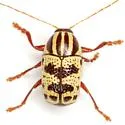
Cryptocephalus leucomelas
Cryptocephalus leucomelas
Identification: Combined pronotal and elytral patterns are unique... The color is too pale for C. castaneus and the basal elytral dark markings are less extensive than typical castaneus although you can find material with more extensive yellow/orange
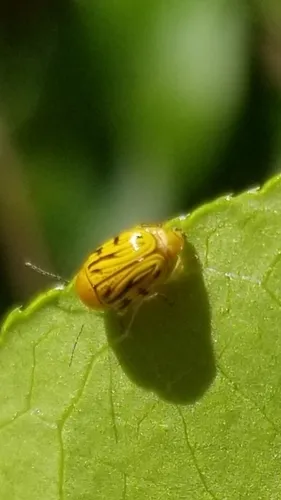
Cryptocephalus luteolus
Cryptocephalus luteolus
Identification: Pronotum light red, elytra cream yellow with brown markings on second, fourth, and sixth intervals (fig, 66) Cryptocephalus luteolus Newman Det. E. G. Riley, 1990 Sanford, Seminole County, Florida 7-21-1927 spmn in the TAMUIC Type Loc
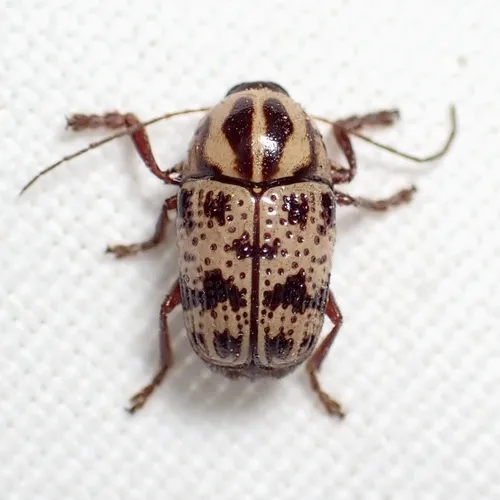
Cryptocephalus maccus
Cryptocephalus maccus
Identification: Det. E. G. Riley, 1987 Type data. - This species is described from four males, all taken in Arizona. The data are as follows (all types in USNM): holotype (type number 69241), "5 mi. s. Rock Springs, Arizona, VI-24-57 R. S. Beal"; par
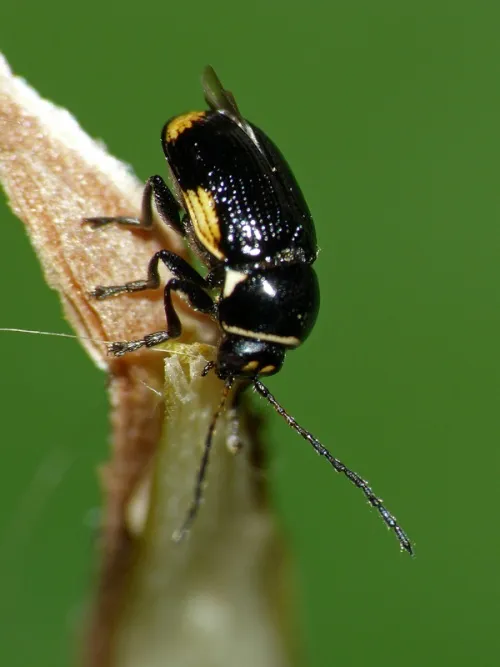
Cryptocephalus moraei
Cryptocephalus moraei
A distinctively marked black beetle with four patches on the elytra which vary in colour from yellow to deep orange. There is one patch on the side and one at the rear of each elytron. Fairly widespread south of The Wash but scarcer further north. No
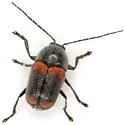
Cryptocephalus mucoreus
Cryptocephalus mucoreus
Identification: Pronotum: With fine, silvery pubescence; black throughout; punctation dual, larger punctures moderate, dense. Elytra: With fine, silvery pubescence.
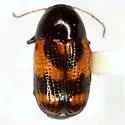
Cryptocephalus multisignatus
Cryptocephalus multisignatus
The male holotype (the only type specimen) is in the U.S. National Museum; it was taken in Arizona. It is the only example of this species that was seen by White, so the extent of variation of the characters referred to in the description and key was
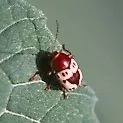
Cryptocephalus mutabilis
Cryptocephalus mutabilis
Identification: Dets. M. A. Quinn, 2010 marked sexual dimorphism: ♂♂ 4.3-5.3 mm, with dark markings usually black; ♀♀ 5.3-6.5 mm, markings usually reddish - spmns from Randolph Co., MO Dets. E. G. Riley 1975
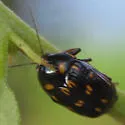
Cryptocephalus nigrocinctus
Cryptocephalus nigrocinctus
Identification: coloration distinctive among Florida congeners: metallic blue, sometimes with a purplish undertone, often with yellowish-orange dorsal markings (Thomas et al. 2001) earliest record in our area: FL 1999
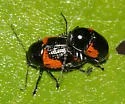
Cryptocephalus notatus
Cryptocephalus notatus
Identification: One broad red shoulder spot, plus two rounded spots at the rear of the elytra. Elytra with 10 rows of punctures. Base of antennae pale. One of the first two species of Cryptocephalus described from N. Amer.
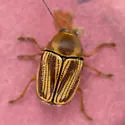
Cryptocephalus obsoletus
Cryptocephalus obsoletus
Identification: Elytra creamy yellow to dull orange (punctures often dark), usually with two vittae, orange to dark reddish, sometimes black in part, vague to rather distinct but not sharply delimited "Note prosternal spine in lateral view" (Ed Riley
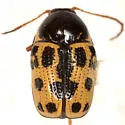
Cryptocephalus optimus
Cryptocephalus optimus
Cryptocephalus optimus (Cryptocephalus optimus) is a species in the family Chrysomelidae, commonly known as leaf beetles, belonging to the order Coleoptera (Beetles). It is classified within the subfamily Cryptocephalinae, tribe Cryptocephalini, subo

Cryptocephalus pallidicinctus
Cryptocephalus pallidicinctus
Identification: Prothorax orange red, the extreme apical edge pale yellow, the basal edge very narrowly blackish; surface sparsely feebly and very finely punctate. Elytra black, with narrow whitish yellow basal and lateral margin which at apex does n
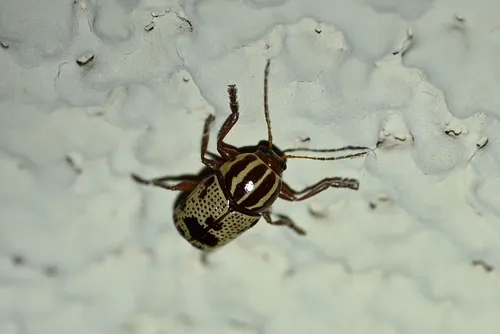
Cryptocephalus pseudomaccus
Cryptocephalus pseudomaccus
Type Locality: three individuals taken in 1934 at Globe, Arizona, by Parker. The holotype (male, in California Academy of Sciences) was taken on April 16, 1934 on Acacia greggii, the allotype (also in California Academy of Sciences) bears the followi
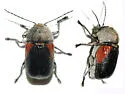
Cryptocephalus pubicollis
Cryptocephalus pubicollis
Cryptocephalus pubicollis (Cryptocephalus pubicollis) is a species in the family Chrysomelidae, commonly known as leaf beetles, belonging to the order Coleoptera (Beetles). It is classified within the subfamily Cryptocephalinae, tribe Cryptocephalini
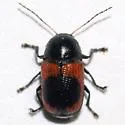
Cryptocephalus pubiventris
Cryptocephalus pubiventris
Identification: Highly variable Dets. E. G. Riley Type Locality: Huachuca Mountains, Cochise, Arizona. Ten specimens examined by White
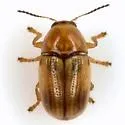
Cryptocephalus pumilus
Cryptocephalus pumilus
Identification: Pronotum: Dull yellowish to (usually) dull orange, disk usually more or less clouded with light to dark brown. Elytra: Dull yellowish to (usually) dull orange, humerus more or less dark, often with vague to distinct brown markings at
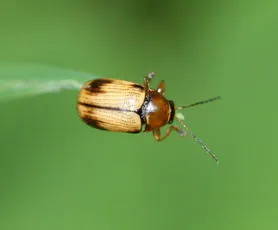
Cryptocephalus pusillus
Cryptocephalus pusillus
A small leaf beetle of around 3mm. The males often have more or less extensive dark markings on the creamy yellow elytra, unlike the females. Summer and autumn, persisting later than many similar species. Grazes on the live leaves of various trees. W
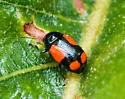
Cryptocephalus quadruplex
Cryptocephalus quadruplex
Identification: Det. M. A. Quinn, 2013 Apical orange marks occasionally absent: Det. E. G. Riley, 2012
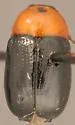
Cryptocephalus sanguinicollis
Cryptocephalus sanguinicollis
Identification: Pronotum red/orange (black in C. s. nigerrimus )
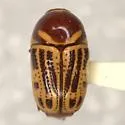
Cryptocephalus snowi
Cryptocephalus snowi
White reports 6 specimens in the USNM from Texas, New Mexico, and Arizona
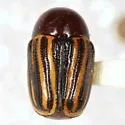
Cryptocephalus spurcus
Cryptocephalus spurcus
Identification: vague and indistinct vittae are characteristic. ‒J.R. Watts, 8.vii.2008
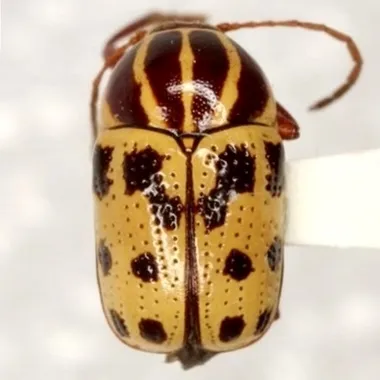
Cryptocephalus texanus
Cryptocephalus texanus
Identification: Det. E. G. Riley 1982 Type Locality: New Braunfels, Comal Co., Texas apparently formerly more common, most records prior to 2002 ( 3 )
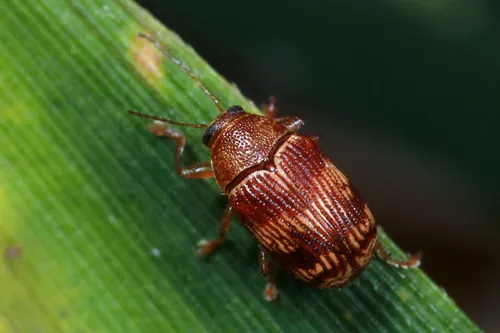
Cryptocephalus tinctus
Cryptocephalus tinctus
Identification: elytral striae (rows of dots) mostly entire, rather then largely confused or double See discussion at
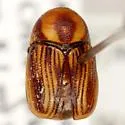
Cryptocephalus trivittatus
Cryptocephalus trivittatus
Identification: elytral vittae are brown instead of black, the lateral ones more or less disrupted - Fig. 50, C. trivitlatus Olivier; 51, C. cuneatus Fall Det. E. G. Riley 1983 one of the first Cryptocephalus species to be described for North America