
Cryptocephalus trivittatus
This record describes Cryptocephalus trivittatus (species). Recorded family: Chrysomelidae. Recorded order: Coleoptera.
Identification and Appearance
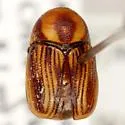
elytral vittae are brown instead of black, the lateral ones more or less disrupted - Fig. 50, C. trivitlatus Olivier; 51, C. cuneatus Fall Det. E. G. Riley 1983 one of the first Cryptocephalus species to be described for North America . Blatchley, in his 1385 page tome on the beetles of Indiana listed only one county (in northeastern IL) and date (July 30) for the species and stated that it was rare. . Blatchley (1924a, 1924b), after extensive field surveys and collection inspections listed only two locations for Florida. Brimley lists 2959 species of beetles (and 9566 species of insects total) for North Carolina, but C. trivittata is not among those listed. White reported only one specimen from Texas (College Station) which he wrote might be in error. (Note that the specimen posted here confirms the record that White doubted. Balsbaugh & Hays reported five specimens from three counties, up from one county reported by Loding Peck & Thomas report two n. Florida county records. Cavey reported only two specimens known to him from Maryland. Ciegler, in addition to her own field surveys, examined the specimens in 10 entomological collections (including the USNM) but only found eight collection localities for South Carolina. Clark et al., in their extensive review of North American chrysomelid literature, list only two references (90 years apart) concerning the host plants of C. trivittatus , namely Blatchley and Clark.
Classification
- Kingdom
- Animalia
- Phylum
- Arthropoda
- Class
- Insecta
- Order
- Coleoptera (Beetles)
- Suborder
- Polyphaga
- Superfamily
- Chrysomeloidea
- Family
- Chrysomelidae (Leaf Beetles)
- Subfamily
- Cryptocephalinae
- Tribe
- Cryptocephalini
- Genus
- Cryptocephalus
Imported taxonomy record. Source availability varies; see the source references and editorial policy below.
Habitat and Range
Habitat
Piedmont to Tidewater in SC ( 7 )
Geographic Range
e US (TX-n.FL-NY-IA) - Map ( 4 ) ( 5 ) ( 6 )
Seasonal Activity
Jun-Aug in SC ( 7 )
Diet and Behavior
Diet: Reported from hazel or hazelnut ( Corylus , Betulaceae) (Birch Family)
Additional species information
Species notes from the sources
Etymology: Cryptocephalus trivittatus Olivier, 1808
About Primitive Winged Insects: the wider group
Order-level background for Coleoptera, the group containing Cryptocephalus trivittatus. Species-specific details appear above.
Group overview
Coleoptera is the largest order of insects with over 400,000 described species, representing ~25% of all known animal species and ~40% of all insects. In the U.S. alone, nearly 30,000 beetle species have been identified.
Ecological role of the group
Beetles are prominent decomposers, especially in forests, breaking down dead wood and recycling nutrients. As predators, they reduce populations of pest insects. Many species are also important pollinators of flowering plants.
Economic and practical significance of the group
Beetles have major economic significance: leaf beetles (Chrysomelidae) and weevils (Curculionoidea) are among the most destructive agricultural pests globally, costing billions annually, while predatory species like ladybugs provide natural pest control.
Recorded sources for this group: Britannica, Smithsonian, NCSU Entomology. Imported estimates may describe particular regions or reporting periods.
Photos of Cryptocephalus trivittatus (5)
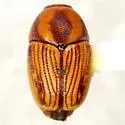
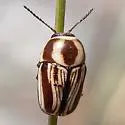
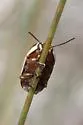
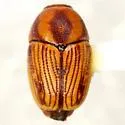
Photo credits: Contributed by Mike Quinn; Additional contributions by Edward Ruden
Frequently Asked Questions About Cryptocephalus trivittatus
What is Cryptocephalus trivittatus?
Cryptocephalus trivittatus is a species in the family Chrysomelidae, within the order Coleoptera.
How big is Cryptocephalus trivittatus?
Length 3.5-4.4 mm
How do you identify Cryptocephalus trivittatus?
elytral vittae are brown instead of black, the lateral ones more or less disrupted - Fig. 50, C. trivitlatus Olivier; 51, C. cuneatus Fall Det. E. G. Riley 1983
Where is Cryptocephalus trivittatus found?
| Feature | Details |
|---|---|
| Habitat | Piedmont to Tidewater in SC ( 7 ) |
| Range | e US (TX-n.FL-NY-IA) - Map ( 4 ) ( 5 ) ( 6 ) |
What does Cryptocephalus trivittatus eat?
The diet of the Cryptocephalus trivittatus includes Reported from hazel or hazelnut ( Corylus , Betulaceae) (Birch Family).
When is Cryptocephalus trivittatus active?
Cryptocephalus trivittatus: seasonal activity - Jun-Aug in SC ( 7 ).