
Cowpea Weevil
Callosobruchus maculatus
This record describes Callosobruchus maculatus (species). Recorded family: Chrysomelidae. Recorded order: Coleoptera.
Identification and Appearance
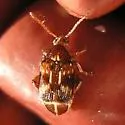
variable in coloration, leading to confusion with other species of Callosobruchus . Part of the variation is due to the presence of two distinct adult forms, which differ not only in their morphology, but in physiology, behaviour, etc. (Utida 1981). Utida named these flightless form and flight form, which Caswell later termed normal and active, respectively. Utida discusses at length the basis of the two forms. One of the best known and most universally destructive of the Bruchidae. Like its sister species, Callosobruchus chinensis , it has the ability to infest and reinfest many species of stored legumes, resulting in enormous post-harvest losses. However, Callosobruchus maculatus is a non-quarantine/non-actionable species for USDA APHIS. (X. Shirley. pers. comm. to MAQ, 2023) This beetle deposits a marking pheromone on beans which inhibits egg deposition by its congener C. rhodesianus but the reverse does not occur. When larvae is in competition on beans, C. maculatus larvae will exclude C. rhodesianus larvae.
Identification notes
variable in coloration, leading to confusion with other species of Callosobruchus . Part of the variation is due to the presence of two distinct adult forms, which differ not only in their morphology, but in physiology, behaviour, etc. (Utida 1981). Utida (1954) named these flightless form and flight form, which Caswell (1960) later termed normal and active, respectively. Utida (1981) discusses at length the basis of the two forms.
Classification
- Kingdom
- Animalia
- Phylum
- Arthropoda
- Class
- Insecta
- Order
- Coleoptera (Beetles)
- Suborder
- Polyphaga
- Superfamily
- Chrysomeloidea
- Family
- Chrysomelidae (Leaf Beetles)
- Subfamily
- Bruchinae
- Tribe
- Bruchini
- Genus
- Callosobruchus
Imported taxonomy record. Source availability varies; see the source references and editorial policy below.
Habitat and Range
Geographic Range
adventive, mostly across s. US - Map ; Cosmopolitan, most likely of African origin
Diet and Behavior
Diet: Cowpeas and other beans in storage, incl. Cajanus cajan; Cicer arietinum; Glycine max; Lablab purpureus; Lathyrus spp.; Lens culinaris; Phaseolus spp.; Pisum sativum arvense; Vicia spp.; Vigna spp.
Life History
Do not deposit eggs randomly, but assess their host for its potential to sustain the offspring, generally looking for larger beans and ones with few eggs on them. This increases larval survival by 70%. ( 4 )
Additional species information
Species notes from the sources
Etymology: Callosobruchus maculatus (Fabricius 1775)
About Primitive Winged Insects: the wider group
Order-level background for Coleoptera, the group containing Callosobruchus maculatus. Species-specific details appear above.
Group overview
Coleoptera is the largest order of insects with over 400,000 described species, representing ~25% of all known animal species and ~40% of all insects. In the U.S. alone, nearly 30,000 beetle species have been identified.
Ecological role of the group
Beetles are prominent decomposers, especially in forests, breaking down dead wood and recycling nutrients. As predators, they reduce populations of pest insects. Many species are also important pollinators of flowering plants.
Economic and practical significance of the group
Beetles have major economic significance: leaf beetles (Chrysomelidae) and weevils (Curculionoidea) are among the most destructive agricultural pests globally, costing billions annually, while predatory species like ladybugs provide natural pest control.
Recorded sources for this group: Britannica, Smithsonian, NCSU Entomology. Imported estimates may describe particular regions or reporting periods.
Photos of Cowpea Weevil (4)
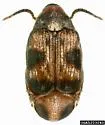
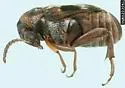
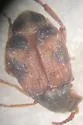
Photo credits: Contributed by Boris Büche; Additional contributions by Beatriz Moisset , Mike Quinn , v belov , Marci Hess
Frequently Asked Questions About Cowpea Weevil
What is Cowpea Weevil?
Cowpea Weevil (Callosobruchus maculatus) is a species in the family Chrysomelidae, within the order Coleoptera.
How big is Cowpea Weevil?
2.7–3.0 mm
How do you identify Cowpea Weevil?
variable in coloration, leading to confusion with other species of Callosobruchus . Part of the variation is due to the presence of two distinct adult forms, which differ not only in their morphology, but in physiology, behaviour, etc. (Utida 1981). Utida (1954) named these flightless form and flight form, which Caswell (1960) later termed normal and active, respectively. Utida (1981) discusses at length the basis of the two forms.
Where is Cowpea Weevil found?
Range: adventive, mostly across s. US - Map ; Cosmopolitan, most likely of African origin
What does Cowpea Weevil eat?
The diet of the Cowpea Weevil includes Cowpeas and other beans in storage, incl. Cajanus cajan; Cicer arietinum; Glycine max; Lablab purpureus; Lathyrus spp.; Lens culinaris; Phaseolus spp.; Pisum sativum arvense; Vicia spp.; Vigna spp..
What is the life cycle of a Cowpea Weevil?
Do not deposit eggs randomly, but assess their host for its potential to sustain the offspring, generally looking for larger beans and ones with few eggs on them. This increases larval survival by 70%. ( 4 )