
Rocky Mountain Locust
Melanoplus spretus
This record describes Melanoplus spretus (species). Recorded family: Acrididae. Recorded order: Orthoptera.
Identification and Appearance
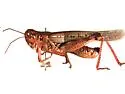
A long-winged and rather dull-patterned Melanoplus , notable for its fantastic swarms and damage to agriculture. It was one of the most abundant large insects in North America (and the world), but is now believed to be extinct. Historical illustrations can, perhaps, give some feeling for the living organism: This living female Melanoplus (likely sanguinipes ) from Wisconsin is said to resemble spretus --see comments there: Apparently M. spretus was known mostly (or only?) as long-winged gregarious phase individuals, while these are only rarely seen in the similar M. sanguinipes , for instance. Definitive differentiation from other Melanoplus requires/required examination of genital structures of the male:
Classification
- Kingdom
- Animalia
- Phylum
- Arthropoda
- Class
- Insecta
- Order
- Orthoptera (Grasshoppers, Crickets, Katydids)
- Suborder
- Caelifera
- Family
- Acrididae (Short-horned Grasshoppers)
- Subfamily
- Melanoplinae
- Tribe
- Melanoplini
- Genus
- Melanoplus
Imported taxonomy record. Source availability varies; see the source references and editorial policy below.
Habitat and Range
Geographic Range
Formerly resident in northern Rocky Mountain region of western North America, with episodic, and agriculturally devastating invasions southward and eastward into the Great Plains. Notable invasions occurred through the 1870's, but the species declined precipitously in the last decades of the 19th century. The last living specimens were seen in southern Canada in 1902 (collected by Norman Criddle near Wawanesa, Manitoba ), and the species is now believed to be extinct . Historical maps show former breeding and irruptive ranges:
Diet and Behavior
Life History
Had a remarkable life cycle, with sedentary and migratory phases. One generation per year. Migratory swarms of immense size were documented in the upper Midwest in the 1870's. One 1875 swarm ("Albert's swarm") in Nebraska was documented with the aid of telegraphed reports and estimated to be 110 miles (180 km) wide by 1,800 miles (2,900 km) in length. This gives an area of 198,000 square miles (500,000 square km), larger than the state of Colorado. This swarm contained perhaps three trillion (3,000,000,000,000) individuals .
Additional species information
Species notes from the sources
Etymology: Species name spretus is Latin, meaning despised . Locust is from Latin, locus ustus , meaning "burnt place", alluding to denuded landscapes left by locusts .
About Grasshoppers, Crickets, Katydids: the wider group
Order-level background for Orthoptera, the group containing Melanoplus spretus. Species-specific details appear above.
Group overview
Orthoptera includes ~28,000 described species of grasshoppers, crickets, and katydids. Desert locusts can form swarms covering 460 square miles containing up to 80 million individuals per square kilometer.
Ecological role of the group
Grasshoppers and crickets are a primary food source for birds, reptiles, and small mammals. Cricket farming is a growing industry - crickets require 12× less feed than cattle to produce the same amount of protein, using 2,000× less water.
Economic and practical significance of the group
A single large locust swarm can consume the same amount of food in one day as 35,000 people. The 2019-2021 East Africa locust crisis affected food security for 42 million people across multiple countries. Global crop losses from locusts can reach billions annually.
Recorded sources for this group: FAO, UN World Food Programme, research publications. Imported estimates may describe particular regions or reporting periods.
Photos of Rocky Mountain Locust (5)
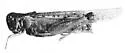
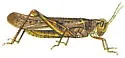
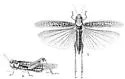
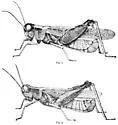
Photo credits: Contributed by Cotinis; Additional contributions by Mike Quinn , David Ferguson
Frequently Asked Questions About Rocky Mountain Locust
What is Rocky Mountain Locust?
Rocky Mountain Locust (Melanoplus spretus) is a species in the family Acrididae, within the order Orthoptera.
How big is Rocky Mountain Locust?
30-36 mm (head to tip of wings) body length 25 mm (male), 28 mm (female) (Scudder, 1898)
How do you identify Rocky Mountain Locust?
A long-winged and rather dull-patterned Melanoplus , notable for its fantastic swarms and damage to agriculture. It was one of the most abundant large insects in North America (and the world), but is now believed to be extinct. Historical illustrations can, perhaps, give some feeling for the living organism: This living female Melanoplus (likely sanguinipes ) from Wisconsin is said to resemble spretus --see comments there: Apparently M. spretus was known mostly (or only?) as long-winged gregarious phase individuals, while these are only rarely seen in the similar M. sanguinipes , for instance. Definitive differentiation from other Melanoplus requires/required examination of genital structures of the male:
Where is Rocky Mountain Locust found?
Range: Formerly resident in northern Rocky Mountain region of western North America, with episodic, and agriculturally devastating invasions southward and eastward into the Great Plains. Notable invasions occurred through the 1870's, but the species declined precipitously in the last decades of the 19th century. The last living specimens were seen in southern Canada in 1902 (collected by Norman Criddle near Wawanesa, Manitoba ), and the species is now believed to be extinct . Historical maps show former breeding and irruptive ranges:
What is the life cycle of a Rocky Mountain Locust?
Had a remarkable life cycle, with sedentary and migratory phases. One generation per year. Migratory swarms of immense size were documented in the upper Midwest in the 1870's. One 1875 swarm (Albert's swarm) in Nebraska was documented with the aid of telegraphed reports and estimated to be 110 miles (180 km) wide by 1,800 miles (2,900 km) in length. This gives an area of 198,000 square miles (500,000 square km), larger than the state of Colorado. This swarm contained perhaps three trillion (3,000,000,000,000) individuals .