
Narrow-winged Spur-throat Grasshopper
Melanoplus angustipennis
This record describes Melanoplus angustipennis (species). Recorded family: Acrididae. Recorded order: Orthoptera.
Identification and Appearance
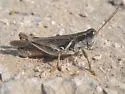
Very similar to M. foedus & packardii , but much smaller (averaging well under 30 mm long), usually without prominent median dark stripe on top of pronotum and head, and without white stripes along top margins of pronotum; male furculae proportionately longer and less divergent; male subgenital plate usually squared off or notched at the tip (as opposed to rounded or slightly pointed). Hind tibia is varied in color, usually reddish or bluish. M. sanguinipes is similar in size, shape and sometimes in pattern. It differs in having short almost triangular cerci (as apposed to dumbbell-shaped); there is a lump under the mid front part of the male thorax (sometimes also the female - missing in M. angustipennis ); and, the pattern is usually more broken and less smooth looking. In M. sanguinipes the principal sulcus (strongest and rear-most groove) divides the mid-line of the pronotum roughly in half, while in M. angustipennis it is normally well to the rear of half. M. arizonae & bruneri are more similar to M. sanguinipes . M. bispinosus looks more like M. sanguinipes in color pattern, but might be confused for M. angustipennis , which is structurally more similar. The cerci are smaller, more slender, and bend in toward the tip; the subgenital plate is rounded apically; the supra-anal plate is strongly constricted past the middle with a prominent lump on either side at this constriction (thus the name bispinosus, though they are hardly spines), while it is more evenly triangular and with nearly straight sides in M. angustipennis . Tip of male abdomen
Classification
- Kingdom
- Animalia
- Phylum
- Arthropoda
- Class
- Insecta
- Order
- Orthoptera (Grasshoppers, Crickets, Katydids)
- Suborder
- Caelifera
- Family
- Acrididae (Short-horned Grasshoppers)
- Subfamily
- Melanoplinae
- Tribe
- Melanoplini
- Genus
- Melanoplus
Imported taxonomy record. Source availability varies; see the source references and editorial policy below.
Habitat and Range
Habitat
Typically in sandy areas in grassland or on sunny river sand deposits.
Geographic Range
Widely distributed east from Rockies in U.S. and southern Canada, but absent from most of ne. U.S. and e. Canada east of the Great Lakes. Westernmost records apparently in Montana, Utah and Arizona. Most abundant on the Great Plains and in the Midwest.
About Grasshoppers, Crickets, Katydids: the wider group
Order-level background for Orthoptera, the group containing Melanoplus angustipennis. Species-specific details appear above.
Group overview
Orthoptera includes ~28,000 described species of grasshoppers, crickets, and katydids. Desert locusts can form swarms covering 460 square miles containing up to 80 million individuals per square kilometer.
Ecological role of the group
Grasshoppers and crickets are a primary food source for birds, reptiles, and small mammals. Cricket farming is a growing industry - crickets require 12× less feed than cattle to produce the same amount of protein, using 2,000× less water.
Economic and practical significance of the group
A single large locust swarm can consume the same amount of food in one day as 35,000 people. The 2019-2021 East Africa locust crisis affected food security for 42 million people across multiple countries. Global crop losses from locusts can reach billions annually.
Recorded sources for this group: FAO, UN World Food Programme, research publications. Imported estimates may describe particular regions or reporting periods.
Photos of Narrow-winged Spur-throat Grasshopper (5)
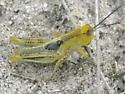
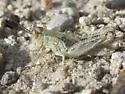
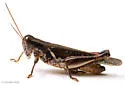
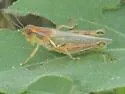
Photo credits: Contributed by Tom Bentley; Additional contributions by David Ferguson , metrioptera , Tyler Hedlund
Frequently Asked Questions About Narrow-winged Spur-throat Grasshopper
What is Narrow-winged Spur-throat Grasshopper?
Narrow-winged Spur-throat Grasshopper (Melanoplus angustipennis) is a species in the family Acrididae, within the order Orthoptera.
How do you identify Narrow-winged Spur-throat Grasshopper?
Very similar to M. foedus & packardii , but much smaller (averaging well under 30 mm long), usually without prominent median dark stripe on top of pronotum and head, and without white stripes along top margins of pronotum; male furculae proportionately longer and less divergent; male subgenital plate usually squared off or notched at the tip (as opposed to rounded or slightly pointed). Hind tibia is varied in color, usually reddish or bluish. M. sanguinipes is similar in size, shape and sometimes in pattern. It differs in having short almost triangular cerci (as apposed to dumbbell-shaped); there is a lump under the mid front part of the male thorax (sometimes also the female - missing in M. angustipennis ); and, the pattern is usually more broken and less smooth looking. In M. sanguinipes the principal sulcus (strongest and rear-most groove) divides the mid-line of the pronotum roughly in half, while in M. angustipennis it is normally well to the rear of half. M. arizonae & bruneri are more similar to M. sanguinipes . M. bispinosus looks more like M. sanguinipes in color pattern, but might be confused for M. angustipennis , which is structurally more similar. The cerci are smaller, more slender, and bend in toward the tip; the subgenital plate is rounded apically; the supra-anal plate is strongly constricted past the middle with a prominent lump on either side at this constriction (thus the name bispinosus, though they are hardly spines), while it is more evenly triangular and with nearly straight sides in M. angustipennis . Tip of male abdomen
Where is Narrow-winged Spur-throat Grasshopper found?
| Feature | Details |
|---|---|
| Habitat | Typically in sandy areas in grassland or on sunny river sand deposits. |
| Range | Widely distributed east from Rockies in U.S. and southern Canada, but absent from most of ne. U.S. and e. Canada east of the Great Lakes. Westernmost records apparently in Montana, Utah and Arizona. Most abundant on the Great Plains and in the Midwest. |