
Wyoming Toothpick Grasshopper
Paropomala wyomingensis
This record describes Paropomala wyomingensis (species). Recorded family: Acrididae. Recorded order: Orthoptera.
Identification and Appearance
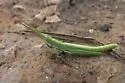
| Feature | Description |
|---|---|
| Additional details | Small (under 2 inch), very slender toothpick grasshopper with large head. |
| Head | Head is approximately 1.3 times longer than pronotum and wider than rest of body (head is approaches twice as long as pronotum in related Prorocorypha snowi ). |
| Coloration | Coloration green, brown, grey, or a combination, with a narrow white stripe on side of face and pronotum that runs below eye, just clipping it (white stripe, when present includes much of eye in P. pallida & virgata , though eye itself may be darker). Broad dark stripe above white stripe is wide and includes eye (narrower than eye in P. pallida & virgata ). |
| Antennae | Antennae thick, sword-shaped and roughly as long as head and pronotum together. Tegmina (front wings) are blunt at tip, and usually do not reach end of hind femur (but vary occasionally to longer). There are no spines pointing back from the knee of the hind leg. There is a triangular tubercle on the prosternum between the front legs but it is low and not prominent. The conical subgenital plate at the tip of the male abdomen is roughly as long as the two previous abdominal segments together (is much shorter in P. virgata & P. pallida , and much longer in Prorocorypha snowi . Males are much smaller than females. In many areas most males are gray to brown and most females are green, though both genders vary in color. Often this species is very abundant within restricted habitats, yet it is uncommonly noticed. |
Classification
- Kingdom
- Animalia
- Phylum
- Arthropoda
- Class
- Insecta
- Order
- Orthoptera (Grasshoppers, Crickets, Katydids)
- Suborder
- Caelifera
- Family
- Acrididae (Short-horned Grasshoppers)
- Subfamily
- Gomphocerinae
- Genus
- Paropomala
Imported taxonomy record. Source availability varies; see the source references and editorial policy below.
Habitat and Range
Habitat
Primarily patches of mid-height grasses (mostly between 1 and 2 ft tall) in slightly moist areas such as roadsides, depressions, arroyos, streamsides, etc. These are usually within drier open short grassland, shrubland, or desert areas, sometimes open woodlands in mountains.
Geographic Range
Wyoming and western South Dakota south to central Mexico and southern California.
Seasonal Activity
Overwinters as eggs; adults late spring to frost; in most areas most common in July and August.
Diet and Behavior
Diet: presumed to be Grasses and perhaps other related monocots.
About Grasshoppers, Crickets, Katydids: the wider group
Order-level background for Orthoptera, the group containing Paropomala wyomingensis. Species-specific details appear above.
Group overview
Orthoptera includes ~28,000 described species of grasshoppers, crickets, and katydids. Desert locusts can form swarms covering 460 square miles containing up to 80 million individuals per square kilometer.
Ecological role of the group
Grasshoppers and crickets are a primary food source for birds, reptiles, and small mammals. Cricket farming is a growing industry - crickets require 12× less feed than cattle to produce the same amount of protein, using 2,000× less water.
Economic and practical significance of the group
A single large locust swarm can consume the same amount of food in one day as 35,000 people. The 2019-2021 East Africa locust crisis affected food security for 42 million people across multiple countries. Global crop losses from locusts can reach billions annually.
Recorded sources for this group: FAO, UN World Food Programme, research publications. Imported estimates may describe particular regions or reporting periods.
Photos of Wyoming Toothpick Grasshopper (5)
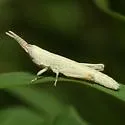
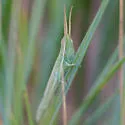
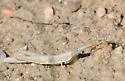
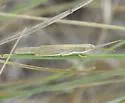
Photo credits: Contributed by Eric R. Eaton; Additional contributions by David Ferguson , Fyn Kynd
Frequently Asked Questions About Wyoming Toothpick Grasshopper
What is Wyoming Toothpick Grasshopper?
Wyoming Toothpick Grasshopper (Paropomala wyomingensis) is a species in the family Acrididae, within the order Orthoptera.
How do you identify Wyoming Toothpick Grasshopper?
| Feature | Description |
|---|---|
| Additional details | Small (under 2 inch), very slender toothpick grasshopper with large head. |
| Head | Head is approximately 1.3 times longer than pronotum and wider than rest of body (head is approaches twice as long as pronotum in related Prorocorypha snowi ). |
| Coloration | Coloration green, brown, grey, or a combination, with a narrow white stripe on side of face and pronotum that runs below eye, just clipping it (white stripe, when present includes much of eye in P. pallida & virgata , though eye itself may be darker). Broad dark stripe above white stripe is wide and includes eye (narrower than eye in P. pallida & virgata ). |
| Antennae | Antennae thick, sword-shaped and roughly as long as head and pronotum together. Tegmina (front wings) are blunt at tip, and usually do not reach end of hind femur (but vary occasionally to longer). There are no spines pointing back from the knee of the hind leg. There is a triangular tubercle on the prosternum between the front legs but it is low and not prominent. The conical subgenital plate at the tip of the male abdomen is roughly as long as the two previous abdominal segments together (is much shorter in P. virgata & P. pallida , and much longer in Prorocorypha snowi . Males are much smaller than females. In many areas most males are gray to brown and most females are green, though both genders vary in color. |
Where is Wyoming Toothpick Grasshopper found?
| Feature | Details |
|---|---|
| Habitat | Primarily patches of mid-height grasses (mostly between 1 and 2 ft tall) in slightly moist areas such as roadsides, depressions, arroyos, streamsides, etc. These are usually within drier open short grassland, shrubland, or desert areas, sometimes open woodlands in mountains. |
| Range | Wyoming and western South Dakota south to central Mexico and southern California. |
What does Wyoming Toothpick Grasshopper eat?
The diet of the Wyoming Toothpick Grasshopper includes presumed to be Grasses and perhaps other related monocots..
When is Wyoming Toothpick Grasshopper active?
Wyoming Toothpick Grasshopper: seasonal activity - Overwinters as eggs; adults late spring to frost; in most areas most common in July and August..