
Dodge's Short-wing Grasshopper, and others
Melanoplus dodgei-species-group
This record describes Melanoplus dodgei-species-group (species). Recorded family: Acrididae. Recorded order: Orthoptera.
Identification and Appearance
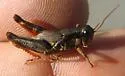
Found at high elevation; broad-bodied insects; wings short (usually not or only slightly longer than pronotum), overlapping at top; sometimes with pale stripe along sides of top of pronotum and wings (stripes most prominent in northern populations), often with top paler than sides; body usually dull grayish to brownish (paler on lower sides and ventrally), often speckled dark; males (sometimes females) with distinct dark postocular black bars extending backward onto pronotum from eyes; hind tibiae red. Male cerci are relatively slender, tapering from base to a relatively narrow, but blunt rounded tip. Other red-legged, equally short-winged Melanoplus from the same region have the tegmina (front wings) not overlapping above (usually not touching) and more rounded in shape. Fairly common in most of the higher mountains within the distribution area, but often overlooked because the insects tend to be inconspicuous in behavior, and other more active species are likely to draw attention away from these little grasshoppers.
Classification
- Kingdom
- Animalia
- Phylum
- Arthropoda
- Class
- Insecta
- Order
- Orthoptera (Grasshoppers, Crickets, Katydids)
- Suborder
- Caelifera
- Family
- Acrididae (Short-horned Grasshoppers)
- Subfamily
- Melanoplinae
- Tribe
- Melanoplini
- Genus
- Melanoplus
Imported taxonomy record. Source availability varies; see the source references and editorial policy below.
Habitat and Range
Habitat
Most often found in relatively dry grassy (often gravelly) sunny openings or understory in Montane and Subalpine conifer forests, above about 6000 ft. (north) or 8000 ft. (south). Often indirectly associated with Ponderosa Pine, White Fir, Douglas Fir, Gambel Oak, Limber Pine, etc.
Geographic Range
In mountains from south-central Wyoming, across Colorado into eastern and central Utah, and to southern New Mexico.
Seasonal Activity
Adults from late June to frost, but generally most often encountered in July and August.
Diet and Behavior
Life History
Overwinters as eggs laid in ground; hatch in spring. Adults late spring or early summer to frost.
Additional species information
Species notes from the sources
Etymology: In 2012 Daniel Otte published 16 new names in this group and elevated two names traditionally treated as subspecies or synonyms to species ranking, bringing the total in the group to 19. These populations were previously treated as but one species (or as two by some authors). The visual differences between these 19 "species" are insignificant, and the distinctions are based on subtle differences in male genitalia. These entities are not reliably distinguishable from their nearest neighbors within the group, except by knowing the location found, and/or by disecting male genitalia. In external appearance these populations form a continuum of variation, from populations in the north with individuals usually relatively contrastingly patterned, to populations in the south with individuals usually relatively dull and non-contrasting in color pattern, but there is no obvious visual demarcation between types. Here they are treated together as one group, since it is not practical to try and separate out all 19 from submitted photographs alone. For further details, and distribution maps, see Daniel Otte's 2012 publication, listed below.
About Grasshoppers, Crickets, Katydids: the wider group
Order-level background for Orthoptera, the group containing Melanoplus dodgei-species-group. Species-specific details appear above.
Group overview
Orthoptera includes ~28,000 described species of grasshoppers, crickets, and katydids. Desert locusts can form swarms covering 460 square miles containing up to 80 million individuals per square kilometer.
Ecological role of the group
Grasshoppers and crickets are a primary food source for birds, reptiles, and small mammals. Cricket farming is a growing industry - crickets require 12× less feed than cattle to produce the same amount of protein, using 2,000× less water.
Economic and practical significance of the group
A single large locust swarm can consume the same amount of food in one day as 35,000 people. The 2019-2021 East Africa locust crisis affected food security for 42 million people across multiple countries. Global crop losses from locusts can reach billions annually.
Recorded sources for this group: FAO, UN World Food Programme, research publications. Imported estimates may describe particular regions or reporting periods.
Photos of Dodge's Short-wing Grasshopper, and others (5)
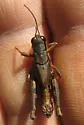
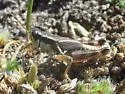
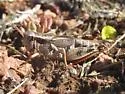
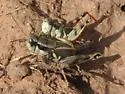
Photo credits: Contributed by David J. Ferguson
Frequently Asked Questions About Dodge's Short-wing Grasshopper, and others
What is Dodge's Short-wing Grasshopper, and others?
Dodge's Short-wing Grasshopper, and others (Melanoplus dodgei-species-group) is a species in the family Acrididae, within the order Orthoptera.
How do you identify Dodge's Short-wing Grasshopper, and others?
Found at high elevation; broad-bodied insects; wings short (usually not or only slightly longer than pronotum), overlapping at top; sometimes with pale stripe along sides of top of pronotum and wings (stripes most prominent in northern populations), often with top paler than sides; body usually dull grayish to brownish (paler on lower sides and ventrally), often speckled dark; males (sometimes females) with distinct dark postocular black bars extending backward onto pronotum from eyes; hind tibiae red. Male cerci are relatively slender, tapering from base to a relatively narrow, but blunt rounded tip. Other red-legged, equally short-winged Melanoplus from the same region have the tegmina (front wings) not overlapping above (usually not touching) and more rounded in shape.
Where is Dodge's Short-wing Grasshopper, and others found?
| Feature | Details |
|---|---|
| Habitat | Most often found in relatively dry grassy (often gravelly) sunny openings or understory in Montane and Subalpine conifer forests, above about 6000 ft. (north) or 8000 ft. (south). Often indirectly associated with Ponderosa Pine, White Fir, Douglas Fir, Gambel Oak, Limber Pine, etc. |
| Range | In mountains from south-central Wyoming, across Colorado into eastern and central Utah, and to southern New Mexico. |
When is Dodge's Short-wing Grasshopper, and others active?
Dodge's Short-wing Grasshopper, and others: seasonal activity - Adults from late June to frost, but generally most often encountered in July and August..
What is the life cycle of a Dodge's Short-wing Grasshopper, and others?
Overwinters as eggs laid in ground; hatch in spring. Adults late spring or early summer to frost.