
Canyon Grasshopper
Melanoplus eumera
This record describes Melanoplus eumera (species). Recorded family: Acrididae. Recorded order: Orthoptera.
Identification and Appearance
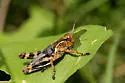
Melanoplus thomasi is usually a richer green or bluish color, has more striking pale stripes along the margins of the upper side, and has a longitudinal dark stripe on the outer hind femur instead of dark cross bands. Similar to M. differentialis , but wings usually shorter, coloring more contrasting, with dark markings more developed; on thorax usually fused into more solid and bold dark patches, and on the hind femur broken into black cross bands (often solid rather than of herring-bone type). M. bivitattus may look similar, but occurs further north and has the same femur pattern as M. thomasi . Close to M. ponderosus , but markings considerably crisper and more contrasting than usual in that species, with dark markings usually decidedly black. Always(?) with wings fully developed (but still relatively short, reaching to tip of hind femur, give or take a bit). Wings are variable, but often much shorter in M. ponderosus . The male cerci of M. eumera are somewhat smaller and less strongly lobed below than in M. ponderosus . M. franciscanus is much smaller, occurs at higher elevations, and has a narrower cercus more dumbbell-shaped and more evenly rounded at the end. It has pale dorsal stripes usually more developed. Occasionally specimens appear to be intermediate in character and it is possible (though unsubstantiated) that the two occasionally hybridize. Tip of male abdomen A very striking species that had been confused with closely related M. ponderosus . It is treated as a distinct species in the Orthoptera Species File , with no indication of having been treated as a subspecies or synonym, so is also treated separately here. It is however possible that this is merely a strikingly colored regional variant of M. ponderosus . Specimens of M. ponderosus from central Texas often approach M. eumera in larger size and in having similar bold coloring, and field studies are needed to see if the populations form a continuum. Rare M. ponderosus found in northeastern New Mexico do not look much like M. eumera (duller in coloring with less developed dark patterning), but are equally large in size.
Classification
- Kingdom
- Animalia
- Phylum
- Arthropoda
- Class
- Insecta
- Order
- Orthoptera (Grasshoppers, Crickets, Katydids)
- Suborder
- Caelifera
- Family
- Acrididae (Short-horned Grasshoppers)
- Subfamily
- Melanoplinae
- Tribe
- Melanoplini
- Genus
- Melanoplus
Imported taxonomy record. Source availability varies; see the source references and editorial policy below.
Habitat and Range
Habitat
Desert Canyons have been been recorded as a habitat. In the original description it is said to be found in brush covered areas, and found abundant only on a steap north-facing slope. At Sanderson, in dry grass in the bed of a stream and on a slope. It apparently favors areas of moderately heavy vegetation within arid environments. In the Guadalupe Mountains southeastern Sacramento Mountains in New Mexico it is found abundantly in diverse habitats, but mostly on steep slopes and in canyons where vegetation is heavier than average, and mostly lower in elevation than the Ponderosa Pine belt.
Geographic Range
Mountainous areas of west Texas, mostly within the Trans-Pecos, and in south-central New Mexico, almost certainly into adjacent Chihuahua Mexico.
Seasonal Activity
Mostly with immatures present in summer and adults in late summer until killed by cold in autumn or early winter.
Diet and Behavior
Life History
Overwinters as eggs, probably laid in the ground.
Additional species information
Species notes from the sources
Etymology: described by Hebard. 1920. Transactions of the Amererican Entomological Society 46:366-369
About Grasshoppers, Crickets, Katydids: the wider group
Order-level background for Orthoptera, the group containing Melanoplus eumera. Species-specific details appear above.
Group overview
Orthoptera includes ~28,000 described species of grasshoppers, crickets, and katydids. Desert locusts can form swarms covering 460 square miles containing up to 80 million individuals per square kilometer.
Ecological role of the group
Grasshoppers and crickets are a primary food source for birds, reptiles, and small mammals. Cricket farming is a growing industry - crickets require 12× less feed than cattle to produce the same amount of protein, using 2,000× less water.
Economic and practical significance of the group
A single large locust swarm can consume the same amount of food in one day as 35,000 people. The 2019-2021 East Africa locust crisis affected food security for 42 million people across multiple countries. Global crop losses from locusts can reach billions annually.
Recorded sources for this group: FAO, UN World Food Programme, research publications. Imported estimates may describe particular regions or reporting periods.
Photos of Canyon Grasshopper (5)
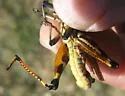
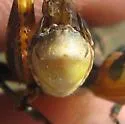
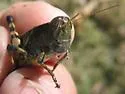
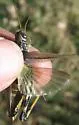
Photo credits: Contributed by David J. Ferguson; Additional contributions by Tyler Hedlund
Frequently Asked Questions About Canyon Grasshopper
What is Canyon Grasshopper?
Canyon Grasshopper (Melanoplus eumera) is a species in the family Acrididae, within the order Orthoptera.
How do you identify Canyon Grasshopper?
Melanoplus thomasi is usually a richer green or bluish color, has more striking pale stripes along the margins of the upper side, and has a longitudinal dark stripe on the outer hind femur instead of dark cross bands. Similar to M. differentialis , but wings usually shorter, coloring more contrasting, with dark markings more developed; on thorax usually fused into more solid and bold dark patches, and on the hind femur broken into black cross bands (often solid rather than of herring-bone type). M. bivitattus may look similar, but occurs further north and has the same femur pattern as M. thomasi . Close to M. ponderosus , but markings considerably crisper and more contrasting than usual in that species, with dark markings usually decidedly black. Always(?) with wings fully developed (but still relatively short, reaching to tip of hind femur, give or take a bit). Wings are variable, but often much shorter in M. ponderosus . The male cerci of M. eumera are somewhat smaller and less strongly lobed below than in M. ponderosus . M. franciscanus is much smaller, occurs at higher elevations, and has a narrower cercus more dumbbell-shaped and more evenly rounded at the end. It has pale dorsal stripes usually more developed. Occasionally specimens appear to be intermediate in character and it is possible (though unsubstantiated) that the two occasionally hybridize. Tip of male abdomen
Where is Canyon Grasshopper found?
| Feature | Details |
|---|---|
| Habitat | Desert Canyons have been been recorded as a habitat. In the original description it is said to be found in brush covered areas, and found abundant only on a steap north-facing slope. At Sanderson, in dry grass in the bed of a stream and on a slope. It apparently favors areas of moderately heavy vegetation within arid environments. In the Guadalupe Mountains southeastern Sacramento Mountains in New Mexico it is found abundantly in diverse habitats, but mostly on steep slopes and in canyons where vegetation is heavier than average, and mostly lower in elevation than the Ponderosa Pine belt. |
| Range | Mountainous areas of west Texas, mostly within the Trans-Pecos, and in south-central New Mexico, almost certainly into adjacent Chihuahua Mexico. |
When is Canyon Grasshopper active?
Canyon Grasshopper: seasonal activity - Mostly with immatures present in summer and adults in late summer until killed by cold in autumn or early winter..
What is the life cycle of a Canyon Grasshopper?
Overwinters as eggs, probably laid in the ground.