
Orange-winged grasshopper
Pardalophora phoenicoptera
This record describes Pardalophora phoenicoptera (species). Recorded family: Acrididae. Recorded order: Orthoptera.
Identification and Appearance
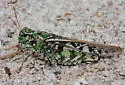
Large gray/brown or green, dark spots on forewings. Hind femur mostly blue with darker near black cross bands and one subapical yellow to orange band. Hind tibia yellow to orange. Bright red-orange to red hindwing. Adults in spring. Hippiscus ocelote may have hind wings in other colors (yellow, lighter orange, pinkish) as well as orange to red. It has the pronotum divided on top into nearly equal length front and rear halves by principal sulcus. Pardalophora species have the rear part distinctly longer than the front. Also, Hippiscus matures in summer and is most common in summer and autumn, while Pardalophora mature in spring and mostly gone by early summer (they can overlap in June and July). Pardalophora saussurei has wings usually yellow to yellow-orange, and only rarely darker orange to red. It is a little larger, and has the pronotum more narrowly pointed toward the rear. It is a western species (primarily of the Great Plains), and is rarely seen much west of Kansas, Oklahoma, and Texas. However, in those states the two species often occur together. Usually P. saussurei is a more active insect, quicker to fly, and stronger and higher in flight (especially the females, which often choose to hide instead of to fly in P. phoenicoptera ). Pardalophora apiculata is mostly more northern, but overlaps distribution. It is a sand-loving insect that is usually appears about a month earlier in the season, is most abundant as adults earlier (April or May as apposed to May or June), and generally disappears earlier as well. It tends to have fewer and larger dark spots on the tegmina; has wings that are usually more pinkish in color; has the hind femora more slender and usually yellow (or orange) with dark markings on the inner side; has the sides of the pronotum more parallel and straight-edged when viewed from above; and has the fastigium produced more forward. Cryptic when at rest, spectacular in flight. Adults, when captured, vomit or exude a foul-smelling orange fluid. (P. Coin)
Classification
- Kingdom
- Animalia
- Phylum
- Arthropoda
- Class
- Insecta
- Order
- Orthoptera (Grasshoppers, Crickets, Katydids)
- Suborder
- Caelifera
- Family
- Acrididae (Short-horned Grasshoppers)
- Subfamily
- Oedipodinae
- Tribe
- Hippiscini
- Genus
- Pardalophora
Imported taxonomy record. Source availability varies; see the source references and editorial policy below.
Habitat and Range
Habitat
Old fields, meadows, open woodlands. Almost always where grassy, sunny, and near (but not usually under) trees. More often seen in upland areas than in valleys.
Geographic Range
Eastern United States, from near the Atlantic coast west as far as eastern Nebraska and Kansas, central Oklahoma, and eastern Texas.
Diet and Behavior
Diet: Probably mostly grasses.
Life History
Nymphs overwinter with adults present in spring. Mostly gone by July, but occasional individuals live longer.
Additional species information
Species notes from the sources
Etymology: Species name " phoenicoptera " refers to color of wings, from phoenico- Greek Phoenecian, plus Greek ptera wing. Phoenecia was a civilization famous and synonymous with a brilliant purple-red dye, see Wikipedia .
About Grasshoppers, Crickets, Katydids: the wider group
Order-level background for Orthoptera, the group containing Pardalophora phoenicoptera. Species-specific details appear above.
Group overview
Orthoptera includes ~28,000 described species of grasshoppers, crickets, and katydids. Desert locusts can form swarms covering 460 square miles containing up to 80 million individuals per square kilometer.
Ecological role of the group
Grasshoppers and crickets are a primary food source for birds, reptiles, and small mammals. Cricket farming is a growing industry - crickets require 12× less feed than cattle to produce the same amount of protein, using 2,000× less water.
Economic and practical significance of the group
A single large locust swarm can consume the same amount of food in one day as 35,000 people. The 2019-2021 East Africa locust crisis affected food security for 42 million people across multiple countries. Global crop losses from locusts can reach billions annually.
Recorded sources for this group: FAO, UN World Food Programme, research publications. Imported estimates may describe particular regions or reporting periods.
Photos of Orange-winged grasshopper (5)
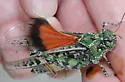
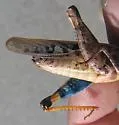
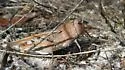
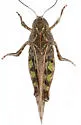
Photo credits: Contributed by Cotinis; Additional contributions by Ted Kropiewnicki , David Ferguson , metrioptera
Frequently Asked Questions About Orange-winged grasshopper
What is Orange-winged grasshopper?
Orange-winged grasshopper (Pardalophora phoenicoptera) is a species in the family Acrididae, within the order Orthoptera.
How big is Orange-winged grasshopper?
| Feature | Details |
|---|---|
| Males | 36-42 mm |
| Females | 45-55 mm |
How do you identify Orange-winged grasshopper?
Large gray/brown or green, dark spots on forewings. Hind femur mostly blue with darker near black cross bands and one subapical yellow to orange band. Hind tibia yellow to orange. Bright red-orange to red hindwing. Adults in spring. Hippiscus ocelote may have hind wings in other colors (yellow, lighter orange, pinkish) as well as orange to red. It has the pronotum divided on top into nearly equal length front and rear halves by principal sulcus. Pardalophora species have the rear part distinctly longer than the front. Also, Hippiscus matures in summer and is most common in summer and autumn, while Pardalophora mature in spring and mostly gone by early summer (they can overlap in June and July). Pardalophora saussurei has wings usually yellow to yellow-orange, and only rarely darker orange to red. It is a little larger, and has the pronotum more narrowly pointed toward the rear. It is a western species (primarily of the Great Plains), and is rarely seen much west of Kansas, Oklahoma, and Texas. However, in those states the two species often occur together. Usually P. saussurei is a more active insect, quicker to fly, and stronger and higher in flight (especially the females, which often choose to hide instead of to fly in P. phoenicoptera ). Pardalophora apiculata is mostly more northern, but overlaps distribution. It is a sand-loving insect that is usually appears about a month earlier in the season, is most abundant as adults earlier (April or May as apposed to May or June), and generally disappears earlier as well. It tends to have fewer and larger dark spots on the tegmina; has wings that are usually more pinkish in color; has the hind femora more slender and usually yellow (or orange) with dark markings on the inner side; has the sides of the pronotum more parallel and straight-edged when viewed from above; and has the fastigium produced more forward.
Where is Orange-winged grasshopper found?
| Feature | Details |
|---|---|
| Habitat | Old fields, meadows, open woodlands. Almost always where grassy, sunny, and near (but not usually under) trees. More often seen in upland areas than in valleys. |
| Range | Eastern United States, from near the Atlantic coast west as far as eastern Nebraska and Kansas, central Oklahoma, and eastern Texas. |
What does Orange-winged grasshopper eat?
The diet of the Orange-winged grasshopper includes Probably mostly grasses..
What is the life cycle of a Orange-winged grasshopper?
Nymphs overwinter with adults present in spring. Mostly gone by July, but occasional individuals live longer.