
Pasture Grasshopper
Melanoplus confusus
This record describes Melanoplus confusus (species). Recorded family: Acrididae. Recorded order: Orthoptera.
Identification and Appearance
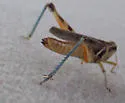
Adult: body gray and brown with black patches; underside cream-colored; shiny black patch behind eye on side of head and on pronotal lobe; white diagonal stripe on side of thorax behind pronotum; wings long; outer surface of hind femur with dark diagonal bands; underside of hind femur orange or yellow; hind tibia greenish-blue; characteristic striped eye of nymph may still be present in adult (see photo of adult male and female ); male cercus twisted and bent medially (see photo of cerci and furcula ) Nymphs: vary in color from gray to green according to instar; eye with broad dark stripe running diagonally in center, and a narrow light line on each side of this stripe [a diagnostic character]; face nearly vertical and colored tan or green and spotted; usually has a cream-colored crescent on side of head below compound eye, and running onto lobe of pronotum; antennae filiform; ( see photos of nymphs) Tip of male abdomen The Pasture Grasshopper occurs in low densities early in the season when vegetation is green and abundant, causing little or no economic damage.
Classification
- Kingdom
- Animalia
- Phylum
- Arthropoda
- Class
- Insecta
- Order
- Orthoptera (Grasshoppers, Crickets, Katydids)
- Suborder
- Caelifera
- Family
- Acrididae (Short-horned Grasshoppers)
- Subfamily
- Melanoplinae
- Tribe
- Melanoplini
- Genus
- Melanoplus
Imported taxonomy record. Source availability varies; see the source references and editorial policy below.
Habitat and Range
Habitat
grass prairies in the west; meadows, pastures, dry sandy wastelands, hillsides, sandy forest clearings in the midwest and east
Geographic Range
southern Canada and northern half of United States, south in the midwest to northern Texas; absent in a U-shaped zone from Oregon to California, through southern Texas and gulf states to North Carolina (see distribution map )
Seasonal Activity
adults in late spring and early summer (mid-June to mid-August) nymphs from early May to late June
Diet and Behavior
Diet: nymphs and adults feed on forbs and grasses
Life History
nymphs hatch in early May and develop through five instars in 40-46 days; adult male usually approaches the female and when close enough, pounces on her and attaches his genitalia; after attachment he jerks his hind femora forward and backward, and his body from side to side for about one minute; a clutch of 10-15 eggs is laid on bare ground in the soil to a depth of about 3 cm; the female then withdraws her abdomen and briefly brushes over the exit hole with her ovipositor before walking away [adapted from text at U. of Wyoming]
About Grasshoppers, Crickets, Katydids: the wider group
Order-level background for Orthoptera, the group containing Melanoplus confusus. Species-specific details appear above.
Group overview
Orthoptera includes ~28,000 described species of grasshoppers, crickets, and katydids. Desert locusts can form swarms covering 460 square miles containing up to 80 million individuals per square kilometer.
Ecological role of the group
Grasshoppers and crickets are a primary food source for birds, reptiles, and small mammals. Cricket farming is a growing industry - crickets require 12× less feed than cattle to produce the same amount of protein, using 2,000× less water.
Economic and practical significance of the group
A single large locust swarm can consume the same amount of food in one day as 35,000 people. The 2019-2021 East Africa locust crisis affected food security for 42 million people across multiple countries. Global crop losses from locusts can reach billions annually.
Recorded sources for this group: FAO, UN World Food Programme, research publications. Imported estimates may describe particular regions or reporting periods.
Photos of Pasture Grasshopper (5)
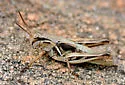
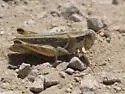
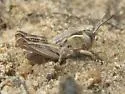
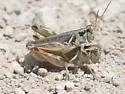
Photo credits: Contributed by Robin McLeod; Additional contributions by metrioptera , Tyler Hedlund
Frequently Asked Questions About Pasture Grasshopper
What is Pasture Grasshopper?
Pasture Grasshopper (Melanoplus confusus) is a species in the family Acrididae, within the order Orthoptera.
How do you identify Pasture Grasshopper?
Adult: body gray and brown with black patches; underside cream-colored; shiny black patch behind eye on side of head and on pronotal lobe; white diagonal stripe on side of thorax behind pronotum; wings long; outer surface of hind femur with dark diagonal bands; underside of hind femur orange or yellow; hind tibia greenish-blue; characteristic striped eye of nymph may still be present in adult (see photo of adult male and female ); male cercus twisted and bent medially (see photo of cerci and furcula ) Nymphs: vary in color from gray to green according to instar; eye with broad dark stripe running diagonally in center, and a narrow light line on each side of this stripe [a diagnostic character]; face nearly vertical and colored tan or green and spotted; usually has a cream-colored crescent on side of head below compound eye, and running onto lobe of pronotum; antennae filiform; ( see photos of nymphs) Tip of male abdomen
Where is Pasture Grasshopper found?
| Feature | Details |
|---|---|
| Habitat | grass prairies in the west; meadows, pastures, dry sandy wastelands, hillsides, sandy forest clearings in the midwest and east |
| Range | southern Canada and northern half of United States, south in the midwest to northern Texas; absent in a U-shaped zone from Oregon to California, through southern Texas and gulf states to North Carolina (see distribution map ) |
What does Pasture Grasshopper eat?
The diet of the Pasture Grasshopper includes nymphs and adults feed on forbs and grasses.
When is Pasture Grasshopper active?
Pasture Grasshopper: seasonal activity - adults in late spring and early summer (mid-June to mid-August) nymphs from early May to late June.
What is the life cycle of a Pasture Grasshopper?
nymphs hatch in early May and develop through five instars in 40-46 days; adult male usually approaches the female and when close enough, pounces on her and attaches his genitalia; after attachment he jerks his hind femora forward and backward, and his body from side to side for about one minute; a clutch of 10-15 eggs is laid on bare ground in the soil to a depth of about 3 cm; the female then withdraws her abdomen and briefly brushes over the exit hole with her ovipositor before walking away [adapted from text at U. of Wyoming]