
American Bird Grasshopper
Schistocerca americana
This record describes Schistocerca americana (species). Recorded family: Acrididae. Recorded order: Orthoptera.
Identification and Appearance
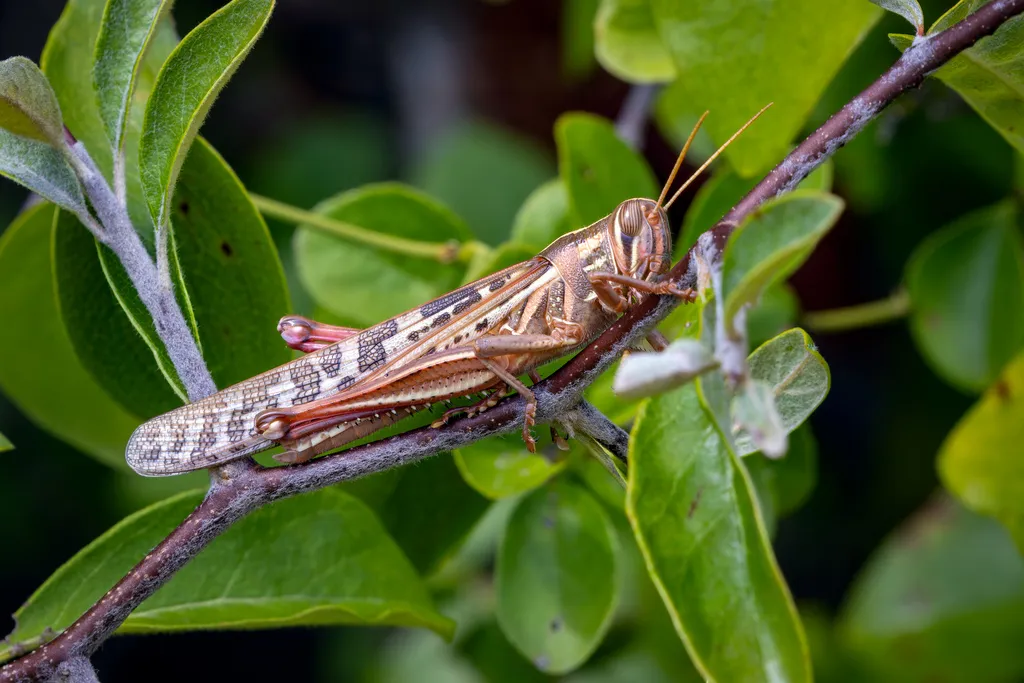
Large, usually has creamy strip extending from head to forewings. Characteristically flies up and into trees when disturbed, behavior quite different from most other grasshoppers. Prosternal spine thick, whitish, only slightly bending backward, not reaching the prosternum at all. Lateral lobes of pronotum with a large brown spot interrupted by a narrow whitish streak, dividing the spot into two. Costal field of tegmina with dark spots. Hind femora without dark bands on the dorsal face , but black marks may be present on the inner face.
Wikipedia reference for Schistocerca americana: http://en.wikipedia.org/wiki/Schistocerca_americana.
Classification
- Kingdom
- Animalia
- Phylum
- Arthropoda
- Class
- Insecta
- Order
- Orthoptera (Grasshoppers, Crickets, Katydids)
- Suborder
- Caelifera
- Family
- Acrididae (Short-horned Grasshoppers)
- Subfamily
- Cyrtacanthacridinae
- Genus
- Schistocerca (Bird Grasshoppers)
Imported taxonomy record. Source availability varies; see the source references and editorial policy below.
Habitat and Range
Habitat
Fields, open woodlands
Geographic Range
e. US / Mex. - Map Somewhat migratory, in northern part of range may be immigrant only, not breeding.
Seasonal Activity
Typically April-June and August-September. Adults overwinter, so sometimes seen late into fall and on warm winter days. July-November (Michigan).
Diet and Behavior
Diet: Herbivore, feeds on a variety of grasses, forbs (non-grass herbs), and foliage of woody plants. It can be a pest of crops.
Life History
Unusual two generations per year: spring and early summer, plus late summer. Broods may overlap, however. (Some sources say there is a single, long-lived brood, with some overlap of generations in late summer.) Under favorable conditions, becomes gregarious, disperses in swarms.
About Grasshoppers, Crickets, Katydids: the wider group
Order-level background for Orthoptera, the group containing Schistocerca americana. Species-specific details appear above.
Group overview
Orthoptera includes ~28,000 described species of grasshoppers, crickets, and katydids. Desert locusts can form swarms covering 460 square miles containing up to 80 million individuals per square kilometer.
Ecological role of the group
Grasshoppers and crickets are a primary food source for birds, reptiles, and small mammals. Cricket farming is a growing industry - crickets require 12× less feed than cattle to produce the same amount of protein, using 2,000× less water.
Economic and practical significance of the group
A single large locust swarm can consume the same amount of food in one day as 35,000 people. The 2019-2021 East Africa locust crisis affected food security for 42 million people across multiple countries. Global crop losses from locusts can reach billions annually.
Recorded sources for this group: FAO, UN World Food Programme, research publications. Imported estimates may describe particular regions or reporting periods.
Photos of American Bird Grasshopper (2)
Photo credits: Contributed by Cotinis; Additional contributions by Chuck Entz , Mike Quinn , David Ferguson , Arturo Santos
Frequently Asked Questions About American Bird Grasshopper
What is American Bird Grasshopper?
American Bird Grasshopper (Schistocerca americana) is a species in the family Acrididae, within the order Orthoptera.
How big is American Bird Grasshopper?
40-70 mm
How do you identify American Bird Grasshopper?
Large, usually has creamy strip extending from head to forewings. Characteristically flies up and into trees when disturbed, behavior quite different from most other grasshoppers. Prosternal spine thick, whitish, only slightly bending backward, not reaching the prosternum at all. Lateral lobes of pronotum with a large brown spot interrupted by a narrow whitish streak, dividing the spot into two. Costal field of tegmina with dark spots. Hind femora without dark bands on the dorsal face , but black marks may be present on the inner face.
Where is American Bird Grasshopper found?
| Feature | Details |
|---|---|
| Habitat | Fields, open woodlands |
| Range | e. US / Mex. - Map Somewhat migratory, in northern part of range may be immigrant only, not breeding. |
What does American Bird Grasshopper eat?
The diet of the American Bird Grasshopper includes Herbivore, feeds on a variety of grasses, forbs (non-grass herbs), and foliage of woody plants. It can be a pest of crops..
When is American Bird Grasshopper active?
American Bird Grasshopper: seasonal activity - Typically April-June and August-September. Adults overwinter, so sometimes seen late into fall and on warm winter days. July-November (Michigan)..
What is the life cycle of a American Bird Grasshopper?
Unusual two generations per year: spring and early summer, plus late summer. Broods may overlap, however. (Some sources say there is a single, long-lived brood, with some overlap of generations in late summer.) Under favorable conditions, becomes gregarious, disperses in swarms.