
Sandbar Grasshopper
Melanoplus fluviatilis
This record describes Melanoplus fluviatilis (species). Recorded family: Acrididae. Recorded order: Orthoptera.
Identification and Appearance
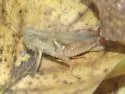
Often treated as a subspecies of M. foedus , but behaves as if a different species with different habitat preferences. The two are easily distinguished where they occur in the same areas. It is possible that there is some hybridization between them, but if this occurs it is probably on an insignificant scale, and I [David Ferguson; as of 2012] have seen no evidence of it. Where formerly abundant (1970's and early 1980's) along stretches of the Rio Grande in central New Mexico, and along the Arkansas River in eastern Colorado and western Kansas, the species seems to be gone now, and it should be watched for in those areas to verify whether it still exists there. It is possible that a combination of human disturbances, drought, and heavy encroachment of Salt Cedar are among causes for it's apparent disappearance from these areas (??).
Classification
- Kingdom
- Animalia
- Phylum
- Arthropoda
- Class
- Insecta
- Order
- Orthoptera (Grasshoppers, Crickets, Katydids)
- Suborder
- Caelifera
- Family
- Acrididae (Short-horned Grasshoppers)
- Subfamily
- Melanoplinae
- Tribe
- Melanoplini
- Genus
- Melanoplus
Imported taxonomy record. Source availability varies; see the source references and editorial policy below.
Habitat and Range
Habitat
Primarily along riparian corridors of streams, rivers, and other drainages, and near the shores of lakes; often but not exclusively where soils are sandy. Occuring most often among open deciduous brush or tall herbaceus growth, often along the edges of and in openings within riparian forest, or on sandbars within the channel. Colonies tend to be localized by habitat preference, and sometimes far between.
Geographic Range
Known from Wyoming, Nebraska, Minnesota, and Illinois, south to central Texas, and west to the Rockies in eastern Colorado and the Rio Grande in central New Mexico.
Diet and Behavior
Diet: Tends to favor tall herbaceus and shrubby dicots, and apparently fond of Legumes (often adults will be found clustered along the stems of a denuded Sweet Clover, Wild Licorice, or young Locust). They are sometimes abundant in open thickets of Sandbar Willow, and likely that is another favored food.
Life History
Overwintering as eggs, hatching in late spring or early summer, with adults in summer and autumn.
Additional species information
Species notes from the sources
Etymology: Southern populations in Texas and Oklahoma (named " isleyi ") tend to be yellowish in body color with the hind tibiae most often buff to yellowish (but they may be other colors) and the postoccular bars of the pronotum usually weak and poorly developed. Populations westward and northward (named " fluviatilis ") tend to be browner or grayer with well-defined dark postocular bars, and with hind tibial color more often of brighter and varied colors. In northern Oklahoma and southern Kansas the " isleyi " and the more typical " fluviatilis " intergrade freely, and cannot be divided as different species. The name isleyi should be treated as a subspecies of M. fluviatilis , but this combination has never been published. M. fluviatilis (including isleyi ) occurs in a habitat usually apart from its near relatives M. packardii and M. foedus , but occasionally they occur side by side, yet remain totally distinct. Since coloration is distinctly different, living specimens are rarely difficult to distinguish, though discolored museum specimens of M. fluviatilis and M. foedus can be difficult to separate since there seems to be no reliable and constant morphological difference.
About Grasshoppers, Crickets, Katydids: the wider group
Order-level background for Orthoptera, the group containing Melanoplus fluviatilis. Species-specific details appear above.
Group overview
Orthoptera includes ~28,000 described species of grasshoppers, crickets, and katydids. Desert locusts can form swarms covering 460 square miles containing up to 80 million individuals per square kilometer.
Ecological role of the group
Grasshoppers and crickets are a primary food source for birds, reptiles, and small mammals. Cricket farming is a growing industry - crickets require 12× less feed than cattle to produce the same amount of protein, using 2,000× less water.
Economic and practical significance of the group
A single large locust swarm can consume the same amount of food in one day as 35,000 people. The 2019-2021 East Africa locust crisis affected food security for 42 million people across multiple countries. Global crop losses from locusts can reach billions annually.
Recorded sources for this group: FAO, UN World Food Programme, research publications. Imported estimates may describe particular regions or reporting periods.
Photos of Sandbar Grasshopper (5)
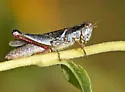
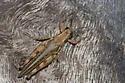
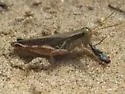
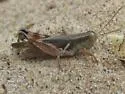
Photo credits: Contributed by David J. Ferguson
Frequently Asked Questions About Sandbar Grasshopper
What is Sandbar Grasshopper?
Sandbar Grasshopper (Melanoplus fluviatilis) is a species in the family Acrididae, within the order Orthoptera.
Where is Sandbar Grasshopper found?
| Feature | Details |
|---|---|
| Habitat | Primarily along riparian corridors of streams, rivers, and other drainages, and near the shores of lakes; often but not exclusively where soils are sandy. Occuring most often among open deciduous brush or tall herbaceus growth, often along the edges of and in openings within riparian forest, or on sandbars within the channel. Colonies tend to be localized by habitat preference, and sometimes far between. |
| Range | Known from Wyoming, Nebraska, Minnesota, and Illinois, south to central Texas, and west to the Rockies in eastern Colorado and the Rio Grande in central New Mexico. |
What does Sandbar Grasshopper eat?
The diet of the Sandbar Grasshopper includes Tends to favor tall herbaceus and shrubby dicots, and apparently fond of Legumes (often adults will be found clustered along the stems of a denuded Sweet Clover, Wild Licorice, or young Locust). They are sometimes abundant in open thickets of Sandbar Willow, and likely that is another favored food..
What is the life cycle of a Sandbar Grasshopper?
Overwintering as eggs, hatching in late spring or early summer, with adults in summer and autumn.