
Green-legged Grasshopper
Melanoplus viridipes-species-group
This record describes Melanoplus viridipes-species-group (species). Recorded family: Acrididae. Recorded order: Orthoptera.
Identification and Appearance
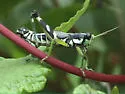
Adult: solid green forelegs & midlegs; black lateral stripe running full length of pronotum; short wings covering less than half of abdomen (this combination of characteristics is diagnostic). Lower half of side of pronotum white, and top of pronotum either all black or black with white patches; adult male cercus triangular and slightly downcurved at tip ; subgenital plate with small hump or tubercle in middle of top edge , visible from above as a pale solid half-circle (both characteristics are diagnostic); hind femur usually with distinct brown or black markings. Dendrotettix and Appalachia usually have more extensive brown on hind femur; a prominent black line along mid-line of pronotum; wing pads separated over back; or, (sometimes in Dendrotettix ) wings fully developed. Melanoplus gracilis has plain, usually green hind femora; wing pads smaller, oval, widely separated. Booneacris has no wings. Otte (2002) recognizes 12 species in the Viridipes Group: Some of these have been treated as subspecies of M. viridipes , and others have tended to be ignored by authors since Hebard. Due to lack of knowledge about them, and the fact that they do not appear in general literature on grasshoppers, they are not well known. Some are perhaps subspecies of the same species that replace one another geographically. Some occur together in the same place and behave as distinct species. How many real biological species are represented is unclear, and the group needs more study in the field to understand relationships better. They are very difficult to identify from photos alone, but some probably can be, based on coloration and location, especially if the male cerci are shown in the picture. So far, these are not separated on BugGuide. Otte included M. gracilis Bruner in his treatment of the Viridipes Group. On the surface, the inclusion implies inclusion in the group, but it is not so included in the Orthoptera Species Files, where it is listed in its own Gracilis Group. Otte actually included the species for completeness and for comparison (it has been included in the group by previous authors), while also expressing doubt as to any close kinship. M. gracilis is distinctly different from the rest. Hebard and later Helfer did not include M. gracilis in the Viridipes Group (see Print References below). The Viridipes and Gracilis Groups are distinctive among Melanoplus and show similarities to the genera Paroxya , Appalachia , Booneacris , and Dendrotettix .
Classification
- Kingdom
- Animalia
- Phylum
- Arthropoda
- Class
- Insecta
- Order
- Orthoptera (Grasshoppers, Crickets, Katydids)
- Suborder
- Caelifera
- Family
- Acrididae (Short-horned Grasshoppers)
- Subfamily
- Melanoplinae
- Tribe
- Melanoplini
- Genus
- Melanoplus
Imported taxonomy record. Source availability varies; see the source references and editorial policy below.
Habitat and Range
Habitat
on ground or low vegetation in open woods or wood edges
Geographic Range
eastern Minnesota through Wisconsin, Michigan, and southern Ontario to Vermont and western Massachusetts, south to northern Georgia and Arkansas, west to eastern Nebraska
Seasonal Activity
nymphs mature rapidly in the spring, with adults May to mid-August
Diet and Behavior
Life History
one generation per year; overwinters as an egg
Additional species information
Species notes from the sources
Etymology: Has been confused with the name Melanoplus juvencus , which was given to a Florida species. viridipes : from the Latin "viridis" (green) + "pes" (foot); probably a reference to the green legs in this species
About Grasshoppers, Crickets, Katydids: the wider group
Order-level background for Orthoptera, the group containing Melanoplus viridipes-species-group. Species-specific details appear above.
Group overview
Orthoptera includes ~28,000 described species of grasshoppers, crickets, and katydids. Desert locusts can form swarms covering 460 square miles containing up to 80 million individuals per square kilometer.
Ecological role of the group
Grasshoppers and crickets are a primary food source for birds, reptiles, and small mammals. Cricket farming is a growing industry - crickets require 12× less feed than cattle to produce the same amount of protein, using 2,000× less water.
Economic and practical significance of the group
A single large locust swarm can consume the same amount of food in one day as 35,000 people. The 2019-2021 East Africa locust crisis affected food security for 42 million people across multiple countries. Global crop losses from locusts can reach billions annually.
Recorded sources for this group: FAO, UN World Food Programme, research publications. Imported estimates may describe particular regions or reporting periods.
Photos of Green-legged Grasshopper (5)
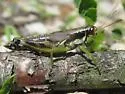
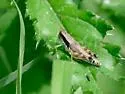
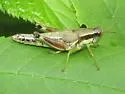
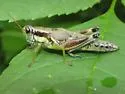
Photo credits: Contributed by Robin McLeod; Additional contributions by Nick Block , David Ferguson
Frequently Asked Questions About Green-legged Grasshopper
What is Green-legged Grasshopper?
Green-legged Grasshopper (Melanoplus viridipes-species-group) is a species in the family Acrididae, within the order Orthoptera.
How big is Green-legged Grasshopper?
body length: male 17.5-18.5 mm; female 21.5-25.5 mm
How do you identify Green-legged Grasshopper?
Adult: solid green forelegs & midlegs; black lateral stripe running full length of pronotum; short wings covering less than half of abdomen (this combination of characteristics is diagnostic). Lower half of side of pronotum white, and top of pronotum either all black or black with white patches; adult male cercus triangular and slightly downcurved at tip ; subgenital plate with small hump or tubercle in middle of top edge , visible from above as a pale solid half-circle (both characteristics are diagnostic); hind femur usually with distinct brown or black markings. Dendrotettix and Appalachia usually have more extensive brown on hind femur; a prominent black line along mid-line of pronotum; wing pads separated over back; or, (sometimes in Dendrotettix ) wings fully developed. Melanoplus gracilis has plain, usually green hind femora; wing pads smaller, oval, widely separated. Booneacris has no wings.
Where is Green-legged Grasshopper found?
| Feature | Details |
|---|---|
| Habitat | on ground or low vegetation in open woods or wood edges |
| Range | eastern Minnesota through Wisconsin, Michigan, and southern Ontario to Vermont and western Massachusetts, south to northern Georgia and Arkansas, west to eastern Nebraska |
When is Green-legged Grasshopper active?
Green-legged Grasshopper: seasonal activity - nymphs mature rapidly in the spring, with adults May to mid-August.
What is the life cycle of a Green-legged Grasshopper?
one generation per year; overwinters as an egg