
Arid Lands Spur-Throat Grasshopper
Melanoplus aridus
This record describes Melanoplus aridus (species). Recorded family: Acrididae. Recorded order: Orthoptera.
Identification and Appearance
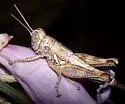
Smallish (mostly under 1 inch, but sometimes longer in the south). Antennae and eyes are usually brown, often strongly reddish. With very short wings, and the tegmina oval and usually widely separated. The bar behind the eyes on the sides of the pronotum is usually wide at the front, with an included pale spot, but narrows to a slightly up-bowed dark line at the top edges of either side of the mesonotum (rear part of the pronotum). There is usually a distinct (often very narrow, at least toward rear) dark stripe down the middle of the top of the pronotum. The abdomen usually has at least indications of two dark bands (often broken) extending back along either side of the top, and often a second pair of dark lines running just above these. The underside is usually yellowish. Hind tibia are blue, usually with blue or yellow on the lower half of the knee of the femur as well. Hind femur is usually mostly light brownish or yellowish on the outer side (more often grayish west of Arizona). Male with end of abdomen not unusually enlarged; with subgenital plate evenly curved around the top edge; with fuculae well-developed, slender, longer than wide; cerci long and very slender, not pointed, usually bent in and up a bit and often very slightly swollen toward the tip, widening at the base. Tip of male abdomen In the east (roughly east of the Rio Grande), individuals often have a gray appearance, but with much yellow, and with bold narrow black dark markings. But toward the south in west Texas and ne. Mexico they are often stocky, green, and can be beautiful gems highlighted with blue and red. West from the Rio Grande, south from the Mogollon Rim and in sw. New Mexico, they also average stocky and often more colorful (but not all individuals are equally colorful) with richer blues and yellows dominating the body and with reddish eyes (these were named M. desultorius ). In mountains of the Gila drainage they are often boldly patterned with heavy dark markings. On the Colorado Plateaus and into the Southern Rockies, coloration tends to be dull grays and browns, and size is often extremely small ( M. tristis ). In the Great Basin, Mojave and Colorado Deserts they average a bit more slender, and most often light gray with dark markings narrow and less developed; the hind femora are often strongly banded. It seems that they look just a bit different in most any region where they are found.
Classification
- Kingdom
- Animalia
- Phylum
- Arthropoda
- Class
- Insecta
- Order
- Orthoptera (Grasshoppers, Crickets, Katydids)
- Suborder
- Caelifera
- Family
- Acrididae (Short-horned Grasshoppers)
- Subfamily
- Melanoplinae
- Tribe
- Melanoplini
- Genus
- Melanoplus
Imported taxonomy record. Source availability varies; see the source references and editorial policy below.
Habitat and Range
Habitat
Highly varied, from low desert and grasslands well up into the mountains. Mostly open dry exposed areas where food plants are found.
Geographic Range
Texas to Kansas and westward into California.
Diet and Behavior
Diet: Mostly Composites in the Aster Tribe, but sometimes other Composites or plants in other families.
Life History
Eggs overwinter. Adults late spring to frost.
Additional species information
Species notes from the sources
Etymology: It is possible that there are more than one species included here, but it's difficult to draw lines if there are. Melanoplus desultorius is frequently treated as a distinct species, but there seems to be no reliable way to separate all individuals into this species or into M. aridus . The supposed distinctions of slightly different male cerci, smaller size, and narrower wings of M. aridus do not seem to hold up, and gray individuals ( aridus ) can sometimes be found mating with colorful red-eyed individuals ( desultorius ). The two might be separable based on coloration and average differences in measurements, but it seems that M. desultorius probably represents optimal development in concert with a regional variation in coloration. Depauperate individuals from high elevations in the Four Corners region and across northern Arizona have been called a separate species ( Melanoplus tristis ) by some authors. However, the only distinction seems to be small size, and most authors have treated it as a synonym. The species (or species complex) shows much regional variation in both size and in coloration; see comments under Remarks below.
About Grasshoppers, Crickets, Katydids: the wider group
Order-level background for Orthoptera, the group containing Melanoplus aridus. Species-specific details appear above.
Group overview
Orthoptera includes ~28,000 described species of grasshoppers, crickets, and katydids. Desert locusts can form swarms covering 460 square miles containing up to 80 million individuals per square kilometer.
Ecological role of the group
Grasshoppers and crickets are a primary food source for birds, reptiles, and small mammals. Cricket farming is a growing industry - crickets require 12× less feed than cattle to produce the same amount of protein, using 2,000× less water.
Economic and practical significance of the group
A single large locust swarm can consume the same amount of food in one day as 35,000 people. The 2019-2021 East Africa locust crisis affected food security for 42 million people across multiple countries. Global crop losses from locusts can reach billions annually.
Recorded sources for this group: FAO, UN World Food Programme, research publications. Imported estimates may describe particular regions or reporting periods.
Photos of Arid Lands Spur-Throat Grasshopper (5)
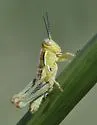
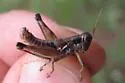
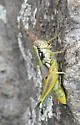
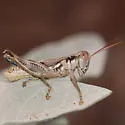
Photo credits: Contributed by Tom Bentley; Additional contributions by David Ferguson , Tyler Hedlund
Frequently Asked Questions About Arid Lands Spur-Throat Grasshopper
What is Arid Lands Spur-Throat Grasshopper?
Arid Lands Spur-Throat Grasshopper (Melanoplus aridus) is a species in the family Acrididae, within the order Orthoptera.
How do you identify Arid Lands Spur-Throat Grasshopper?
Smallish (mostly under 1 inch, but sometimes longer in the south). Antennae and eyes are usually brown, often strongly reddish. With very short wings, and the tegmina oval and usually widely separated. The bar behind the eyes on the sides of the pronotum is usually wide at the front, with an included pale spot, but narrows to a slightly up-bowed dark line at the top edges of either side of the mesonotum (rear part of the pronotum). There is usually a distinct (often very narrow, at least toward rear) dark stripe down the middle of the top of the pronotum. The abdomen usually has at least indications of two dark bands (often broken) extending back along either side of the top, and often a second pair of dark lines running just above these. The underside is usually yellowish. Hind tibia are blue, usually with blue or yellow on the lower half of the knee of the femur as well. Hind femur is usually mostly light brownish or yellowish on the outer side (more often grayish west of Arizona). Male with end of abdomen not unusually enlarged; with subgenital plate evenly curved around the top edge; with fuculae well-developed, slender, longer than wide; cerci long and very slender, not pointed, usually bent in and up a bit and often very slightly swollen toward the tip, widening at the base. Tip of male abdomen
Where is Arid Lands Spur-Throat Grasshopper found?
| Feature | Details |
|---|---|
| Habitat | Highly varied, from low desert and grasslands well up into the mountains. Mostly open dry exposed areas where food plants are found. |
| Range | Texas to Kansas and westward into California. |
What does Arid Lands Spur-Throat Grasshopper eat?
The diet of the Arid Lands Spur-Throat Grasshopper includes Mostly Composites in the Aster Tribe, but sometimes other Composites or plants in other families..
What is the life cycle of a Arid Lands Spur-Throat Grasshopper?
Eggs overwinter. Adults late spring to frost.