
Haldeman's Grasshopper
Pardalophora haldemanii
This record describes Pardalophora haldemanii (species). Recorded family: Acrididae. Recorded order: Orthoptera.
Identification and Appearance
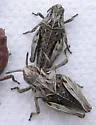
Very similar to Xanthippus corallipes , but somewhat smoother looking; pronotum with median carina fairly evenly elevated and usually only cut once; hind femur slender (not widened strongly along lower margin); hind tibia and inner face of hind femur more often yellow or orange than red, inner face only rarely darkened, and then usually only appearing washed with dark, not boldly so. Wings yellow, orange, red, or pink (only yellow X. corallipes in most areas where the two occur together). This species intergrades with Pardalophora saussurei at roughly the latitude of the south border of Kansas and Colorado, and most specimens from southern Kansas, southeastern Colorado, as well as many from northernmost Oklahoma, and the north end of the Texas Panhandle are intermediate in nature. These tend to have the fastigium a bit more produced, the pronotum more acute at the hind angle, the hind femur wider below, the inner face of the hind femur variably bluish to solid yellow/orange, etc. Biologically P. saussurei is a southern subspecies of P. haldemanii , but it is treated as a species in publications. Often attracted to bright lights at night.
Classification
- Kingdom
- Animalia
- Phylum
- Arthropoda
- Class
- Insecta
- Order
- Orthoptera (Grasshoppers, Crickets, Katydids)
- Suborder
- Caelifera
- Family
- Acrididae (Short-horned Grasshoppers)
- Subfamily
- Oedipodinae
- Tribe
- Hippiscini
- Genus
- Pardalophora
Imported taxonomy record. Source availability varies; see the source references and editorial policy below.
Habitat and Range
Habitat
Open grasslands, especially gravelly patches in prairies on hilltops and hillsides, and in sandhills areas, but it is a common species, not too picky as long as the habitat is relatively dry, has grass, and is open and sunny.
Geographic Range
Primarily prairies of west from southernmost Canada to Oklahoma, the Texas Panhandle and ne. New Mexico, and from Michigan, Illinois, Missouri, and Arkansas to almost or just barely the east base of the Rockies. Also, in Great Basin near west base of high central mountains of Utah and into se. Idaho (often associated with old Lake Bonneville shoreline deposites).
Seasonal Activity
Adults mostly in the later half of spring, most common in June-July in the north and May-June in the south. Adults are rarely seen anywhere after July.
Diet and Behavior
Diet: Mostly grasses, but will eat a wide range of herbaceous plants, and occasionally other insects.
Life History
overwinters as nymphs; matures in spring; adults usually most common in June.
About Grasshoppers, Crickets, Katydids: the wider group
Order-level background for Orthoptera, the group containing Pardalophora haldemanii. Species-specific details appear above.
Group overview
Orthoptera includes ~28,000 described species of grasshoppers, crickets, and katydids. Desert locusts can form swarms covering 460 square miles containing up to 80 million individuals per square kilometer.
Ecological role of the group
Grasshoppers and crickets are a primary food source for birds, reptiles, and small mammals. Cricket farming is a growing industry - crickets require 12× less feed than cattle to produce the same amount of protein, using 2,000× less water.
Economic and practical significance of the group
A single large locust swarm can consume the same amount of food in one day as 35,000 people. The 2019-2021 East Africa locust crisis affected food security for 42 million people across multiple countries. Global crop losses from locusts can reach billions annually.
Recorded sources for this group: FAO, UN World Food Programme, research publications. Imported estimates may describe particular regions or reporting periods.
Photos of Haldeman's Grasshopper (5)
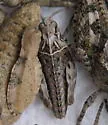
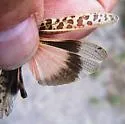
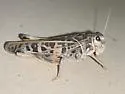
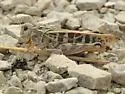
Photo credits: Contributed by David J. Ferguson
Frequently Asked Questions About Haldeman's Grasshopper
What is Haldeman's Grasshopper?
Haldeman's Grasshopper (Pardalophora haldemanii) is a species in the family Acrididae, within the order Orthoptera.
How do you identify Haldeman's Grasshopper?
Very similar to Xanthippus corallipes , but somewhat smoother looking; pronotum with median carina fairly evenly elevated and usually only cut once; hind femur slender (not widened strongly along lower margin); hind tibia and inner face of hind femur more often yellow or orange than red, inner face only rarely darkened, and then usually only appearing washed with dark, not boldly so. Wings yellow, orange, red, or pink (only yellow X. corallipes in most areas where the two occur together).
Where is Haldeman's Grasshopper found?
| Feature | Details |
|---|---|
| Habitat | Open grasslands, especially gravelly patches in prairies on hilltops and hillsides, and in sandhills areas, but it is a common species, not too picky as long as the habitat is relatively dry, has grass, and is open and sunny. |
| Range | Primarily prairies of west from southernmost Canada to Oklahoma, the Texas Panhandle and ne. New Mexico, and from Michigan, Illinois, Missouri, and Arkansas to almost or just barely the east base of the Rockies. Also, in Great Basin near west base of high central mountains of Utah and into se. Idaho (often associated with old Lake Bonneville shoreline deposites). |
What does Haldeman's Grasshopper eat?
The diet of the Haldeman's Grasshopper includes Mostly grasses, but will eat a wide range of herbaceous plants, and occasionally other insects..
When is Haldeman's Grasshopper active?
Haldeman's Grasshopper: seasonal activity - Adults mostly in the later half of spring, most common in June-July in the north and May-June in the south. Adults are rarely seen anywhere after July..
What is the life cycle of a Haldeman's Grasshopper?
overwinters as nymphs; matures in spring; adults usually most common in June.